



Table of contents
Key Takeaways
- WordPress powers 3,595 HVAC websites out of 5,957 tracked, making it the dominant CMS in the heating and ventilation space — but speed-optimized custom sites outscore it 95+ vs 40–65 on PageSpeed (SiteStatsDB, WebsitesForHVAC)
- 18% of HVAC contractor websites load too slowly on mobile, with the slowest 11% averaging 9.5-second LCP — more than double Google's 4.0s "poor" threshold (Full Stack HVAC, 1.1M audits)
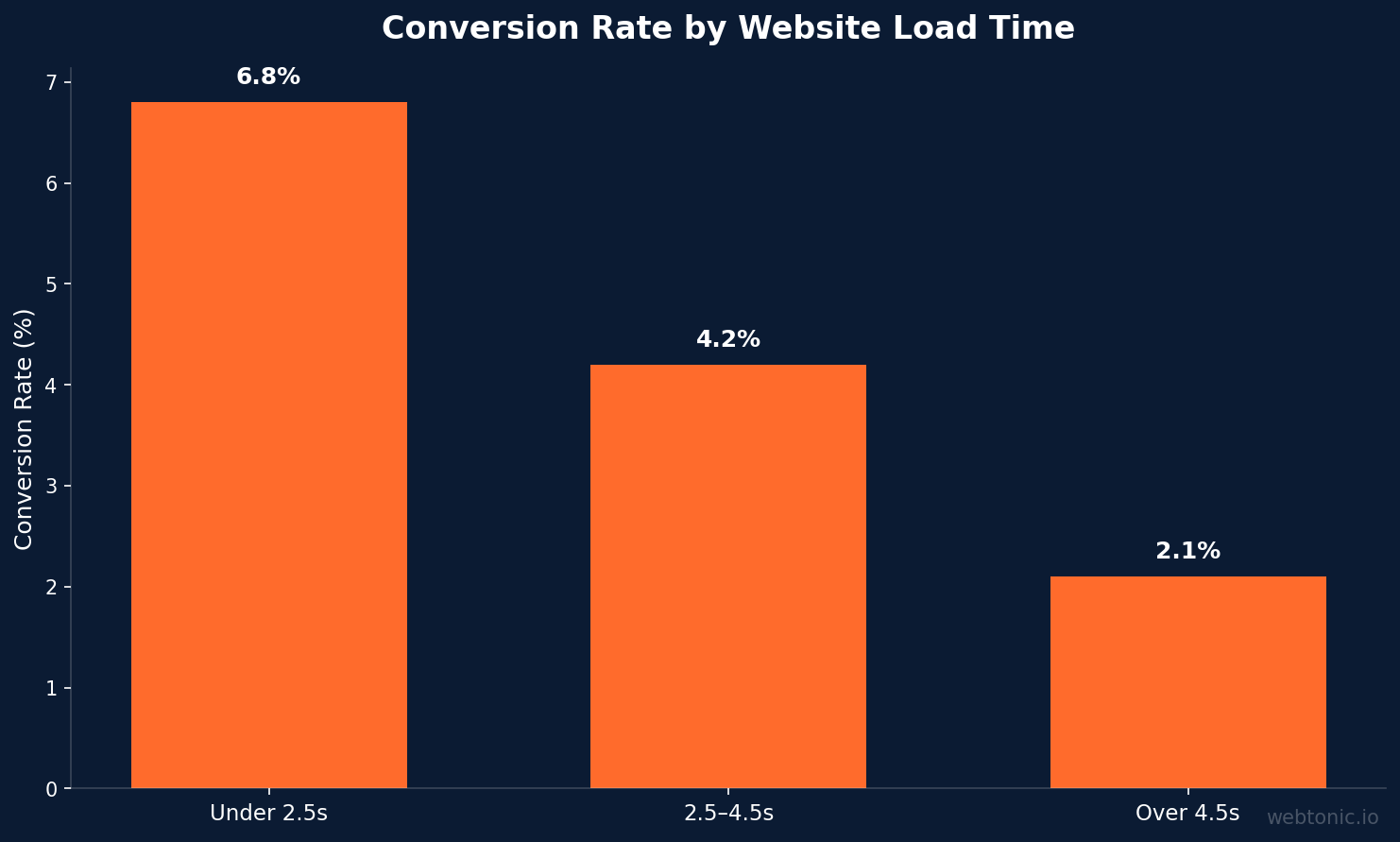
- Sites loading under 2.5 seconds convert at 6.8% versus 2.1% for sites over 4.5 seconds — a 3.2× difference from the same traffic (OnwardCraft, 200-site study)
- 11,334 new WordPress vulnerabilities were discovered in 2025, a 42% increase from 2024, with 90% of CMS-targeted hacks hitting WordPress installations (Patchstack)
- 76% of HVAC searches happen on mobile, yet the average HVAC website takes 7.4 seconds to render main content — 4.9 seconds over Google's passing threshold (RYN Digital, Borah Labs)
WordPress in the HVAC Industry: Market Share at a Glance
| CMS / Platform | HVAC Websites | Market Share |
|---|---|---|
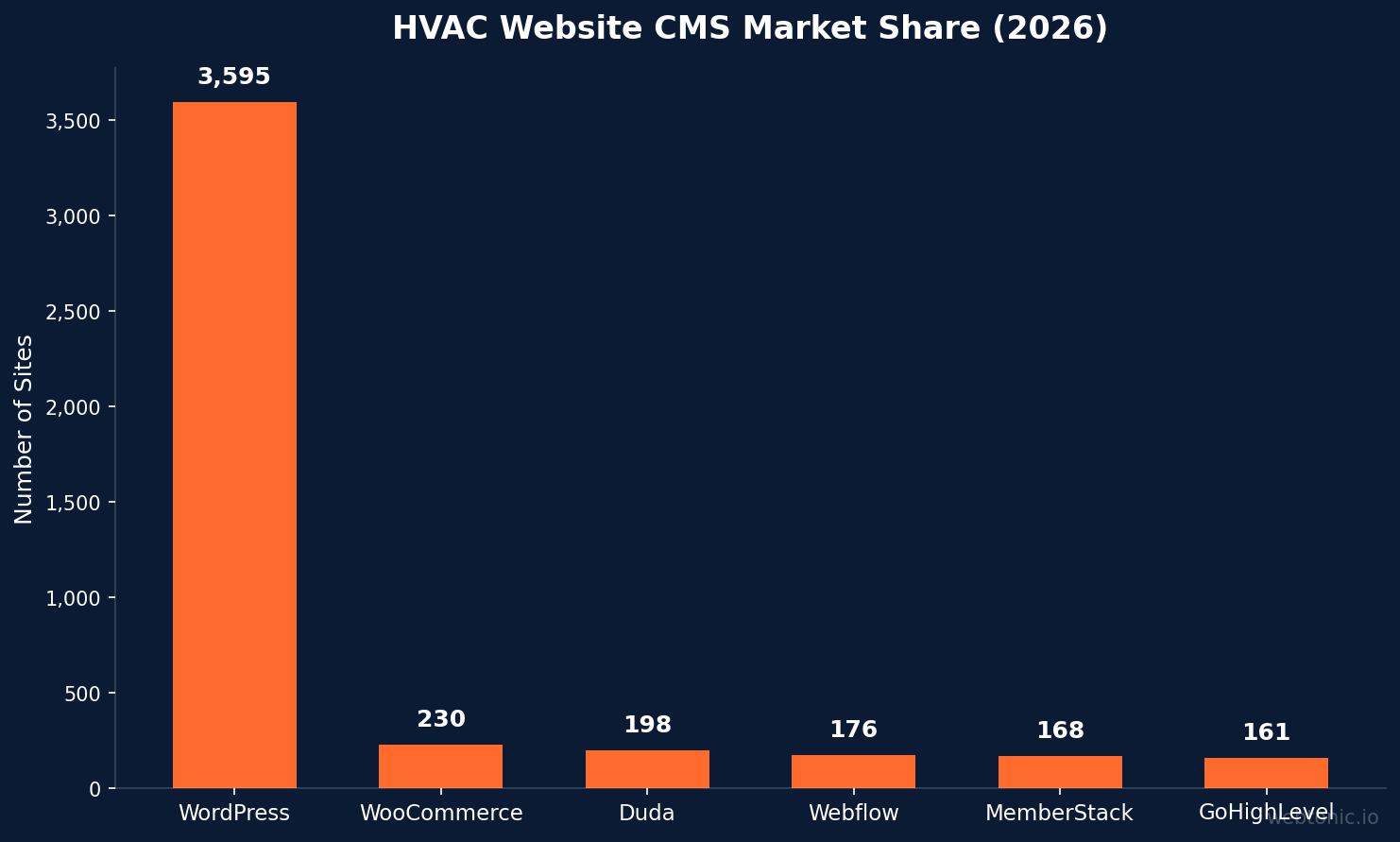
| WordPress | 3,595 | 60.3% |
| WooCommerce (WordPress) | 230 | 3.9% |
| Duda | 198 | 3.3% |
| Webflow | 176 | 3.0% |
| MemberStack | 168 | 2.8% |
| GoHighLevel | 161 | 2.7% |
| Next.js (custom) | 117 | 2.0% |
| Other / custom | 1,312 | 22.0% |
SiteStatsDB tracks 5,957 HVAC websites as of July 2026, drawing a combined 46.4 million monthly visits. WordPress dominates with 3,595 HVAC sites (60.3%), followed by WooCommerce at 230, Duda at 198, Webflow at 176, and GoHighLevel at 161. This mirrors the broader web where WordPress holds 33.2% of all measurable web origins as of April 2026, per GravityKit's market share analysis.
The HVAC sector's WordPress concentration is nearly double the global average, reflecting the platform's low upfront cost ($500–$3,000 for a basic site) and massive plugin ecosystem (60,000+ plugins). For heating contractors launching their first website, WordPress remains the path of least resistance. But as the data below shows, that initial cost advantage often reverses when speed, security, and ongoing maintenance enter the equation.
WordPress Speed and Performance for HVAC Websites
The average HVAC website takes 7.4 seconds to render its main content — 4.9 seconds over Google's 2.5-second "good" threshold for Largest Contentful Paint, according to Borah Labs' HVAC website benchmark study. The average PageSpeed Performance score sits at just 62 out of 100, while SEO scores average 90 and accessibility scores average 84.
Full Stack HVAC's analysis of over 1.1 million Lighthouse audits reveals a more nuanced picture: 75% of HVAC sites earn strong synthetic scores (90+), and the median mobile site paints in under a second. The damage is in the tail — 18% load too slowly on mobile, with the poorest 11% averaging 9.5 seconds on a phone. Contractors check their own sites on desktop; their customers search on a phone in the driveway.
The speed gap between WordPress and custom-built HVAC sites is dramatic. WebsitesForHVAC's comparison shows WordPress HVAC sites scoring 40–65 on PageSpeed with 3–8 second load times, while custom Next.js builds score 95+ with sub-second loads. The trade-off: WordPress costs $500–$3,000 upfront versus $2,295–$3,999 for custom, but WordPress total cost of ownership runs $300–$800/month in hidden maintenance versus $399–$1,039/month all-in for managed custom solutions.
Website Speed and Conversion Rate Impact
| Load Time | Avg Conversion Rate | Multiplier vs Slow |
|---|---|---|
| Under 2.5 seconds | 6.8% | 3.2× |
| 2.5–4.5 seconds | 4.2% (est.) | 2.0× |
| Over 4.5 seconds | 2.1% | 1.0× (baseline) |
OnwardCraft's study of 200 contractor websites across six trades found that sites loading under 2.5 seconds averaged 6.8% conversion, while sites over 4.5 seconds averaged just 2.1% — a 3.2× difference from the same traffic. The median contractor site captures only 2–4% of visitors as leads, while the top 6% convert at 8–12% and emergency service pages hit 16%.
For heating companies where 76% of searches happen on mobile (RYN Digital) and 60% of emergency calls originate from mobile search (MarketingLTB), mobile speed is not a technical nice-to-have — it is the difference between capturing and losing a $15,000 system replacement lead. Campaigns optimized for mobile call extensions see 34% lower CPL compared to desktop-first campaigns.
Google's published mobile-page research puts the abandonment rate at 50–55% at three seconds of load time across consumer-services queries, per Full Stack HVAC's analysis. The practical conclusion has held across multiple re-measurements since Google's original 2017 study. For HVAC companies spending $3,000–$12,000/month on Google Ads, a slow WordPress site is effectively burning 30–50% of that ad budget on visitors who bounce before the page loads.
WordPress Security Risks for HVAC Businesses
11,334 new WordPress vulnerabilities were discovered in 2025, a 42% increase over 2024, according to Patchstack's 2026 State of WordPress Security whitepaper. 46% of these vulnerabilities were not fixed in time for public disclosure, leaving millions of WordPress sites exposed to known exploits.
WordPress accounts for approximately 90% of all CMS-targeted hacks, per WebsitesForHVAC's analysis. For heating and ventilation companies handling customer data — names, addresses, phone numbers, and sometimes payment information for maintenance plans — a security breach carries both reputation and compliance risk. Custom-built sites running on serverless architectures like Next.js or Webflow eliminate the database attack surface entirely.
93.2% of WordPress sites are missing one or more modern security headers (HSTS, CSP, and others), according to GuardingWP's 2026 research. The plugin-heavy architecture that gives WordPress its flexibility is also its security liability: every third-party plugin is a potential entry point, and heating companies rarely have in-house IT staff to monitor and patch them.
Total Cost of Ownership: WordPress vs Alternatives
| Cost Factor | WordPress | Custom (Next.js) | Webflow |
|---|---|---|---|
| Upfront build cost | $500–$3,000 | $2,295–$3,999 | $1,500–$5,000 |
| Monthly maintenance | $300–$800 (hidden) | $399–$1,039 (all-in) | $29–$79 (hosting) |
| Security risk | High (90% of CMS hacks) | Minimal (no database) | Minimal (managed) |
| PageSpeed score | 40–65 | 95+ | 80–95 |
| Plugin ecosystem | 60,000+ | Custom built-in | 200+ integrations |
| Content management ease | Built-in CMS | Agency-managed | Visual editor |
WordPress's low upfront cost is its biggest advantage — and its biggest trap. For heating and ventilation companies just starting out, $500–$2,000 for a basic WordPress site is a legitimate entry point. However, the total monthly cost including hosting, security plugins, backup services, and developer maintenance runs $300–$800/month — costs that are rarely transparent at the point of purchase.
The technology landscape in HVAC is shifting. Borah Labs found that WordPress accounts for only 10.5% of detected technologies in their sample when counting at the technology level (alongside Google Tag Manager at 11.6%, PHP at 11.6%, and jQuery at 10.5%), suggesting that many WordPress sites rely on a fragmented stack of plugins and dependencies rather than a unified architecture. 93.3% of HVAC sites have SSL certificates, but the lone unprotected site in Borah Labs' sample loses visitors at Chrome's browser warning — a basic hygiene issue that WordPress does not enforce by default.
HVAC Website Conversion Benchmarks by Page Type
| Page Type | Conversion Rate | Key Insight |
|---|---|---|
| Emergency service pages | 10–15% | Urgency drives immediate action |
| Maintenance plan CTA pages | 8–12% | Recurring revenue driver |
| Overall contractor site average | 7.8% | OnwardCraft 200-site study |
| System replacement pages | 3–6% | Longer consideration cycle |
| Median contractor site | 2–4% | Most sites underperform |
HVAC repair pages convert at 10–15% on emergency service pages and 3–6% on system replacement pages, according to PipelineOn's contractor conversion rate analysis. The top 6% of contractor sites convert at 8–12%, while the median site captures only 2–4% of visitors. Emergency pages convert at 3–5× the rate of research-phase pages because the homeowner has already decided to buy — they just need to know who to call.
For WordPress HVAC sites, the conversion gap often comes down to speed and mobile experience. A site loading in 2.5 seconds on mobile captures 3.2× more leads than one loading in 4.5+ seconds — and most WordPress sites in the HVAC space fall into the slower category. The fastest path to improving conversion is not a redesign but a speed optimization: image compression, deferred JavaScript, browser caching, self-hosted fonts, and mobile-cellular testing cover the majority of the problem.
Best Practices for HVAC WordPress Sites
- Run PageSpeed Insights on mobile, not desktop. Your customers search on phones. A 95 desktop score means nothing if mobile LCP is 7+ seconds. Test on a real mid-range Android device on cellular data.
- Compress every image before upload. Unoptimized hero images are the single biggest cause of slow HVAC WordPress sites. Use WebP format and lazy loading on below-fold images.
- Minimize plugin count. Each plugin adds JavaScript, database queries, and potential security vulnerabilities. Target 10–15 essential plugins maximum. Audit quarterly.
- Install an application-level firewall. With 11,334 new WordPress vulnerabilities in 2025, relying on "update when I remember" is not a security strategy. Use Patchstack, Wordfence, or Sucuri.
- Build dedicated landing pages by service type. Emergency repair, maintenance plan, and system replacement pages each need their own URL, CTA, and tracking. Don't send all traffic to the homepage.
- Enable SSL and HSTS headers. 93.3% of HVAC sites have SSL, but 93.2% are missing modern security headers. Both are free to implement and affect trust scores.
- Evaluate alternatives at the 3-year mark. If total WordPress maintenance exceeds $500/month, custom or Webflow alternatives may deliver better ROI through speed, security, and lower ongoing costs.
- Track conversion by page type and speed tier. Segment analytics by mobile vs desktop, by service page, and by load time to identify exactly where the WordPress speed tax is costing you leads.
Related reading
- Webflow Performance in Heating & Ventilation: 35+ Stats for 2026
- HVAC Landing Page & CRO Statistics: Benchmarks and Conversion Data (2026)
- HVAC E-Commerce & Shopify Statistics: Online Parts Sales Data for 2026
- Custom Web Development services at Web Tonic
Frequently Asked Questions
Is WordPress good for HVAC company websites?
WordPress is the most popular CMS for HVAC companies, powering 3,595 of 5,957 tracked HVAC sites. It offers low upfront costs ($500–$3,000) and a massive plugin ecosystem. However, HVAC WordPress sites typically score 40–65 on PageSpeed versus 95+ for custom builds, and WordPress accounts for 90% of all CMS-targeted hacks. It works well for startups on tight budgets but becomes increasingly costly as maintenance, security, and speed optimization needs compound.
How fast should an HVAC website load?
Google's threshold for "good" LCP is 2.5 seconds, and sites loading under this mark convert at 6.8% versus 2.1% for sites over 4.5 seconds. The average HVAC website currently takes 7.4 seconds to render main content, which is nearly 3× the recommended threshold. Target sub-2-second load times on mobile devices for maximum conversion.
How much does a WordPress HVAC website cost per month?
Total monthly cost for a WordPress HVAC website runs $300–$800 including hosting ($30–$100), security plugins and monitoring ($20–$50), backup services ($10–$30), developer maintenance ($100–$300), and premium plugin licenses ($50–$200). Many contractors only budget for hosting and underestimate the total cost of ownership by 3–5×.
Should HVAC companies switch from WordPress to another platform?
Consider switching if your WordPress site scores below 60 on mobile PageSpeed, requires more than 20 active plugins, or costs more than $500/month in total maintenance. Webflow and custom Next.js builds offer better speed (80–95+ PageSpeed), minimal security risk, and comparable or lower total cost of ownership. The migration typically pays for itself within 6–12 months through improved conversion rates and reduced maintenance.
What percentage of HVAC searches are mobile?
76% of HVAC searches happen on mobile devices, and 60% of emergency HVAC calls originate from mobile search. This makes mobile website performance critical — yet the average HVAC site takes 7.4 seconds to render on mobile, causing an estimated 50–55% abandonment rate based on Google's published consumer-services research.
Sources
sitestatsdb.com/topics/hvac
websitesforhvac.com/blog/wordpress-vs-custom-hvac-website-comparison
fullstackhvac.com/blog/9-second-problem-hvac-website-speed
borahlabs.us/insights/hvac
onwardcraft.com/blog/contractor-website-study
patchstack.com/whitepaper/state-of-wordpress-security-in-2026
guardingwp.com/research/state-of-wordpress-security-2026
ryndigital.com/hvac-marketing-statistics-2026
marketingltb.com/blog/statistics/hvac-marketing-statistics
pipelineon.com/blog/contractor-website-conversion-rate
gravitykit.com/wordpress-market-share-2026


