



Table of contents

Key Takeaways
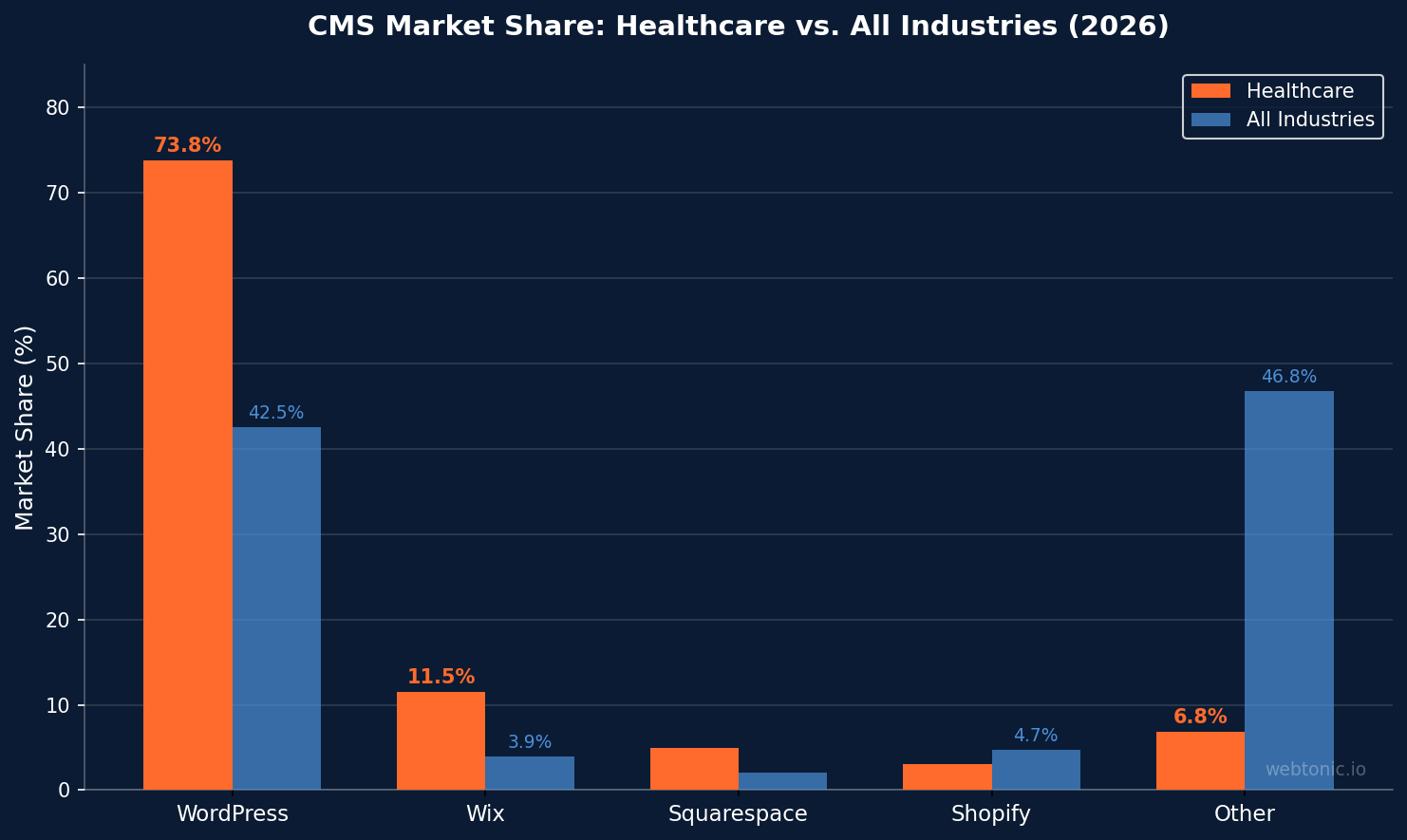
- WordPress powers 73.8% of UK healthcare company websites, dominating the vertical over Wix (11.5%) and Squarespace (4.9%) in the most comprehensive CMS market-share study for healthcare (Firmbase).
- 25,088 active WooCommerce stores operate in the health and wellness segment, growing at approximately 6% monthly (BootLeads).
- WordPress's overall market share dipped to 42.5% of all websites in 2026 — the first meaningful decline in 23 years — though it still holds 59.8% of CMS-powered sites (ZeroToWP).
- The fastest healthcare WordPress sites load in 0.7 seconds, while the slowest image-heavy practices clock 3.7–4.4 seconds (PageSpeedMatters).
- Contact Form 7 is installed on 41.3% of hospital WordPress sites, followed by Yoast SEO at 30.5% and Elementor at 19.0% (ILOVEWP).
- Wellness landing pages convert at 8.2% median, with top performers reaching 21.1% — a 4× gap between average and optimized pages (Unbounce via prior research).
- A WordPress health site rebuilt for speed cut load time from 5.8 seconds and achieved a 62% bounce-rate reduction on organic landings (Digital1010).
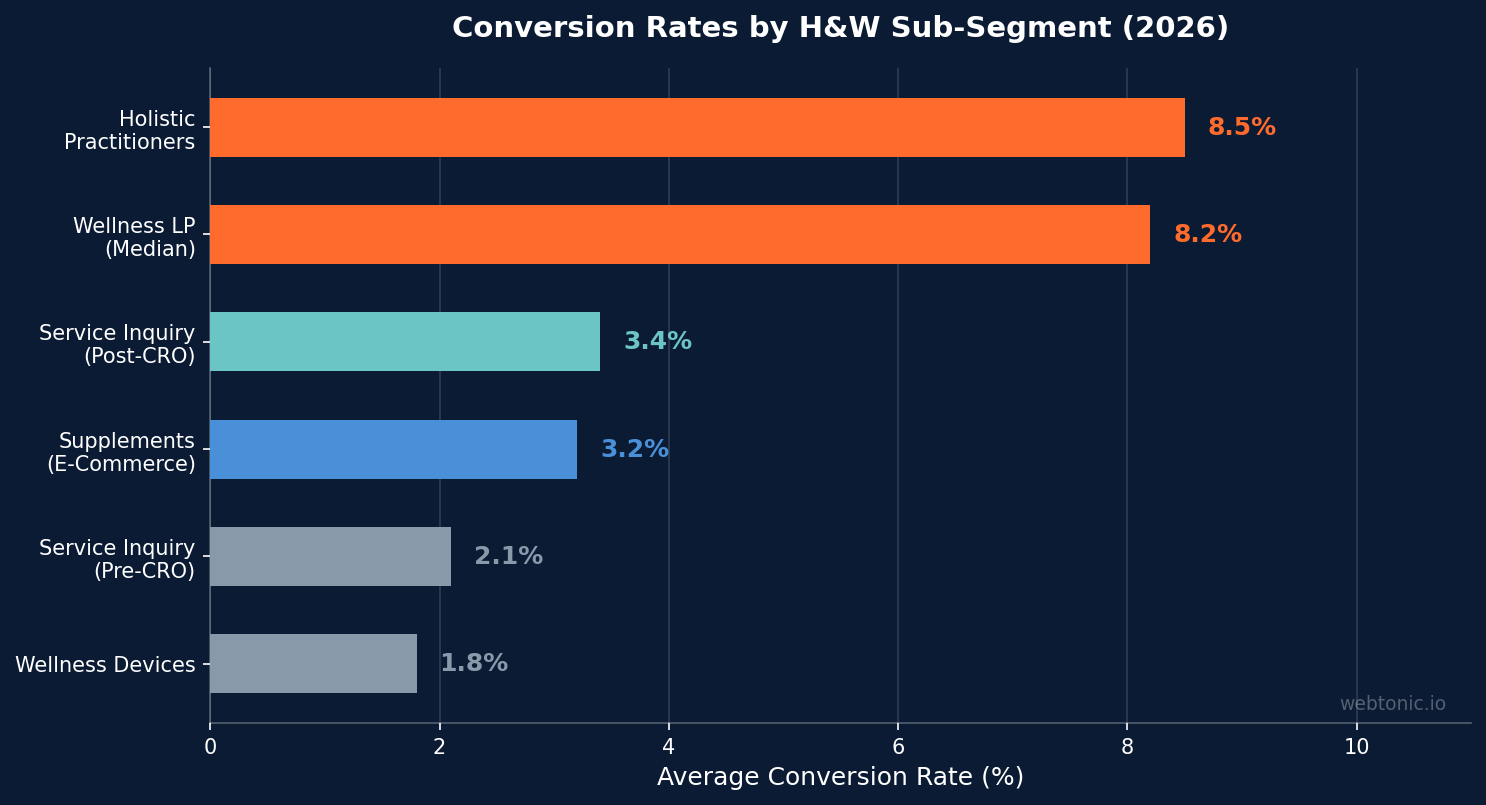
- Holistic practitioners convert at 8.5% average, compared to 3.2% for supplement e-commerce and 1.8% for wellness devices (CuFinder).
WordPress remains the default web platform for health and wellness businesses, from solo practitioners to multi-location health networks. The data below breaks down market share, performance benchmarks, plugin adoption, e-commerce metrics, and conversion data that define WordPress's role in the wellness vertical heading into 2026.
WordPress Market Share in Health & Wellness
Firmbase's 2026 UK healthcare CMS study — the most granular industry-specific CMS report available — shows WordPress powering 73.8% of healthcare company websites (6,778 of 9,187 companies with detectable CMS), far ahead of Wix at 11.5% and Squarespace at 4.9%. This dominance is even more striking than WordPress's overall market share of 42.5% (ZeroToWP), suggesting healthcare businesses are significantly more WordPress-reliant than the average website.
However, WordPress's macro trajectory shows its first decline. GauravTiwari's 2026 statistics roundup confirms the 1.1 percentage-point drop to 42.5%, primarily attributed to growth in Shopify, Wix, and Squarespace rather than a mass exodus. WordPress still commands 59.8% of all CMS-powered sites — roughly 9× larger than Shopify. Different measurement methodologies yield different headline numbers — some peg WordPress closer to 33% — but all agree it remains the dominant CMS by a wide margin.
Table 1 — CMS Market Share: Healthcare vs. Overall (2026)
| CMS Platform | Healthcare Share | Overall Web Share | Gap |
|---|---|---|---|
| WordPress | 73.8% | 42.5% | +31.3 pp |
| Wix | 11.5% | 3.9% | +7.6 pp |
| Squarespace | 4.9% | 2.1% | +2.8 pp |
| Shopify | <3% | 4.7% | −1.7+ pp |
| Custom / Other | ~7% | ~47% | −40 pp |
WordPress Site Performance and Speed Data for Healthcare
Page speed is a critical conversion factor for healthcare sites, where patients often search on mobile in urgent contexts. PageSpeedMatters' 2026 guide reveals a wide performance range: the fastest local practices load in 0.7 seconds (a dermatology group), while image-heavy sites lag at 3.7 to 4.4 seconds. The study found that local practices generally outperform hospital systems on speed benchmarks.
Digital1010's SaVida Health case study illustrates the business impact: a health-practice WordPress site with a 5.8-second load time on its top ten landing pages was bleeding traffic — a 62% bounce rate on organic landings masked true content engagement. After a WordPress performance rebuild addressing LCP, INP, and CLS, the site recovered significantly. For wellness businesses running WordPress, Borah Labs' wellness website benchmark shows that only 10.4% of holistic wellness sites run WordPress at the top end, with Cloudflare (9.8%) and HTTP/3 (7.8%) adoption lagging behind jQuery usage (14.3%).
WordPress Plugin Adoption in Healthcare
Plugin choice reveals how healthcare sites prioritize functionality. ILOVEWP's hospital plugin study analyzed thousands of hospital websites and found clear leaders:
- Contact Form 7: 41.3% adoption (8,927 sites) — the default contact solution
- Yoast SEO: 30.5% adoption (6,600 sites) — the dominant SEO plugin
- Elementor Page Builder: 19.0% adoption (4,102 sites) — visual editor for non-technical teams
- WPBakery (Visual Composer): 8.8% — legacy page builder still common
The prevalence of Contact Form 7 over more sophisticated form builders suggests that many healthcare WordPress sites still prioritize simplicity. For practices looking to upgrade their digital presence, modern alternatives like Gravity Forms and WPForms offer HIPAA-adjacent features and CRM integrations. Learn more about optimizing healthcare web presence in our growth marketing guide.
Table 2 — Most-Used WordPress Plugins on Hospital Websites (2026)
| Plugin | Category | Adoption Rate | Total Sites |
|---|---|---|---|
| Contact Form 7 | Forms | 41.3% | 8,927 |
| Yoast SEO | SEO | 30.5% | 6,600 |
| Elementor | Page Builder | 19.0% | 4,102 |
| WPBakery | Page Builder | 8.8% | 1,901 |
| Google Analytics | Analytics | 11.4% | ~2,460 |
WooCommerce and E-Commerce in Health & Wellness
BootLeads tracks 25,088 active WooCommerce stores in the wellness segment, growing at approximately 6% monthly. This makes WooCommerce the largest WordPress-native e-commerce channel in the vertical, though it trails Shopify (32,690 active wellness stores per prior research). Health and beauty is one of WooCommerce's top five categories, alongside home and garden, fashion, electronics, and food.
CommerceCatalyst's supplement benchmarks provide performance data that applies to WooCommerce wellness stores: 37.7% repurchase rate (the highest of any e-commerce category), with a minimum 3:1 LTV:CAC target after three years. For the broader alternative medicine segment, CuFinder reports an overall conversion rate of 3.8%, broken down by sub-segment: holistic practitioners at 8.5%, supplements at 3.2%, and wellness devices at 1.8%.
Conversion Rates and Website Performance for Wellness WordPress Sites
Conversion rate data shows the gap between average and optimized wellness websites. Grover Web Design's benchmark study found that the average service-inquiry conversion rate is 2.1% before optimization, jumping to 3.4% after structured CRO improvements — a 62% lift. For wellness-specific data, prior research (Unbounce) benchmarks wellness landing pages at 8.2% median conversion, with top performers reaching 21.1%.
The WordPress-vs-custom debate matters for conversion. InvigoMedia's 2026 comparison concludes that WordPress represents the superior choice for the vast majority of growing medical practices, including dental clinics, specialty surgery centers, and healthcare groups. Custom solutions only make sense at scale or when headless architecture is needed for multi-channel delivery. For practices evaluating their web platform, our data intelligence services can benchmark current performance against industry standards.
Table 3 — Conversion Rates by Health & Wellness Sub-Segment (2026)
| Sub-Segment | Avg. CVR | Top-Performer CVR | Primary Platform |
|---|---|---|---|
| Holistic Practitioners | 8.5% | 15%+ | WordPress |
| Wellness Landing Pages | 8.2% (median) | 21.1% | Mixed |
| Supplements (E-Commerce) | 3.2% | 5.8% | WooCommerce / Shopify |
| Service Inquiry (General) | 2.1% → 3.4% | 5.0%+ | WordPress |
| Wellness Devices | 1.8% | 3.5% | Custom / Shopify |
Security and Compliance Considerations for Health WordPress Sites
Security is a critical concern for healthcare WordPress sites handling patient data. ZeroToWP's 2026 data tracks new WordPress vulnerabilities annually, with plugin-based exploits accounting for the majority of incidents. For healthcare sites, the stakes are higher: HIPAA compliance requirements mean that a compromised contact form or unencrypted patient intake form carries regulatory risk beyond standard data breaches.
The plugin ecosystem reflects this concern. While Contact Form 7 dominates at 41.3% adoption, it lacks built-in encryption or HIPAA compliance features. Healthcare-specific WordPress configurations increasingly pair Gravity Forms or WPForms with SSL enforcement, server-side encryption, and BAA-compliant hosting providers like WP Engine Health or Pantheon. GauravTiwari notes that the WordPress vulnerability landscape is primarily plugin-driven, making plugin audit and update cadence the single most impactful security practice for health websites. For practices building their digital strategy, explore our agency approach to secure, high-performing web properties.
Best Practices for WordPress in Health & Wellness
- Prioritize Core Web Vitals aggressively. The fastest healthcare WordPress sites load in 0.7 seconds; the slowest hit 4.4 seconds. Target sub-2-second LCP by optimizing images, using lazy loading, and choosing lightweight themes.
- Replace Contact Form 7 with HIPAA-aware form builders. While 41.3% of hospital sites still use CF7, practices handling PHI should upgrade to Gravity Forms or WPForms with encryption and access controls.
- Invest in conversion rate optimization. The 2.1% → 3.4% average CVR lift from structured optimization represents significant patient-acquisition volume. A/B test form placement, CTA copy, and page speed simultaneously.
- Consider WooCommerce for supplement and wellness product sales. With 25,088 active stores and 6% monthly growth, the WooCommerce wellness ecosystem has mature plugin support. The 37.7% repurchase rate in supplements makes subscription mechanics essential.
- Leverage Yoast SEO with structured data. At 30.5% adoption among hospitals, Yoast is the industry default — but most implementations lack healthcare-specific schema (MedicalOrganization, Physician, MedicalClinic). Add structured data for search visibility.
- Evaluate WordPress vs. alternatives honestly. WordPress is the right choice for most growing practices, but wellness device brands and high-traffic supplement e-commerce may benefit from Shopify's infrastructure.
Table 4 — WordPress Ecosystem Metrics: Health & Wellness vs. Overall (2026)
| Metric | Health & Wellness | All Industries | Delta |
|---|---|---|---|
| WordPress Adoption | 73.8% (healthcare) | 42.5% | +31.3 pp |
| WooCommerce Stores | 25,088 active | 6.9M+ total | 0.36% of total |
| Top Plugin (CF7) | 41.3% hospitals | ~27% all sites | +14.3 pp |
| Page Load (Best) | 0.7s | 2.5s median | −72% |
| Service CVR | 2.1%–8.5% | 2.1%–3.4% | Higher ceiling |
| E-Commerce Repurchase | 37.7% | 27% | +10.7 pp |
The WordPress ecosystem for health and wellness continues to evolve. As the platform faces increased competition from Shopify and Wix, its advantages — deep customization, SEO plugin maturity, and a massive developer community — remain strongest in healthcare verticals where 73.8% adoption demonstrates entrenched trust. The key strategic question for wellness businesses is not whether to use WordPress, but how to configure it for maximum speed, security, and conversion performance within their specific sub-vertical.
Related reading
- Health & Wellness Webflow Statistics: Key Data Points for 2026
- Health & Wellness Landing Page Statistics & Benchmarks (2026)
- Health & Wellness Shopify Statistics: 2026 Store Data, Conversion Rates & Growth Trends
- Custom Web Development services at Web Tonic
Frequently Asked Questions
What percentage of healthcare websites use WordPress?
73.8% of UK healthcare companies with a detectable CMS run WordPress, according to Firmbase's 2026 data — far above WordPress's overall market share of 42.5%. This makes WordPress the dominant platform in healthcare, ahead of Wix (11.5%) and Squarespace (4.9%).
How fast should a healthcare WordPress website load?
The best healthcare WordPress sites load in 0.7–1.0 seconds, while the slowest image-heavy practices hit 3.7–4.4 seconds. A load time above 3 seconds significantly increases bounce rates — one health site with 5.8-second load times had a 62% bounce rate before optimization.
Is WooCommerce good for health and wellness e-commerce?
Yes — there are 25,088 active WooCommerce wellness stores growing at 6% monthly. The supplement category offers strong unit economics with a 37.7% repurchase rate (highest in e-commerce). WooCommerce works well for brands with existing WordPress sites, though high-volume supplement brands may benefit from paid acquisition strategies on dedicated Shopify infrastructure.
What are the most popular WordPress plugins for healthcare websites?
Contact Form 7 leads at 41.3% adoption, followed by Yoast SEO (30.5%), Elementor (19.0%), and WPBakery (8.8%). Healthcare sites prioritize contact forms and SEO over advanced functionality, though HIPAA-aware form builders are increasingly recommended for practices handling protected health information.
What conversion rate should a wellness WordPress site target?
Average service-inquiry conversion is 2.1%, improving to 3.4% after structured optimization. Wellness landing pages convert at 8.2% median, with top performers at 21.1%. Holistic practitioners see the highest rates at 8.5% average, while supplement e-commerce averages 3.2% and wellness devices average 1.8%. The performance gap between optimized and unoptimized wellness WordPress sites is significant — practices that invest in speed optimization, structured schema, and CRO workflows consistently outperform those running default WordPress configurations with stock themes and minimal customization.
Sources
Firmbase — CMS Used by UK Healthcare Companies 2026
ZeroToWP — WordPress Statistics 2026
GauravTiwari — WordPress Statistics 2026
PageSpeedMatters — Healthcare Website Speed Guide 2026
Digital1010 — SaVida Health WordPress Performance Rebuild
ILOVEWP — Most Popular WordPress Plugins for Hospitals
BootLeads — WooCommerce Wellness Stores 2026
CuFinder — Alternative Medicine Benchmarks 2026
Grover Web Design — Website Performance Benchmark Study
InvigoMedia — WordPress vs Custom for Medical Practices 2026


