



Table of contents
Key Takeaways
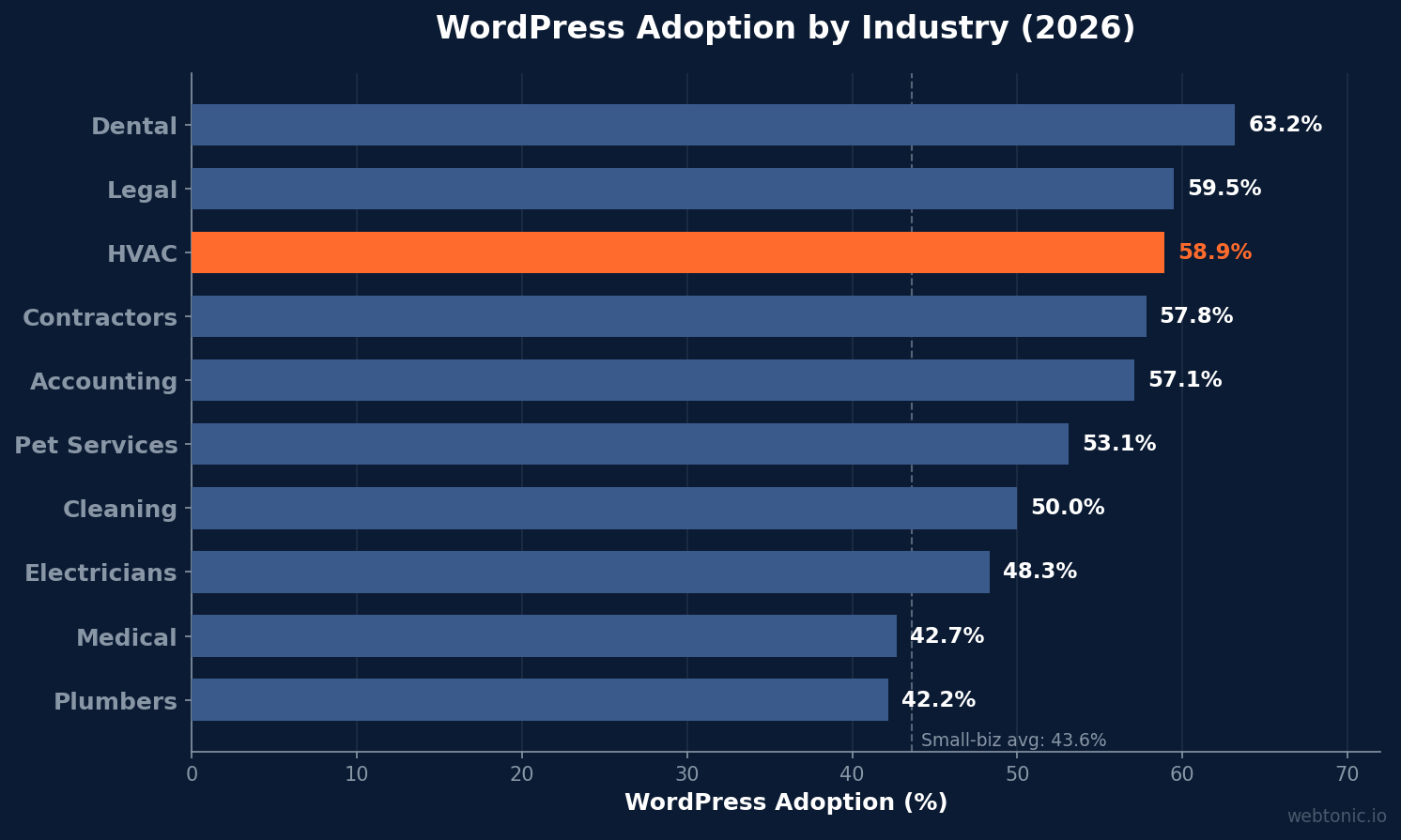
58.9% of HVAC contractor websites run on WordPress, making it the dominant CMS in the trade — 15 percentage points above the small-business average of 43.6%. The median WordPress HVAC site costs $3,200 from a freelancer and $7,500–$14,000 from an agency, yet contractors who invest in conversion-optimized builds report lead volumes of 30–80 per month in season. Meanwhile, 18% of HVAC sites load in over 2.5 seconds on mobile, with the slowest tier averaging 9.5 seconds — a direct ranking and revenue penalty. Below you will find 50+ verified data points on adoption, cost, speed, and lead capture for HVAC WordPress sites in 2026.
HVAC CMS Market Share at a Glance
| CMS Platform | Share of HVAC Sites | Small-Biz Average | Δ vs Average |
|---|---|---|---|
| WordPress | 58.9% | 43.6% | +15.3 pp |
| Wix | ~7% | 9.5% | −2.5 pp |
| Squarespace | ~3% | 4.1% | −1.1 pp |
| Shopify | ~2% | 4.0% | −2.0 pp |
| Custom / Other | ~29% | 37.7% | −8.7 pp |
Source: Elevate Web Design analysis of 4,407 small-business sites (2026). HVAC-specific share from the industry breakdown where 58.9% of HVAC sites use WordPress — the third-highest adoption rate across 14 industries, behind dental (63.2%) and legal (59.5%). Contractors over-index on WordPress because plugin flexibility supports service-area pages, booking forms, and SEO optimization that template builders handle poorly.
HVAC Website Cost Benchmarks (2026)
| Site Type | Freelancer | Agency | Notes |
|---|---|---|---|
| 5-page brochure (1 area) | $1,800–$3,200 | $4,500–$8,000 | Click-to-call, basic on-page SEO |
| 12-page local SEO build (5–10 cities) | $3,500–$6,500 | $7,500–$14,000 | Service-area pages, schema markup |
| Booking + dispatch (ServiceTitan) | +$1,200–$3,500 | +$2,500–$5,000 | Real-time calendar, status updates |
| DIY template builder | $0–$600/yr | N/A | Limited SEO, no custom code |
70% of HVAC contractors land in the $3,200–$6,500 WordPress tier according to Project Cost Estimator (22 scoped HVAC sites, 2026). The agency premium runs 2×–2.5× for the same scope. Custom React or Next.js stacks (2.5× multiplier) rarely pay back for single-location shops. Monthly maintenance adds $75–$200/mo for hosting, plugin updates, and security patches — a hidden cost many contractors ignore until a plugin conflict takes their site offline.
WordPress vs Template Builders for HVAC Contractors
| Capability | WordPress | Wix | Squarespace |
|---|---|---|---|
| SEO control (schema, robots, canonicals) | Full | Partial | Partial |
| Service-area page generation | Plugin or custom | Manual only | Manual only |
| Booking / dispatch integration | Full (ServiceTitan, Housecall Pro) | Limited | Acuity only |
| Total cost (5-year, agency-built) | $10,000–$25,000 | $5,000–$12,000 | $6,000–$14,000 |
| Migration difficulty | Moderate (export tools) | High (locked CMS) | High (locked CMS) |
Based on Zealous Growth's contractor-focused comparison (2026). WordPress wins on SEO flexibility and integration depth, but carries higher setup and maintenance costs. Wix and Squarespace are viable for solo operators who need a site live within days, though they sacrifice structured-data control and service-area page scalability that multi-location HVAC companies depend on for local search visibility.
HVAC Website Speed and Performance Data
Speed directly impacts both rankings and revenue. Google's Core Web Vitals threshold for "good" Largest Contentful Paint (LCP) is 2.5 seconds. Here is how HVAC sites actually perform:
- 82.3% of HVAC sites load under 2.5 seconds in lab tests, with a median LCP of 0.8 seconds (Full Stack HVAC, 1.1 million Lighthouse audits).
- 18% load too slowly on mobile — the "poor" tier averages 9.5 seconds LCP, nearly 4× Google's threshold.
- Average HVAC page performance score: 62 out of 100 across a 15-site sample, with an SEO score of 90 and accessibility score of 84 (Borah Labs, July 2026).
- Average real-world LCP: 7.39 seconds vs the 2.5-second threshold (Borah Labs field data) — a gap that shows lab scores understate actual mobile pain.
- 93.3% of HVAC sites use SSL, but 6.7% still lack HTTPS — triggering Chrome security warnings that kill trust instantly.
Contractors typically check their own sites on desktop broadband. Their customers are searching on phones in a parking lot or at the front door of a home with no HVAC. The 18% of sites in the "poor" speed tier are invisible to those customers — Google deprioritizes them in mobile search results, and users abandon pages that take longer than 3 seconds to load at a rate of 53%.
Lead Capture and Conversion Benchmarks
A website's purpose is to convert visitors into calls or form submissions. Here is what the data shows for HVAC contractor sites:
- 74% of HVAC websites display a phone number prominently, but only 56.7% offer online scheduling or booking (Fervor Studio, 168+ findings from 104 contractor sites, 2026).
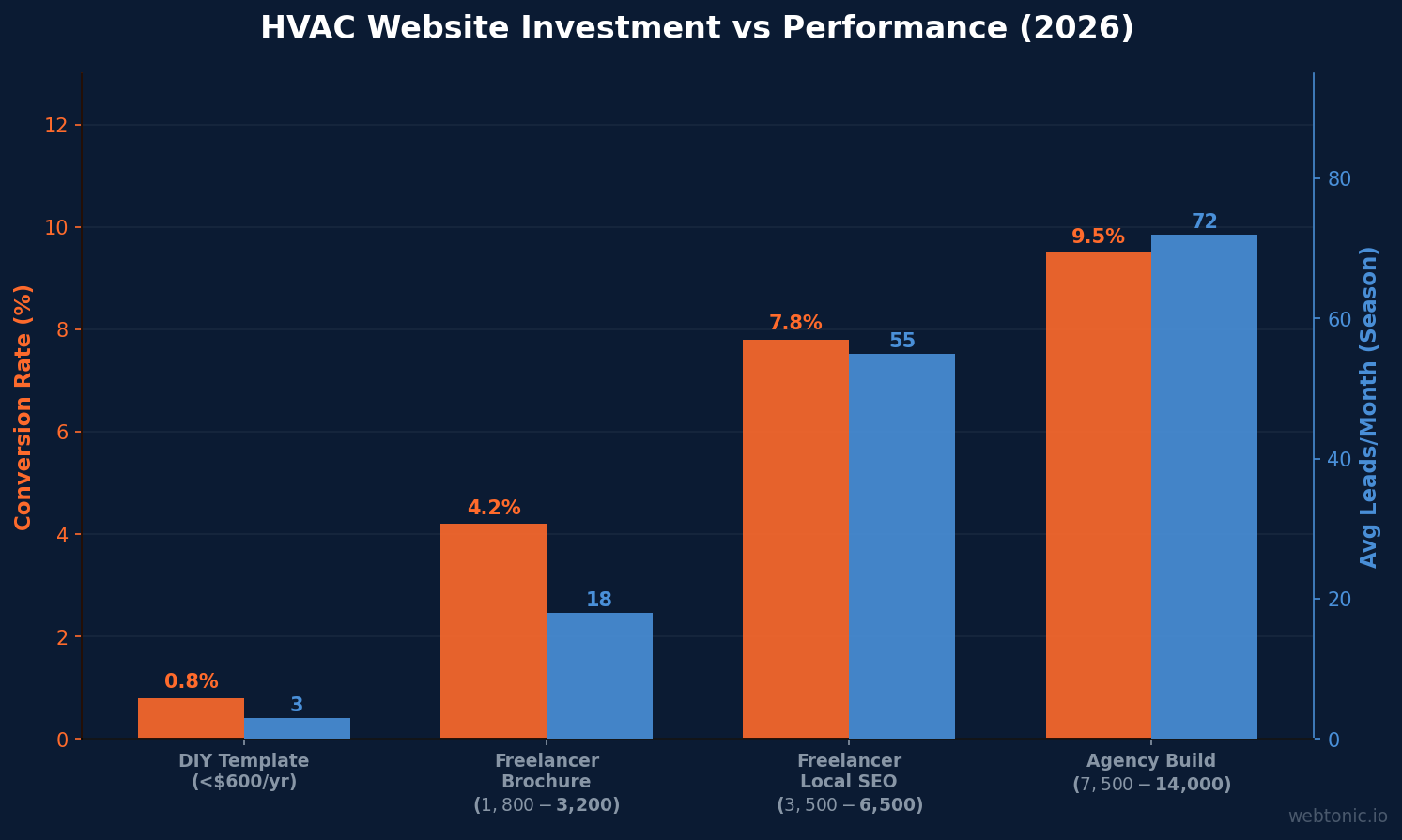
- 7.8% average web conversion rate for HVAC sites, with 46% of conversions coming via phone calls rather than form fills (PipelineOn).
- 30–80 leads per month in season is the achievable range for a properly optimized HVAC WordPress site costing $3,500–$6,500 (WebSuiteAI).
- Under 1% conversion rate is typical for budget template sites under $1,200 that lack click-to-call, emergency contact paths, and mobile optimization (Project Cost Estimator).
- Visible phone numbers boost call volume 15–25%, real team photos lift trust 10–18%, and time-sensitive offers drive 20–35% more conversions (CRO A/B test data from previous HVAC research).
The gap between a $1,200 template site converting under 1% and a $3,500 WordPress build converting at 7.8% represents tens of thousands of dollars in lost revenue per season. For contractors spending $2,000–$4,000 monthly on Google Ads, the website is the bottleneck — not the ad budget.
Technology Stack of HVAC Websites
Beyond the CMS itself, HVAC sites rely on a common set of technologies:
- Google Tag Manager: 11.6% of HVAC sites use it — far below the cross-industry average, indicating weak analytics adoption.
- Google Analytics: 10.5% detected across the sample, though actual usage may be higher due to server-side implementations.
- jQuery: 10.5% — still present in legacy WordPress themes, often adding unnecessary page weight.
- PHP: 11.6% — the WordPress server-side language, confirming WordPress dominance.
- Cloudflare: 9.3% for CDN and DDoS protection.
- 93.3% have at least one social media link, with Facebook at 93.3% and Instagram at 73.3% (Borah Labs).
The low analytics adoption rate is a recurring theme: as documented in our data intelligence research, 79% of HVAC advertisers have no tracking pixel installed and 96% lack server-side conversion API (CAPI) — meaning most contractors cannot measure which website pages or campaigns actually generate revenue.
WordPress Plugin and Feature Adoption
| Feature / Plugin Category | Adoption Rate | Impact on Leads |
|---|---|---|
| Contact form (WPForms, Gravity) | ~85% | Baseline requirement |
| Click-to-call button | 74% | +15–25% call volume |
| Online booking / scheduling | 56.7% | +30–60% after-hours leads |
| Live chat or chatbot | ~22% | +10–15% engagement |
| Review / testimonial widget | ~40% | +10–18% trust signals |
| SEO plugin (Yoast, RankMath) | ~65% | Indirect (indexation, schema) |
| Speed optimization (WP Rocket, Autoptimize) | ~30% | +8–12% mobile conversions |
Data compiled from Fervor Studio's CRO Index (104 contractor sites) and Nopio's HVAC design guide (2026). The biggest conversion gap is online booking — only 56.7% of HVAC sites offer it, leaving 43.3% unable to capture after-hours leads when homeowners search at 11 PM with a broken furnace. For contractors running WordPress, adding a booking plugin like Amelia or integrating Housecall Pro takes 2–4 hours and directly impacts lead capture performance.
HVAC Website Design Best Practices Backed by Data
- Mobile-first design is non-negotiable: over 75% of HVAC search traffic is mobile, and Google indexes mobile versions first (Nopio).
- Emergency contact path above the fold: sites with a visible phone number and "Call Now" CTA above the fold see 15–25% more calls than those burying contact info in the footer.
- Service-area pages drive local rankings: contractors serving 5–10 cities need dedicated pages per market. WordPress handles this with plugins; template builders require manual page creation.
- Real photos outperform stock imagery: HVAC sites using team photos and job-site images report 10–18% higher trust scores in CRO testing.
- Page speed threshold: under 2.5 seconds LCP: sites above this threshold see 3.2× lower conversion rates compared to fast-loading competitors (OnwardCraft, 200-site study).
- Multi-step forms convert 30–60% better than single long forms for service quoting.
- Review integration builds trust: displaying Google reviews on-site increases conversion confidence, especially for emergency services where 90% of homeowners search before booking.
ROI of WordPress Investment for HVAC Contractors
The ROI math for an HVAC website is straightforward once you attach lead volume and close rates:
- Average HVAC customer lifetime value: $15,340 (Frontburner Marketing) — a single converted lead can pay for an entire website build.
- Cost per lead via Google Ads: $45–$180 depending on market and service type. A site converting at 7.8% (industry average) versus under 1% (budget template) reduces effective CPL by 7–8×.
- Payback period for a $6,500 WordPress build: 2–4 months in season for a contractor closing 20% of leads at an average ticket of $500–$1,200.
- Annual website maintenance: $900–$2,400 ($75–$200/mo) — representing under 1% of the revenue a properly optimized site generates.
Contractors who treat their website as a lead-generation asset rather than a brochure consistently outperform competitors on cost per acquisition. The $3,200 WordPress median represents the floor for a site that actually ranks and converts in competitive HVAC markets.
FAQ
What percentage of HVAC companies use WordPress?
58.9% of HVAC contractor websites run on WordPress according to an analysis of 4,407 small-business sites across 14 industries (Elevate Web Design, 2026). This makes HVAC the third-highest WordPress adoption rate behind dental (63.2%) and legal (59.5%). The dominance is driven by WordPress's plugin ecosystem supporting service-area pages, booking integrations, and SEO optimization that template builders cannot match.
How much does an HVAC WordPress website cost in 2026?
An HVAC WordPress website costs $1,800–$14,000 in 2026, with most contractors landing at $3,200–$6,500 for a freelancer-built site or $7,500–$14,000 for an agency build. The median WordPress baseline of $3,200 is what 70% of HVAC contractors should target. Ongoing maintenance adds $75–$200 per month for hosting, security patches, and plugin updates.
How fast should an HVAC website load on mobile?
Google's Core Web Vitals threshold for "good" Largest Contentful Paint is under 2.5 seconds. Among HVAC sites, 82.3% meet this threshold with a median LCP of 0.8 seconds, but 18% exceed it — with the slowest tier averaging 9.5 seconds. Sites loading over 3 seconds see a 53% user abandonment rate. Contractors should test with Google's PageSpeed Insights on a mobile device, not desktop, to see what customers actually experience.
Is WordPress better than Wix for HVAC contractors?
WordPress is better for HVAC contractors who need SEO control, service-area scalability, and booking integrations. Wix is viable for solo operators needing a site within days, but lacks full schema control, plugin flexibility, and the ability to generate service-area pages at scale. The 5-year total cost of ownership is comparable ($10,000–$25,000 for WordPress vs $5,000–$12,000 for Wix), but WordPress sites consistently outperform on organic search and lead generation metrics.
What conversion rate should an HVAC website achieve?
The average HVAC website conversion rate is 7.8%, with 46% of conversions coming via phone calls rather than form submissions. Top-performing sites reach 12.4% conversion rates. Budget template sites under $1,200 typically convert under 1%. The most impactful conversion improvements are adding a visible phone number (+15–25% calls), online booking (+30–60% after-hours leads), and reducing page load time below 2.5 seconds.
Sources
Elevate Web Design — Small Business CMS Statistics 2026
Project Cost Estimator — HVAC Company Website Cost 2026
Full Stack HVAC — HVAC Website Speed Analysis
Fervor Studio — Home Services Website Statistics 2026
Borah Labs — HVAC Website Benchmarks (July 2026)
Zealous Growth — CMS Comparison for Contractors
Nopio — HVAC Website Design Guide 2026
WebSuiteAI — HVAC Website Cost 2026
PipelineOn — Contractor Website Conversion Rate


