Table of contents
Key Takeaways
- Organic search drives 51.2% of global veterinary website traffic, making SEO the single largest acquisition channel for pet care practices.
- The average veterinary website scores 55/100 on Google PageSpeed, with a Largest Contentful Paint of 9.31 seconds — nearly 4x above Google's passing threshold.
- Multi-location clinics in a top-3 Map Pack position see 2.1x more appointment requests than those ranking outside the local pack, based on 34 practice audits.
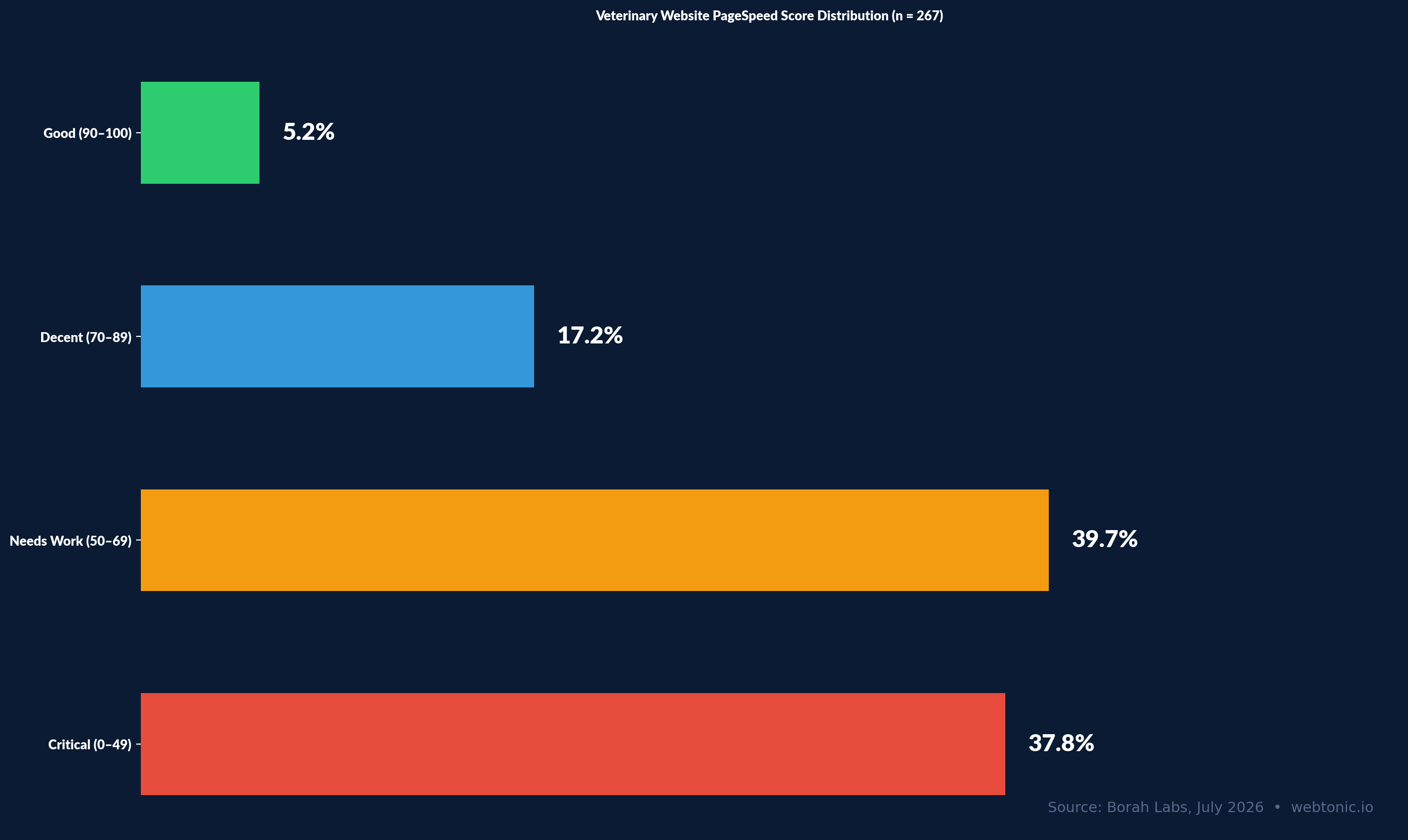
- Only 5.2% of veterinary websites score 90+ on PageSpeed, while 37.8% fall into the critical 0–49 range.
- 75% of users never scroll past Google page one, and the top organic result captures approximately 31.7% of all clicks.
- Monthly SEO investment for veterinary practices ranges from $800 to $3,500, with ranking improvements typically visible within 3–6 months.
- AI assistants recommend hiring a vet in 57.8% of pet health queries, but only 17% of AI responses name specific providers — structured data is key to getting cited.
Veterinary SEO Benchmarks at a Glance
| SEO Metric | Veterinary Benchmark | Source |
|---|---|---|
| Organic Traffic Share (Global) | 51.2% | CUFinder, 2026 |
| Organic Traffic Share (U.S.) | 46.5% | CUFinder, 2026 |
| Website Conversion Rate | 4.2% | CUFinder, 2026 |
| Mobile Traffic Share | 72.4% | CUFinder, 2026 |
| Average Bounce Rate | 54.8% | CUFinder, 2026 |
| Average PageSpeed Score | 55/100 | Borah Labs, 2026 |
| Largest Contentful Paint | 9.31s (threshold: 2.5s) | Borah Labs, 2026 |
| Sites with Schema Markup | 64.6% | Borah Labs, 2026 |
| Top Organic Result CTR | ~31.7% | Stethon Digital, 2026 |
| Map Pack Appointment Lift | 2.1x more requests | Authority Specialist, 2026 |
Organic Search Traffic Performance for Veterinary Practices
Organic search is the dominant traffic source for veterinary websites worldwide. According to CUFinder's 2026 veterinary industry benchmarks, organic search drives 51.2% of global veterinary website traffic and 46.5% in the U.S. market. The remaining traffic splits between direct (28.5%), paid search (12.3%), social media (5.8%), and referral/email (2.2%).
The U.S. organic share is lower than the global average because corporate veterinary groups like VCA and Banfield run aggressive paid acquisition campaigns that capture a larger share of search traffic in competitive metro markets. Independent practices in less competitive areas often see organic shares above 60%.
Authority Specialist's 2026 audit of 34 veterinary practices confirmed that organic search drives 58–67% of new pet owner discovery in suburban and mid-size metro markets, outperforming paid search for practices with established domain authority. The study also found that practices with fewer than 40 Google reviews and incomplete GBP profiles consistently underperform on branded and emergency-intent queries.
For practices looking to build organic traffic, understanding the true costs of paid alternatives helps justify the longer-term SEO investment.

Technical SEO Health Across 267 Veterinary Websites
The 2026 Borah Labs audit of 267 veterinary websites across the United States reveals a market where basic technical SEO adoption remains inconsistent. While some practices have invested in modern web infrastructure, the majority lag significantly behind Google's performance standards.
Core Web Vitals
- Largest Contentful Paint (LCP): 9.31 seconds — Google's threshold is 2.5 seconds. The average vet site loads its main content nearly 4x slower than required for a "Good" rating.
- First Contentful Paint (FCP): 3.72 seconds — above Google's 1.8-second threshold
- Cumulative Layout Shift (CLS): 0.12 — slightly above the 0.10 threshold, indicating minor layout stability issues
- Time to First Byte (TTFB): 0.11 seconds — the one metric where veterinary sites actually pass Google's 0.8-second benchmark
On-Page SEO Fundamentals
- Viewport meta tag: 85.8% — without this, Chrome renders pages at desktop zoom on phones
- Meta descriptions: 71.3% — nearly 29% of vet sites let Google auto-generate their search snippets
- Canonical tags: 70.9% — prevents duplicate-content penalties across www, http, and tracking-parameter variants
- Open Graph tags: 66.0% — controls how links preview on social platforms
- Structured data (JSON-LD schema): 64.6% — unlocks rich results like stars, hours, and FAQ snippets
The performance distribution tells an even starker story: 37.8% of veterinary sites score in the critical 0–49 range on PageSpeed, 39.7% need work (50–69), 17.2% are decent (70–89), and only 5.2% score good (90–100). This means nearly 78% of veterinary websites underperform on page speed — a factor that affects both rankings and advertising performance.
Most Common Technical SEO Issues on Veterinary Websites
| Issue | Prevalence | Impact Level |
|---|---|---|
| Main content takes too long to appear (LCP) | 82.8% of sites | High |
| Duplicate title tags across pages | 79.5% of sites | Medium |
| Broken links (2+ per site) | 39.9% of sites | Medium |
| No XML sitemap found | 35.1% of sites | High |
| No robots.txt file | 31.3% of sites | High |
| Missing meta descriptions | 28.7% of sites | Medium |
| No canonical tag | 29.1% of sites | Medium |
| Missing SSL certificate | 10.1% of sites | High |
Source: Borah Labs Veterinary Website Benchmarks, July 2026 (267 sites analyzed).
Veterinary Keyword Landscape and Search Competition
Veterinary keyword competition varies dramatically by intent type and geographic specificity. The highest-value queries for pet care practices fall into several distinct categories:
- Emergency keywords ("emergency vet near me," "24-hour animal hospital") — highest conversion rates, competitive CPC of $5–$20 on Google Ads
- Service-specific keywords ("dog dental cleaning cost," "cat vaccination schedule") — high intent, moderate competition
- Location-based keywords ("veterinarian [city]," "vet clinic [neighborhood]") — strong local intent, Map Pack dominance determines winners
- Informational keywords ("why is my dog limping," "cat not eating") — high volume, lower conversion, but valuable for brand building and AI citation
According to Stethon Digital Marketing's 2026 veterinary statistics, 75% of users never scroll past Google page one, and the #1 organic result captures approximately 31.7% of all clicks. The click-through rate drops steeply after position three, making the difference between page one and page two not marginal but functionally invisible.
For veterinary practices investing in paid search, the industry's Google Ads CPC averages $3.45 with a 12.6% conversion rate (CUFinder, 2026). This provides a useful cost benchmark for evaluating organic SEO ROI — practices acquiring clients organically for less than the equivalent paid CPC are generating positive returns.
SEO ROI and Investment Benchmarks for Veterinary Practices
SEO is a compounding investment — unlike paid advertising, where visibility stops when the budget runs out, organic authority accumulates over time. Authority Specialist's 2026 benchmark data provides realistic timeline expectations:
- Ranking improvements: 3–6 months for measurable movement
- Organic traffic growth: 6–9 months for meaningful traffic that converts
- Sustained Map Pack presence: 6–12 months depending on market competition
- Cost-per-client decrease: Organic acquisition costs decline as the investment matures
Monthly SEO investment ranges from $800 to $3,500 depending on market competition, practice size, and scope. Emergency and specialty practices in competitive markets require higher investment to compete with corporate consolidators.
The ROI case for veterinary SEO centers on lifetime client value. Average annual veterinary spending is $410 per dog and $283 per cat (APPA, 2026), with a 78% annual client retention rate (CUFinder, 2026). A single organic client acquisition can represent $1,500–$2,500+ in lifetime revenue, making the monthly SEO spend a fraction of the return.
Compared to Google Ads (average CPC $3.45, CPA $48), organic SEO delivers lower cost-per-acquisition over time as domain authority compounds. However, the channels work best in combination: paid search for immediate visibility during the SEO growth phase, and organic for long-term sustainable traffic.
AI Visibility and the Future of Veterinary SEO
AI-powered search is changing how veterinary practices are discovered. The Authority Specialist 2026 AI Study measured how ChatGPT, Claude, and Gemini respond to veterinary-related queries:
- 57.8% AI Recommendation Index — AI assistants recommend hiring a veterinarian in 57.8% of pet health queries (14-industry average: 44.2%)
- Only 17% of AI responses name specific providers — AI models rarely cite individual veterinary practices by name
- ChatGPT recommends hiring a vet 67% of the time, Claude 60%, and Gemini 47% — significant variation by model
The iVET360 2026 report adds that 94% of veterinary practice websites are not optimized for AI citations. Practices that invest in structured data, comprehensive service pages, and authoritative content will be better positioned as AI search continues to grow.
For practices building their digital marketing strategy, AI visibility should be treated as an extension of SEO — the same fundamentals (structured data, content depth, authority signals) that drive organic rankings also improve AI citation likelihood.
Veterinary SEO vs. Other Marketing Channels
| Channel | Cost Benchmark | Timeline | Compounding |
|---|---|---|---|
| Organic SEO | $800–$3,500/month | 3–12 months to impact | Yes — authority grows over time |
| Google Ads | $3.45 CPC, $48 CPA | Immediate | No — stops when budget ends |
| Facebook Ads | $1.15 CPC, $65 CPA | 1–2 weeks to optimize | No |
| Social Media (Organic) | Staff time | Ongoing | Partial — community builds |
| Direct Mail | $0.50–$2.00/piece | 2–4 weeks per campaign | No |
Source: CUFinder veterinary benchmarks 2026, Authority Specialist 2026 data. The distinctive characteristic of organic SEO is compounding return — content and backlinks earned in year one continue contributing to rankings in year three, while paid advertising costs remain flat or increase with competition.
FAQ
How long does SEO take to work for a veterinary practice?
Based on Authority Specialist's 2026 data, veterinary practices typically see measurable ranking improvements in 3–6 months, meaningful organic traffic growth in 6–9 months, and sustained Map Pack presence within 6–12 months. Practices in highly competitive metro markets with corporate competitors should plan for the longer end. The SEO timeline is affected by starting domain authority, technical site health, content baseline, review profile, and competitive density.
What is a good PageSpeed score for a veterinary website?
Anything above 80/100 puts a veterinary site ahead of most competitors. The industry average is just 55/100 (Borah Labs, 2026). Below 50 is critical — Google's data shows bounce rates climb sharply past a 3-second load time. Only 5.2% of vet sites score 90+, making speed optimization one of the highest-ROI technical SEO investments.
How much should a veterinary practice invest in SEO?
Monthly SEO investment typically ranges from $800 to $3,500. Small-market practices can see results with $800–$1,500/month, while competitive metro markets require $2,500–$3,500/month. The investment pays for itself through client lifetime value: average annual spending of $410/dog and $283/cat, with 78% annual retention.
What percentage of veterinary traffic comes from organic search?
Organic search drives 51.2% of global veterinary website traffic and 46.5% in the U.S. (CUFinder, 2026). The U.S. share is lower because corporate veterinary groups run aggressive paid campaigns. Independent practices in less competitive areas often see organic shares above 60%. Direct traffic accounts for 28.5%, paid search 12.3%, and social media 5.8%.
Do veterinary websites need structured data (schema markup)?
Yes. Only 64.6% of veterinary websites currently use JSON-LD schema (Borah Labs, 2026), which means the other 35.4% miss opportunities for rich results (star ratings, business hours, FAQ snippets) in search. Schema also increases the likelihood of AI assistants citing a practice, with only 17% of AI responses naming specific providers.
Sources
borahlabs.us/insights/veterinary
authorityspecialist.com — Veterinary SEO Benchmarks 2026
cufinder.io/blog/benchmarks/veterinarians
authorityspecialist.com — Veterinary SEO ROI
ivet360.com — Local SEO Stats for Veterinary Practices 2026
stethondigitalmarketing.com — 100+ Veterinary Marketing Statistics
americanpetproducts.org — APPA Industry Data