Table of contents
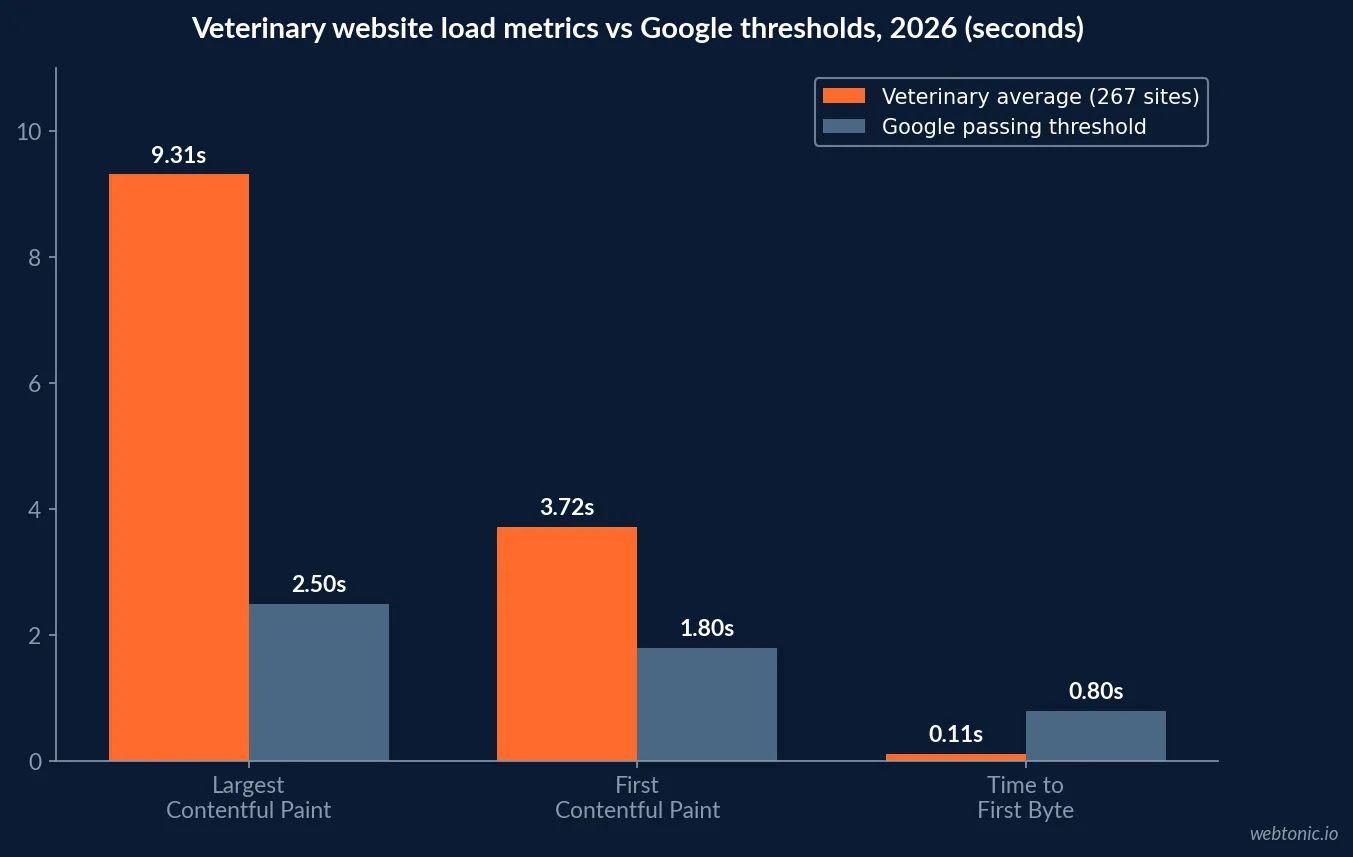
The average veterinary website takes 9.31 seconds to render its main content - 6.8 seconds past Google’s 2.5-second threshold - while its server responds in 0.11 seconds. Veterinary technical SEO is therefore not a hosting problem. It is a front-end and machine-readability problem, and in 2026 it decides whether AI assistants can read your clinic at all. Here are the numbers.
Key Takeaways
- Average veterinary LCP is 9.31 seconds against a 2.5-second threshold, with FCP at 3.72s, CLS at 0.12 and TTFB at just 0.11s (267 US clinic sites, July 2026).
- 78% of veterinary sites score below 70 on PageSpeed: 37.8% critical (0-49), 39.7% needs-work (50-69), only 5.2% score 90+.
- 51.3% of all origins pass every Core Web Vital on mobile in June 2026, up from 43.2% a year earlier - so clinics are losing to a rising baseline.
- Only 64.6% of clinic sites publish any JSON-LD, and 46.7% of graded veterinary homepages have no VeterinaryCare or LocalBusiness schema.
- Valid schema earns 3.1x more AI Overview citations than no-schema controls; FAQPage lifts 3.4x and JSON-LD is 70% of deployments.
- Major AI crawlers do not run JavaScript, and an estimated 42% of JavaScript-rendered content is never indexed by AI systems.
- Google cut the HTML crawl limit from 15MB to 2MB in January 2026; 78% of audited sites have at least one page over it.
- Core Web Vitals fail on 91% of sites at site level and 34% of crawled URLs; long-tail pages pass at 51% versus 84% for homepages.
- 72.4% of veterinary traffic is mobile and bounce averages 54.8% - the two conditions that punish slow pages hardest.
- Each extra second of load time costs about 7% of conversions, and passing all three vitals is associated with 24% fewer bounces.
- Only 68% of AI-surfaced business contact details match Google Business Profile, and AI local recommendation is up to 30x more selective than the local pack.
- 89.9% of clinic sites use SSL - meaning 27 of 267 still trigger a Chrome warning in 2026.
The veterinary web is a slow web
The cleanest measurement of the veterinary market’s technical health comes from Borah Labs, which ran full diagnostics on 267 US veterinary websites in July 2026. The headline is brutal: average Largest Contentful Paint of 9.31 seconds against Google’s 2.50-second threshold, First Contentful Paint of 3.72 seconds against 1.80, Cumulative Layout Shift of 0.12 against 0.10 - and Time to First Byte of 0.11 seconds against a 0.80-second threshold.
Read those four numbers together and the diagnosis writes itself. Hosting is not the problem; the server answers seven times faster than it needs to. Everything is lost after the first byte, in images, scripts and third-party widgets. The distribution confirms it: 37.8% of clinic sites land in the critical 0-49 PageSpeed band, 39.7% in 50-69, 17.2% in 70-89 and only 5.2% score 90 or above. The average veterinary site scores 55/100, and the sample’s most common technologies are jQuery (57.5%), Google Analytics (55.6%) and PHP (42.9%).
| Metric | Veterinary average (267 sites) | Google threshold | Gap |
|---|---|---|---|
| Largest Contentful Paint | 9.31s | 2.50s | 6.81s over |
| First Contentful Paint | 3.72s | 1.80s | 1.92s over |
| Cumulative Layout Shift | 0.12 | 0.10 | 0.02 over |
| Time to First Byte | 0.11s | 0.80s | 0.69s under |
| PageSpeed score (avg) | 55/100 | 90+ for good | 35 points short |
| Sites scoring 90+ | 5.2% | n/a | The whole opportunity |
| SSL adoption | 89.9% | 100% | 27 sites unprotected |
How that compares with the rest of the web
The baseline clinics are being measured against keeps rising. Analysis of Chrome User Experience Report data by JustAnalytics puts 51.3% of origins passing all three Core Web Vitals on mobile as of June 2026, up from 43.2% a year earlier and 67.8% on desktop. Individually, LCP passes on 63.7% of mobile origins, INP on 71.2% and CLS on 78.9%. LCP is the binding constraint everywhere - including in veterinary.
Connection type matters as much as code. The same dataset reports pass rates of 58.2% on 4G, 31.7% on 3G and 8.3% on 2G. Since 72.4% of veterinary sessions are mobile according to CUFinder’s veterinary benchmarks, with an average bounce rate of 54.8%, a clinic site is being judged in exactly the conditions where weight hurts most. Platform choice shifts the odds too: CMS-level pass rates in the CrUX analysis run from 27.3% to 61.2%, with WordPress at 47.3% and Shopify at 52.1%.
| Cohort | All-CWV mobile pass rate | What it means for a clinic |
|---|---|---|
| All origins, June 2026 | 51.3% | Half the web now passes |
| All origins, June 2025 | 43.2% | The bar moved 8.1 points in a year |
| Desktop, June 2026 | 67.8% | Mobile is where you lose |
| 4G connections | 58.2% | Best realistic case for pet owners |
| 3G connections | 31.7% | Rural and in-clinic dead zones |
| WordPress origins | 47.3% | Plugin audit is non-negotiable |
| Shopify origins | 52.1% | Relevant to clinic retail pages |
The technical issues an audit actually finds
Aggregate crawl data published by Crawlix ranks issues by how often they appear across sites. Core Web Vitals failures show up on 91% of sites and 34% of crawled URLs, and the pass rate is concentrated at the top of the site: 84% of homepages pass but only 51% of long-tail pages do. That is precisely the shape of a veterinary site, where the homepage got the design attention and forty service, team and location pages did not.
Two 2026-specific items deserve a place on every clinic checklist. First, Google reduced its HTML crawl limit from 15MB to 2MB per URL in January 2026, and 78% of audited sites have at least one page over it. Second, schema validation errors appear on 69% of sites and 22% of URLs carrying structured data, frequently because AI-generated markup is syntactically valid but semantically wrong - invented review counts, fabricated aggregateRating, sameAs URLs that do not resolve. Beyond that: soft 404s on 64% of sites, redirect chains three or more hops deep on 58%, and orphan pages with ranking potential on 52%, where adding five to ten internal links often moves a page from position 8-15 into the 3-7 range within 30 days.
| Issue | Site frequency | URL frequency | Veterinary relevance |
|---|---|---|---|
| Core Web Vitals failure | 91% | 34% of URLs | Highest - the vet average is 9.31s LCP |
| Soft 404s (200 status, empty page) | 64% | 8% of URLs | Retired services, old team members |
| Pages over the 2MB HTML limit | 78% | n/a | Image-heavy gallery and tour pages |
| Schema validation errors | 69% | 22% of schema URLs | Very high - see the next section |
| Redirect chains 3+ hops | 58% | n/a | Accumulate across site rebuilds |
| Orphan pages with potential | 52% | n/a | Service pages with no internal links |
Schema: present on most clinic sites, correct on far fewer
64.6% of the 267 veterinary sites publish JSON-LD structured data, which sounds reasonable until you look at what is missing and what is broken. A separate audit of 45 graded veterinary homepages by Codivox found 46.7% missing VeterinaryCare or LocalBusiness schema entirely, alongside 73.3% with no client portal, 37.8% with no prescription refill path, 22.2% with no appointment call-to-action and 13.3% with no online booking at all. The median graded homepage scored 88/100 and 11% scored a C or lower, so the front page is usually fine - the machine-readable and transactional layers are what fail.
The payoff for fixing it has changed. Research from Presenc reports that pages with valid schema are cited 3.1 times more often in AI Overviews than no-schema controls, that FAQPage markup lifts citations 3.4x and Dataset 4.0x, and that JSON-LD is 70% of all structured-data deployments. Meanwhile technical benchmark work from Authority Specialist estimates roughly 60% of sites using schema carry at least one validation error that blocks rich results, and that resolving canonical conflicts improves indexation coverage 20-35% within 60 days. Valid beats present, every time.
The 2026 change that matters most: AI crawlers do not render JavaScript
This is the single technical fact most likely to cost a clinic visibility this year. A review of vendor documentation through Q2 2026 by HybridRanking confirms that GPTBot, OAI-SearchBot, ChatGPT-User, ClaudeBot, Claude-User, PerplexityBot, Perplexity-User, Bytespider and CCBot all fail to execute JavaScript. One February 2026 analysis it cites puts a number on the consequence: 42% of JavaScript-rendered content is never indexed by AI systems. Google is the exception - Gemini uses the same Web Rendering Service as Googlebot - which is exactly why the problem hides. Your JavaScript-injected hours can rank in Google and be invisible to ChatGPT at the same time.
For a veterinary site the exposure is concrete and easy to test. Open the page source, not the inspector, and search for your phone number, your address, your emergency hours, your service list and your pricing. If any of it is absent from the raw HTML, the assistants cannot read it. The same applies to a booking widget that renders the whole services block client-side, and to review carousels that fetch content after load. Server-side rendering, static HTML for NAP data and schema in the initial response fix all of it.
- Put NAP, hours and services in the raw HTML. Widgets can enhance them; they must not be the only source.
- Keep JSON-LD in the server response and under 100KB per block.
- Do not block AI crawlers by accident. Roughly 28% of websites now block AI crawlers in robots.txt, sometimes without deciding to.
- Check third-party scripts - they account for 54% of total JavaScript weight and block rendering on 23% of pages.
- Prefer static generation for service and location pages, the pages assistants quote from.
| AI crawler | Executes JavaScript? | What it feeds |
|---|---|---|
| GPTBot | No | ChatGPT training |
| OAI-SearchBot / ChatGPT-User | No | ChatGPT browsing and search |
| ClaudeBot / Claude-User | No | Claude answers |
| PerplexityBot / Perplexity-User | No | Perplexity citations |
| Bytespider | No | TikTok search and AI |
| CCBot | No | Common Crawl, used by many models |
| Googlebot | Yes | Google Search and AI Overviews |
| Google-Extended / Gemini | Yes (same rendering service) | Gemini |
Speed, bounce and booking: what the delay actually costs
The commercial case does not depend on Google’s ranking weighting at all. Technical benchmark data compiled by Searchlab reports that each additional second of load time costs about 7% of conversions, that sites passing all three vitals see 24% fewer bounces, that pages under a 2.5-second LCP average 27% more organic traffic than slower ones, and that 95.6% of pages in Google’s top 10 use HTTPS - 97.2% at position 1. It also notes AI bot crawl requests up 340% since 2024, HTTP/2 on 68% of sites delivering 15-20% faster loads, and infinite scroll without pagination cutting indexed items by 41%.
Apply the veterinary economics on top. CUFinder puts veterinary Google Ads CPC at $3.45 with 12.6% conversion, animal-care paid-search cost per lead at $31.50, dedicated landing pages converting at 10.5% versus 4.2% site-wide and click-to-call at 18.3%. A clinic paying $31.50 a lead on a site that loses roughly 7% of conversions per second of delay is buying traffic and then discarding it. Our veterinary landing page statistics break the post-click half down further.
Technical hygiene beyond speed
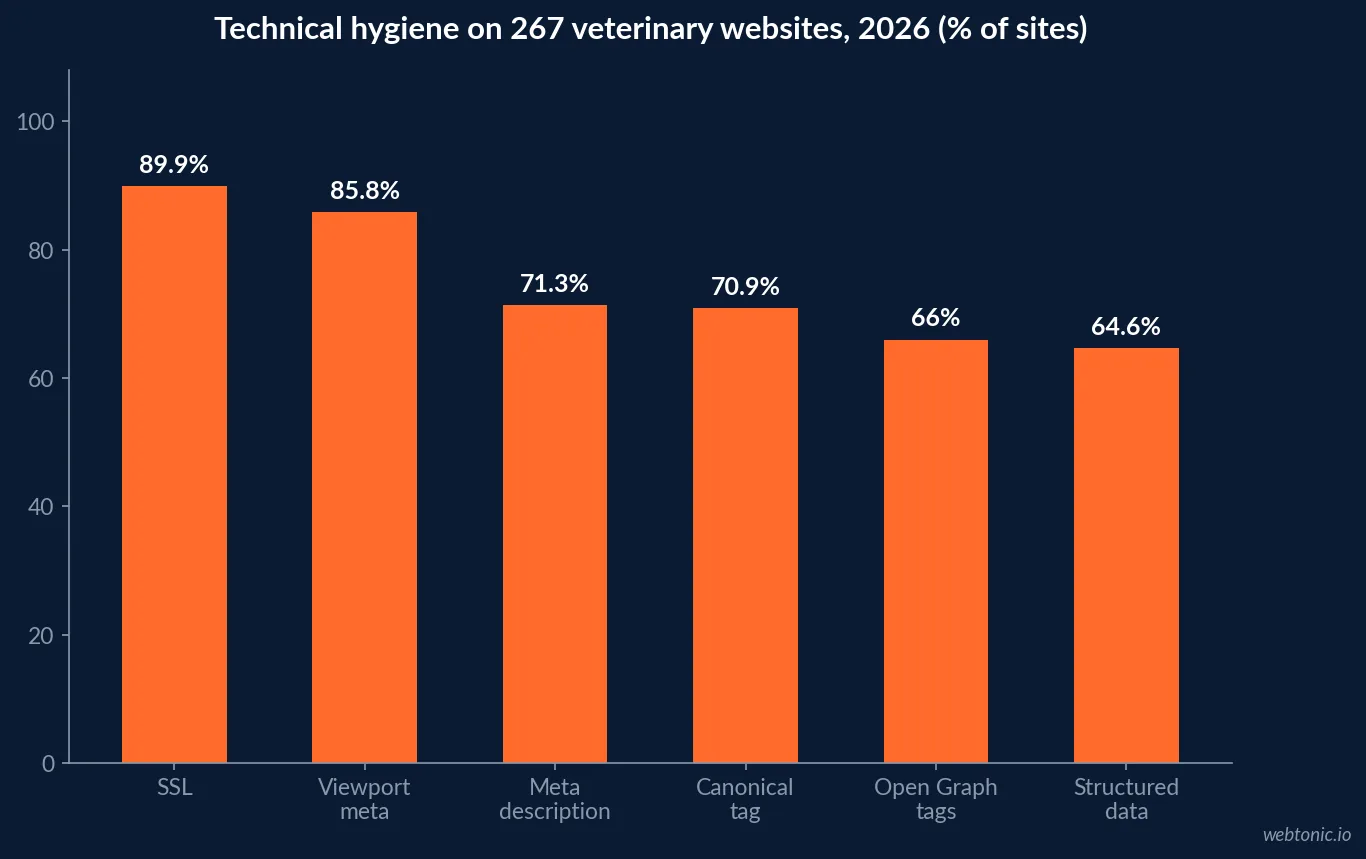
The 267-site sample also measured the unglamorous head-of-document work, and the gaps are uniform enough to be a checklist. Viewport meta is declared on 85.8% of clinic sites - so roughly one in seven still renders at desktop zoom on a phone. Meta descriptions exist on 71.3%, canonical tags on 70.9%, Open Graph tags on 66% and structured data on 64.6%. SSL is at 89.9%, leaving 27 sites serving a Chrome security warning to pet owners in 2026.
None of these are expensive. All of them are compounding. A missing canonical multiplies into duplicate versions across www, non-www and tracking parameters; a missing Open Graph image turns every shared link into grey text on Facebook and iMessage, which matters when 68.3% of clinic sites link to at least one social profile and 64.9% to Facebook. Fixing the head of the document is usually a day of work with a multi-year payoff, and it is the natural companion to the content work in our veterinary SEO statistics.
Local and AI discovery depend on the same technical layer
Technical SEO for a clinic is not separate from local visibility - it feeds it. Local research compiled by iVET360 reports that 46% of Google searches have local intent, 80% of US consumers search for local businesses weekly, 72% use Google for local business information, 62% would avoid a business with incorrect information online and 47% look for a different business if the one they wanted appears closed. It also flags the AI layer: 45% of consumers now use ChatGPT or similar tools for local recommendations, AI visibility is up to 30 times more selective than Google’s local results, and only 68% of AI-surfaced business contact details match the Google Business Profile.
Cross-vertical evidence assembled by OpenLens sharpens the target: in the healthcare subset of a 6.8-million-citation study, 52.6% of AI citations came from listings, 28.7% from first-party websites and 13.3% from reviews and social; healthcare shows the highest AI Overview trigger rate of any sector at 48.75% while AI referral traffic is still only 0.63% of sessions; and only 1.2% of locations are recommended by ChatGPT versus 35.9% appearing in Google’s local 3-pack. Selectivity heuristics that recur across the studies are 4.3+ star ratings, a 5%+ review response rate and consistent NAP - all of which are technical consistency problems as much as marketing ones. Our veterinary local SEO statistics go deeper on the listings side.
A 2026 technical priority order for a clinic site
Ranked by expected return against effort, using the benchmarks above:
- Fix LCP first. Compress and correctly size the hero image, preload it, serve it from a CDN, defer everything non-critical. The market average is 9.31s; getting under 2.5s puts a clinic in the top few percent of its category.
- Move NAP, hours, services and schema into the server response so the non-rendering AI crawlers can read them.
- Deploy and validate VeterinaryCare or LocalBusiness plus FAQPage JSON-LD. 46.7% of clinic homepages have none, and valid markup earns 3.1x more AI Overview citations.
- Audit long-tail pages, not just the homepage - 84% of homepages pass CWV against 51% of long-tail URLs.
- Close the head-of-document gaps: canonicals (29% missing), meta descriptions (29% missing), Open Graph (34% missing), viewport (14% missing).
- Check page weight against the new 2MB HTML limit and kill soft 404s left by retired services.
- Add five to ten internal links to orphaned service pages, the cheapest ranking movement available.
- Then measure booking, not scores. Track click-to-call and form completion against the 18.3% and 10.5% benchmarks; page speed is a means, not the KPI. Our veterinary analytics statistics cover the measurement side.
Limits of this data
Three caveats worth stating plainly. The 267-site speed sample and the 45-homepage grading sample are both US-skewed and vendor-published, so treat the exact decimals as directional and the direction as reliable - a 6.8-second gap is too large to be a methodology artefact. The AI-citation multipliers are correlational; valid schema and citation-worthy content travel together. And veterinary is one of the least-studied verticals in AI-visibility research: citation-dominance syntheses through April 2026 explicitly note that no published study covers veterinary with per-domain statistical rigour, which is why the honest guidance here is healthcare-adjacent rather than vet-specific.
Frequently Asked Questions
How fast should a veterinary website load in 2026?
Google's passing threshold for Largest Contentful Paint is 2.5 seconds, Interaction to Next Paint must stay under 200ms and Cumulative Layout Shift under 0.1. Veterinary sites are nowhere near it: across 267 US clinic websites the average LCP is 9.31 seconds - 6.8 seconds over the threshold - with First Contentful Paint at 3.72 seconds and CLS at 0.12. The realistic target for a clinic rebuild is an LCP under 2.5 seconds on a 4G phone connection, which is achievable because the same sample shows Time to First Byte averaging just 0.11 seconds. The delay is front-end weight, not hosting.
Why is the average veterinary website so slow?
Because almost nothing in the failure is server-side. In the 267-site veterinary sample, TTFB averages 0.11 seconds against a 0.80-second threshold, while LCP misses by 6.8 seconds. That pattern means uncompressed hero images, render-blocking scripts, embedded booking and chat widgets, and jQuery - detected on 57.5% of clinic sites. Every one of those is fixable without changing hosts or platforms. Site-wide, 37.8% of veterinary sites score in the critical 0-49 PageSpeed band and another 39.7% score 50-69, so 78% sit below 70.
Does schema markup matter for a veterinary clinic?
More in 2026 than it did in 2023, because it is now an AI-visibility lever as well as a rich-result lever. Pages with valid schema are cited 3.1 times more often in AI Overviews than no-schema controls, with FAQPage at 3.4 times, and JSON-LD accounts for 70% of all structured-data deployments. The veterinary opportunity is that the market has not done it properly: 64.6% of clinic sites publish any JSON-LD, 46.7% of graded veterinary homepages are missing VeterinaryCare or LocalBusiness schema, and about 60% of sites using schema have at least one validation error that blocks rich-result eligibility.
Do AI assistants read a veterinary website the same way Google does?
No, and that is the biggest technical shift of 2026. Vendor documentation through Q2 2026 confirms that GPTBot, OAI-SearchBot, ClaudeBot, PerplexityBot, Bytespider and CCBot do not execute JavaScript, and one February 2026 analysis estimates 42% of JavaScript-rendered content never gets indexed by AI systems. Googlebot and Google's Gemini crawler share a rendering service, so client-side content can still rank in classic search while being invisible to ChatGPT and Perplexity. If your services, hours or phone number are injected by JavaScript, assume the assistants cannot see them.
What technical issues should a clinic fix first?
In order of expected return: get the largest hero image and any video off the critical path so LCP clears 2.5 seconds; add or validate VeterinaryCare and LocalBusiness JSON-LD plus FAQPage on service pages; make sure NAP, hours and services exist in the raw HTML rather than in JavaScript; populate meta descriptions and canonicals - missing on roughly 29% of clinic sites; and keep every page's HTML under Google's new 2MB crawl limit, introduced in January 2026 and already breached on at least one URL by 78% of audited sites.
Sources
Borah Labs - Veterinary website benchmarks (267 sites, July 2026)
Codivox - State of Veterinary Websites 2026
JustAnalytics - Core Web Vitals Statistics 2026
Crawlix - 2026 Technical SEO Issues Aggregate
Presenc - State of Schema.org for AI Search 2026
HybridRanking - AI Crawlers and JavaScript, Q2 2026
Searchlab - Technical SEO Statistics 2026
Authority Specialist - Technical SEO Statistics
iVET360 - Local SEO Statistics for Veterinary Practices 2026
OpenLens - Veterinary AI Visibility Evidence Review 2026
CUFinder - Veterinary Marketing Benchmarks 2026