



Table of contents

Key Takeaways
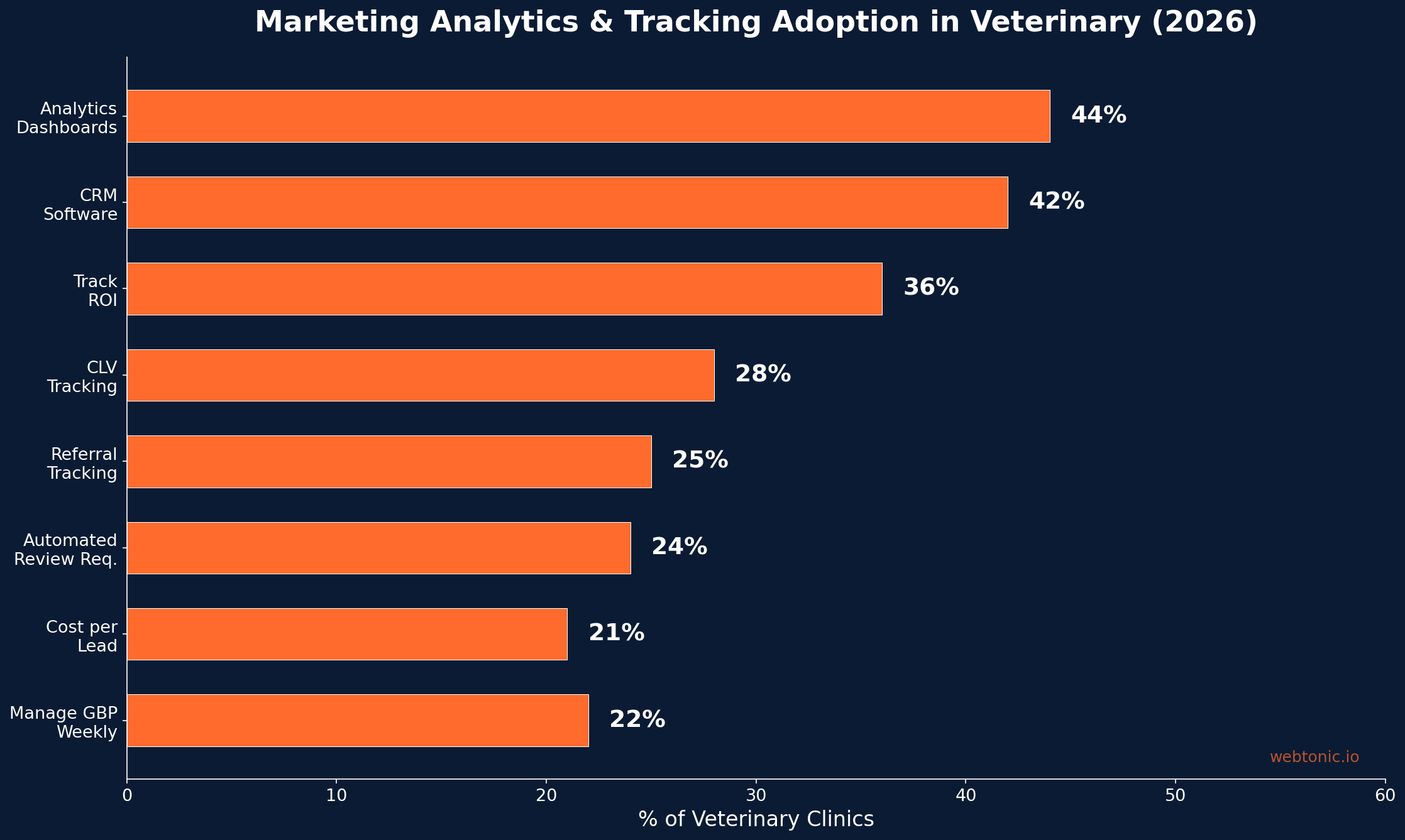
- Only 36% of veterinary clinics actively track ROI from their marketing campaigns, leaving the majority flying blind on ad spend effectiveness.
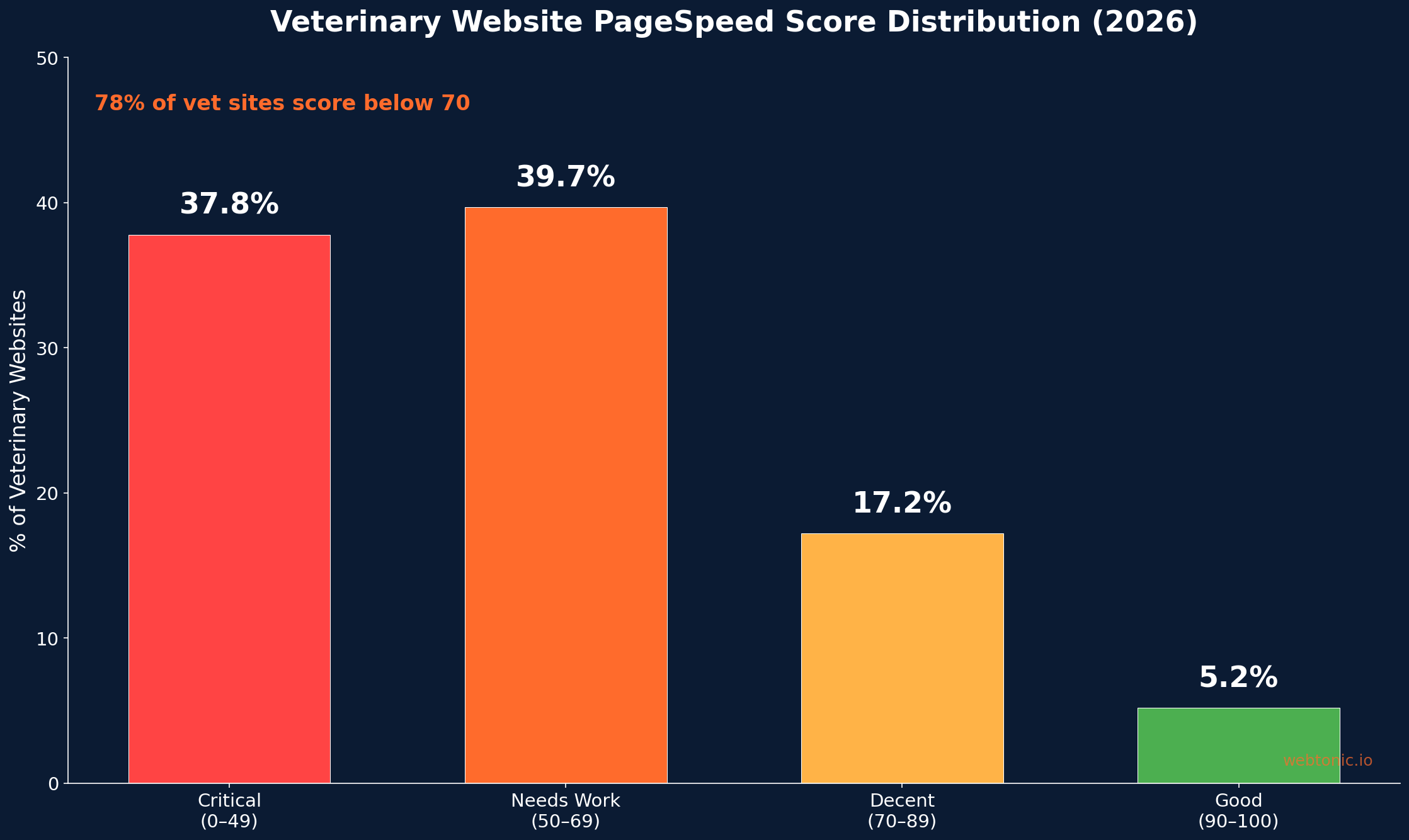
- 78% of veterinary websites score below 70 on Google PageSpeed, with an average Largest Contentful Paint of 9.3 seconds — nearly 4x Google's passing threshold.
- Google Ads conversion rates for veterinary reach 12.6%, the highest of nearly any local service industry, yet only 21% of clinics track cost per lead.
- 72.4% of veterinary website traffic comes from mobile devices, but only 85.8% of vet sites declare a mobile viewport meta tag.
- 24% of pet owners now use AI assistants (ChatGPT, Perplexity, Google AI Overviews) during their veterinary research, up from 6% in 2024.
- Practices using PIMS-integrated analytics reclaim 8–12 hours of staff time per week while connecting ad spend directly to booked appointments and paying patients.
Veterinary Analytics Benchmarks at a Glance
The veterinary industry sits at a crossroads: practices that invest in analytics outperform those that do not — by wide margins. The table below captures the most referenced benchmarks for 2026 veterinary analytics and tracking performance. Whether you run a single-location clinic or manage a multi-practice group, these numbers form the baseline every practice should measure against.
| Metric | Benchmark | Source |
|---|---|---|
| Mobile Traffic Share | 72.4% | CuFinder 2026 |
| Avg. Bounce Rate | 54.8% | CuFinder 2026 |
| Avg. Session Duration | 2 min 18 sec | CuFinder 2026 |
| Pages Per Session | 2.4 | CuFinder 2026 |
| Google Ads CVR | 12.6% | CuFinder 2026 |
| Google Ads CPC | $3.45 | CuFinder 2026 |
| Organic Search Share (US) | 46.5% | CuFinder 2026 |
| Avg. PageSpeed Score | 55 / 100 | Borah Labs 2026 |
| Clinics Tracking ROI | 36% | Marketing LTB 2026 |
| Clinics Using Analytics Dashboards | 44% | Marketing LTB 2026 |
While the 12.6% Google Ads conversion rate ranks among the highest of any local service industry, the fact that only 36% of clinics track ROI and 21% track cost per lead means most practices cannot prove their marketing works. That disconnect is the single largest analytics gap in veterinary today. The practices that close this gap — connecting ad platforms to practice management systems for revenue-level attribution — gain a decisive competitive advantage over clinics still relying on guesswork.
Website Performance and Core Web Vitals
Borah Labs analyzed 267 US veterinary websites in July 2026 and the results reveal a performance crisis that directly impacts both user experience and search rankings. The average veterinary site takes 9.31 seconds to render its main content — nearly four times Google's 2.5-second threshold. Speed is not a vanity metric: 55% of pet owners abandon booking if a website is slow, according to Marketing LTB's 2026 survey. Every second of delay costs real appointments.
| Website Metric | Veterinary Average | Google Threshold | Gap |
|---|---|---|---|
| Largest Contentful Paint | 9.31s | 2.50s | 6.81s over |
| First Contentful Paint | 3.72s | 1.80s | 1.92s over |
| Cumulative Layout Shift | 0.12 | 0.10 | 0.02 over |
| Time to First Byte | 0.11s | 0.80s | Passes ✓ |
| Performance Score | 55 / 100 | 90+ | 35 pts below |
| SEO Score | 91 / 100 | 90+ | Passes ✓ |
The PageSpeed distribution tells an even starker story: 37.8% of vet sites score "Critical" (0–49), 39.7% "Needs Work" (50–69), only 17.2% reach "Decent" (70–89), and a mere 5.2% hit "Good" (90–100). When 78% of sites score below 70, page speed becomes a real competitive differentiator for the minority investing in it. The sites that fix their Largest Contentful Paint — typically by compressing hero images, lazy-loading below-fold assets, and switching to modern image formats — see measurable improvements in both organic rankings and conversion rates.
Conversion Tracking and Marketing Attribution
Conversion tracking in veterinary marketing is uniquely challenging. Most high-value conversions — emergency calls, appointment bookings, walk-ins — happen off-screen. The Visible Vet identifies the core tracking stack as phone calls over 60 seconds, form submissions, online booking confirmations, and offline import of booked appointments from the practice management system. Without this multi-touch approach, clinics measure clicks instead of patients.
| Tracking Behavior | % of Clinics | Source |
|---|---|---|
| Track ROI from marketing | 36% | Marketing LTB 2026 |
| Use marketing analytics dashboards | 44% | Marketing LTB 2026 |
| Track cost per lead | 21% | Marketing LTB 2026 |
| Use referral tracking software | 25% | Marketing LTB 2026 |
| Use CRM software | 42% | Marketing LTB 2026 |
| Track customer lifetime value | 28% | Marketing LTB 2026 |
| Manage GBP weekly | 22% | Marketing LTB 2026 |
| Use automated review requests | 24% | Marketing LTB 2026 |
iVET360's PULSE Data Dashboard connects Google Ads data directly to PIMS revenue data, giving practices cost-per-paying-patient metrics rather than cost-per-click. Practices using PIMS-integrated attribution reclaim 8–12 hours of staff time per week while gaining full-funnel visibility, according to US Tech Automations' 2026 practice efficiency analysis. Veterinary Practice Partners achieved a 30% reduction in directory ad spend after implementing CallRail call tracking with proper conversion attribution, demonstrating that better measurement often pays for itself by identifying waste.
The conversion tracking gap is particularly costly for veterinary because the industry's $3.45 average CPC and 12.6% conversion rate mean that even modest optimization — cutting wasted spend on non-converting keywords, for instance — can save thousands of dollars monthly. Clinics that track at the patient level rather than the click level discover which campaigns actually generate revenue, not just traffic.
SEO and Technical Health Signals
The technical health of veterinary websites varies dramatically by practice size and budget. iVET360's marketing benchmark report shows that only 15.2% of mid-tier and 0% of entry-level practices are properly SEO-optimized, versus 95% of top-tier practices. Borah Labs' 267-site audit provides the adoption breakdown for fundamental SEO signals that Google uses to evaluate site quality.
| SEO Signal | Adoption Rate | Impact |
|---|---|---|
| SSL Certificate | 89.9% | Trust signal + Chrome warning avoidance |
| Viewport Meta Tag | 85.8% | Mobile rendering correctness |
| Meta Description | 71.3% | SERP snippet control |
| Canonical Tag | 70.9% | Duplicate content prevention |
| Schema Markup | 35–44% | Rich results eligibility |
| Google Analytics Installed | 79.4–96.2% | Traffic measurement baseline |
| Google Tag Manager | 10.2% | Event tracking flexibility |
Schema markup adoption at 35–44% represents both a gap and an opportunity. Practices running structured data markup gain eligibility for rich results — including FAQ snippets and veterinary practice knowledge panels — that drive higher click-through rates from organic search. The most impactful schema types for veterinary include LocalBusiness, VeterinaryCare, and FAQPage, yet the majority of sites implement none of them.
The technology landscape also reveals important patterns: jQuery still runs on 13.8% of vet sites, WordPress powers 9.8%, and Cloudflare protects 8.8%. Google Tag Manager adoption at 10.2% is surprisingly low given its role in enabling conversion tracking without developer involvement — a tool that directly addresses the tracking adoption gap documented above.
AI Search and Generative Engine Visibility
The rise of AI-powered search is reshaping how pet owners discover veterinary clinics in ways that traditional analytics are not yet equipped to measure. The AVMA's 2026 Pet Owner Survey reports 24% of US pet owners used a generative AI assistant (ChatGPT, Google AI Overviews, Perplexity, DeepSeek) for at least one stage of veterinary research — up from 6% in 2024, a 4x increase in just two years. Among pet owners under 40, AAHA Trends 2026 places the figure at 31%.
OpenLens found that 37% of clinics received a new-patient call in the past 90 days where the owner cited an AI tool as the source of the clinic's name. Emergency, exotic, and specialty referral queries — the highest-margin, lowest-loyalty traffic — are increasingly AI-first because pet owners under stress prefer text-based answers over scrolling review tiles. The most common AI prompts include symptom-checking queries (28% of pet owners monthly), best vet in a specific city (14%), and emergency vet availability (8%).
The clinics getting cited in AI-generated answers are not necessarily the ones with the most Google reviews. Instead, AI citations correlate with structured content on AAHA-accredited profiles, trade-pub mentions, and topical authority signals — a fundamentally different optimization target than traditional SEO. This creates a measurement challenge: practices need to track AI-referral traffic alongside traditional channels, and most analytics setups are not configured to do this yet.
Practice Technology and PIMS Analytics Adoption
The veterinary practice management software market is valued at over $1.5 billion in 2025 and growing, driven by cloud-based analytics, telemedicine integration, and electronic medical records adoption. The trend toward PIMS-connected marketing dashboards means practices can finally close the loop between ad spend and patient revenue — but only if they invest in the integration layer.
Social presence data from Borah Labs shows 68.3% of vet sites link to at least one social platform, with Facebook (64.9%) and Instagram (39.9%) leading — but connecting social engagement to practice revenue remains an unsolved analytics challenge for most clinics. The practices gaining the most insight are those using UTM parameters on social links, call tracking numbers per platform, and CRM tagging of lead sources at intake.
Marketing Measurement Best Practices for Veterinary
The data points to a clear hierarchy of analytics priorities for veterinary practices. Here are the measurement essentials ranked by impact, drawn from across the benchmark sources:
- Call tracking with 60-second minimum duration filters — most emergency and appointment bookings happen by phone, making call attribution the single most important tracking layer for veterinary practices of any size.
- PIMS-to-ad-platform integration — connecting Google Ads and Meta Ads to practice management software reveals cost per paying patient, not just cost per click. This is the metric that actually determines marketing ROI.
- Google Business Profile analytics — 46% of clients discover clinics via maps apps, yet only 22% of clinics manage their GBP weekly. GBP insights reveal search query data, direction requests, and call volume that many practices overlook entirely.
- Core Web Vitals monitoring — with 78% of vet sites underperforming, fixing LCP and CLS is a high-ROI technical improvement that impacts both rankings and user experience simultaneously.
- Multi-touch attribution models — 52% of new clients come from Google Search, but the journey often includes reviews, social media, word-of-mouth, and AI-assisted research across multiple touchpoints before a booking decision.
Veterinary Analytics vs. Other Industries
How does veterinary compare to other healthcare-adjacent and local service industries? The data reveals some surprising positioning that shapes strategic priorities:
- Google Ads CVR (12.6%) — highest among local services. Dental averages 7–8%, HVAC 5–6%, and personal injury law 3–4%. This means veterinary gets more patients per dollar spent on search advertising.
- Bounce rate (54.8%) — appears high but reflects positive intent: pet owners grabbing a phone number and calling immediately. CuFinder notes this is a "positive intent bounce" rather than a quality signal.
- Mobile traffic (72.4%) — above the 60–65% average for local services, indicating stronger mobile-first behavior among pet owners searching for urgent care.
- PageSpeed (55/100) — below most local service verticals, where dental practices average 59 and HVAC companies average 62. Speed is the clearest technical differentiator available.
- ROI tracking adoption (36%) — lower than dental (42%) and similar to other fragmented local service industries where independent operators dominate.
Frequently Asked Questions
What analytics should a veterinary practice track first?
Start with call tracking (60-second duration filter), online booking completions, and Google Business Profile insights. These three data sources capture the highest-volume conversion paths for most veterinary practices. Add PIMS integration once the foundational tracking is stable — this connects ad spend to actual paying patients rather than proxy metrics like clicks or form submissions.
Why is the veterinary Google Ads conversion rate so high at 12.6%?
Veterinary searches carry high urgency and clear intent. Pet owners searching "emergency vet near me" or "vet appointment today" convert at much higher rates than browsers in less urgent verticals. The $3.45 average CPC also reflects a less competitive auction than legal or dental, making the cost-per-acquisition more favorable even at lower budgets.
How many veterinary clinics use marketing analytics dashboards?
According to 2026 industry surveys, 44% of clinics use marketing analytics dashboards, while 42% use CRM software and 36% actively track ROI from marketing campaigns. Adoption increases sharply with practice size — top-tier multi-location practices report near-universal analytics usage compared to entry-level practices where adoption is minimal.
What is a good website PageSpeed score for a veterinary practice?
Google considers 90+ a "Good" score, but only 5.2% of vet sites reach that level. A realistic near-term target is 70+ (the "Decent" threshold), which only 22.4% of vet sites currently achieve. Improving Largest Contentful Paint to under 2.5 seconds from the current 9.3-second average should be the priority — it directly impacts both user experience and Google Ads Quality Score.
How are AI search tools changing veterinary practice discovery?
As of 2026, 24% of pet owners use AI assistants during veterinary research — up from 6% in 2024. AI tools cite clinics based on structured content, trade publication mentions, and topical authority — not review volume alone. Practices investing in schema markup, AAHA accreditation profiles, and specialty content pages are more likely to appear in AI-generated clinic recommendations.
Sources
cufinder.io — Veterinarians Industry Marketing Benchmarks 2026
borahlabs.us — Veterinary Website Benchmarks 2026
marketingltb.com — Veterinary Marketing Statistics 2026
ivet360.com — 2026 Veterinary Industry Benchmark Report
ivet360.com — Veterinary Marketing Benchmark Report
openlens.com — Do Pet Owners Use ChatGPT to Find Vets
visiblevet.com — Conversion Tracking for Vet Google Ads
ustechautomations.com — Veterinary Vaccination Reminder Automation 2026


