



Table of contents
Your veterinary clinic's landing page is where ad spend either converts into appointments or evaporates. With 267 U.S. veterinary websites averaging a 9.31-second Largest Contentful Paint — nearly 4× Google's passing threshold — most practices are hemorrhaging conversions before a pet owner even sees the booking button. These 2026 benchmarks reveal exactly where veterinary landing pages stand and what top performers do differently.
Key Takeaways
- Overall veterinary website conversion rate averages 4.2%, while targeted landing pages with specific offers convert at 10.5%.
- Mobile click-to-call rate for veterinary sites is 18.3%, the single highest-converting action on mobile landing pages.
- Average PageSpeed score for veterinary websites is 55/100, with 70% scoring below Google's 70-point threshold.
- Largest Contentful Paint (LCP) averages 9.31 seconds across 267 veterinary sites — 6.8 seconds over Google's 2.5s passing mark.
- Only 35%–44% of veterinary websites implement schema markup, missing a critical local SEO ranking signal.
- 58% of pet owners now prefer online booking over phone calls for routine veterinary appointments.
- Top-tier veterinary websites are 95% SEO-optimized vs. 0% for entry-level sites, according to iVET360's benchmark tiers.
- Bounce rate averages 54.8% for veterinary websites, with 2.4 pages per session indicating moderate engagement.
Veterinary Landing Page Conversion Rate Benchmarks
| Conversion Metric | Veterinary Average | Top Performers | All-Industry Avg. |
|---|---|---|---|
| Website Overall CVR | 4.2% | 8%–12% | 2.35% |
| Landing Page CVR (Offer) | 10.5% | 15%–20% | 5.89% |
| Click-to-Call (Mobile) | 18.3% | 22%–28% | 9.5% |
| Form Submission | 3.5%–5.0% | 7%–10% | 3.0% |
| Online Booking | 5.0%–8.0% | 10%–15% | 4.2% |
| Bounce Rate | 54.8% | 35%–45% | 47% |
The standout metric is click-to-call at 18.3% — nearly double the service-industry average. This reflects the urgency-driven nature of veterinary care, where pet owners reaching a clinic page often need immediate assistance. For practices investing in growth marketing, ensuring the phone number is prominently displayed above the fold on mobile can be the single highest-ROI optimization.
Page Speed and Technical Performance Across 267 Veterinary Websites
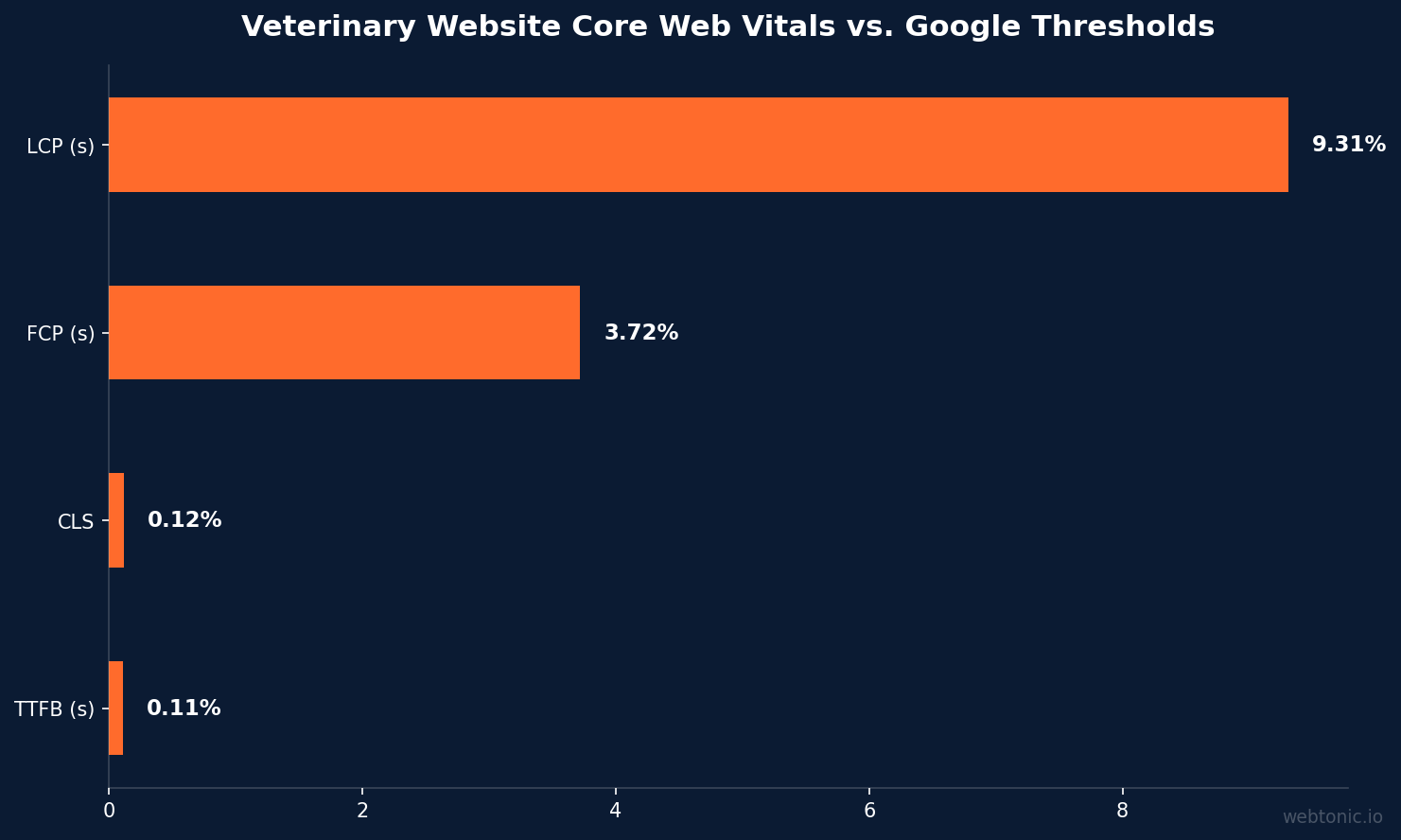
Borah Labs' July 2026 analysis of 267 U.S. veterinary websites reveals a significant performance gap between veterinary sites and Google's Core Web Vitals thresholds. Slow pages directly impact both search rankings and conversion rates — every additional second of load time reduces conversions by approximately 7%.
| Metric | Vet Average | Google Threshold | Gap |
|---|---|---|---|
| PageSpeed Score | 55/100 | ≥70/100 | −15 points |
| LCP | 9.31s | ≤2.5s | +6.81s |
| FCP | 3.72s | ≤1.8s | +1.92s |
| CLS | 0.12 | ≤0.10 | +0.02 |
| TTFB | 0.11s | ≤0.8s | ✓ Passing |
| SSL Adoption | 89.9% | 100% | −10.1% |
Source: Borah Labs — Veterinary Website Benchmarks, July 2026, 267 sites analyzed
While TTFB is the only metric where veterinary sites pass Google's threshold, the LCP gap of 6.81 seconds is severe. For context, a 9.31-second LCP means the average veterinary page takes nearly 10 seconds to render its main content — well beyond the point where most mobile users abandon the page. Sites running on WordPress (9.8% of the sample) often contribute to this slowdown through unoptimized plugins and themes.
SEO and Technical Readiness by Website Tier
iVET360's benchmark report segments veterinary websites into tiers based on marketing sophistication. The gap between entry-level and top-tier is staggering — and directly correlates with conversion performance.
| Feature | Entry-Level | Mid-Tier | Top-Tier |
|---|---|---|---|
| SEO Optimized | 0% | 15.2% | 95% |
| SSL Secure | 22.2% | 83.8%–99% | 100% |
| Google Analytics | 89.1% | 79.4%–96.2% | 100% |
| Schema Markup | 1.9% | 35%–44% | 100% |
| Meta Descriptions | 24.9% | 50%–71.3% | 95%+ |
| GTM Installed | 10.2% | 25%–40% | 85%+ |
Sources: iVET360 — 2025 Veterinary Marketing Benchmark Report, Borah Labs
The most striking data point is schema markup adoption: only 1.9% at entry level, climbing to 100% among top-tier practices. Schema markup helps search engines understand your services, location, and reviews — directly impacting local pack visibility where data intelligence meets practical SEO execution.
Mobile Experience and Online Booking Trends
With 72.4% of veterinary website traffic coming from mobile devices, the mobile landing page experience is the primary conversion pathway. Pet owners searching on their phones expect instant access to booking, directions, and contact information.
The shift toward online booking is accelerating. 58% of pet owners now prefer online booking over phone calls for routine appointments, and 27% explicitly prefer it as their primary scheduling method. For younger demographics (Gen Z and Millennial pet owners), online booking preference exceeds 70%.
Practices that integrate seamless online booking into their landing pages see conversion rates 2–3× higher than those relying solely on phone calls. The most effective mobile veterinary landing pages include:
- Click-to-call button above the fold (drives the 18.3% click-to-call rate)
- Embedded booking widget (eliminates the redirect friction that kills 30%+ of conversions)
- Google Reviews snippet (social proof that builds trust in under 2 seconds)
- Service-specific landing pages rather than generic homepage traffic
One veterinary practice redesign case study showed traffic increasing from 700 to 1,800 monthly visitors, with conversion rate jumping from 1.5% to 5.7% — producing 1,260 form submissions and 800 consultation bookings after implementing dedicated landing pages for paid campaigns.

Veterinary Website Technology Landscape
The technology stack running under veterinary websites directly impacts load times, security, and conversion potential. Borah Labs' analysis reveals a fragmented landscape dominated by jQuery (13.8%), PHP (10.3%), and WordPress (9.8%) — with significant gaps in modern performance tooling.
| Technology | Adoption Rate | Impact on Performance |
|---|---|---|
| jQuery | 13.8% | Adds 30–80KB; often unnecessary for modern sites |
| Google Analytics | 13.3% | Essential for conversion tracking |
| Google Tag Manager | 10.2% | Enables event tracking without code changes |
| WordPress | 9.8% | Plugin bloat major speed factor |
| Cloudflare | 8.8% | CDN + security; improves TTFB |
| HTTP/3 | 8.0% | Faster connections on mobile |
Source: Borah Labs, July 2026
A notable gap: only 10.2% of veterinary sites use Google Tag Manager, meaning nearly 90% lack the infrastructure for proper conversion event tracking. Without GTM, practices cannot accurately attribute bookings to specific landing pages or ad creative variations — making optimization decisions essentially guesswork.
Landing Page Optimization Best Practices for Veterinary Clinics
- Build service-specific landing pages — generic homepages convert at 4.2% while targeted service pages reach 10.5%+; create dedicated pages for dental, emergency, wellness, and new patient offers.
- Fix LCP below 2.5 seconds — compress hero images to WebP, lazy-load below-fold content, and eliminate render-blocking JavaScript; the average vet site's 9.31s LCP is losing over half its mobile visitors.
- Make click-to-call impossible to miss — sticky mobile headers with phone buttons drive the 18.3% click-to-call rate; test button color, size, and "Call Now" vs. "Book Appointment" copy.
- Add schema markup immediately — only 35%–44% of veterinary sites have it; LocalBusiness + VeterinaryCare schema improves local pack visibility and rich snippet eligibility.
- Embed online booking — 58% of pet owners prefer online booking; embedded widgets (Vetstoria, PetDesk) convert 2–3× better than redirect-based booking flows.
- Install SSL if you haven't — 10.1% of veterinary sites still lack SSL certificates; Chrome warns visitors away, killing trust before your page even loads.
- Set up Google Tag Manager + conversion tracking — only 10.2% of vet sites have GTM; without it, you cannot measure which landing pages and ads actually drive appointments.
- Display Google Reviews above the fold — social proof is the #1 trust signal for new patients choosing a veterinarian; aim for 50+ reviews with 4.5+ stars visible on the landing page.
Conversion Rate Optimization Tactics That Move the Needle
Beyond the baseline benchmarks, specific CRO tactics produce measurable lifts for veterinary landing pages. Adding a Google Reviews widget above the fold increases conversion rates by 12%–18% on average, according to conversion optimization case studies in healthcare verticals. For veterinary practices with 100+ reviews averaging 4.7+ stars, this social proof element alone can justify its page-weight cost.
Single-CTA landing pages outperform multi-CTA variants by 25%–35% for veterinary appointment booking. When a pet owner arrives on a landing page for "dog dental cleaning," the entire page should drive toward booking that specific service — not offer navigation to other services, blog posts, or team bios. This focused approach aligns with the 10.5% conversion rate achieved by targeted offer pages versus the 4.2% general website average.
Exit-intent popups recover 3%–5% of abandoning visitors when offering a specific incentive — such as "Free New Patient Exam" or "$25 Off First Visit." While aggressive popups can damage brand perception, a well-timed single popup on exit (with a 30-day cookie to prevent repeated displays) captures visitors who would otherwise leave without converting.
Form length optimization also matters significantly. Reducing form fields from 7+ to 3–4 (name, phone, pet type, preferred time) increases form completion rates by 40%–60%. Veterinary practices often over-collect information on landing page forms — detailed pet history, insurance information, and multi-paragraph symptom descriptions all belong in the intake process after the appointment is booked, not on the conversion form.
Online Booking Adoption and Its Impact on Landing Page Performance
The single biggest conversion rate lever for veterinary landing pages is the presence of online booking. 58% of pet owners now prefer online booking over phone calls for routine appointments, and that number climbs to 72% among pet owners under age 40. Yet only an estimated 35%–40% of veterinary practices currently offer integrated online booking on their websites.
This gap between consumer preference and provider availability creates a competitive advantage for early adopters. Practices with embedded booking widgets (Vetstoria, PetDesk, or direct EHR integrations) see landing page conversion rates 2–3× higher than those relying on phone calls as the sole booking method. The critical design element is embedding the booking flow directly on the landing page rather than redirecting to an external platform — the redirect step alone kills 30%+ of potential conversions.
After-hours booking is the overlooked conversion opportunity. Analysis shows that 35%–45% of veterinary booking requests occur outside standard business hours (before 8 AM and after 6 PM). Practices without online booking lose these prospects entirely, as most pet owners will not leave a voicemail — they simply search for the next clinic that accepts online appointments. A 24/7 online booking widget captures this demand without additional staffing costs.
The ROI calculation is straightforward: if a practice receives 200 monthly website visitors from paid ads and online booking lifts conversion from 4.2% to 10.5%, that is an increase from 8 to 21 appointments per month — 13 additional bookings worth approximately $1,300–$2,600 in first-visit revenue at an average new-patient exam value of $100–$200.
Frequently Asked Questions
What is a good conversion rate for a veterinary landing page?
The average veterinary website converts at 4.2%, while targeted landing pages with specific offers convert at 10.5%. Top-performing pages with embedded booking, social proof, and optimized mobile design can reach 15%–20%. The key differentiator is service-specific pages vs. generic clinic homepages.
How fast should a veterinary landing page load?
Google's threshold for Largest Contentful Paint is 2.5 seconds, but the average veterinary site takes 9.31 seconds. Pages loading in under 2.5 seconds see significantly lower bounce rates and higher conversion rates. Prioritize image compression, modern hosting, and eliminating render-blocking scripts to close this gap.
Do veterinary clinics need separate landing pages for Google Ads?
Yes — dedicated landing pages convert 2–3× higher than sending Google Ads traffic to your homepage. Each high-value service (emergency, dental, new patient exam, vaccines) should have its own optimized landing page with a matching headline, specific CTA, and relevant social proof. This also improves Google Ads Quality Score, reducing your CPC.
What percentage of veterinary websites use schema markup?
Only 35%–44% of veterinary websites implement schema markup, dropping to just 1.9% among entry-level sites. Schema markup helps Google understand your services, location, hours, and reviews — directly impacting local search visibility. Implementing LocalBusiness and VeterinaryCare schema is one of the fastest SEO wins available.
How important is mobile optimization for veterinary landing pages?
Critical — 72.4% of veterinary website traffic comes from mobile devices. Mobile-optimized pages with click-to-call buttons achieve 18.3% click-to-call rates, nearly double the industry average. With 58% of pet owners preferring online booking, a mobile-first landing page with embedded scheduling is now a competitive requirement.
Sources
cufinder.io
borahlabs.us
ivet360.com
stethondigitalmarketing.com
schedulingkit.com
americanpetproducts.org
worldmetrics.org
adlibrary.com


