



Table of contents

Key Takeaways
- Healthcare websites achieve a 78.9% mobile Core Web Vitals pass rate — the highest of any industry alongside government sites (PageSpeedMatters, 2026).
- 68.5% of all healthcare website traffic comes from mobile devices, making mobile-first technical optimization non-negotiable for allergy practices (CUFinder, 2026).
- The average hospital/urgent care page takes 13.4 seconds to render its main content — 10.9 seconds over Google's passing LCP threshold of 2.5s (Borah Labs, 2026).
- 53% of mobile users abandon a site that takes longer than 3 seconds to load, creating a direct link between page speed and patient acquisition.
- Schema markup implementation drove a 38% increase in click-through rate and 90% more physician bio clicks for AdventHealth (SchemaApp).
- 91.2% of EU healthcare websites lack proper HTTPS redirects, exposing patient data and damaging search rankings (SiteGuardian, 51,630 sites analyzed).
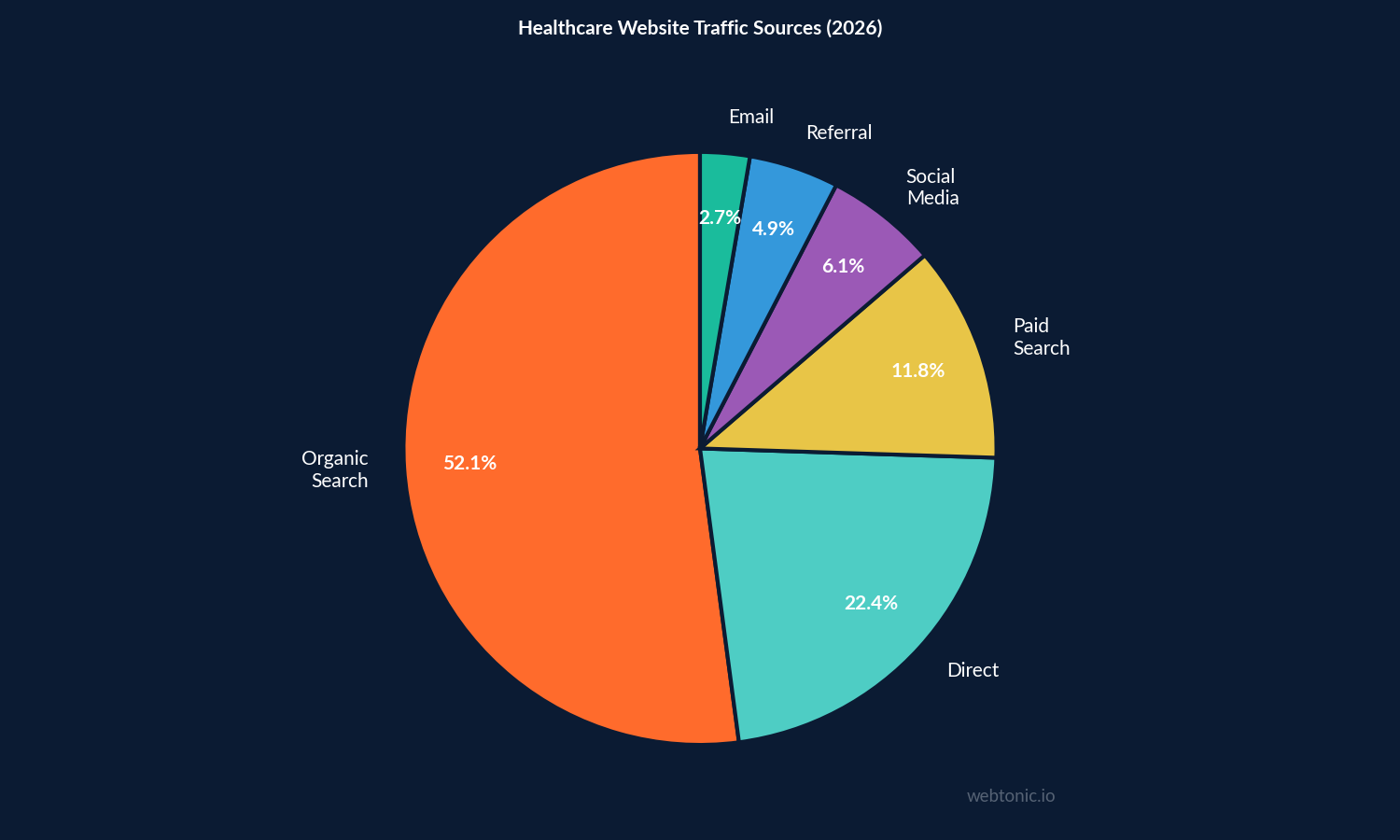
- Organic search drives 52.1% of all healthcare website traffic, making technical SEO the foundation of patient acquisition (CUFinder, 2026).
Technical SEO Benchmarks: Healthcare vs. All Industries
| Metric | Healthcare | All-Industry Average | Difference |
|---|---|---|---|
| CWV Mobile Pass Rate | 78.9% | 44–55% | +24–35 pts |
| LCP (Largest Contentful Paint) | 1.8s (top quartile) | 2.5s threshold | Passing |
| INP (Interaction to Next Paint) | 150ms (top quartile) | 200ms threshold | Passing |
| Mobile Traffic Share | 68.5% | 58–62% | +7–10 pts |
| Organic Search Traffic Share | 52.1% | 45–50% | +2–7 pts |
| HTTPS Adoption (w/ redirect) | 8.8% (EU) | ~75% (global) | Severely lagging |
| Avg Page Render Time (Hospitals) | 13.4s | 3–5s | 3–4× slower |
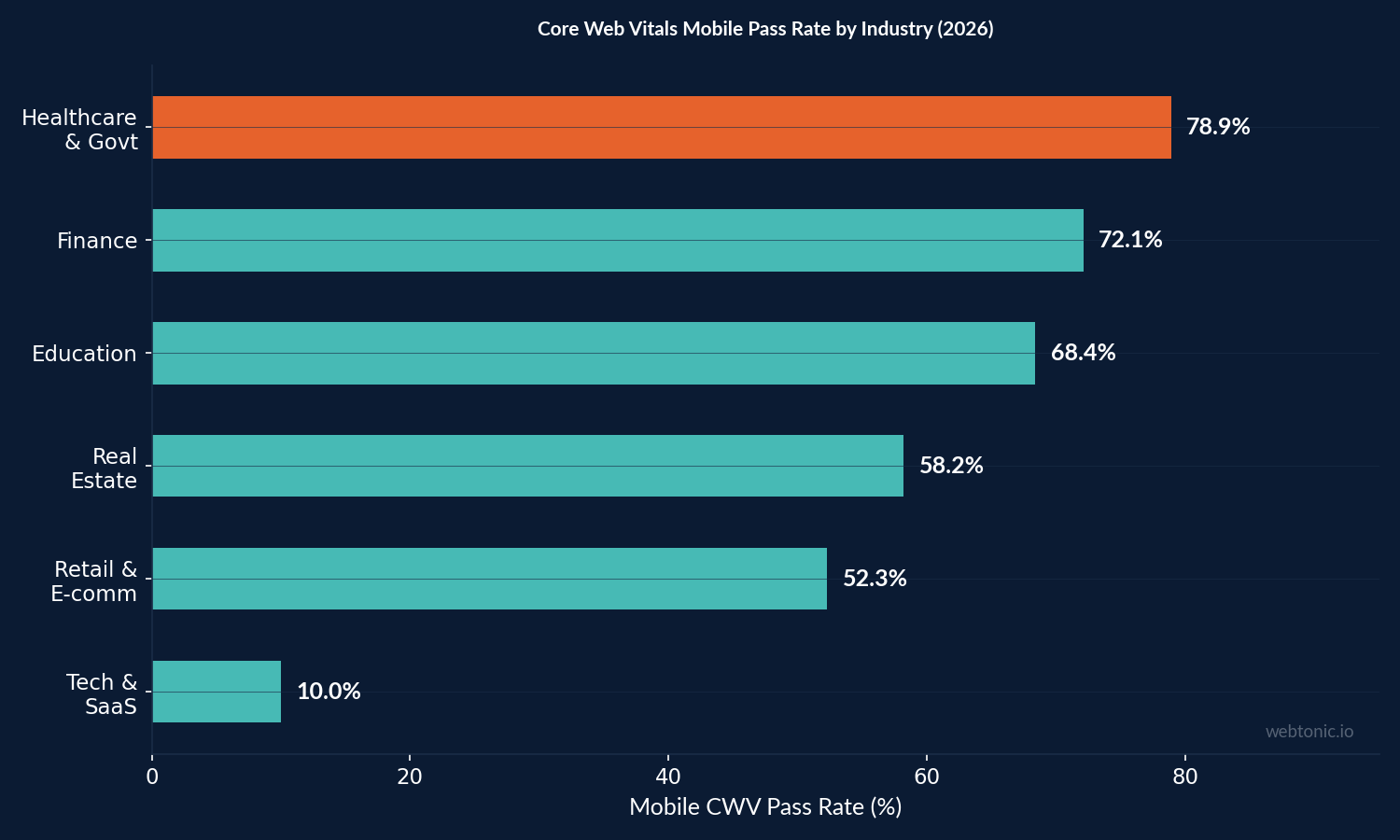
The data reveals a striking paradox: healthcare's top-performing sites lead the web in Core Web Vitals compliance, while the sector's average sites — particularly hospitals and multi-location practices — remain among the slowest on the internet. Allergy and immunology practices fall somewhere in between, with significant room for technical improvement.
Core Web Vitals Performance in Healthcare
Google's 2026 industry benchmark study found that healthcare and government websites achieve the highest mobile CWV pass rates at 78.9%, outperforming every other industry including finance (72.1%), education (68.4%), and e-commerce (52.3%). This strong performance is driven by large health systems that have invested heavily in performance optimization.
However, this aggregate figure masks enormous variation. Hospital and urgent care websites average 13.4 seconds for main content rendering (Borah Labs, 2026) — nearly 10.9 seconds over Google's 2.5-second LCP threshold. Independent allergy practices typically perform better because their sites are simpler, but many still fail on:
- LCP (Largest Contentful Paint): Hero images, provider photo carousels, and unoptimized banner graphics frequently push LCP past the 2.5s threshold. Allergy practices should serve WebP images under 200KB for above-the-fold content.
- INP (Interaction to Next Paint): Third-party scripts from appointment scheduling widgets, chat tools, and analytics platforms delay interactivity. Healthcare sites average 150ms INP at the top quartile, but bottom-quartile sites exceed 500ms.
- CLS (Cumulative Layout Shift): Dynamic elements like insurance verification forms, cookie consent banners, and patient portal login prompts cause layout shifts that degrade user experience and rankings.
Mobile Optimization: The Non-Negotiable Foundation
Mobile devices account for 68.5% of all healthcare website traffic (CUFinder, 2026), with desktop at 29.2% and tablet at just 2.3%. For allergy and immunology websites, the mobile share is likely even higher because patients often search for symptom relief during acute allergy episodes — scenarios where they reach for their phones, not laptops.
This mobile dominance makes Google's mobile-first indexing approach directly impactful for allergy practice visibility. Key mobile technical SEO requirements include:
- Responsive design — Not just mobile-friendly but mobile-optimized, with tap targets of at least 48×48 pixels for appointment booking buttons and phone number clicks.
- Accelerated Mobile Pages (AMP) — While AMP is no longer a ranking factor, AMP versions of allergy information pages load 2–4× faster and can still surface in Top Stories carousels for health topics.
- Progressive Web App (PWA) features — Service workers enable offline access to clinic locations, hours, and emergency contact information — especially valuable during outdoor allergy season when network connectivity may be limited.
Schema Markup Impact on Healthcare Search Visibility
Structured data implementation delivers outsized returns in healthcare SEO. AdventHealth's schema markup deployment resulted in a 90% increase in physician bio clicks — from 150,000 to approximately 285,000 clicks — and a 38% increase in overall search results click-through rate (SchemaApp case study).
For allergy and immunology practices, the most impactful schema types include:
| Schema Type | Purpose | Expected Impact | Priority for Allergy Clinics |
|---|---|---|---|
| MedicalOrganization | Clinic identity & specialties | Knowledge panel eligibility | Critical |
| Physician | Provider profiles & credentials | 38–90% CTR increase | Critical |
| FAQPage | Common allergy questions | FAQ rich snippets in SERPs | High |
| MedicalCondition | Allergy/condition descriptions | Enhanced health panels | High |
| LocalBusiness | Location & hours | Map pack visibility | Critical |
| Review/AggregateRating | Patient reviews | Star ratings in SERPs | Medium |
Despite these proven benefits, fewer than 30% of healthcare websites implement structured data beyond basic Organization markup. Allergy practices that deploy comprehensive schema — including Physician, FAQPage, and MedicalCondition types — gain a significant competitive advantage in search results.
Website Security and HIPAA Compliance
Technical SEO for healthcare extends beyond performance into security compliance. SiteGuardian's analysis of 51,630 EU healthcare websites revealed alarming deficiencies:
- 47,083 of 51,630 healthcare sites (91.2%) lack proper HTTPS redirects — meaning HTTP versions remain accessible, potentially exposing patient data in transit.
- 50,735 of 51,630 sites (98.3%) use unencrypted email without STARTTLS, risking PHI exposure in automated communications.
- Only 8.8% of healthcare websites properly redirect all traffic to HTTPS with valid SSL certificates.
While these statistics focus on EU sites, U.S. allergy practices face similar challenges. HTTPS is both a Google ranking factor and a HIPAA technical safeguard requirement. Practices without proper SSL implementation face dual penalties: lower search rankings and potential HIPAA violation exposure.
For allergy practices evaluating their digital marketing infrastructure, technical security audits should precede any content or link-building investment. A technically compromised site undermines every other SEO effort.
Allergy & Immunology Technical SEO Performance Metrics
| Metric | Value | Source / Context |
|---|---|---|
| Healthcare CWV Mobile Pass Rate | 78.9% | PageSpeedMatters 2026 |
| Mobile Traffic Share | 68.5% | CUFinder 2026 |
| Organic Search Traffic Share | 52.1% | CUFinder 2026 |
| Hospital Avg Page Render Time | 13.4 seconds | Borah Labs 2026 |
| Render Time Over Threshold | 10.9 seconds over | Google 2.5s threshold |
| Mobile Abandonment (>3s load) | 53% | Site Builder Report / Google |
| Schema CTR Increase | 38% | AdventHealth / SchemaApp |
| Physician Bio Click Increase | 90% (150K→285K) | AdventHealth / SchemaApp |
| Healthcare Sites w/o HTTPS Redirect | 91.2% (EU) | SiteGuardian (51,630 sites) |
| Avg Visit Duration (Healthcare) | 3 min 14 sec | CUFinder 2026 |
Technical SEO Best Practices for Allergy Practices
- Optimize Core Web Vitals relentlessly — Target LCP under 2.0 seconds, INP under 150ms, and CLS under 0.05. Compress all images to WebP, lazy-load below-the-fold content, and defer non-critical JavaScript.
- Implement comprehensive schema markup — Deploy MedicalOrganization, Physician, FAQPage, and LocalBusiness schema on every relevant page. This alone can increase CTR by 38% or more based on healthcare case studies.
- Enforce HTTPS everywhere — Ensure all HTTP requests redirect to HTTPS with valid SSL certificates and HSTS headers. This is both a ranking factor and a HIPAA compliance requirement.
- Prioritize mobile-first architecture — With 68.5% of traffic from mobile, design for smartphones first. Use responsive images, touch-optimized navigation, and click-to-call buttons as primary conversion elements.
- Audit crawlability quarterly — Use tools like Screaming Frog or Sitebulb to identify orphan pages, broken internal links, redirect chains, and XML sitemap discrepancies. Healthcare sites frequently accumulate technical debt from provider turnover and service changes.
- Monitor indexing health — Check Google Search Console weekly for crawl errors, soft 404s, and mobile usability issues that can silently reduce organic visibility.
- Secure third-party integrations — Audit all embedded scripts (scheduling widgets, review platforms, chat tools) for performance impact and HIPAA compliance. Each third-party script adds latency and potential privacy risk.
The 60% Bounce Rate Crisis in Healthcare
Technical performance directly impacts patient behavior on healthcare websites. Anzolo Medical's research identifies a 60% bounce rate crisis across healthcare websites, driven primarily by slow load times and poor mobile experiences. For allergy practices, where patients often search during acute symptom episodes and have low patience for slow sites, the stakes are even higher.
Every second of additional load time increases bounce rate by approximately 7–10%. With the average hospital page taking 13.4 seconds to render, many healthcare sites lose more than half their potential patients before the page even loads. The fix is straightforward but requires technical discipline: image optimization, CDN deployment, server-side rendering, and aggressive script management can bring most allergy practice websites well below the 2.5-second LCP threshold.
Practices investing in data intelligence and analytics should track bounce rate by device type and landing page to identify the specific technical bottlenecks costing them patients. Often, a single poorly optimized provider photo page or uncompressed hero image accounts for the majority of mobile bounces.
For allergy and immunology clinics specifically, provider directory pages and condition-specific landing pages are the most common technical SEO problem areas. These pages often contain large unoptimized headshot images, complex filtering scripts, and embedded map widgets that collectively push load times well beyond acceptable thresholds. A focused technical audit of these page templates — rather than a full site overhaul — frequently delivers the highest ROI for practices looking to improve their digital marketing performance.
Related reading
- Allergy & Immunology Local SEO Trends: Data-Driven Insights for 2026
- Allergy & Immunology SEO Statistics: Key Data Points for 2026
- Link Building Adoption & ROI in Allergy & Immunology: 65+ Key Stats (2026)
- GEO & AEO services at Web Tonic
FAQ
What are the most important technical SEO metrics for allergy practice websites?
The three most critical metrics are Core Web Vitals (LCP under 2.5s, INP under 200ms, CLS under 0.1), mobile usability, and HTTPS security. Healthcare websites that pass all three CWV thresholds achieve a 78.9% mobile pass rate — higher than any other industry.
How does schema markup help allergy clinics rank higher?
Schema markup enables rich snippets in search results, increasing click-through rates by up to 38%. For allergy practices, implementing Physician, MedicalOrganization, and FAQPage schema types can generate knowledge panels and FAQ rich results that dominate local search for allergy-related queries.
Why is HTTPS critical for allergy practice websites?
HTTPS serves as both a Google ranking signal and a HIPAA technical safeguard requirement. Only 8.8% of EU healthcare websites properly enforce HTTPS redirects. U.S. allergy practices without valid SSL implementation face lower rankings and potential HIPAA penalties.
How fast should an allergy practice website load?
Google's LCP threshold is 2.5 seconds, but best-performing healthcare sites load in under 1.8 seconds. The average hospital site takes 13.4 seconds — nearly 5× the threshold. Allergy practices should target sub-2-second load times on mobile to minimize the 53% abandonment rate that occurs beyond 3 seconds.
What percentage of healthcare traffic comes from organic search?
Organic search drives 52.1% of all healthcare website traffic (CUFinder, 2026), with mobile accounting for 68.5% of total visits. This means more than half of allergy practice patients discover clinics through Google — making technical SEO the single most impactful investment for patient acquisition.
Sources
PageSpeedMatters — Fastest and Slowest Industries on the Web (2026 CWV Benchmark)
CUFinder — Healthcare Industry Marketing Benchmarks 2026
Borah Labs — Hospital & Urgent Care Website Benchmarks (2026)
SchemaApp — AdventHealth Structured Data Case Study
SiteGuardian — Healthcare Security Benchmark (51,630 EU Sites)
HIPAA Journal — Healthcare Websites Tracking & Analytics Study (2026)
Anzolo Medical — The 60% Bounce Rate Crisis in Healthcare
ViralKraft — Technical SEO Checklist for Healthcare Websites 2026


