Table of contents
Key Takeaways
- 46% of all Google searches have local intent, making local SEO the primary acquisition channel for veterinary practices competing for nearby pet owners.
- 42% of local searchers click the Google Map Pack, meaning practices outside the top three local results lose nearly half of all potential clicks.
- 80% of U.S. consumers search for local businesses weekly, and veterinary practices with incomplete Google Business Profiles miss these repeated discovery opportunities.
- 97% of consumers read online reviews before choosing a local business, and review volume is a top Google ranking signal for veterinary practices.
- 62% of consumers will avoid a business with incorrect information online, making NAP consistency a direct revenue factor.
- Practices in the Google Map Pack receive 2.1x more appointment requests than those ranking only in organic results, based on 34 veterinary audits.
- 72.4% of veterinary website traffic comes from mobile devices, making mobile optimization a non-negotiable local ranking factor.
Veterinary Local SEO Benchmarks at a Glance
| Local SEO Metric | Benchmark | Source |
|---|---|---|
| Google Searches with Local Intent | 46% | Google / Search Engine Roundtable |
| Consumers Searching Locally Weekly | 80% | SOCi Consumer Index, 2024 |
| Searches Using "Near Me" | 46% always/often | BrightLocal, 2025 |
| Consumers Using Google for Local Info | 72% | SOCi Consumer Index, 2024 |
| Map Pack Click Share | 42% | Backlinko, 2024 |
| Map Pack Appointment Lift | 2.1x more requests | Authority Specialist, 2026 |
| Mobile Traffic Share | 72.4% | CUFinder, 2026 |
| Click-to-Call Rate (Mobile) | 18.3% | CUFinder, 2026 |
| Consumers Reading Reviews | 97% | iVET360, 2026 |
| Avoid Business with Wrong Info | 62% | iVET360, 2026 |
How Pet Owners Find Veterinary Practices Locally
Local search is not a secondary channel for veterinary practices — it is the primary way pet owners discover and choose their veterinarian. According to iVET360's 2026 local SEO statistics report, 46% of all Google searches have local intent, and 80% of U.S. consumers search for local businesses on a weekly basis (SOCi Consumer Behavior Index, 2024).
The behavior patterns are clear: 46% of consumers "always" or "often" add "near me" to their searches (BrightLocal, 2025). For veterinary practices, this means queries like "vet near me," "emergency veterinarian near me," and "cat vet near me" represent the highest-converting search queries in the industry. Practices not optimized for near-me searches through a fully built Google Business Profile, accurate location data, and local keyword content are invisible to a massive share of their potential market.
Even word-of-mouth referrals now run through search: pet owners who receive a recommendation typically search the practice name before calling to check reviews, confirm hours, and validate the recommendation. This means online presence is part of the referral conversion process, not separate from it.
For practices investing in local visibility, understanding digital marketing costs across channels helps contextualize the value of organic local positioning versus paid alternatives.

Google Map Pack Performance Data for Veterinary Practices
The Google Map Pack — the three local business listings that appear at the top of search results for location-based queries — is the single most valuable piece of digital real estate for veterinary practices. According to Backlinko (2024), 42% of local searchers click the Map Pack. That captures nearly half of all clicks before a single organic result gets attention.
Authority Specialist's 2026 audit of 34 veterinary practices found that multi-location clinics in a top-three Google Maps position see 2.1x more new-client appointment requests than those ranking outside the local pack. The data also shows that organic search drives 58–67% of new pet owner discovery in suburban and mid-size metro markets.
Google determines Map Pack rankings using three primary factors:
- Relevance — Does the practice match what the searcher is looking for? Service pages, accurate categories, and detailed business descriptions improve relevance signals.
- Proximity — How close is the practice to the searcher's current location? This is largely outside a practice's control but affects which competitors appear.
- Prominence — How established and trusted is the practice online? Review volume, backlink authority, citation consistency, and brand search volume all feed this signal.
According to Visible Vet's 2026 analysis of Google Maps ranking for vet clinics, 66% of consumers search local businesses on Google Maps, and the platform serves as both a discovery and navigation tool — pet owners often call or request directions directly from the Map Pack listing without visiting the practice website at all.
Online Reviews and Their Impact on Veterinary Local Rankings
Reviews are not just social proof — they are a direct ranking signal in Google's local algorithm. The iVET360 2026 report presents compelling data on review influence for veterinary practices:
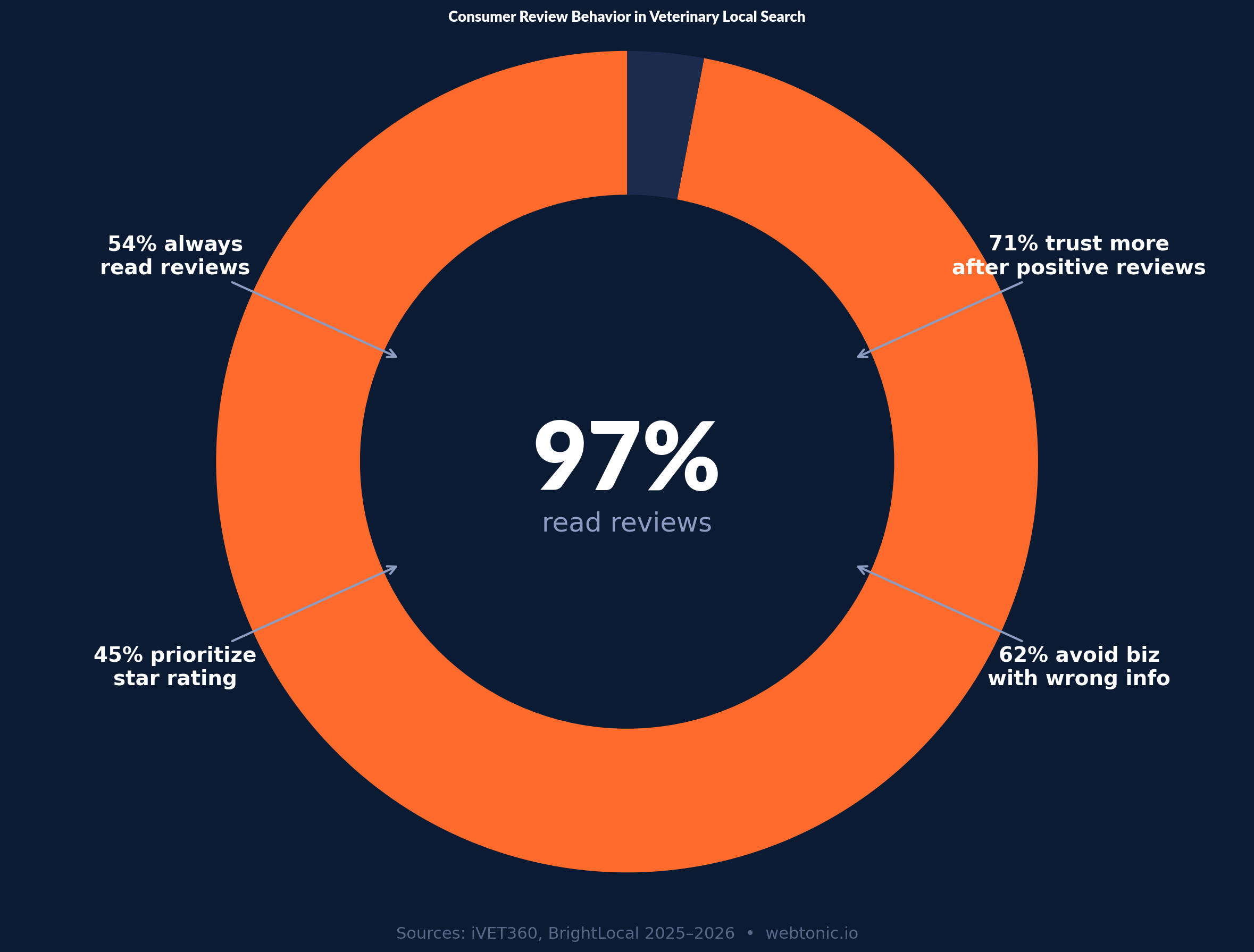
- 97% of consumers read online reviews before choosing a local business
- 54% of consumers "always" read reviews before making a decision
- 71% of consumers will trust a business more after reading positive reviews
- 45% of consumers consider star rating a top factor when evaluating local businesses
For veterinary practices specifically, review recency matters as much as volume. Authority Specialist's 2026 benchmarks note that practices with a consistent stream of recent reviews tend to hold Map Pack positions more reliably than those with a larger but older review profile. A practice with 40 reviews from the past six months typically outperforms one with 200 reviews that are mostly three years old.
Practices with fewer than 40 Google reviews and incomplete GBP profiles consistently underperform on branded and emergency-intent queries. The correlation between review volume, recency, and local ranking position is one of the strongest signals in veterinary local SEO.
Review Benchmarks for Veterinary Practices
| Review Metric | Benchmark | Impact |
|---|---|---|
| Consumers Reading Reviews | 97% | Near-universal influence on local decisions |
| Star Rating as Top Factor | 45% | Below 4.0 stars significantly reduces clicks |
| Trust After Positive Reviews | 71% | Directly increases call and booking rates |
| Minimum Reviews for Map Pack | ~40 recent | Threshold for consistent local visibility |
| Client Retention Rate | 78% annual | Retained clients leave repeat reviews |
NAP Consistency and Citation Management
Name, address, and phone number (NAP) consistency across online directories is a foundational local SEO signal. The data makes the business case clear: 62% of consumers will avoid a business if they find incorrect information online, and practices with consistent citation profiles generate 2.7x more calls than those with NAP inconsistencies (iVET360, 2026).
For veterinary practices, citation management extends beyond the obvious directories. Key platforms include Google Business Profile, Yelp, Facebook, Apple Maps, and veterinary-specific directories like the AVMA vet finder. Data aggregators such as Foursquare and Data Axle distribute NAP data to hundreds of smaller directories, making accuracy at the aggregator level critical.
The iVET360 benchmark report also found that 70% of consumers said inaccurate business information made them lose trust in a local business. For a veterinary practice where trust is the foundation of the client relationship, a wrong phone number or outdated address on a directory listing can cost more than lost traffic — it damages the practice reputation before a pet owner ever calls.
Practices aiming to improve their data-driven marketing should start with a citation audit across the top 50 local directories.
Mobile Search and Local Veterinary Discovery
Mobile devices drive 72.4% of veterinary website traffic (CUFinder, 2026), making mobile optimization a non-negotiable factor in local search performance. The urgency of veterinary queries — a pet emergency, an after-hours search, a quick check of clinic hours — means the majority of searches happen on smartphones.
Key mobile benchmarks for veterinary practices:
- Click-to-call rate (mobile): 18.3% — nearly one in five mobile visitors calls the practice directly
- Average session duration: 2 minutes 18 seconds — pet owners make fast decisions on mobile
- Average bounce rate: 54.8% — many visitors find the phone number and leave (a successful visit, not a failure)
- Pages per session: 2.4 — concise navigation drives engagement
The Borah Labs 2026 audit found that the average veterinary website has a Largest Contentful Paint of 9.31 seconds — nearly four times Google's 2.5-second threshold. Only 5.2% of veterinary sites score 90 or above on PageSpeed. For mobile users with urgent veterinary needs, these delays directly translate to lost appointments and calls to faster-loading competitors.
Mobile-first design is not just a technical SEO consideration — it is a revenue variable that complements paid marketing efforts by ensuring landing page experience matches user expectations.
AI Visibility and the Evolution of Local Veterinary Search
AI-powered search is reshaping how pet owners discover veterinary practices. The iVET360 2026 report highlights several emerging trends that local SEO strategies must account for:
- 45% of searches now trigger AI Overviews in some markets, pulling answers directly from web content before users click any result
- AI models rarely name specific providers — only 17% of AI responses mention specific healthcare providers by name (Authority Specialist AI Study, 2026)
- 57.8% AI Recommendation Index — AI assistants recommend hiring a veterinarian in 57.8% of pet health queries, compared to a 44.2% average across 14 industries
- 94% of practice websites are not optimized for AI citations according to iVET360's analysis
The Authority Specialist AI study also revealed significant variation by model: ChatGPT recommends hiring a vet in 67% of responses, Claude in 60%, and Gemini in just 47%. This variance means practices cannot rely on a single AI platform for visibility.
For veterinary practices, optimizing for AI visibility requires structured data (JSON-LD schema), comprehensive service pages, and authoritative content that AI models can cite. With only 64.6% of veterinary sites publishing structured data (Borah Labs, 2026), early adopters of AI-optimized marketing strategies have a significant competitive window.
Local SEO Timeline Expectations for Veterinary Practices
| Market Size | Map Pack Entry | Organic Traffic Growth | Monthly Investment |
|---|---|---|---|
| Small (< 100K pop.) | 3–5 months | 4–6 months | $800–$1,500 |
| Mid-size | 4–7 months | 5–8 months | $1,500–$2,500 |
| Major Metro | 6–12 months | 8–12 months | $2,500–$3,500 |
Source: Authority Specialist campaign observations, 2026. Timelines assume consistent monthly work and no major technical issues. Practices with corporate veterinary competitors (VCA, Banfield, BluePearl) should plan for the longer end of each range.
FAQ
What is the most important local SEO factor for veterinary practices?
Google Business Profile optimization is the single most impactful local SEO factor. This includes accurate business information, complete service categories, regular Google Posts, photo uploads, and active review management. Practices with complete GBP profiles are far more likely to appear in the Map Pack, which captures 42% of all local search clicks.
How many Google reviews does a veterinary practice need to rank in the Map Pack?
There is no fixed number, but Authority Specialist's 2026 data shows that practices with fewer than 40 recent Google reviews consistently underperform on local queries. Review recency matters more than volume — 40 reviews from the past six months typically outperform 200 reviews that are mostly years old. Aim for a steady stream of 4–6 new reviews per month.
How does mobile optimization affect veterinary local SEO?
With 72.4% of veterinary website traffic coming from mobile devices and a click-to-call rate of 18.3%, mobile optimization directly impacts both rankings and conversions. The average veterinary site loads its main content in 9.31 seconds — nearly 4x slower than Google's threshold. Faster-loading mobile sites rank higher and convert more callers.
Should veterinary practices invest in local SEO or Google Ads?
Both channels serve different purposes. Google Ads deliver immediate visibility with a veterinary CPC of $3.45 and 12.6% conversion rate (CUFinder, 2026), while local SEO builds compounding organic traffic over 3–12 months. Practices typically see the best results running both simultaneously — ads for immediate patient flow, and local SEO for long-term dominance.
How does AI search affect veterinary local SEO?
AI Overviews now appear in 45% of local searches in some markets. AI models recommend hiring a veterinarian in 57.8% of pet health queries, but only 17% of responses name specific providers. Practices with structured data, comprehensive service pages, and authoritative local content are better positioned to be cited by AI assistants.
Sources
ivet360.com — Local SEO Stats for Veterinary Practices 2026
authorityspecialist.com — Veterinary SEO Benchmarks 2026
cufinder.io/blog/benchmarks/veterinarians
visiblevet.com — Google Maps Ranking for Vet Clinics
borahlabs.us/insights/veterinary
stethondigitalmarketing.com — 100+ Veterinary Marketing Statistics
authorityspecialist.com — Veterinary SEO ROI