Table of contents

As of July 2026 the most popular keyword on Google is "chatgpt" at roughly 94.6 million US searches a month. Knowing that is entertaining; knowing which popular keywords you can actually win, and how to spot the next one early, is the useful part.
Key Takeaways
- The top 6 US searches are chatgpt (94.6M), youtube (86.1M), amazon (85.8M), gmail (58.0M), wordle (45.9M) and facebook (41.9M) — all navigational.
- Roughly 9 of the top 10 highest-volume keywords are brand or tool names, so the biggest search volume is almost never available to a challenger site.
- Google Trends does not report search volume. It reports a relative index scaled 0 to 100 against total searches for that place and period.
- Trends filters out low-volume terms (shown as 0), repeated searches from one person, queries with apostrophes, and internal searches made by AI Mode and AI Overviews.
- Ahrefs' keyword database holds 28.7 billion keywords; the useful subset for any site is usually a few hundred.
- Use a 3-signal test — trend direction, intent match, and ranking feasibility — before adding any popular keyword to a content plan.
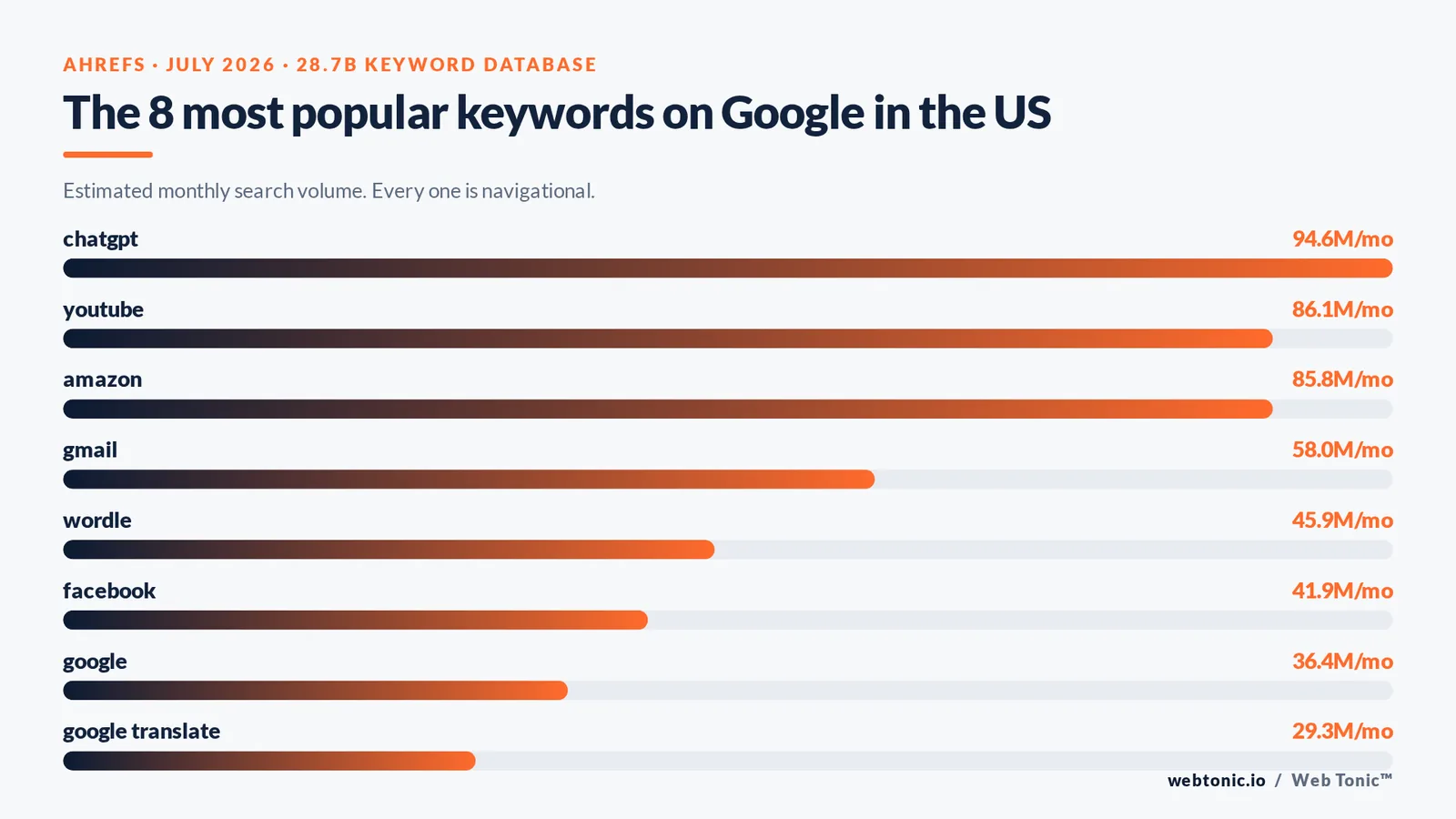
The most popular keywords on Google right now
These are the highest monthly search volume keywords in the United States as reported by Ahrefs' top Google searches study, refreshed July 2026 from a database of 28.7 billion keywords.
| Rank | Keyword | US monthly search volume | Search intent |
|---|---|---|---|
| 1 | chatgpt | 94,610,000 | Navigational |
| 2 | youtube | 86,140,000 | Navigational |
| 3 | amazon | 85,770,000 | Navigational |
| 4 | gmail | 58,010,000 | Navigational |
| 5 | wordle | 45,910,000 | Navigational |
| 6 | 41,890,000 | Navigational | |
| 7 | 36,380,000 | Navigational | |
| 8 | google translate | 29,260,000 | Navigational / tool |
| 9 | weather | 25,900,000 | Informational |
| 10 | walmart | 25,510,000 | Navigational |
| 11 | canva | 24,400,000 | Navigational / tool |
| 12 | nfl | 24,390,000 | Informational |
| 13 | calculator | 21,000,000 | Tool |
| 14 | google docs | 18,730,000 | Navigational |
| 15 | home depot | 17,620,000 | Navigational |
Fact 1 — the head of the curve is a brand directory. Of the 15 most popular searches above, 12 are brand or product names and 2 more are utilities Google answers itself. The practical lesson: the top of the list tells you what people use, not where the opportunity is.
Worldwide the same pattern holds with local variation — Flipkart, cricket fixtures, "météo", "pogoda" and "天気" all appear in the global top 100, which is why country-level lists matter more than global ones when you are planning content.
Why the most popular keywords are the worst content targets
High volume attracts attention and hides three problems: intent, feasibility and value. Run every popular keyword through this filter before it reaches a brief.
| Problem | What it looks like | Diagnostic question | Better move |
|---|---|---|---|
| Navigational intent | People want one specific site, not information | Does the SERP show a single dominant destination? | Target the modifier variants instead |
| Answered on the page | Google returns a widget: weather, calculator, translation | Is there an instant answer above the results? | Skip; clicks are structurally unavailable |
| Ranking infeasibility | Difficulty far above the site's link profile | Are the top 10 all household-name domains? | Take the long tail with the same intent |
| No commercial value | Traffic never touches a buying decision | Can I name the next step a visitor takes? | Trade volume for intent depth |
| Seasonal collapse | Huge annual volume concentrated in 3 weeks | Does the 5-year trend line spike and flatten? | Publish 8-10 weeks before the ramp |
| Fad decay | Vertical rise, no repeat pattern | Has interest held above baseline for 2+ quarters? | Cover it in news format, not evergreen |
Google's own guidance on creating helpful, people-first content is explicit that chasing search traffic without something useful to say is a losing strategy. Our guide to SEO keywords covers the research process end to end; this page is about the popularity data itself.
How to find trending keywords on Google
Google Trends is the primary free source for direction of travel, and it is widely misread. It never shows monthly search volume. Each data point is divided by the total searches for that geography and time range, then scaled 0 to 100 against the topic's share of all searches, per Google's Trends data FAQ.
| Trends feature | What it answers | How to read it | Trap |
|---|---|---|---|
| Interest over time | Is demand rising, flat or seasonal? | Use 5 years for seasonality, 90 days for momentum | Reading the index as volume |
| Compare terms | Which of 2-5 phrasings people actually use | Compare within one country and period | Comparing across regions with different totals |
| Related queries — rising | Which specific searches are accelerating | "Breakout" means growth above 5,000% | Rising terms with no repeat pattern |
| Trending now | Today's spikes by country | Use for newsjacking within 24-48 hours | Building evergreen pages on a one-day spike |
| By region and city | Where the demand concentrates | Sort sub-regions for local campaigns | Small samples looking like real differences |
| Category filter | Disambiguates homonyms | Filter before comparing anything ambiguous | "Jaguar" without a category filter |
Four filtering rules matter when you interpret the output, all documented by Google: terms searched by very few people appear as 0; repeated searches by the same person in a short period are removed; queries containing apostrophes and special characters are filtered; and internal searches made by Google products, including AI Mode and AI Overviews, are excluded. Small random noise is also injected for privacy, which is most visible on low-interest queries. Start at Google Trends and the Trending Now feed; Google's Trends help centre explains each report.
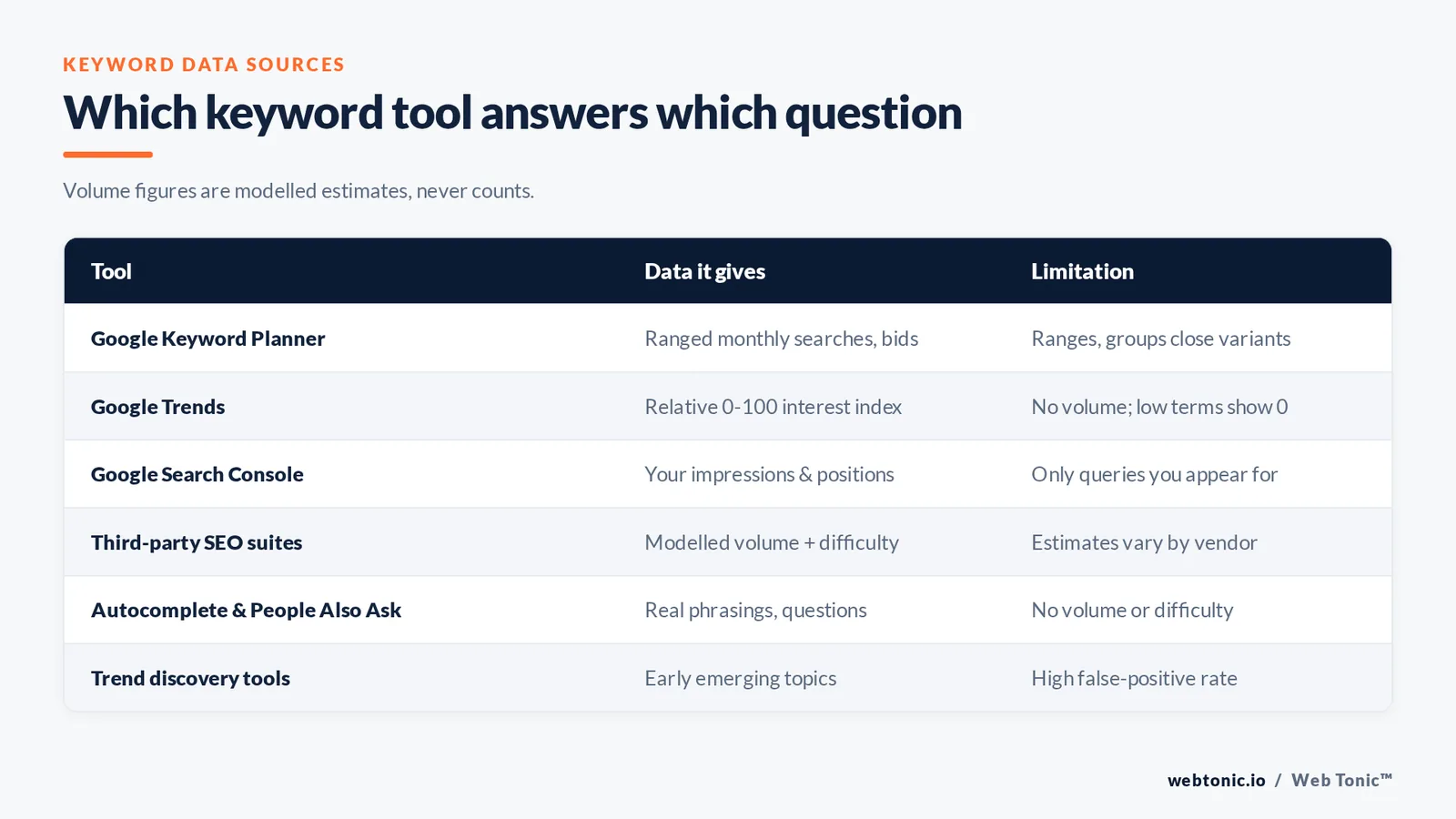
Keyword tools compared: which numbers to trust
Popular keyword data comes from three different kinds of source, and they disagree by design. Volume figures are modelled estimates, not counts.
| Tool | Data it gives | Cost | Best use | Limitation |
|---|---|---|---|---|
| Google Keyword Planner | Average monthly searches in ranges, competition, top-of-page bid | Free with a Google Ads account | Paid search planning and CPC reality checks | Ranges rather than exact figures; groups close variants |
| Google Trends | Relative interest index, rising queries, geography | Free | Direction, seasonality, term choice | No volume; filters low-interest terms to 0 |
| Google Search Console | Your own impressions, clicks, position by query | Free | Finding popular keywords you already almost rank for | Only queries you already appear for |
| Third-party SEO suites | Modelled volume, keyword difficulty, traffic potential, parent topic | Paid | Scale research and competitor gap analysis | Estimates vary between vendors on the same term |
| Autocomplete and People Also Ask | Real phrasings and question variants | Free | Long tail keyword discovery and subheadings | No volume or difficulty attached |
| Trend discovery tools | Early-stage topics before suites price them in | Freemium | Spotting emerging demand | High false-positive rate on fads |
Rule 2 — never plan from one tool. Cross-check a shortlist in Google's Keyword Planner documentation workflow, confirm direction in Trends, and validate feasibility with a difficulty metric such as Ahrefs' keyword difficulty explainer. Free discovery tools such as Exploding Topics are useful for the earliest signals, and StatCounter's search engine market share data is the reference for how much of the market a Google-only view represents.
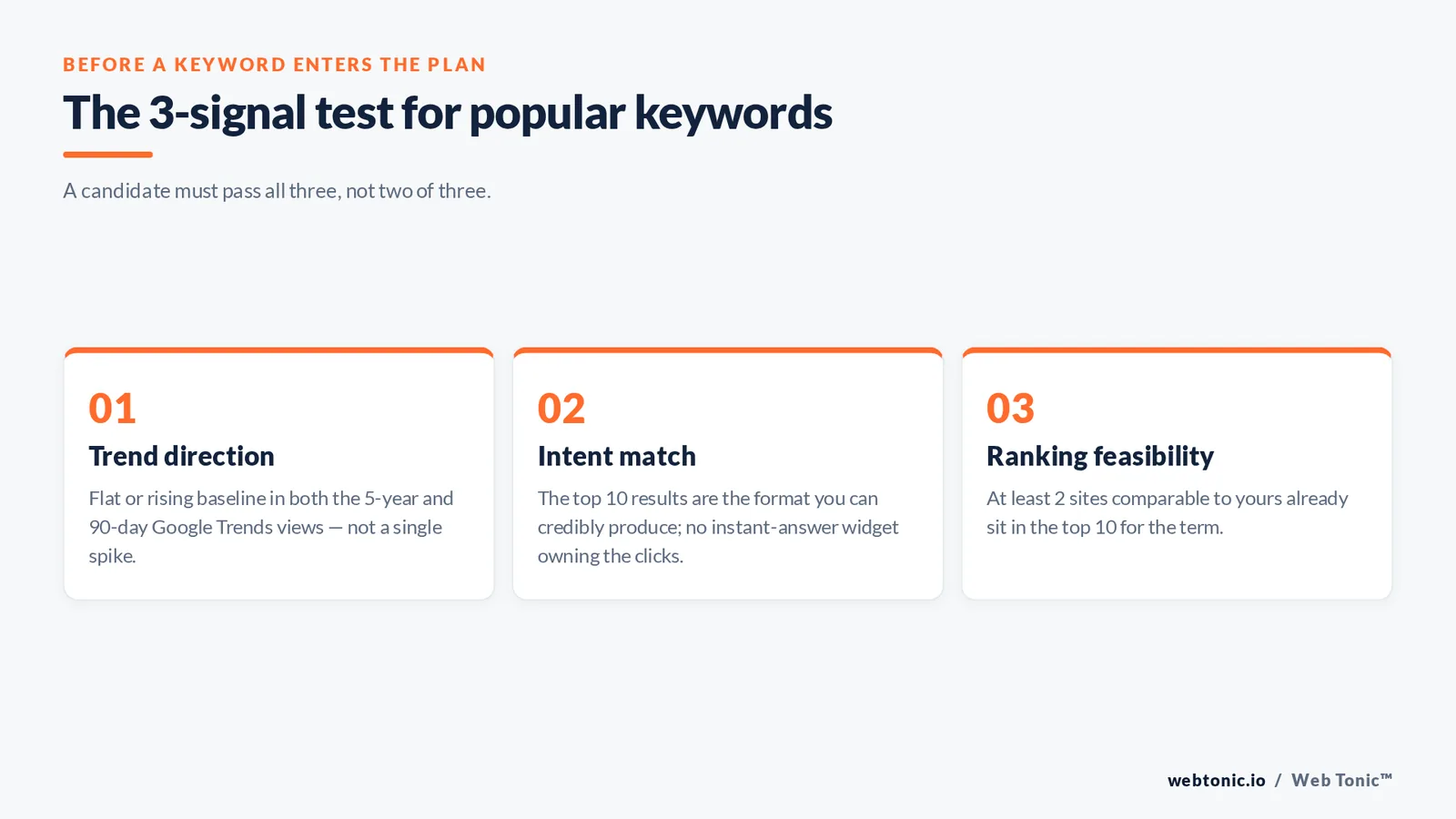
The 3-signal test for adding a popular keyword to your plan
Volume alone is a vanity metric. Score each candidate on three signals and only build for terms that pass all three.
| Signal | Source | Pass condition | If it fails |
|---|---|---|---|
| 1. Trend direction | Google Trends, 5-year and 90-day views | Flat or rising baseline, not a single spike | Cover as news, not as an evergreen page |
| 2. Intent match | Manual SERP review of the top 10 | Results are the format you can credibly make | Reframe to a variant you can serve |
| 3. Ranking feasibility | Difficulty metric plus your existing authority | At least 2 comparable sites in the top 10 | Take the long tail cluster instead |
Limit 3 — no more than 20% of a content plan should target head terms. A durable split is roughly 20% head, 30% mid-tail, 50% long tail, because long tail keywords convert closer to the decision and compound faster. Our long tail keyword guide shows how to build those clusters, and Moz's keyword research chapter is a solid primer on the underlying model.
How often popular keywords change, and how to keep up
Different layers of the list move at very different speeds, and your review cadence should match the layer you care about.
| Layer | Typical churn | Review cadence | What to do with it |
|---|---|---|---|
| Top 20 navigational terms | Years; new entrants only after platform shifts | Annually | Context only; not a target list |
| Category head terms | Slow drift in phrasing over 12-24 months | Twice a year | Refresh titles and headings to current phrasing |
| Seasonal peaks | Predictable annual cycle | Quarterly, 8-10 weeks ahead of each peak | Update and re-promote existing pages |
| Rising queries | Weeks | Monthly | Add sections to existing pages first |
| Trending now spikes | Hours to days | Only when you have a real angle | Social or news post, never a new evergreen URL |
| Your own near-miss queries | Continuous | Monthly in Search Console | Optimise pages ranking positions 5-20 |
Fact 4 — the fastest wins are already in your own data. Queries where you sit in positions 5 to 20 with meaningful impressions usually beat any new page built for a popular keyword, because the intent match is already proven.
A 6-step workflow to turn popular keywords into published pages
- Step 1 — pull a raw list of 200-500 candidates from a keyword tool, autocomplete, People Also Ask and your Search Console queries.
- Step 2 — group by intent into informational, commercial, navigational and transactional buckets; discard navigational terms owned by other brands.
- Step 3 — check direction in Trends for the 20-30 survivors, using both the 5-year and 90-day views.
- Step 4 — apply the 3-signal test and keep only terms passing all three.
- Step 5 — cluster into pages, one page per intent rather than one page per keyword, with the head term as the title and the variants as headings.
- Step 6 — set a review date per page based on its churn layer, and re-check position and impressions at that date.
For a working example of how the metrics behave once pages are live, see our organic keywords guide, and Ahrefs' keyword research walkthrough for the tool mechanics. If you would rather have this run for you, that is what our growth marketing team does.
7 mistakes that waste a popular-keyword list
| Mistake | Why it happens | The fix |
|---|---|---|
| Treating the Trends index as volume | The 0-100 scale looks like a percentage | Pair Trends with a volume estimate from a keyword tool |
| Building pages for brand searches | The volume is irresistible | Target comparison and alternative variants instead |
| Ignoring zero-click SERPs | Volume is visible, click share is not | Manually inspect the SERP before committing |
| One page per keyword | Spreadsheets encourage it | Cluster by intent; one page can serve 30+ variants |
| Publishing seasonal content late | Planning starts when demand appears | Publish 8-10 weeks before the historical ramp |
| Chasing every breakout term | Rising queries feel urgent | Require 2+ quarters above baseline for evergreen pages |
| Never revisiting the list | Research is treated as a one-off project | Set a churn-based review cadence per page |
Trap 5 — the 90-day view flatters everything. Any term looks like it is rising if you only look at a quarter. Always open the 5-year view before you call something a trend. Need a second pair of eyes on a keyword plan? Talk to us.
FAQ
What are the most popular keywords right now?
In the United States as of July 2026, the most searched keywords are chatgpt (94.6M/mo), youtube (86.1M), amazon (85.8M), gmail (58.0M), wordle (45.9M) and facebook (41.9M), according to Ahrefs' database of 28.7 billion keywords. Almost all top-20 terms are navigational brand or tool searches, so the list is best used as market context rather than as a target list.
How can I find trending keywords on Google?
Use Google Trends for direction: the "rising" related queries report surfaces accelerating searches, and Trending Now shows today's spikes by country. Cross-check anything promising against a keyword tool for volume and difficulty, and require at least two quarters of interest above baseline before you build an evergreen page around it.
Which tools provide reliable keyword volume and trend data?
Google Keyword Planner gives ranged average monthly searches and top-of-page bids free with a Google Ads account; Google Search Console gives your own real impressions and positions; Google Trends gives relative interest but no volume. Third-party suites add modelled volume, keyword difficulty and traffic potential — useful at scale, but the numbers are estimates and vary between vendors.
Does Google Trends show actual search volume?
No. Each data point is divided by the total searches for its geography and time range, then scaled 0 to 100 based on the topic's share of all searches. Terms with very low volume appear as 0, duplicate searches from one person are removed, queries with apostrophes are filtered, and internal searches from Google products such as AI Mode and AI Overviews are excluded.
How often do popular keywords change?
The top navigational terms barely move from year to year, category head terms drift in phrasing over 12 to 24 months, seasonal peaks repeat annually, and rising queries turn over in weeks. Match your review cadence to the layer: annual for the head, twice yearly for category terms, quarterly for seasonal pages, monthly for your own near-miss queries in Search Console.
Sources
Ahrefs, Top Google Searches (July 2026) and keyword research and keyword difficulty guides · Google, Trends Help — FAQ about Google Trends data · Google Trends and Trending Now · Google Ads Help, Keyword Planner documentation · Google Search Central, Creating helpful, reliable, people-first content · Moz, Beginner's Guide to SEO keyword research chapter · Exploding Topics · StatCounter Global Stats, search engine market share. Volume figures are modelled estimates as reported by each source; last reviewed August 2026.