Table of contents
The meta keywords tag is an HTML <meta> element in a page's <head> that lists target keywords for search engines. Google has ignored it since 2009, and no major Western search engine uses it as a ranking signal today.
Key Takeaways
- 0 of the 4 largest Western search engines use the keywords meta tag as a ranking factor.
- Google confirmed it publicly in September 2009 and has never reversed that position.
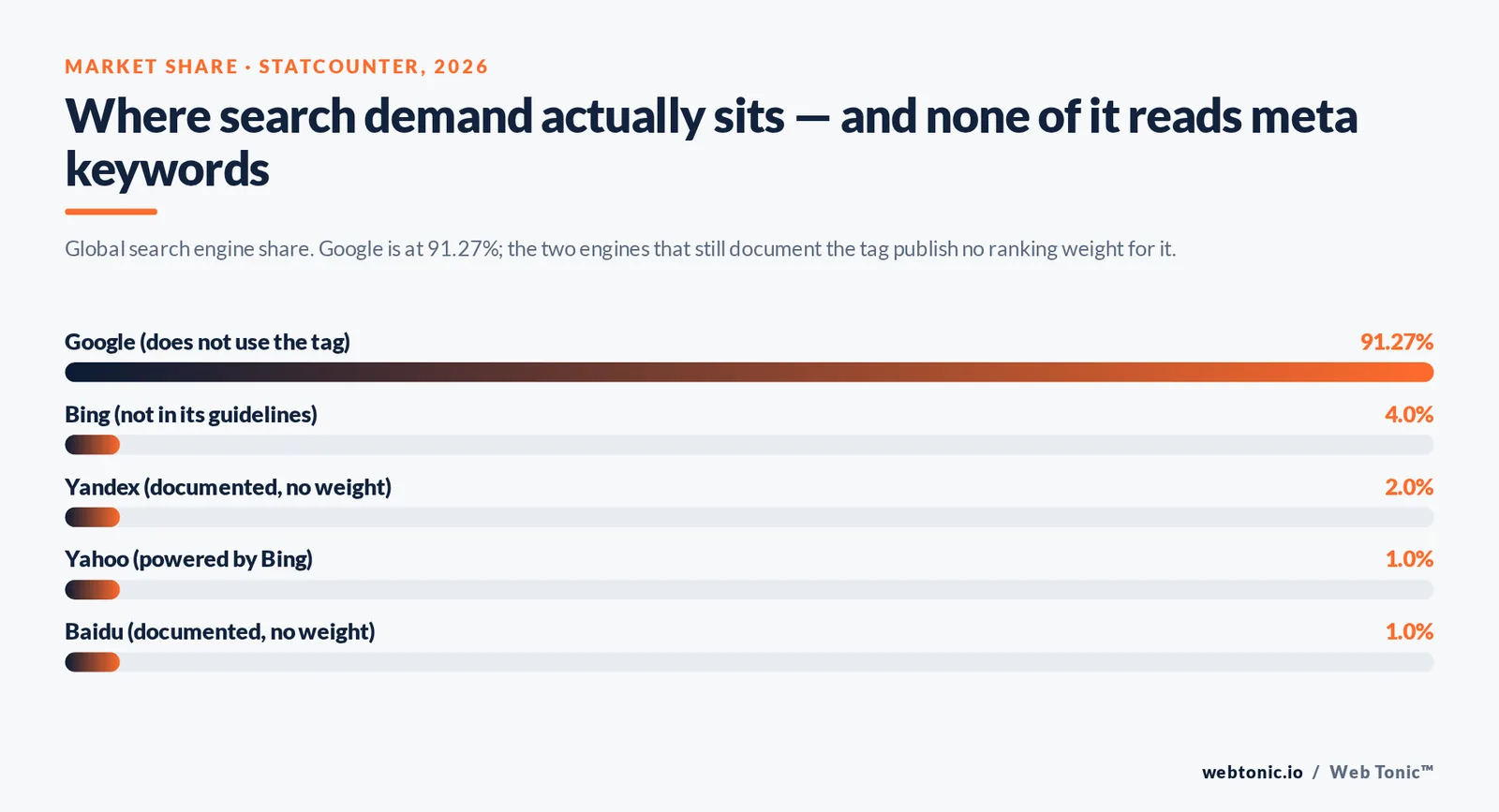
- Google handles roughly 91.27% of global search traffic, so ignoring the tag is effectively an industry-wide default.
- Only 4 meta tags reliably change how a page appears or behaves in search: title, description, robots and viewport.
- Leaving a keyword list in your source code hands competitors a free copy of your keyword strategy.
- Removing the tag site-wide is usually a 1-line template change, not a migration.
What the meta keywords tag actually is
The keywords meta tag is one of the original name/content metadata pairs defined for HTML documents. Its syntax has never changed:
<meta name="keywords" content="running shoes, trail shoes, marathon shoes">
It sits in the <head> alongside the title tag, the meta description and the viewport meta tag. The HTML specification still permits arbitrary name values, and MDN's reference for meta names documents keywords as a legacy, non-standardised value. Rule 1 — valid HTML is not the same as a useful signal. The tag renders nothing, breaks nothing and does nothing.
The idea made sense in the mid-1990s. Early search engine algorithms had little content to work with and few links to weigh, so authors were asked to declare their own topics. That trust was abused within a couple of years by keyword stuffing, and the major search engines dropped it. Modern crawlers infer topic from the page itself: headings, body copy, internal anchors, structured data and site context, all described in Google's SEO starter guide.
Which search engines use the keywords meta tag in 2026
| Search engine | Uses keywords meta tag? | What the documentation says | Share of search |
|---|---|---|---|
| No | Publicly confirmed in 2009; the tag is absent from Google's valid page metadata list | ~91% | |
| Bing | No | Webmaster guidelines describe content, titles and links as the signals; keywords is not among them | ~4% |
| Yahoo | No | Results are powered by Bing, so it inherits Bing's handling | ~1% |
| DuckDuckGo | No | Relies on its own crawler plus Bing results; no keywords support documented | <1% |
| Yandex | Documented, no published weight | Webmaster docs still list the tag among page metadata without claiming ranking value | ~2% |
| Baidu | Documented, no published weight | Webmaster resources reference classic meta tags; content quality is the stated priority | ~1% |
Global share figures come from StatCounter's search engine market share tracker, where Google sits at 91.27%. Google's own 2009 announcement that it does not use the keywords meta tag remains live and unretracted, and the tag does not appear in the current list of page metadata Google supports. Limit 1: even the two engines that still document the tag publish no weight for it, so building a strategy on it means betting on an unquantified signal in under 3% of the market. See Bing's webmaster guidelines, Yandex Webmaster documentation and Baidu's webmaster resources for the primary wording.
The meta tags that do change results
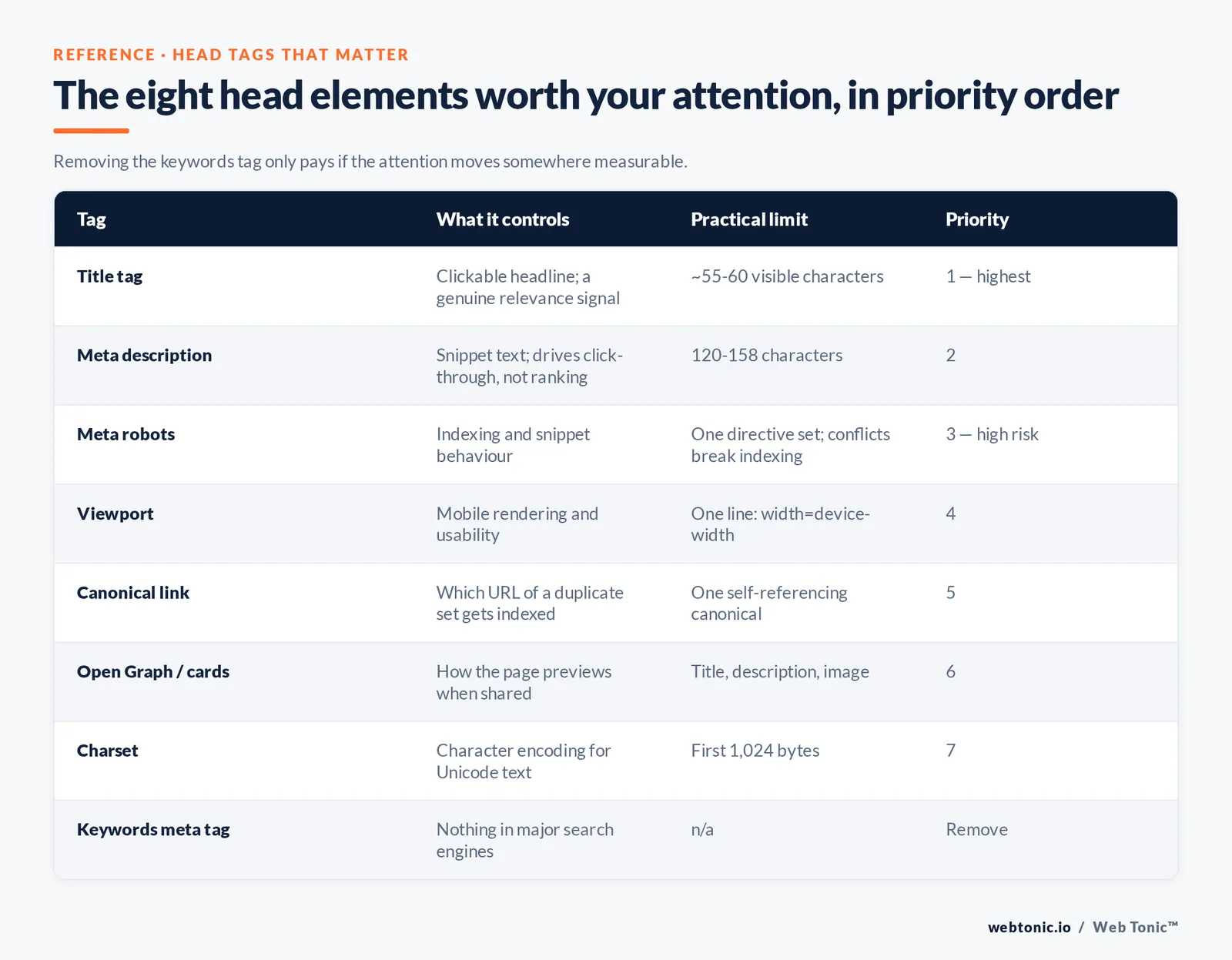
Removing the keywords tag is only useful if you spend the attention somewhere that pays. These are the head elements that measurably affect crawling, indexing, appearance or usability.
| Tag | What it controls | Practical limit | Priority |
|---|---|---|---|
| Title tag | The clickable headline in search results; a genuine relevance signal | ~55-60 visible characters on desktop | 1 — highest |
| Meta description | Snippet text; influences click-through, not ranking | 120-158 characters before truncation | 2 |
| Meta robots | Indexing and snippet behaviour (noindex, nofollow, max-snippet) | 1 directive set per page; conflicts break indexing | 3 — high risk |
| Viewport meta tag | Mobile rendering; missing it hurts usability on phones | 1 line: width=device-width, initial-scale=1 | 4 |
| Canonical link | Which URL of a duplicate set should be indexed | 1 self-referencing canonical per page | 5 |
| Open Graph / card tags | How the page previews when shared on social platforms | 3 essentials: title, description, image | 6 |
| Charset declaration | Character encoding, so Unicode text renders correctly | Must appear in the first 1,024 bytes | 7 |
| Keywords meta tag | Nothing in major search engines | n/a | Remove |
Google's guidance on how snippets are generated is explicit that the meta description is one input among several, and the robots meta tag reference is the single most consequential tag on this list: 1 mistaken noindex can remove an entire template from search. Moz's primer on the meta description is a good refresher for writing snippets that earn clicks rather than just fill a field.

Why the tag died: a 30-year timeline
| Period | Status of the keywords meta tag | What changed |
|---|---|---|
| 1995-1997 | Actively used by early engines | Thin indexes and few links meant self-declared topics carried weight |
| 1997-2000 | Heavily abused | Keyword stuffing, competitor brand names and hidden text made the field unusable |
| 2000-2009 | Quietly discounted | Link-based ranking and full-text analysis replaced author-declared metadata |
| 2009 | Officially ignored by Google | Google published a direct statement and a video confirming zero use in web ranking |
| 2010-2019 | Legacy field in CMS plugins | Most SEO plugins hid or removed the field by default |
| 2020-2026 | Irrelevant and mildly risky | AI-assisted search reads content and entities, not declared keyword lists |
Trap 1 — treating "Google ignores it" as "Google penalises it." Neither Google nor Bing has documented a penalty tied to the keywords meta tag alone. The cost is not an algorithmic hit; it is wasted effort, leaked strategy and a false sense that on-page optimisation is finished. As AI-generated answers reshape result pages, described in Google's guidance on AI features in Search, the winners are pages with clear entities and substantiated content — not pages with tidy keyword declarations.
5 real risks of keeping meta keywords
| Risk | How it shows up | Severity |
|---|---|---|
| Strategy leak | Any competitor can read your full target list with 1 keyboard shortcut | High |
| Opportunity cost | Time spent filling 500 keyword fields instead of improving 20 pages | High |
| False confidence | Checklists mark pages "optimised" when the title and content were never touched | Medium |
| Spam adjacency | Stuffed lists with 50+ terms or competitor brands look manipulative in manual review | Medium |
| Page weight and clutter | Thousands of pages carrying 200-400 useless bytes each in the head | Low |
Limit 2: the leak risk is the only one that scales against you. If your keyword research cost real money, publishing it in plain HTML is a strange way to protect it. Teams that treat research as an asset keep it in their analytics and reporting layer instead — the approach behind our data intelligence work.
How to remove meta keywords, by platform
| Platform | Where the field lives | Removal step | Effort |
|---|---|---|---|
| WordPress + SEO plugin | Legacy "focus keywords" or a meta keywords box in older plugins | Disable the field in plugin settings, then clear the stored values in bulk | 1-2 hours |
| Custom theme or template | Hard-coded in the head partial | Delete the 1 template line and redeploy | 15 minutes |
| Webflow | Page settings custom head code | Remove the tag from head code, republish the site | 10 minutes |
| Shopify | theme.liquid head section | Edit the layout file, remove the tag, save | 15 minutes |
| Wix / Squarespace | Advanced SEO panel or code injection | Clear the injected tag per template | 30 minutes |
| Headless / framework | Head component or metadata function | Drop the keywords property from the shared metadata object | 20 minutes |
Step 1 — crawl first, edit second. Export every URL that carries a keywords tag before touching templates, so you can verify the count drops to 0 of your indexed pages afterwards. WordPress alone powers a large majority of CMS-driven sites tracked by W3Techs, which is why plugin-stored keyword values are the most common source in audits. If templates are part of the problem, that is a web development fix, not a content one.
Where your keyword list should live instead
| Placement | Signal strength | How to use it |
|---|---|---|
| Title tag | Strong | 1 primary keyword, front-loaded, written for a human scanning 10 results |
| H1 and H2 headings | Strong | Map 1 subtopic per H2 so the page covers the whole question set |
| Body copy and entities | Strong | Name the products, places and concepts a reader would expect |
| Internal anchor text | Medium-strong | Link with descriptive anchors, not "click here", across 3+ related pages |
| Image alt text | Medium | Describe the image in 8-15 words; accessibility first |
| Structured data | Medium (eligibility, not ranking) | Mark up the page type so it qualifies for rich results |
| URL slug | Weak-medium | Keep 3-5 words, readable, stable after publication |
| Meta keywords | None | Do not use |
Google's structured data introduction is the reference for the markup layer, and MDN's meta element documentation covers the head tags worth keeping. Rule 2 — one page, one primary intent. A page that tries to serve 12 keywords in a meta tag but answers none of them well will lose to a page that answers 1 question completely.
What to do instead, by site type
| Site type | Biggest on-page gap we see | First 30-day move |
|---|---|---|
| Local service business | Generic titles repeated across every service page | Rewrite titles as service + city, 1 page per service |
| Ecommerce | Category pages with 0 unique copy above the product grid | Add 150-250 words of buying guidance to the top 20 categories |
| SaaS | Feature pages written in internal vocabulary | Retitle around the job to be done, add 2 comparison tables |
| Publisher / blog | Dozens of near-duplicate posts competing for 1 query | Consolidate into 1 canonical page and redirect the rest |
| Marketplace | Thin faceted pages indexed by the thousand | Apply robots directives to low-value facets |
| Enterprise multi-brand | 3-4 teams shipping conflicting head tags | Publish 1 shared head-tag standard and audit monthly |
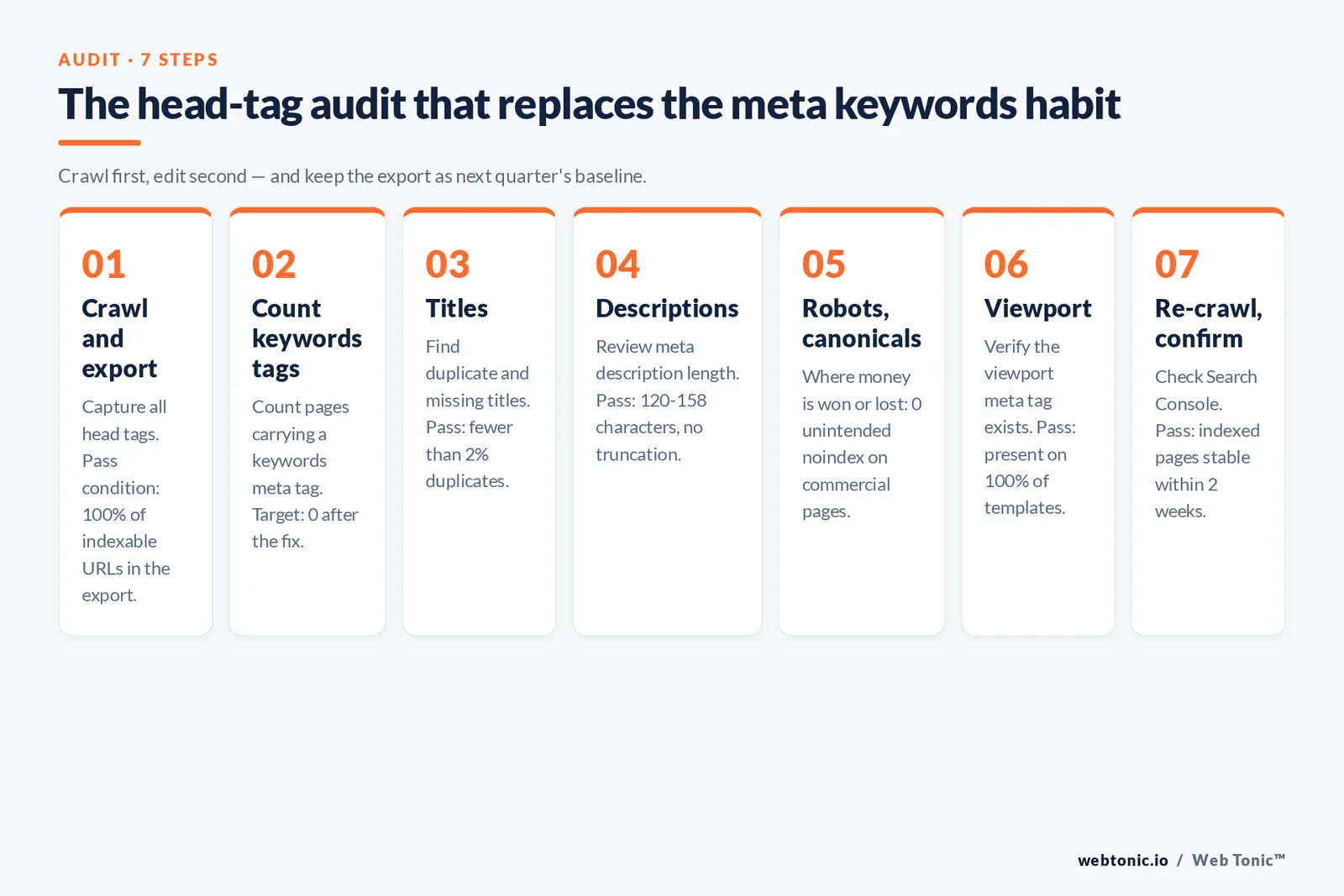
A 7-step head-tag audit that replaces the keywords habit
| Step | Check | Pass condition |
|---|---|---|
| 1 | Crawl the site and export all head tags | 100% of indexable URLs captured |
| 2 | Count pages carrying a keywords meta tag | Target 0 after the fix |
| 3 | Find duplicate and missing titles | Fewer than 2% duplicates |
| 4 | Review meta description length | 120-158 characters, no truncation |
| 5 | Audit robots directives and canonicals | 0 unintended noindex on money pages |
| 6 | Verify the viewport meta tag exists | Present on 100% of templates |
| 7 | Re-crawl and confirm in Search Console | Indexed pages stable within 2 weeks |
Step 5 is where money is won or lost: a single stray directive can cost more traffic in 1 week than every meta keywords tag ever earned. Validate the result in the reporting tools you already own before declaring the audit finished, and keep the export so the next quarterly review starts from a known baseline. More audit playbooks sit on the Web Tonic blog.
Myth versus reality
| Myth | Reality |
|---|---|
| "Meta keywords still help a little" | No major engine documents any weight; the realistic value is 0 |
| "Google penalises the tag" | No documented penalty for the tag alone — it is ignored, not punished |
| "Bing uses it" | Bing's guidelines centre on content, titles and links, not keyword declarations |
| "It helps in China and Russia" | Both ecosystems document the tag but publish no ranking weight; content wins there too |
| "Meta keywords help internal site search" | Only if your own search tool indexes the field — check before relying on it |
| "It costs nothing to leave it" | It costs research secrecy and audit attention across 1,000s of pages |
If your internal site search, DAM or e-learning platform genuinely reads the field, keep it there and nowhere else — that is a product decision, not an SEO one. Trap 2 — copying the tag from an old template into a new build "just in case" is how a 2003 habit survives a 2026 redesign.
FAQ
Do meta keywords still work for SEO in 2026?
No. Google confirmed in 2009 that it does not use the keywords meta tag for web ranking, and Bing, Yahoo and DuckDuckGo do not document any use of it either. Together those engines cover the overwhelming majority of search demand, so the practical value of the tag is zero.
Will removing the meta keywords tag hurt my rankings?
No. Because major engines ignore the tag, removing it changes no ranking input. Remove it in the template, re-crawl to confirm the count is zero, and monitor indexed pages for two weeks as a routine safety check.
What is the difference between meta keywords and a meta description?
The meta keywords tag lists terms for machines and is ignored. The meta description is snippet copy shown to humans in search results; it does not rank the page but it can meaningfully change click-through rate, so it is worth writing carefully in 120 to 158 characters.
Should I use meta keywords for Yandex or Baidu?
Their documentation still references classic meta tags, but neither publishes a ranking weight for keywords. If you target those markets, invest in localised content, local hosting and clean titles rather than keyword declarations.
Are focus keywords in SEO plugins the same thing?
No. A focus keyword in a plugin is an internal editorial reminder used to score your draft; it is not published as a meta keywords tag unless the plugin explicitly outputs one. Check your rendered HTML to be sure.
Turn head-tag hygiene into rankings
Deleting a dead tag takes an afternoon. Building titles, content and internal links that actually earn positions takes a plan. If you want that plan built against your own crawl data, talk to our team or review how we structure organic programmes across our services.
Sources: Google Search Central (2009 keywords meta tag announcement, valid page metadata, robots meta tag, snippets, structured data, AI features in Search, SEO starter guide) · MDN Web Docs (meta element, meta name reference) · WHATWG HTML Standard · Bing Webmaster Guidelines · Yandex Webmaster documentation · Baidu webmaster resources · StatCounter Global Stats search engine market share · W3Techs content management system usage · Moz meta description guide.