Table of contents

SEO keywords are the words and phrases people type or speak into a search engine, which you then target deliberately in your pages so those searches can find you. They are not tags you sprinkle in — they are demand signals that tell you what to write, how to structure it, and which pages deserve investment.
Key Takeaways
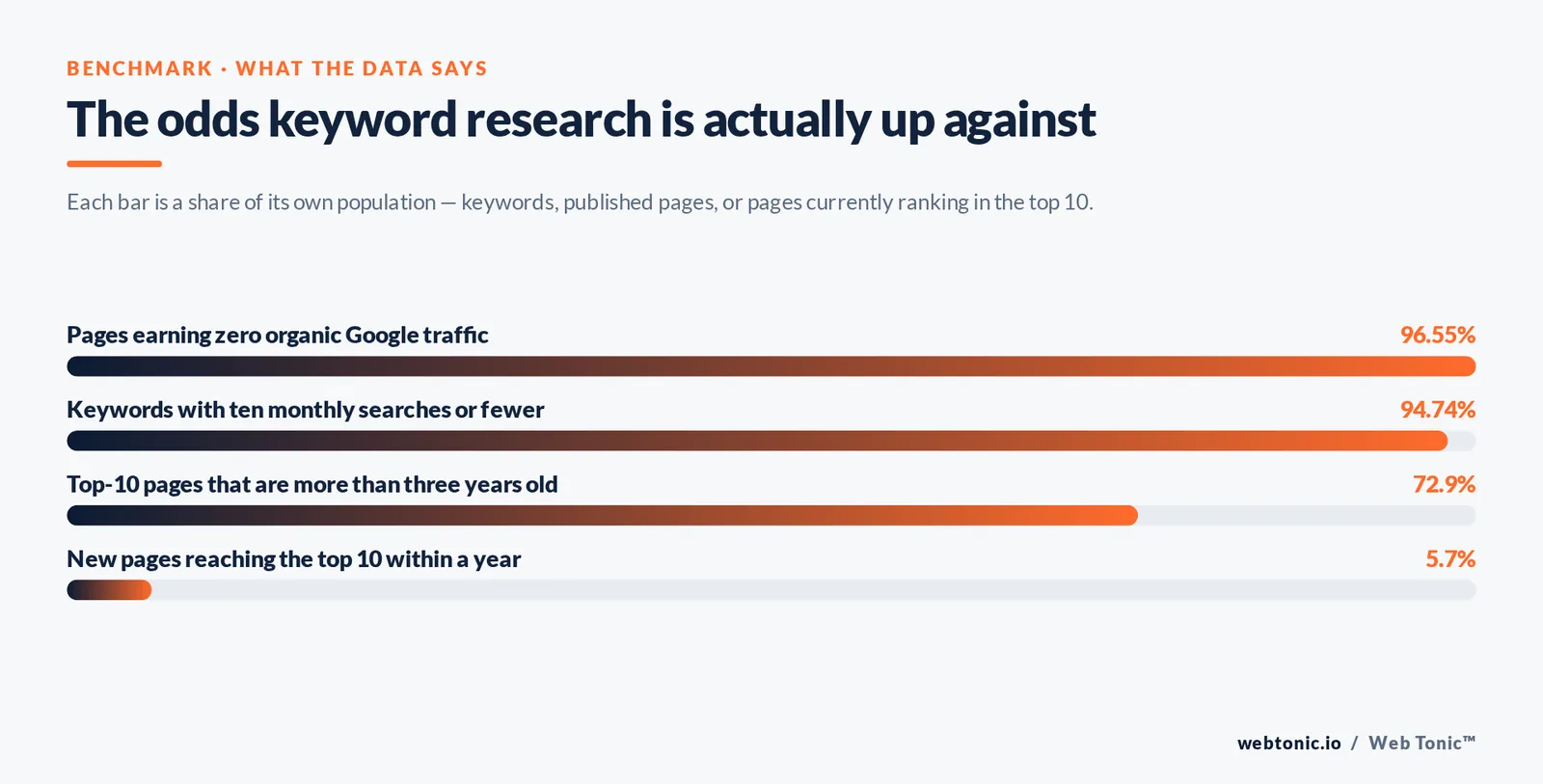
- 94.74% of all keywords get 10 monthly searches or fewer, so almost all search demand sits in the long tail rather than in a handful of head terms.
- Only 0.0008% of keywords receive more than 100,000 monthly searches — the terms most beginners chase are statistically freakish.
- 15% of all Google searches have never been searched before, which is why no keyword tool can ever show you the full market.
- Google holds a 90.39% global search engine market share across all devices, so keyword data modelled on Google covers the overwhelming majority of demand.
- Google Ads Keyword Planner overestimates search volumes 54.28% of the time and is roughly accurate only 45.22% of the time — treat volume as a range, not a number.
- The average top-ranking page also ranks in the top 10 for nearly 1,000 other relevant keywords, so one strong page serves a whole cluster.
- 96.55% of pages get zero organic search traffic from Google, usually because nobody validated demand before publishing.
- The first organic result earns an average click-through rate of 39.8%, and the top three results take 68.7% of all clicks — keyword choice decides whether ranking is even worth attempting.
- 46.08% of clicks reported in Google Search Console go to hidden terms, so your own data always understates your keyword footprint.
- 72.9% of pages ranking in Google's top 10 are more than three years old — keyword bets need time as well as intent.
What are SEO keywords, exactly?
An SEO keyword is any query — one word or twelve — that you have decided a specific page on your site should be found for. The keyword is not really the point; the query behind it is. Someone searching running shoes and someone searching best running shoes for flat feet under $120 are at different stages, need different pages, and will convert at wildly different rates.
Search engines no longer match strings literally. Google's own SEO starter guide is explicit that it tries to understand what a page is about rather than count how often a phrase appears, and its guidance on creating helpful, people-first content warns against writing primarily for search engines. So a keyword functions as a brief. It tells you the topic, the vocabulary your reader uses, and the depth expected — then you write for the human.
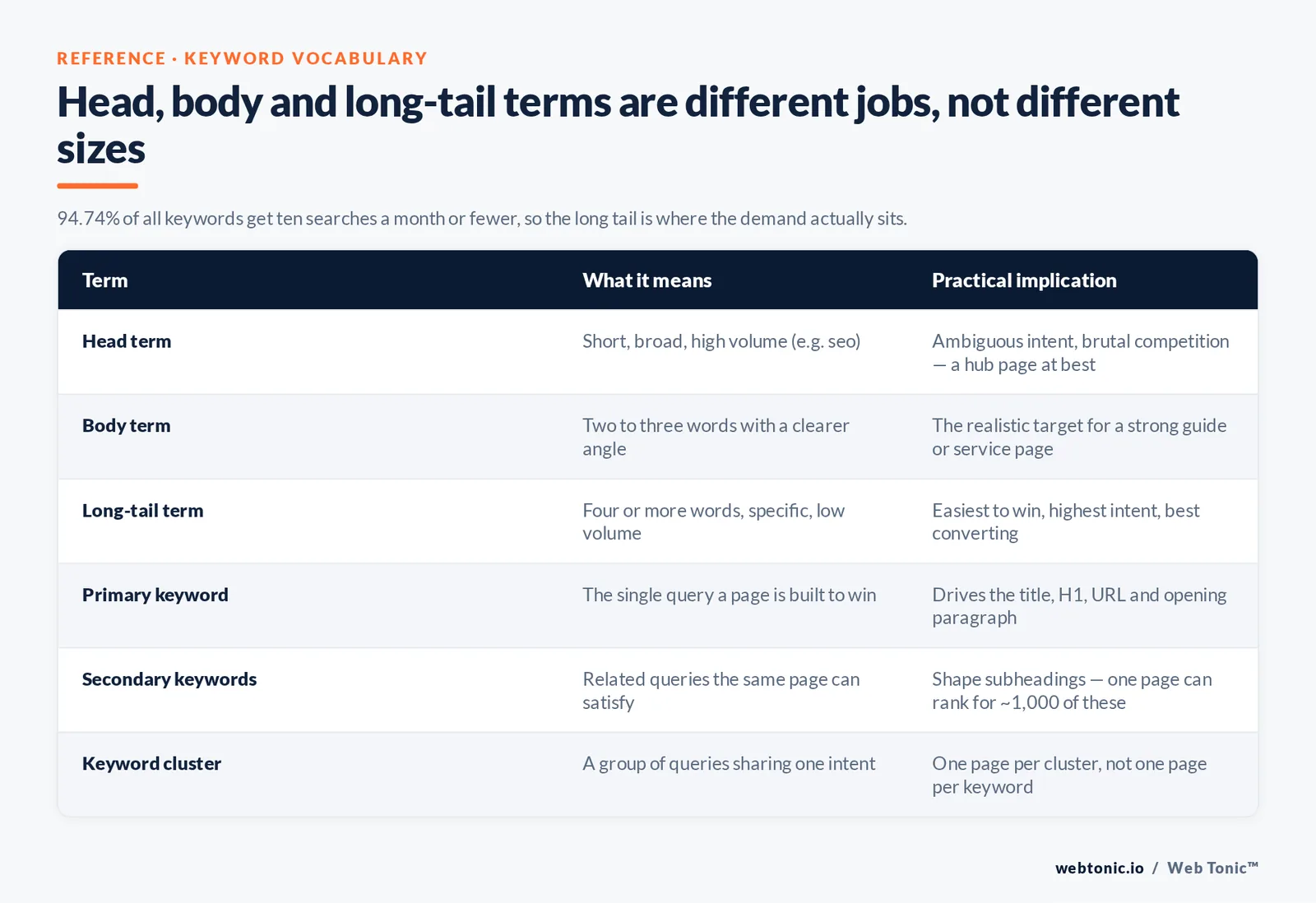
Three distinctions are worth fixing in your head before you open any tool:
| Term | What it means | Practical implication |
|---|---|---|
| Head term | Short, broad query with high volume (e.g. seo) | Ambiguous intent, brutal competition — usually a hub page at best |
| Body term | Two to three words with a clearer angle (e.g. seo keywords) | The realistic target for a strong guide or service page |
| Long-tail term | Four or more words, specific, low volume | Easiest to win, highest intent, best converting — and where 94.74% of keywords live |
| Primary keyword | The single query a page is built to win | Drives the title, H1, URL and opening paragraph |
| Secondary keywords | Related queries the same page can satisfy | Shape subheadings and sections — one page can rank for ~1,000 of these |
| Keyword cluster | A group of queries sharing one intent | One page per cluster, not one page per keyword |
That last row is the single most useful correction to how most teams work. If seo keywords, what are seo keywords and seo keyword meaning all want the same answer, they are one page. Splitting them creates near-duplicate content that competes with itself.
Why keywords still matter in an AI-driven search era
The rise of AI Overviews and answer engines has convinced some marketers that keywords are dead. The data says otherwise — it says the stakes moved. AI Overviews are associated with a 58% lower average click-through rate for the top-ranking organic page, according to Ahrefs' compiled search statistics. That does not remove the need for keyword targeting; it means winning informational head terms yields fewer clicks than it used to, while specific, commercially loaded queries matter more.
Meanwhile StatCounter's market share data still puts Google above 90% of global search, and the mechanics of retrieval have not changed: a system still has to decide which pages are relevant to a query. Keyword research is how you find out which queries exist, how many people ask them, and what a satisfying answer looks like. Language models trained on the web inherit that same vocabulary.
The practical shift is one of emphasis. Keyword work now sits closer to demand research than to on-page optimisation — which is exactly how we approach it in growth marketing programmes, where a keyword map doubles as a content and paid-media roadmap.
How to find the right SEO keywords: a repeatable process
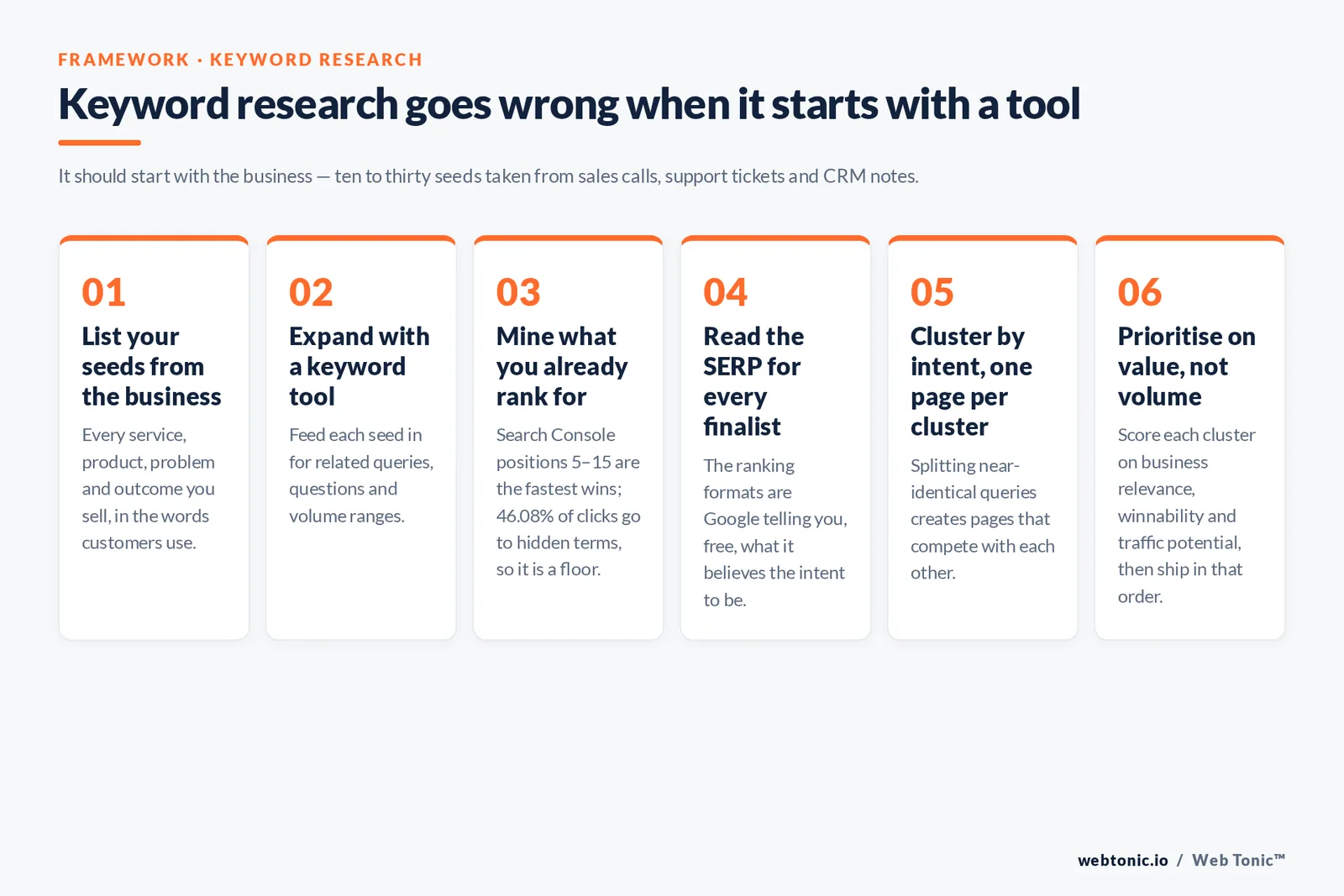
Keyword research goes wrong when it starts with a tool. It should start with the business.
- List your seeds from the business, not the software. Write down every service, product, problem and outcome you sell, in the words your customers use. Ten to thirty seeds is plenty. Sales calls, support tickets and CRM notes beat brainstorming.
- Expand with a keyword tool. Feed each seed into a research tool to get related queries, questions and volumes. Both Semrush's keyword research walkthrough and Ahrefs' keyword research guide document this expansion step well.
- Mine what you already rank for. Google Search Console's performance report shows real queries, impressions and positions. Terms sitting in positions 5–15 are your fastest wins. Remember that 46.08% of clicks land on hidden terms, so the report is a floor, not a ceiling.
- Check the trend before you commit. Google Trends tells you whether a term is growing, seasonal or dying — something absolute volume hides completely.
- Read the SERP for every finalist. Open the results page. What formats rank? Guides, product pages, videos, comparison tables? That is Google showing you, for free, what it believes the intent to be.
- Cluster by intent, then assign one page per cluster. HubSpot's research process covers grouping into topic pillars, which prevents cannibalisation.
- Prioritise on value, not volume. Score each cluster on business relevance, realistic winnability and traffic potential. Ship in that order.
Search intent: the filter that saves the most wasted effort
Every query carries an intent, and matching it is non-negotiable. Publishing a blog post for a query where Google only ranks product pages is the most common reason a well-written article never ranks. Semrush's breakdown of search intent uses the standard four categories, and mapping them to page types looks like this:
| Intent | Example query | What the searcher wants | Page you should build |
|---|---|---|---|
| Informational | what are seo keywords | To understand a concept | Guide, glossary entry or explainer |
| Navigational | google search console login | A specific site or tool | Brand or product page (rarely worth chasing) |
| Commercial | best keyword research tools | To compare options before buying | Comparison, listicle or review with a decision table |
| Transactional | hire seo agency dubai | To act now | Service or landing page with proof and a clear CTA |
A useful discipline: for every keyword you plan to target, write one sentence describing what the searcher should be able to do after reading. If you cannot write it, you do not understand the intent yet.
Reading the metrics: volume, difficulty, CPC and potential
Four numbers appear next to every keyword. Each is useful and each is regularly misread.
Search volume is a modelled monthly average, not a count. Keyword Planner overestimates 54.28% of the time, so treat any figure as a band — a keyword shown at 3,600 might realistically deliver 2,000 to 5,000 impressions a month. Use volume to compare keywords against each other, never as a traffic forecast.
Keyword difficulty is a proprietary 0–100 score, and different tools disagree because each weights link and content signals differently. Semrush's explanation of keyword difficulty is worth reading precisely because it exposes the assumptions. Difficulty is a shortcut for what you should do manually on your shortlist: look at who ranks, how strong they are, and whether their content is actually good.
Cost per click is the most underrated SEO metric on the list. It is a live auction price for commercial intent. A term with 300 searches and a $22 CPC is usually worth more than one with 8,000 searches and a $0.40 CPC — a judgement we apply constantly when balancing organic and paid budgets in data intelligence work.
Traffic potential asks how much total traffic the current top-ranking page gets across all its keywords, not just the one you searched. Because the average top page also ranks in the top 10 for close to 1,000 other terms, traffic potential is a far better estimate of the prize than single-keyword volume.
| Metric | What it measures | Common mistake | Better use |
|---|---|---|---|
| Search volume | Modelled monthly searches | Reading it as guaranteed traffic | Relative comparison between candidates |
| Keyword difficulty | Estimated competitiveness, 0–100 | Trusting one tool's score absolutely | Shortlisting, then manual SERP review |
| CPC | Paid auction price per click | Ignoring it on organic projects | Proxy for commercial value of the query |
| Traffic potential | Total traffic of the top-ranking page | Never checking it | Sizing the real opportunity of a cluster |
| SERP features | AI Overviews, snippets, packs, ads | Assuming rank 1 means the clicks | Discounting click forecasts where AI Overviews appear |
Long-tail keywords: where most sites should actually start
The distribution of search demand is extreme. Since 94.74% of keywords get ten searches a month or fewer, and only 0.0008% break 100,000, a strategy built on head terms is a strategy built on the rarest possible outcome. Ahrefs' analysis of long-tail keywords makes the important secondary point: long-tail terms come in two flavours. Topical long tails are specific niches worth targeting individually; supporting long tails are simply less common phrasings of a bigger topic, best served by one comprehensive page.
The commercial case is stronger than the SEO case. Long-tail queries state the problem, the constraint or the location, which means the reader has already qualified themselves. Combine that with the click reality — the first organic result averages a 39.8% CTR while the top three take 68.7% of clicks — and ranking first for a 200-search term beats ranking eighth for a 20,000-search one, almost every time.
Using keywords on the page without keyword stuffing
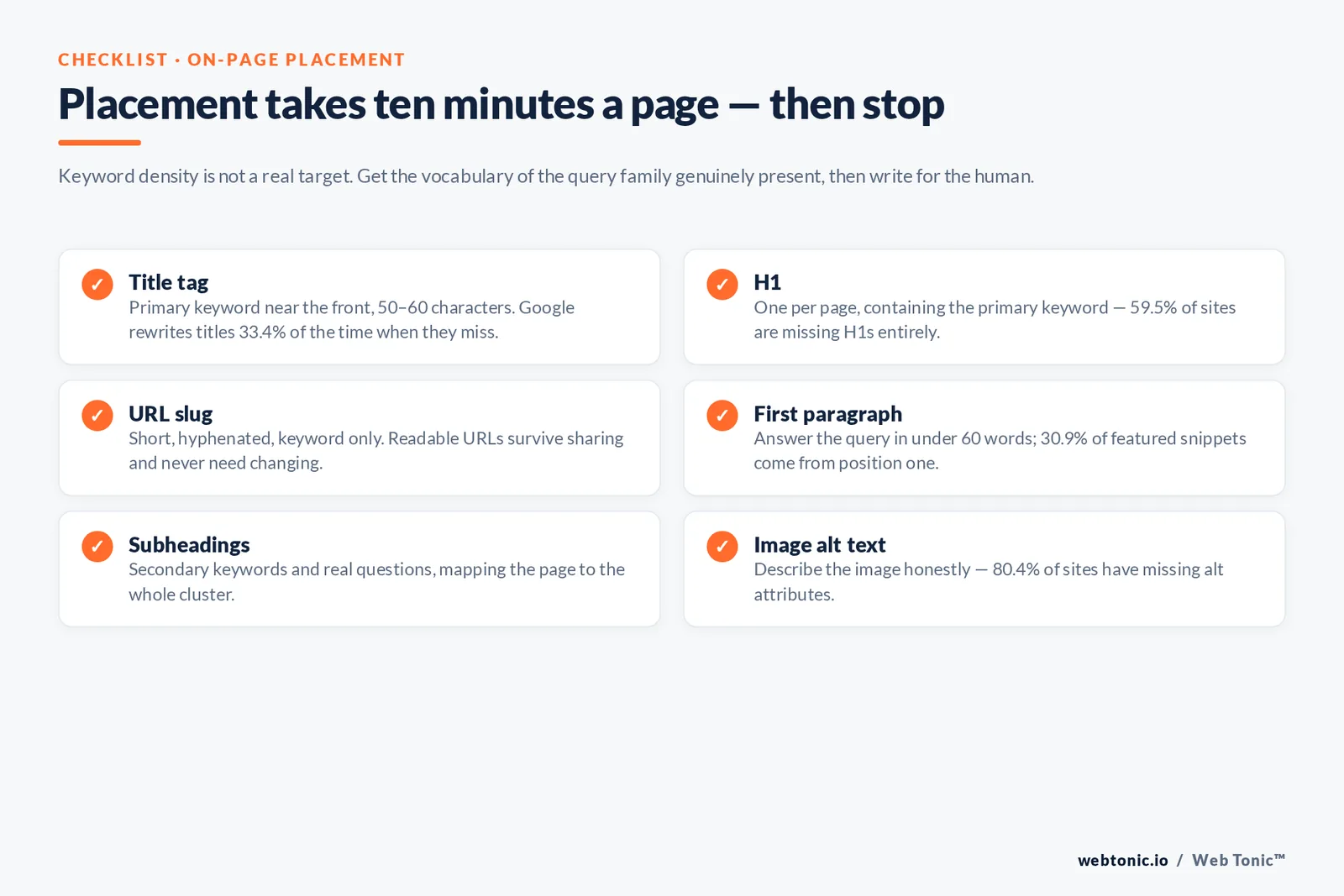
Once the research is done, placement is simple and takes about ten minutes per page. Put the primary keyword in the title tag, the H1, the URL slug and the first 100 words. Use secondary keywords as H2 and H3 subheadings where they read naturally. Write descriptive alt text for images. Then stop — remembering that 25.02% of top-ranking pages do not even have a meta description, and Google rewrites the ones that exist 62.78% of the time.
| Placement | Guideline | Why |
|---|---|---|
| Title tag | Primary keyword near the front, 50–60 characters | Strongest relevance signal; Google rewrites titles 33.4% of the time when they miss |
| H1 | One per page, contains the primary keyword | 59.5% of sites are missing H1s entirely — an easy edge |
| URL slug | Short, hyphenated, keyword only | Readable URLs survive sharing and never need changing |
| First paragraph | Answer the query in under 60 words | Wins featured snippets; 30.9% of snippets come from position one |
| Subheadings | Secondary keywords and real questions | Maps the page to the whole cluster |
| Internal links | Descriptive anchors to related pages | Anchor variety correlates strongly with more search traffic |
| Image alt text | Describe the image, include the term if honest | 80.4% of sites have missing alt attributes |
Keyword density is not a real target. There is no threshold to hit, and no correlation exists between readability scores and ranking position — so optimising prose for a formula is wasted work. Write the best version of the page, then check that the vocabulary of the query family is genuinely present.
Building a keyword map you can actually run
A keyword map is a spreadsheet with one row per target page: primary keyword, cluster of secondary keywords, intent, page type, current URL or "to create", current rank, and owner. It is the artefact that turns research into shipped work, and it prevents two teams writing the same article six months apart.
Refresh it quarterly with Search Console data. Three signals drive action: pages ranking 5–15 need improvement, not replacement; clusters with impressions but no clicks usually have a title and intent mismatch; and queries appearing that you never targeted are free topic ideas. Given that 72.9% of top-10 pages are older than three years and only 5.7% of newly published pages reach the top 10 within a year, patience is part of the method — improving existing pages beats publishing new ones more often than most teams expect. If the map needs to translate into templates, navigation and page structure, that becomes a web development conversation, not just a content one.
Related keyword terms worth knowing
| Term | Definition |
|---|---|
| Seed keyword | A starting term you expand from, usually taken straight from your offering |
| Keyword cannibalisation | Two or more of your pages targeting the same intent and splitting signals |
| Keyword gap | Terms competitors rank for and you do not — the fastest source of a content backlog |
| SERP feature | Any non-standard result: AI Overview, featured snippet, local pack, image carousel |
| Zero-click search | A search ending without a click — 61.5% of desktop and 34.4% of mobile searches |
| Branded keyword | Query containing your company or product name; high converting, low incremental |
| Topic cluster | A pillar page plus supporting pages, interlinked around one subject |
| Anchor text | The clickable words of a link; exact-match anchors correlate with 5x more traffic |
None of this requires expensive software to begin. Search Console, Google Trends and a careful read of the results pages will get a small site through its first keyword map. Tools buy speed and depth, not judgement — and judgement about which queries are worth your time remains the whole game. If you want that judgement applied to your site, our service overview is the place to start, or get in touch with the specifics.
FAQ
What are SEO keywords in simple terms?
They are the search queries you deliberately build pages to be found for. You research which phrases real people use, confirm there is genuine demand, then create a page that answers that query better than what currently ranks. The keyword is the brief; the page is the deliverable.
How many keywords should one page target?
One primary keyword and one cluster of closely related secondary terms. Because the average top-ranking page also ranks in the top 10 for nearly 1,000 other keywords, a well-built page naturally captures dozens of variations. Creating separate pages for near-identical queries causes cannibalisation.
What tools can I use to research SEO keywords for free?
Google Search Console shows the queries you already appear for, Google Trends shows direction and seasonality, and Keyword Planner gives volume ranges — though it overestimates volume 54.28% of the time. Paid tools such as Semrush, Ahrefs and Moz add difficulty scores, competitor gap analysis and traffic potential.
How do search volume and keyword difficulty affect which keywords I choose?
Volume sizes the prize and difficulty estimates the cost of winning it, but both are modelled. Start where difficulty is low and intent is commercial, even at modest volume: the first organic result averages a 39.8% CTR, so ranking first on a small term usually beats ranking eighth on a big one.
Are keywords still relevant with AI Overviews in search results?
Yes, but the payoff has shifted. AI Overviews are associated with a 58% lower click-through rate for the top organic result, which devalues broad informational terms and increases the relative value of specific, commercially loaded queries. Google still handles over 90% of global search, and its systems still match pages to queries.
Sources: Google Search Central — SEO starter guide, creating helpful people-first content · Google Search Console Help — performance report · Google Trends · Ahrefs — 107 SEO statistics for 2026 (keyword, ranking, technical and CTR data), keyword research guide, long-tail keywords analysis · Semrush — keyword research guide, keyword difficulty, search intent · HubSpot — how to do keyword research · StatCounter Global Stats — search engine market share · First Page Sage — Google click-through rates by ranking position. All figures verified at time of publication.