Table of contents
Organic keywords are the search queries your website ranks for in unpaid results. You do not choose them — you earn them, then discover which ones already drive traffic and grow those.
Key Takeaways
- Search Console is the only free source of your own organic keyword data, and it is the starting point for every credible report.
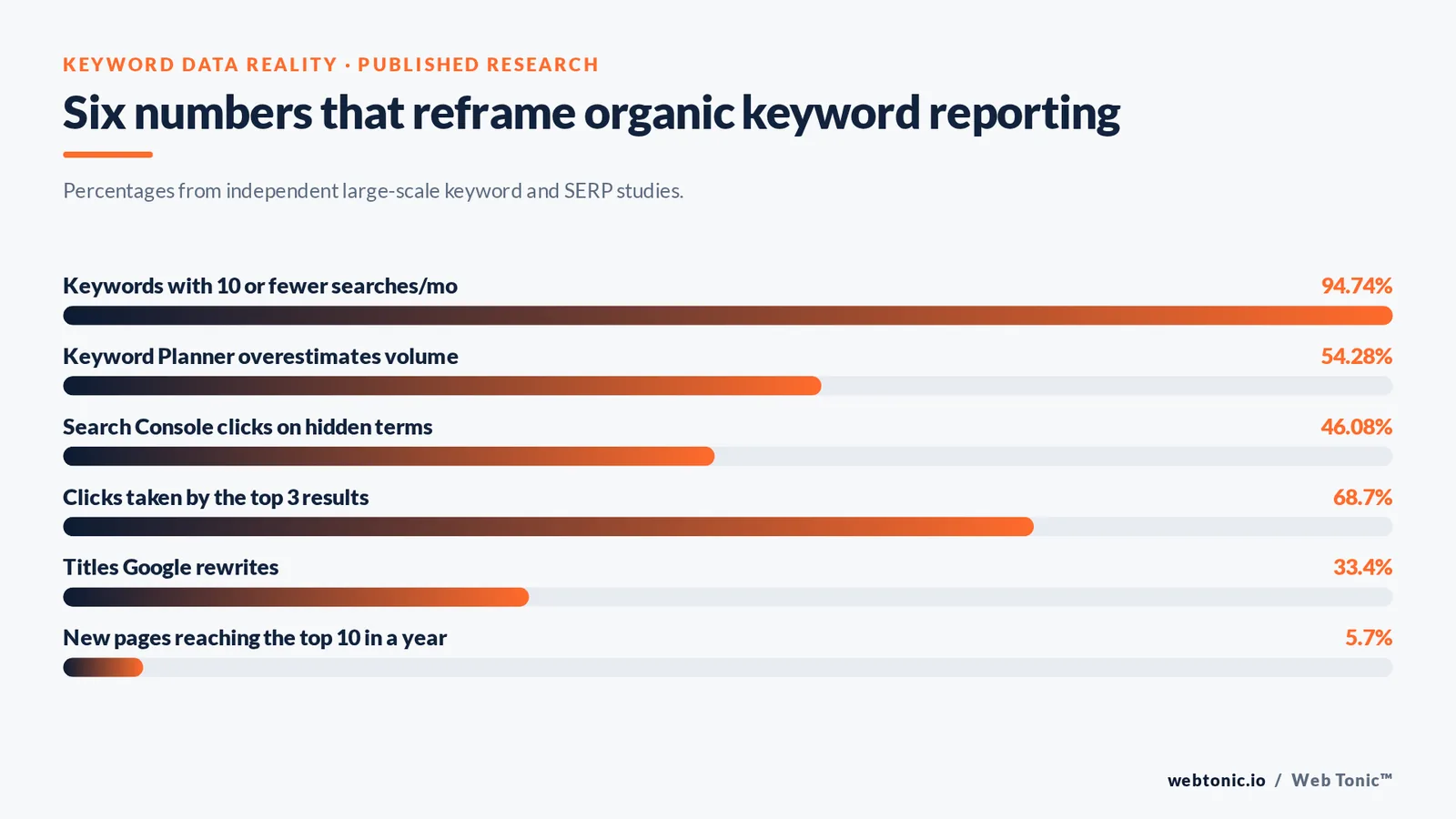
- 94.74% of keywords get 10 or fewer searches per month and only 0.0008% exceed 100,000, so most of your organic traffic comes from a very long tail.
- 46.08% of Search Console clicks land on hidden or anonymised queries, which is why your keyword list will never sum to your total clicks.
- An average top-ranking page also ranks in the top 10 for roughly 1,000 other keywords — one page, hundreds of organic keywords.
- Google Keyword Planner overestimates search volume 54.28% of the time, so treat third-party volume as a range, not a fact.
- Only 5.7% of new pages reach the top 10 within a year, so prioritise keywords where you already rank positions 5–20.
What organic keywords are, and how they differ from paid keywords
An organic keyword is a query a search engine matches to one of your pages in its unpaid results. A paid keyword is one you bid on. The mechanics, the cost and the reporting are all different, and mixing them is the most common reason keyword reports get disputed.
| Dimension | Organic keywords | Paid keywords |
|---|---|---|
| How you get them | Earned when a page ranks in organic search | Chosen and bid on in an ad account |
| Cost per click | No media cost, high content cost | CPC paid per click |
| Control | Indirect — you influence via content | Direct — match types and negatives |
| Speed | Weeks to months | Hours |
| Data source | Search Console, rank trackers, SEO tools | Ad platform search terms report |
| Decay | Slow, content ages | Instant when you pause |
Google's own SEO starter guide frames it plainly: you optimise pages for the way people search, and search engines decide the match. That decision is made by the ranking systems documented in Google's guide to Search ranking systems, not by a keyword field you fill in — which is also why meta keywords have been irrelevant for well over a decade.
Where your organic keyword data actually lives
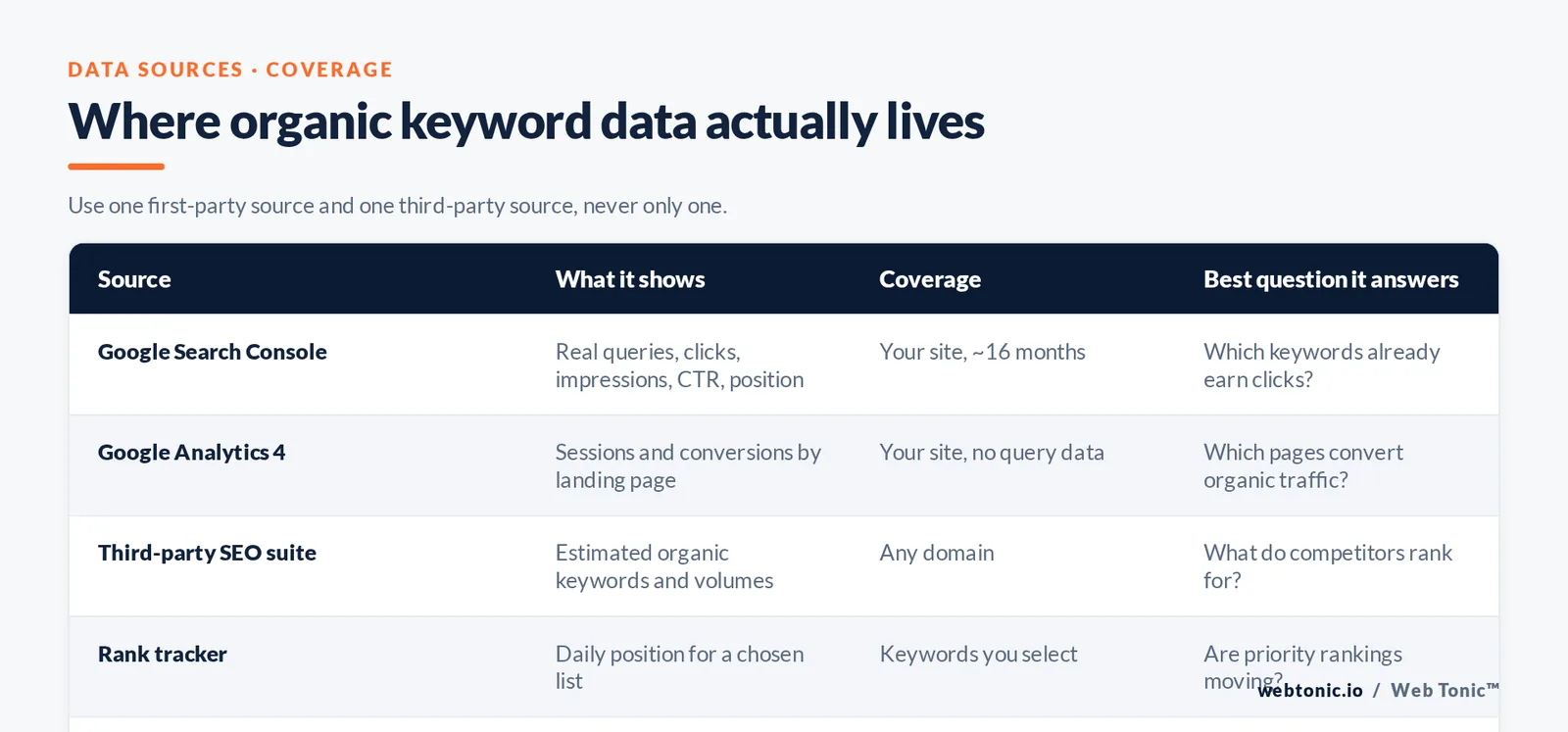
Rule 1 — use 2 sources minimum: one first-party (your own click data) and one third-party (competitive estimates). Each answers a different question.
| Source | What it shows | Coverage | Best question it answers |
|---|---|---|---|
| Google Search Console | Real queries, clicks, impressions, CTR, position | Your site only, ~16 months | Which organic keywords already earn clicks? |
| Google Analytics 4 | Sessions and conversions by landing page | Your site, no query data | Which pages convert organic traffic? |
| Third-party SEO suites | Estimated organic keywords and volumes | Any domain | What are competitors ranking for? |
| Rank tracker | Daily position for a chosen list | Keywords you select | Are priority rankings moving? |
| Keyword Planner | Paid volume ranges and CPC | Google network | Is there commercial value here? |
| Google Trends | Relative interest over time | Global, topic level | Is demand rising or seasonal? |
Start in the Search Console performance report, which is the canonical record of the queries Google matched to your pages. Add commercial context from Google Keyword Planner and seasonality from Google Trends. GA4 completes the picture on the money side through its dimensions and metrics for landing pages and conversions.
Find your top organic keywords in six steps
| Step | Action | Where | Output |
|---|---|---|---|
| 1 | Export 12 months of queries with clicks, impressions, CTR and average position | Search Console performance report | Raw CSV of every organic keyword |
| 2 | Split brand from non-brand queries | Spreadsheet filter | Honest non-brand baseline |
| 3 | Group queries by the landing page that receives them | Pages plus queries view | Page-to-keyword map |
| 4 | Tag each query by search intent | Manual or rule-based tagging | Intent-labelled list |
| 5 | Add search volume and keyword difficulty from a third-party tool | SEO suite export | Opportunity-scored list |
| 6 | Sort by impressions with position 5–20 to find striking distance wins | Spreadsheet sort | Your 90-day priority list |
Fact 1 — step 6 is where most of the short-term upside sits, because a page already at position 11 needs relevance work, not a new page. If Search Console is not verified yet, Google's Search Console setup documentation covers verification and property types before you export anything.

Organic keyword checkers and tools, compared
Limit 2 — no tool sees more than a fraction of Google's index, so tool-to-tool variance of 30% or more on the same domain is normal.
| Tool type | Strength | Weakness | Use it for |
|---|---|---|---|
| Search Console | First-party truth, free | Hidden queries, no competitor view | Reporting and striking distance |
| Full SEO suite | Competitor organic keywords at scale | Estimated volumes, subscription cost | Gap analysis and forecasting |
| Browser keyword extensions | Volume shown inside the SERP | Credit limits, rough data | Fast qualification while researching |
| Dedicated rank tracker | Daily accuracy on a fixed list | Blind to keywords you never added | Client dashboards |
| Keyword Planner | Direct from Google, CPC data | Volume ranges, paid bias | Commercial value checks |
| Spreadsheet plus CSV exports | Zero cost, full control | Manual maintenance | One-off audits |
Independent testing found that Keyword Planner was accurate only 45.22% of the time and overestimated volume in 54.28% of cases, and that 46.08% of Search Console clicks are attributed to hidden terms. Cross-referencing methodology guides such as Moz's keyword research guide and Ahrefs' keyword research walkthrough is the fastest way to sanity-check a number before it reaches a slide. Full context on volume, difficulty and CPC together lives in our guide to SEO keywords.
Reading the metrics: what each number is worth
| Metric | What it really tells you | Trap | Decision rule |
|---|---|---|---|
| Clicks | Realised organic traffic | Brand queries inflate it | Always report non-brand separately |
| Impressions | Latent demand you already touch | Deep positions inflate it | Pair with average position |
| Average position | Where you sit across queries | An average of very different SERPs | Segment by page, not site |
| CTR | Title and snippet performance | Varies hugely by intent | Compare like-for-like intent only |
| Search volume | Estimated market size | Overstated more than half the time | Treat as a band, not a target |
| Keyword difficulty | Link-based competitiveness proxy | Ignores intent match | Filter by difficulty, decide on intent |
Fact 2 — the first organic result attracts roughly 39.8% of clicks and the top three take about 68.7%, with 96.6% of all clicks landing on page one. That distribution is why position matters more than volume for small sites. Vendor methodology for difficulty scoring is documented by both Ahrefs and Semrush, and click-curve research is collected by Backlinko.
Competitor organic keyword gap analysis
Your own list tells you what you have. A gap analysis tells you what you are missing. Run it against three to five direct competitors, never more, or the output becomes unusable.
| Gap type | Definition | Typical size | Action |
|---|---|---|---|
| Missing | Competitors rank, you do not rank at all | Largest bucket | New page, only if intent fits your offer |
| Weak | You rank 11–30, they rank top 10 | Highest ROI bucket | Improve depth and internal links |
| Shared | Both in the top 10 | Medium | Win CTR with titles and schema |
| Untapped | Nobody covers it properly | Small | Publish first, build the topic hub |
| Irrelevant | Volume with no commercial fit | Often overestimated | Exclude deliberately and document why |
Limit 3 — around 15% of Google searches are brand new every day, so a gap list is a snapshot with a shelf life of roughly one quarter. Rebuild it quarterly rather than trusting a year-old export. If you want that process run for you, that is what our growth marketing team does month after month.
Cannibalisation, decay and other diagnostics
| Symptom | Likely cause | Diagnostic | Fix |
|---|---|---|---|
| Two pages swapping positions | Keyword cannibalisation | Filter one query, view pages over time | Consolidate or differentiate intent |
| Impressions flat, clicks falling | SERP feature or AI answer above you | Check CTR by query and inspect the SERP | Rewrite title, add structured data |
| Steady multi-month decline | Content decay | Compare year-over-year by page | Refresh data, examples and internal links |
| Ranking without traffic | Wrong intent match | Read the top 10 for the query | Change the page format to match |
| Sudden broad drop | Ranking systems update | Compare pre and post-update windows | Improve helpfulness, not tricks |
Trap 4 — 72.9% of pages ranking in the top 10 are more than 3 years old, so patience and refreshing beat constant new publishing. Cannibalisation diagnosis is covered step by step in Ahrefs' cannibalisation guide, and Google's own bar for surviving updates is set out in its helpful content guidance. Density is not the lever people expect either, as our breakdown of keyword density explains.
Turning organic keywords into content actions
Rule 2 — 1 intent per page. The intent label decides the page format, and the format decides whether you rank at all.
| Intent | Query pattern | Page format that ranks | Primary KPI |
|---|---|---|---|
| Informational | what is, how does, why | Definition-led guide with tables | Clicks and assisted conversions |
| Navigational | brand plus feature or login | Product or support page | Branded click share |
| Commercial | best, top, vs, review | Comparison or listicle | Qualified leads |
| Transactional | buy, pricing, near me, agency | Service or product page | Conversions |
| Long tail question | 5+ word questions | FAQ section inside a hub page | Impression growth |
Because the average top-ranking page also ranks in the top 10 for around 1,000 other keywords, the winning move is usually one deep page per intent rather than one thin page per keyword. That is the same logic behind targeting long tail keywords as an entry strategy, and commerce-specific application is well covered in Shopify's keyword guide.
Reporting organic keywords without misleading anyone
| Report line | Definition to state | Cadence | Why it earns trust |
|---|---|---|---|
| Non-brand organic clicks | Clicks excluding brand queries | Monthly | Removes the easiest number to fake |
| Keywords in top 10 | Count of queries with average position under 10.5 | Monthly | Tracks visibility, not vanity |
| Striking distance count | Queries in positions 5–20 with impressions | Monthly | Shows the next 90 days of upside |
| Page-level keyword breadth | Distinct queries per landing page | Quarterly | Proves topical depth is working |
| Organic conversions | Conversions from organic landing pages | Monthly | Connects keywords to revenue |
| Hidden-query caveat | Share of clicks on anonymised terms | Every report | Prevents false precision |
Fact 3 — Google rewrites 33.4% of title tags and 62.78% of meta descriptions, so a CTR change is not always something you did. Note it in the report before someone else finds it. More reporting templates and teardowns sit on the Web Tonic blog, and if you would rather hand the whole workflow over, talk to us.

FAQ
What are organic keywords?
Organic keywords are the search queries your pages rank for in unpaid search results. You do not select them the way you select paid keywords; search engines match queries to your content, and you discover the resulting keywords in Search Console.
How do I find my website's top organic keywords for free?
Open the Search Console performance report, choose a 12-month range, add clicks, impressions, CTR and average position, then export the queries. Split brand from non-brand and sort by clicks to see your top organic keywords.
Why don't my organic keyword numbers match my traffic?
Search Console anonymises rare queries, and roughly 46% of clicks are attributed to hidden terms. Third-party tools only estimate. Expect a permanent gap between your keyword list and total organic sessions, and say so in every report.
How many organic keywords should one page target?
One intent per page, which in practice covers dozens to hundreds of related queries. Research shows an average top-ranking page also ranks in the top 10 for roughly 1,000 other keywords, so depth beats one page per keyword.
How long do organic keywords take to rank?
Only 5.7% of new pages reach the top 10 within a year, and most top-10 pages are over three years old. The fastest wins come from improving pages already ranking in positions 5–20 rather than publishing new ones.
Sources
Google Search Central — SEO starter guide; A guide to Google Search ranking systems; Creating helpful content; Search Console setup. Search Console Help — Performance report. Google Keyword Planner. Google Trends. Google Analytics Help — Dimensions and metrics. Moz — Beginner's guide to keyword research. Ahrefs — Keyword research; Keyword difficulty; Keyword cannibalisation; SEO statistics compilation. Semrush — Keyword difficulty. Backlinko — Google CTR statistics. Shopify — SEO keywords. All statistics cited from published research and verified live at publication.