Table of contents
Long tail keywords are longer, more specific search queries with lower individual search volumes but clearer intent and lower keyword difficulty. This guide defines them, shows how to find them, and explains how to rank for them.
Key Takeaways
- A long tail keyword is typically 3 or more words with a monthly search volume under roughly 1,000 and a clearly stated intent.
- Google has said for years that around 15% of daily searches are queries it has never seen before — the tail is permanently regenerating.
- Long tail queries usually carry lower keyword difficulty, so a page can rank with 0 new backlinks if the content genuinely answers the query.
- Google Search Console is the only free source of your own long tail data: filter for queries with impressions but positions 8–30.
- 4 reliable discovery methods — Search Console, autocomplete and People Also Ask, community forums, and internal site search — cover most of what paid tools return.
- Group long tail keywords into topic clusters of 5–15 queries per page instead of building one thin page per query.
What are long tail keywords?
A long tail keyword is a search query that is longer and more specific than a head term, attracts a small monthly search volume on its own, and signals a narrow intent — for example "best crm for a two person accounting firm" instead of "crm". Individually these queries are small; collectively they make up the majority of search demand.
The name comes from the shape of the demand curve. Plot every query in a niche by search volume and you get a short, tall head of generic terms and a long, flat tail of specific ones that never quite reaches zero. The concept was popularised outside SEO first, and the general long tail distribution describes the same pattern in retail, publishing and media catalogues.
Two properties make the tail valuable. First, specificity correlates with intent: someone typing eight words has usually already decided what they want. Second, competition thins out, because most sites optimise for the head terms an executive can name off the top of their head.
Long tail vs short tail keywords
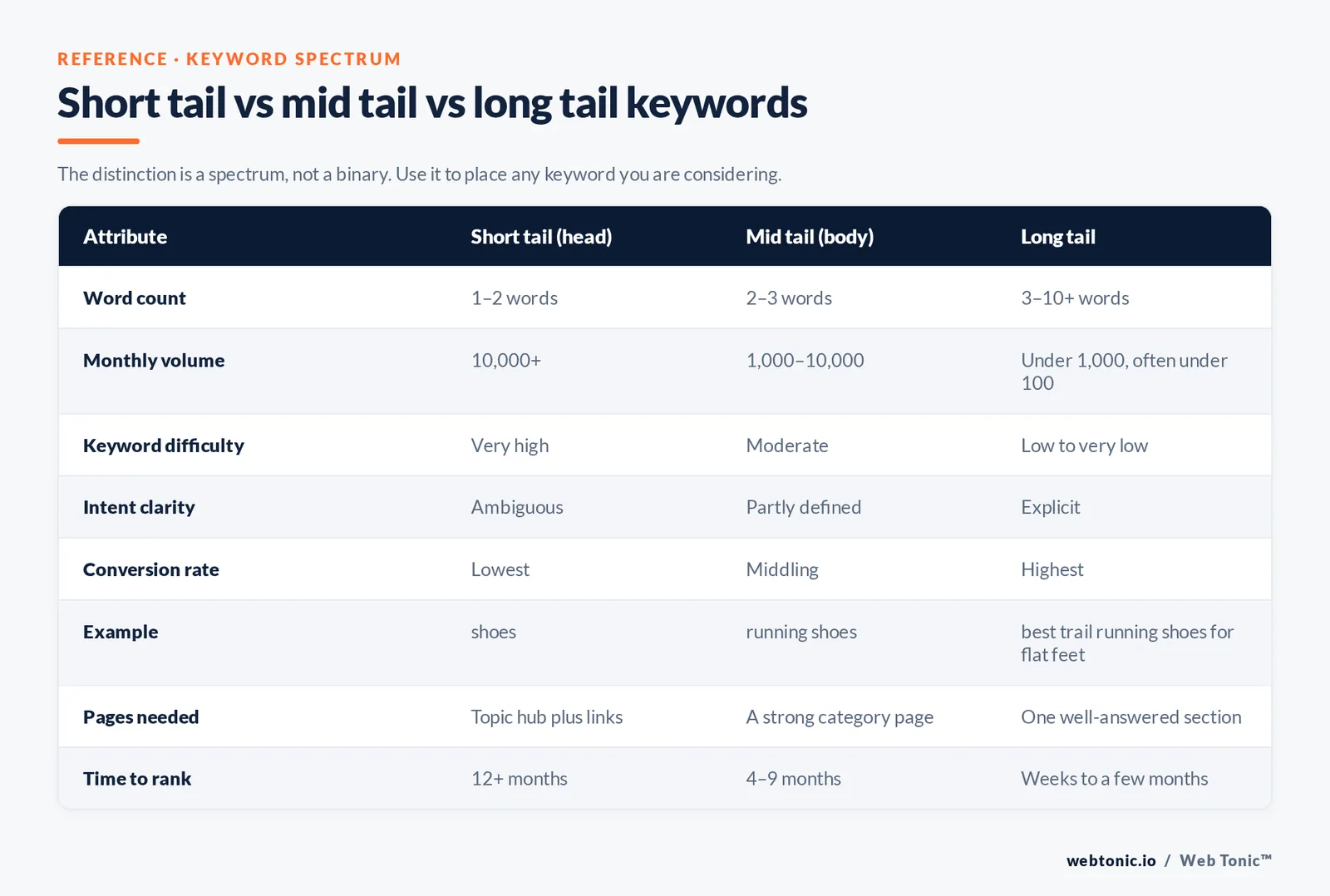
The distinction is a spectrum, not a binary. Use this table to place any keyword you are considering.
| Attribute | Short tail (head) | Mid tail (body) | Long tail |
|---|---|---|---|
| Word count | 1–2 words | 2–3 words | 3–10+ words |
| Monthly search volume | 10,000+ | 1,000–10,000 | Under 1,000, often under 100 |
| Keyword difficulty | Very high | Moderate | Low to very low |
| Intent clarity | Ambiguous | Partly defined | Explicit |
| Typical conversion rate | Lowest | Middling | Highest |
| Example | shoes | running shoes | best trail running shoes for flat feet |
| Pages needed to compete | A full topic hub plus links | A strong category page | One well-answered section |
| Realistic time to rank | 12+ months | 4–9 months | Weeks to a few months |
The strategic implication is that the two keyword types are not alternatives. Long tail pages earn traffic, links and topical evidence early; that accumulated authority is what eventually makes a head term winnable. Treating the tail as a stepping stone rather than a consolation prize is the difference between a content plan that compounds and one that stalls.
Why long tail keywords are easier to rank for
Three mechanics stack in your favour. Fewer competing pages target the exact query, so the ranking set is weaker on average. The query itself tells you precisely what the answer should contain, so relevance is easier to demonstrate than on a broad term. And the result set is often assembled from passages inside longer pages rather than dedicated pages, which is why a well-structured section can outrank a whole thin article.
Google's own guidance supports the practical approach: the SEO starter guide tells site owners to write for people describing things the way readers actually describe them, and to organise content so each topic has a clear place. That is a description of long tail optimisation without the jargon.
The tail also refreshes itself constantly. Google has repeatedly stated that a meaningful share of daily searches — commonly cited at around 15% — have never been seen before, which means no competitor has pre-optimised for them. Product releases, price changes, regulation and new tools all mint fresh long tail queries every quarter. Watching which categories are churning is a cheap way to find tail queries before competitors do.
How to find long tail keywords: 6 methods
Run these in order. The first two use data nobody else has, so they should always come before paid tools.
| Method | Where to look | What it gives you | Cost |
|---|---|---|---|
| 1. Search Console mining | Performance report, query filter | Queries you already get impressions for at positions 8–30 | Free |
| 2. Internal site search | Analytics site-search report | The exact phrasing your visitors use | Free |
| 3. Autocomplete and PAA | Google suggestions, People Also Ask | Real query completions and adjacent questions | Free |
| 4. Community mining | Reddit threads, niche forums, review sites | Problem language before it becomes a keyword | Free |
| 5. Trend checking | Google Trends comparisons | Whether a query is rising, flat or seasonal | Free |
| 6. Keyword tools | Keyword Planner and paid SEO suites | Volume estimates, difficulty scores, competitor gaps | Free to $99+/mo |
Search Console deserves the most attention because it reports your site's actual queries rather than a modelled estimate. Open the Search Console performance report, set a 3-month range, enable impressions and average position, then sort for queries with meaningful impressions and an average position between 8 and 30. Those are pages Google already considers relevant but not yet best — the cheapest ranking gains available.
Google Keyword Planner covers the paid-media side of the same demand. It is built for advertisers, and its keyword ideas tool groups suggestions with volume ranges and competition bands. Volumes for very specific queries are often shown as ranges or bucketed to zero, so treat absence of data as "too small to model", not "nobody searches this". For seasonality and direction, Google Trends is a better signal than any absolute volume figure.
Long tail keyword examples by industry
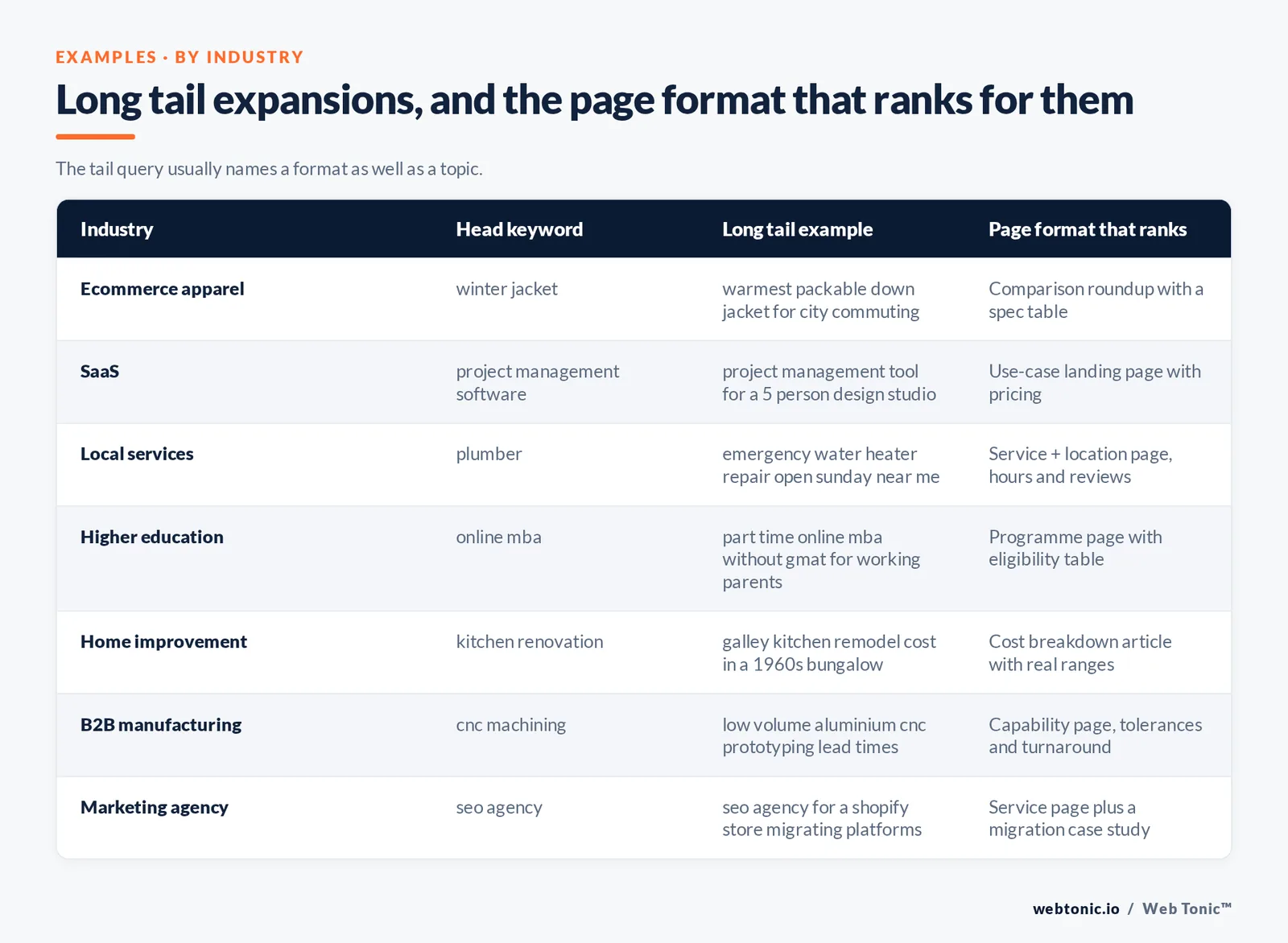
Specificity looks different in each vertical. These examples show the head term, the tail expansion, and the page format that usually wins the tail query.
| Industry | Head keyword | Long tail example | Page format that ranks |
|---|---|---|---|
| Ecommerce apparel | winter jacket | warmest packable down jacket for city commuting | Comparison roundup with a spec table |
| SaaS | project management software | project management tool for a 5 person design studio | Use-case landing page with pricing |
| Local services | plumber | emergency water heater repair open sunday near me | Service + location page with hours and reviews |
| Healthcare | back pain | lower back pain after sitting all day at a desk | Symptom explainer reviewed by a clinician |
| Higher education | online mba | part time online mba without gmat for working parents | Programme page with eligibility table |
| Finance | business loan | equipment financing for a first year contractor | Guide with a qualification checklist |
| Home improvement | kitchen renovation | galley kitchen remodel cost in a 1960s bungalow | Cost breakdown article with real ranges |
| B2B manufacturing | cnc machining | low volume aluminium cnc prototyping lead times | Capability page with tolerances and turnaround |
| Travel | japan itinerary | 10 day japan itinerary with toddlers and no car | Day-by-day guide with a map |
| Marketing agency | seo agency | seo agency for a shopify store migrating platforms | Service page plus a migration case study |
Notice the pattern in the right column: none of these are 400-word blog posts. The tail query usually names a format as well as a topic — cost, comparison, checklist, itinerary — and matching that format matters as much as matching the words.
How to use long tail keywords in content
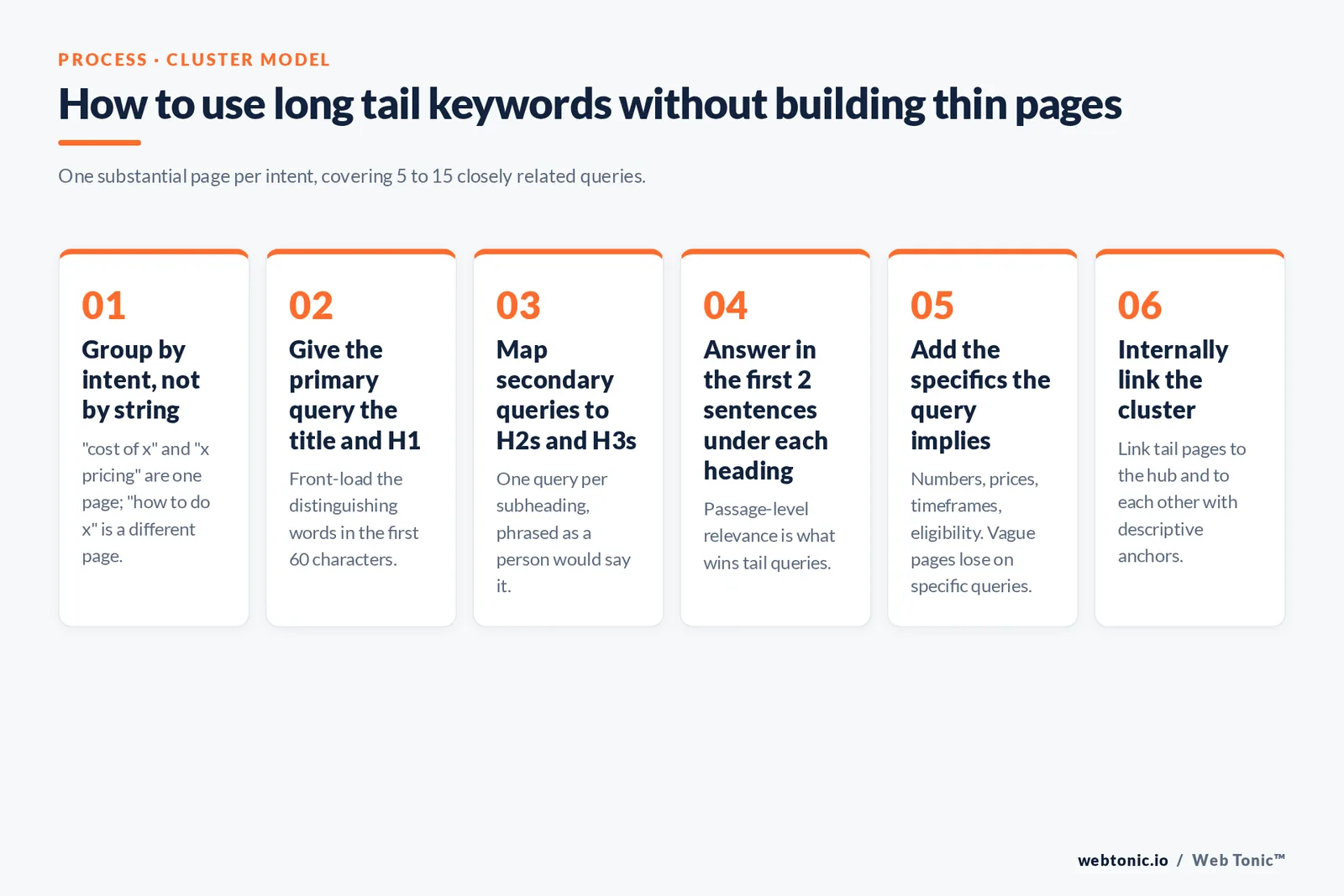
The old approach of one page per keyword produces thin pages that cannibalise each other. The workable model is clusters: one substantial page per intent, covering 5 to 15 closely related long tail queries through its subheadings, tables and FAQ.
- Step 1 — Group by intent, not by string. "cost of x" and "x pricing" are one page; "how to do x" is a different page.
- Step 2 — Give the primary query the title and H1. Front-load the distinguishing words in the first 60 characters, since the title link is what gets truncated in results.
- Step 3 — Map secondary queries to H2s and H3s. One query per subheading, phrased as a person would say it.
- Step 4 — Answer in the first 2 sentences under each heading. Passage-level relevance is what wins tail queries.
- Step 5 — Add the specifics the query implies. Numbers, prices, timeframes, eligibility. Vague pages lose to specific ones on specific queries.
- Step 6 — Internally link the cluster. Link the tail pages to the hub and to each other with descriptive anchors.
- Limit 1: never repeat the exact phrase more than the prose naturally allows — keyword stuffing is a documented spam signal, not a ranking tactic.
On-page mechanics still matter alongside the mapping. The fundamentals set out in Moz's beginner's guide to SEO and the standard on-page references — descriptive titles, clean URLs, one clear topic per page, useful internal links — apply unchanged. And because the title is what searchers actually judge, Google's documentation on how title links are generated is worth reading before you write another headline.
How to prioritise a long tail list
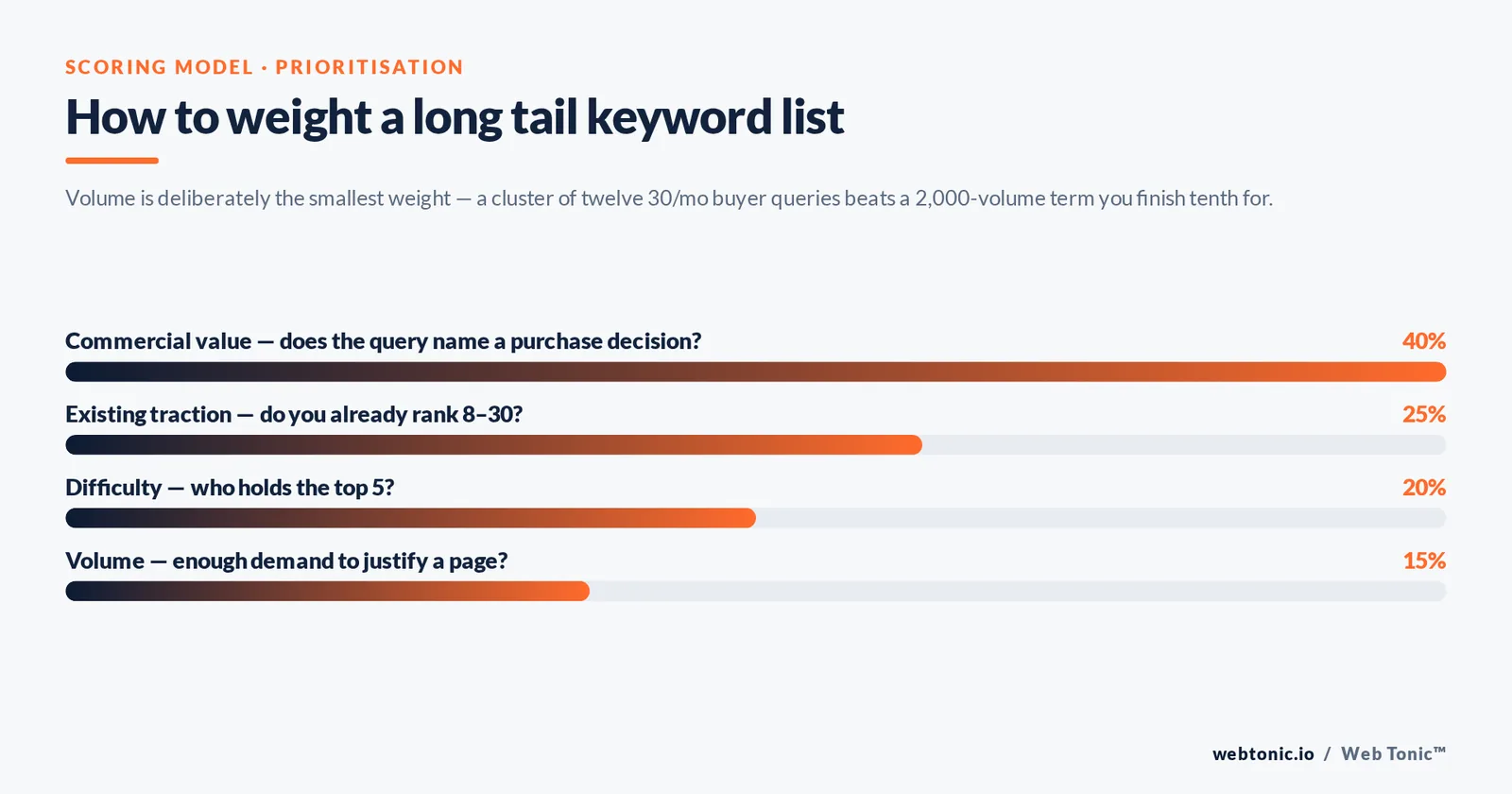
A raw export of 800 tail queries is not a plan. Score each one on four factors and work top-down.
| Factor | What to check | Weight | Fast test |
|---|---|---|---|
| Commercial value | Does the query name a purchase decision? | 40% | Are there ads on the SERP? |
| Existing traction | Do you already rank 8–30? | 25% | Search Console filter |
| Difficulty | Who holds the top 5? | 20% | Any forum or small site in the top 5 means it is winnable |
| Volume | Enough demand to justify a page? | 15% | Cluster of 5+ queries totalling 200+/mo |
Volume is deliberately the smallest weight. A cluster of twelve queries at 30 searches a month each is 360 monthly searches with buyer intent and almost no competition, which will usually outperform a single 2,000-volume head term you finish tenth for. The 15% weighting stops volume from silently dominating the ranking, which is the default failure mode of most spreadsheets. Wiring the scoring into a live dashboard rather than a static sheet is where data intelligence work pays for itself.
Realistic effort estimates matter too. Industry surveys such as the Orbit Media blogger survey put the average post at 1,333 words and about 3.5 hours of work, and only 21% of bloggers report strong results — a reminder that publishing volume alone is not the strategy. Fewer, better-targeted cluster pages beat a high-frequency schedule aimed at nothing in particular. This is the core of how we approach growth marketing content programmes, and the same prioritisation logic drives the work covered across our blog.
Long tail keywords in paid search and AI search
The tail behaves differently in Google Ads. Broad match plus smart bidding now absorbs much of the tail automatically, so building thousands of exact-match tail keywords is largely obsolete. What still pays is mining the search terms report for tail queries that convert, then either giving them their own ad group with matching copy or adding the non-converting ones as negatives.
Generative and AI-assisted results change the calculation again. Conversational queries are longer by nature, which pushes even more demand into the tail, and answers are assembled from passages that directly address a specific question. Structured, specific, well-sourced sections are therefore the unit of optimisation — a point running through Google's own search product announcements and reflected in how modern tail keyword research workflows are built. Practitioner guides such as Backlinko's long tail walkthrough and the paid-search literature land on the same conclusion from different directions.
The practical read-across: write the page so any single H2 could stand alone as a complete answer. That serves classic rankings, featured snippets and AI summaries at once, and it costs nothing extra at drafting time.
FAQ
What is a long tail keyword, in simple terms?
A long tail keyword is a longer, more specific search phrase — usually three or more words — with a low individual search volume but a very clear intent. "Coffee maker" is a head term; "best cold brew coffee maker for a small kitchen" is a long tail keyword. Each one attracts fewer searchers, but the people who do search are further along in their decision, which is why tail traffic converts at higher rates.
How many words make a keyword long tail?
Word count is a rough proxy rather than a rule. Three or more words is the common threshold, but the real test is specificity and search volume: a two-word query in a narrow B2B niche can behave exactly like a long tail keyword if it has low volume, low difficulty and unambiguous intent. Judge by difficulty and intent, not length alone.
How do I find long tail keywords for free?
Start with Google Search Console and filter for queries where you already earn impressions at average positions between 8 and 30. Then use Google autocomplete and the People Also Ask box for the phrasings real searchers use, check your own internal site search logs, read forum and review threads in your niche, and confirm direction with Google Trends. These five free sources cover most of what a paid tool returns for tail research.
Should I create a separate page for every long tail keyword?
No. Building one thin page per query creates cannibalisation, where several of your own pages compete for the same result and none of them wins. Group five to fifteen closely related queries that share an intent into a single substantial page, then use subheadings, tables and an FAQ to address each variation. One strong page beats twelve weak ones.
Do long tail keywords still matter with AI search results?
They matter more. Conversational and voice queries are longer and more specific by nature, so search demand keeps shifting into the tail, and AI-generated answers are assembled from passages that directly address a specific question. Pages built as a set of clearly headed, self-contained answers are exactly what both classic rankings and generated summaries draw from.
Sources
Google Search Central, SEO starter guide and title link documentation · Google Search Console Help, performance report · Google Ads Help, Keyword Planner keyword ideas · Google Trends · Google, The Keyword search product blog · Moz, Beginner's Guide to SEO · Backlinko, long tail keywords guide · Ahrefs blog, long tail keyword research · Orbit Media Studios, Annual Blogger Survey (1,333-word average post, ~3.5 hours, 21% reporting strong results) · Wikipedia, the long tail distribution. All sources accessed August 2026.