Table of contents
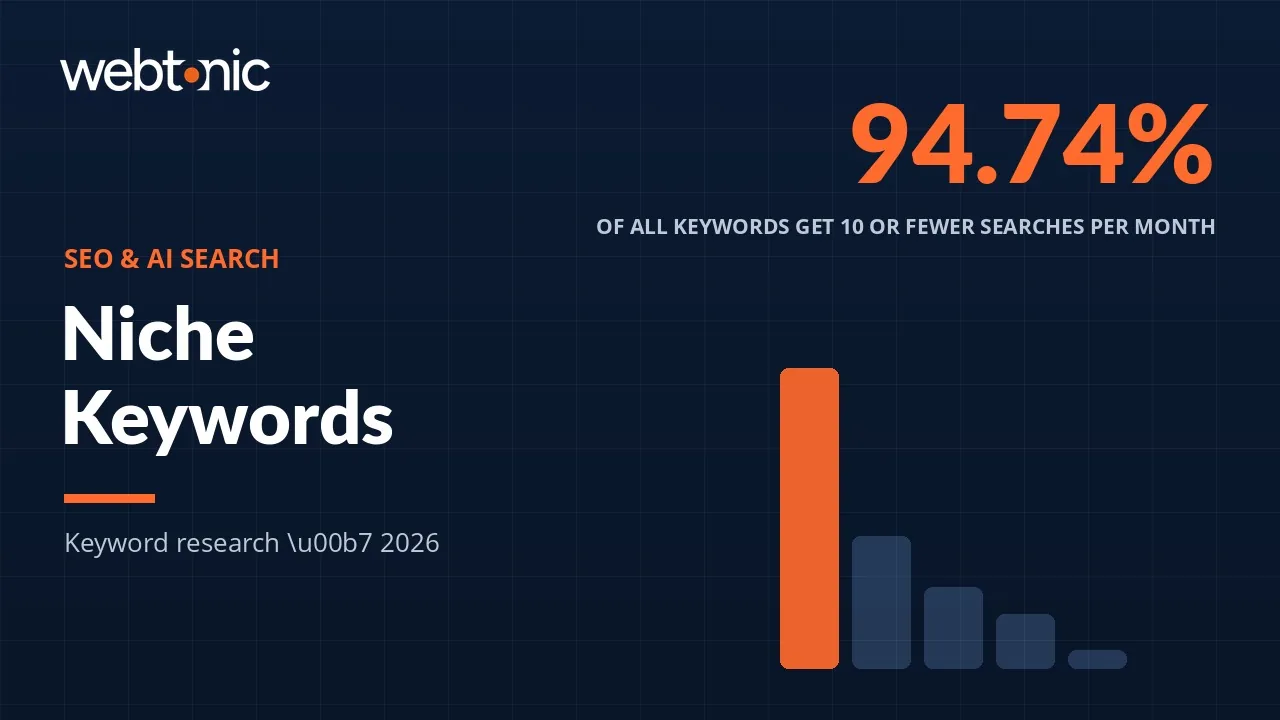
A niche keyword is a narrow, specific search phrase used by a small, self-selecting audience — usually 10 to 300 US searches a month, with buying intent that a head term never carries. The point is not that it is small. The point is that the searcher has already made most of the decision.
Key Takeaways
- 94.74% of all keywords get 10 or fewer searches per month, so the niche tail is not an edge case — it is almost the entire index.
- Only 0.0008% of keywords exceed 100,000 monthly searches, which is where every competitor is fighting.
- 46.08% of Search Console clicks come from queries Google hides in the performance report, meaning your best niche terms are partly invisible by design.
- Keyword Planner overestimates volume 54.28% of the time, so a "0 volume" niche term is often a real term with real clicks.
- A niche keyword is qualified on 5 signals, not one: intent, revenue proximity, SERP softness, coverage gap, and cluster fit.
- 15% of daily Google searches have never been seen before, so a niche list needs a monthly refresh, not an annual rebuild.
What actually makes a keyword "niche"
Three properties have to be true at once. Miss one and you have a low-volume term that will never pay you back rather than a niche keyword worth a page.
| Property | What it looks like | Test you can run in 60 seconds |
|---|---|---|
| Narrow audience | The phrase only makes sense to one job, industry or use case | Would a stranger outside your market type this? If yes, it is not niche |
| Explicit intent | The searcher names a product, constraint, price or outcome | Does the phrase imply the next action? 3 words minimum is typical |
| Thin supply | The top 10 results are forums, aggregators or partial answers | Count real dedicated pages in the top 10 — under 4 is a gap |
Ahrefs' keyword research guide frames research as demand discovery; the niche filter is what you apply after demand exists. Moz's beginner keyword chapter makes the same distinction between what people search and what you can realistically win.
Niche keywords vs long tail vs low competition: three different things
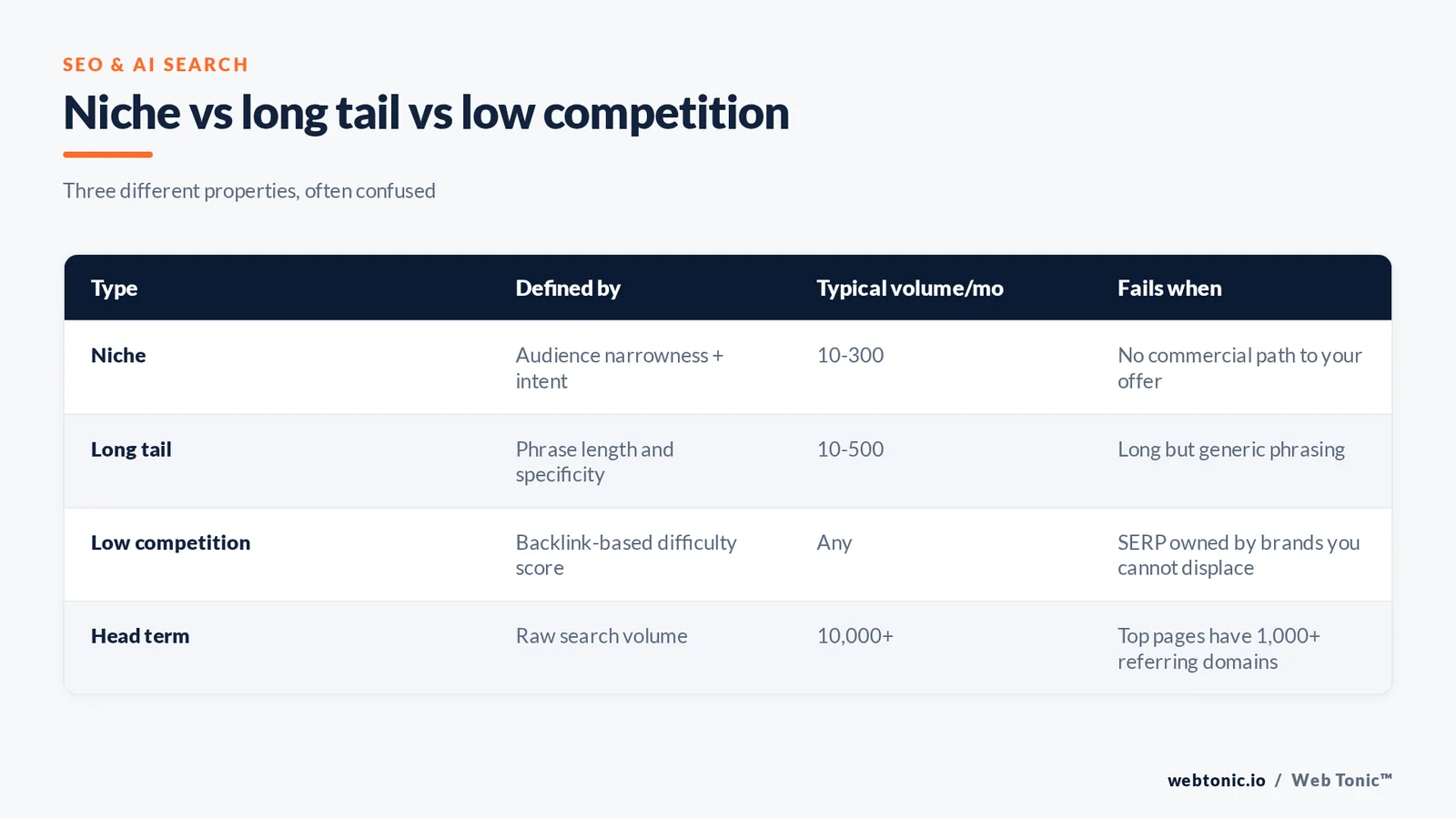
These get used interchangeably and they are not the same. Length is a shape, difficulty is a competitive score, and niche is about audience narrowness. A phrase can be long and still brutally hard.
| Type | Defined by | Typical monthly volume | Fails when |
|---|---|---|---|
| Long tail | Word count and phrase specificity | 10-500 | The phrase is long but generic, e.g. a 5-word question anyone might ask |
| Low competition | Difficulty score from backlink profiles | Any volume | Difficulty is under 20 but the SERP is owned by brands you cannot displace |
| Niche | Audience narrowness plus intent | 10-300 | There is no commercial path from the query to your offer |
| Head term | Raw volume | 10,000+ | You publish against sites with 1,000+ referring domains and rank nowhere |
Ahrefs explains Keyword Difficulty is explicit that difficulty is scored from the backlink profiles of top-ranking pages, not from your ability to win. A KD 5 keyword inside a SERP full of category giants is still a loss. See our breakdown of long tail keywords for the shape question, and SEO keywords for the wider research process.
The 5-signal qualification test
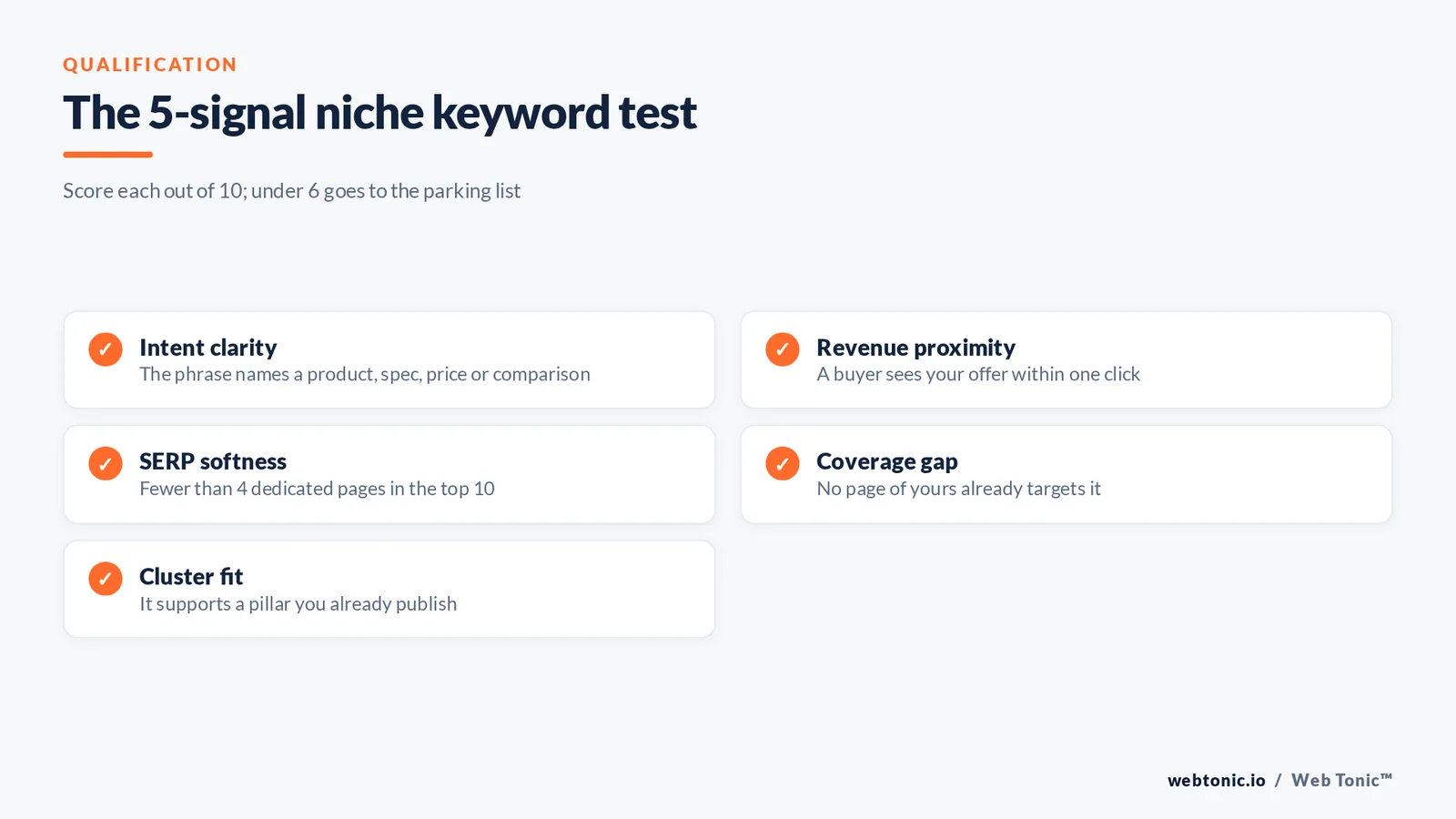
Score every candidate out of 10. Anything under 6 goes in a parking list, not a content calendar. This is the difference between a niche list and a spreadsheet of noise.
| Signal | Score 2 when | Score 0 when | Weight |
|---|---|---|---|
| Intent clarity | The phrase names a product, spec, price or comparison | It is a curiosity question with no next step | Highest |
| Revenue proximity | A buyer would see your offer within 1 click | The path to money needs 3+ steps | High |
| SERP softness | Fewer than 4 dedicated pages in the top 10 | Every result is a dedicated, updated page | High |
| Coverage gap | No existing page of yours targets it | You already rank top 20 for it | Medium |
| Cluster fit | It supports a pillar you already publish | It is an orphan topic | Medium |
Rule 1 — a niche keyword with a 2 on revenue proximity beats a keyword with 5x the volume and a 0. Volume is the cheapest signal on the list and the only one most teams use.
Where niche keywords actually hide: 9 sources
Seed keywords from a tool give you the same list your competitors bought. The sources below give you phrases the tools have not modelled yet — WordStream's free keyword tool and paid suites both start from crawled corpora, so anything spoken this month is missing.
| Source | What to extract | Why it beats a tool export |
|---|---|---|
| Google autocomplete | Suffix and prefix variants typed by real users | Reflects live query volume, not a database snapshot |
| People Also Ask | Question phrasing and sub-intents | Google is telling you the sub-questions it wants answered |
| Search Console queries | Terms you already get impressions for at position 11-30 | These are proven, attributable, and already half-ranked |
| Community threads | The words practitioners use, not marketers | Vocabulary mismatch is the #1 cause of missed niches |
| Marketplace search | Product qualifiers, sizes, compatibility phrases | Commercial by construction |
| Sales call notes | Objections and constraints stated verbatim | Highest revenue proximity of any source |
| Support tickets | Problem phrasing after purchase | Feeds retention content that also ranks |
| Competitor site search | Their internal search terms if exposed | Demand they see and do not serve |
| Google Trends | Rising related queries in a region | Catches terms before volume registers |
Google Trends deserves care: Google's own note on how Trends data is scaled confirms the index is scaled 0-100 relative to the period and geography, and low-volume terms simply display as zero. Use it for direction, never for absolute demand.
Mining Search Console for niche keywords you almost rank for
This is the highest-yield hour in niche keyword research and almost nobody runs it monthly. The Google Search Console performance report already holds the terms Google associates with you.
| Filter | Setting | What it surfaces | Action |
|---|---|---|---|
| Position | Between 8 and 30 | Terms one content upgrade from page one | Add a section to the ranking URL |
| Impressions | Above 50, clicks under 3 | Demand you attract but do not convert | Rewrite the title and intro |
| Query contains | A product qualifier or modifier | Niche variants of a head term you own | Build a child page |
| Pages | One URL, all queries | Accidental keyword spread | Split if intents conflict |
| Comparison | Last 3 months vs previous | New phrasing entering the market | Fast-publish a short answer page |
Limit 2: Search Console caps its query rows and anonymises rare queries, and roughly 46% of clicks sit in that hidden bucket. Treat the report as a floor on your niche demand, never a census.
Niche keyword examples across 10 industries
The pattern to copy: head term, then the constraint a real buyer adds. The constraint is the niche.
| Industry | Head term (avoid) | Niche keyword (target) | Constraint added |
|---|---|---|---|
| Dental | dentist | emergency root canal same day appointment | Urgency |
| SaaS | project management software | project management software for construction subcontractors | Vertical |
| Ecommerce | running shoes | wide toe box trail running shoes for flat feet | Fit spec |
| Legal | personal injury lawyer | rideshare accident passenger claim deadline | Scenario |
| Home services | roofing company | metal roof cost per square foot in coastal climates | Cost plus condition |
| B2B manufacturing | industrial pumps | food grade sanitary diaphragm pump specifications | Compliance |
| Finance | accounting services | cash basis to accrual conversion for ecommerce sellers | Task |
| Fitness | personal trainer | postnatal core rehab trainer certification | Population |
| Travel | hotels near airport | layover hotel with day rate and shuttle | Use case |
| Education | online courses | part time bookkeeping certificate for career changers | Learner state |
Tools compared for niche discovery, not head-term volume
Every tool is competent at head terms. They separate on tail coverage and on whether they show zero-volume phrases at all. Google's Keyword Planner documentation confirms Planner reports ranges and averages built for ad forecasting.
| Tool type | Tail coverage | Shows near-zero volume | Best used for |
|---|---|---|---|
| Keyword Planner | Ad-oriented, grouped ranges | Rarely — buckets to 0 | CPC signal and commercial proof |
| Full SEO suite | Large crawled databases | Yes, with estimates | Building the raw candidate pool |
| Free keyword tools | Top 25 results typical | Sometimes | Fast first pass on a new market |
| Search Console | Your own impressions only | Yes for shown rows | Terms you already half-own |
| Autocomplete scrapers | Live suffix expansion | No volume at all | Discovering phrasing |
| Trends | Relative index only | Displays 0 below threshold | Direction and seasonality |
Google Keyword Planner still earns its place because CPC is a commercial vote: a niche phrase with a real cost per click has proven buyers. Cross-check volume, though — Planner's estimates run high more often than not.
Turning a niche list into a topical cluster
Isolated niche pages underperform. Ahrefs on topical authority makes the case for depth across a subject, and the mechanics matter: the average top-ranking page also ranks in the top 10 for roughly 1,000 other keywords, which only happens when a page sits inside a coherent body of work.
| Layer | What it targets | Page count | Internal linking rule |
|---|---|---|---|
| Pillar | The broad commercial term | 1 | Links down to every child |
| Sub-topic | A mid-tail decision term | 3-6 | Links up to pillar, sideways to peers |
| Niche page | One specific query and its variants | 10-40 | Links up to its sub-topic only |
| Proof asset | Data, template or calculator | 1-3 | Linked from every layer |
Rule 2 — group niche keywords by answer, not by string similarity. If two phrases need the same page to be satisfied, they are one page. Splitting them creates cannibalisation and halves both.
How many niche pages does it take to move traffic
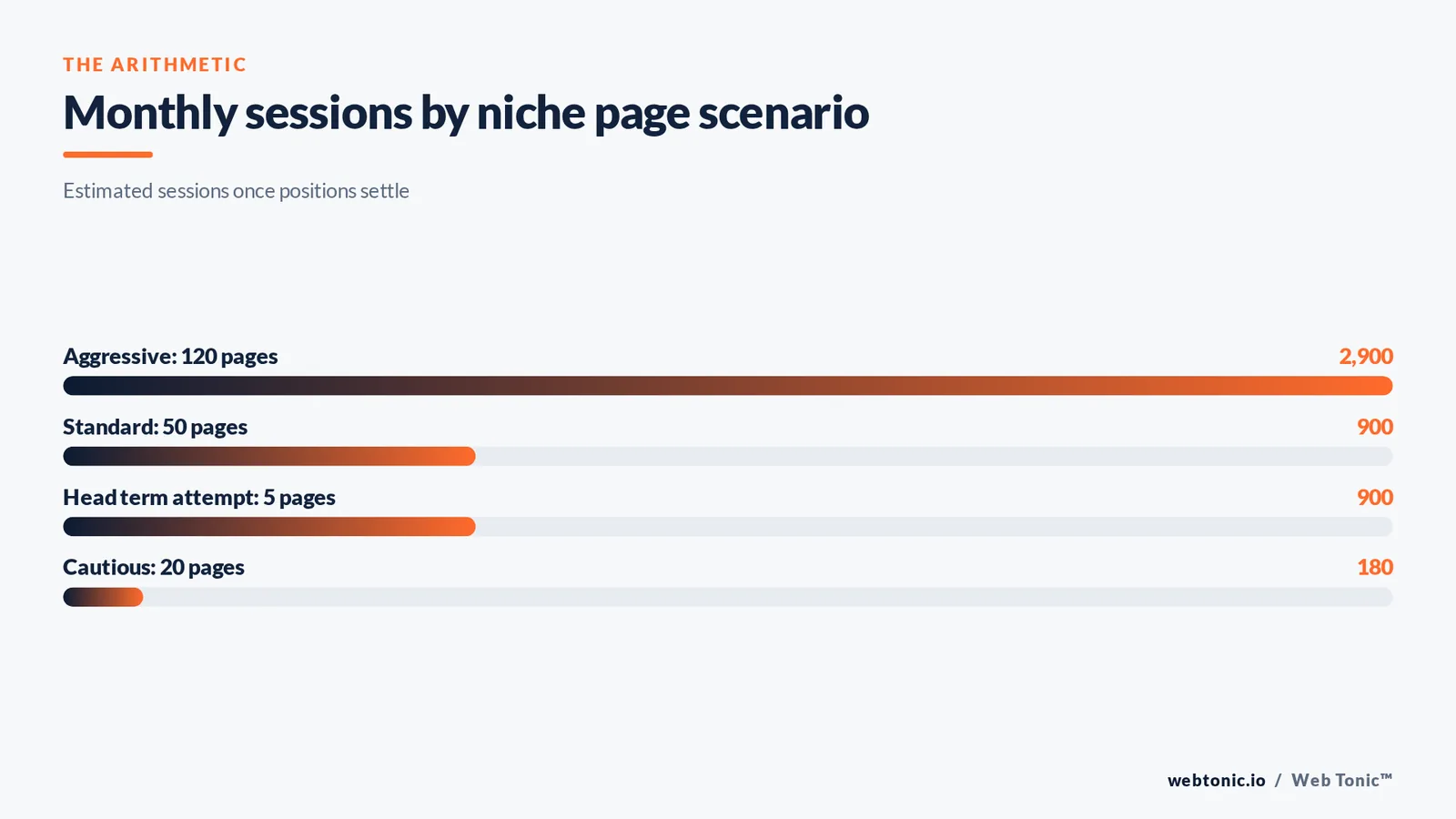
Run the arithmetic before committing a quarter to the tail, because the model only works at volume.
| Scenario | Pages | Avg volume each | Realistic CTR at won positions | Monthly sessions |
|---|---|---|---|---|
| Cautious | 20 | 60 | 15% | ~180 |
| Standard | 50 | 90 | 20% | ~900 |
| Aggressive | 120 | 110 | 22% | ~2,900 |
| Head-term attempt | 5 | 18,000 | 1% if you rank at all | ~900 at best |
Fact 3 — only 5.7% of new pages reach the top 10 within a year, and 72.9% of pages that do are over three years old. Niche keywords are the shortcut around that queue, not an exception to it.
Writing the page so it wins the narrow query
A niche query punishes padding. Google's helpful-content guidance is unusually direct about people-first content, and a specific query makes the test easy: answer it in the first two sentences or lose the click.
| Element | Niche keyword page | Head term page |
|---|---|---|
| Intro length | 2 sentences with the direct answer | Context setting |
| Word count | 900-1,600 is often enough | 2,500+ |
| Title | Exact phrasing plus the constraint | Broad benefit framing |
| Structure | One question per H2 | Full topic map |
| Proof | One number, one example | Multiple studies |
| Conversion | A single next step | Soft nurture |
Trap 1 — stuffing a niche phrase into 12 places. The term is narrow, so 2-4 natural placements (title, intro, one H2, one FAQ) is the whole budget.
Niche keywords in paid search and AI answers
The same list feeds two other channels. In paid search, niche phrases sit in exact and phrase match where CPCs are cheap and conversion rates are high; in AI answers, they are the questions models can actually attribute. Ahrefs' long tail analysis notes the tail's cost advantage holds in both.
| Channel | How the niche list is used | Metric that proves it |
|---|---|---|
| Paid search | Exact-match ad groups on 10-30 phrases | Cost per conversion vs account average |
| Organic | One page per qualified query | Position 1-5 and click share |
| AI answers | Structured, quotable answers with sources | Citations and referral sessions |
| Internal search | Site search terms fed back into content | Zero-result searches trending down |
Limit 4: AI Overviews cut clickthrough for the top organic result by roughly 58% on affected queries, so build niche pages that earn a click through depth and tools, not summary answers a model can restate.
Six traps that kill a niche keyword programme
| Trap | What it costs | Fix |
|---|---|---|
| Chasing volume anyway | 90% of effort on unwinnable SERPs | Cap the list at difficulty you have earned |
| One page per string | Cannibalisation across 3-5 URLs | Group by answer, one page each |
| Zero-volume dismissal | Missing terms Planner rounds to 0 | Validate with autocomplete and CPC data |
| No refresh cadence | Stale list within 2 quarters | Monthly Search Console pass |
| Thin pages | No ranking, no trust | 900-word floor with real specifics |
| No conversion path | Traffic with 0 revenue | One offer per page, matched to intent |
If you want this run as a system rather than a spreadsheet, our growth marketing and data intelligence teams build the cluster map and the reporting together. More research playbooks sit on the Web Tonic blog, and you can talk to us if you want the first pass audited.

FAQ
What is a niche keyword?
A niche keyword is a specific search phrase used by a narrow audience, typically 10 to 300 US searches per month, that carries clear intent. Its value comes from buyer specificity and weak competing supply rather than volume.
Are niche keywords the same as long tail keywords?
No. Long tail describes phrase length and specificity, while niche describes how narrow the audience is. Most niche keywords are long tail, but a long five-word question that anyone might ask is not niche.
How do I find niche keywords with zero search volume?
Use sources tools have not modelled: Google autocomplete, People Also Ask, community threads, marketplace search boxes, and your own Search Console queries. Keyword Planner rounds many real terms to zero, so validate demand with CPC data and live autocomplete instead.
How many niche keyword pages do I need to see results?
Around 50 qualified pages at roughly 90 searches each is the point where the arithmetic becomes visible, producing a few hundred to a few thousand monthly sessions once positions settle. Twenty pages is a test, not a programme.
Do niche keywords still work with AI Overviews in search results?
Yes, but the page has to earn the click. Specific queries are where models cite sources, and pages with original data, tools or worked examples keep their clickthrough while summary-style pages lose it.