Table of contents
Paid search conquesting means bidding on a competitor brand name so your ad appears when someone searches for them. It is legal in most cases, allowed by Google, and reliably more expensive than your own branded search.
Key Takeaways
- Google restricts trademarks in ad text, not in keyword targeting — the mark must appear in the ad itself before a complaint can restrict it.
- Policy warnings arrive at least 7 days before any suspension, so a mistake in copy is recoverable if you monitor notifications.
- Expect a lower Quality Score on competitor brand terms: the 1-10 score compares you to advertisers shown for the same query in the past 90 days.
- Benchmark against $5.42 CPC and a 6.64% CTR; conquesting rows typically run 2-4x the CPC of your own brand terms at a fraction of the CTR.
- Budget a 90-day test before judging results — one month of data on a low-volume brand term proves nothing.
- Defence matters more than offence: owning your own brand terms is usually the cheapest conversion in the account.
What conquesting is, and what it is not
A conquesting campaign targets demand that already has a preferred vendor. Instead of bidding on category terms where nobody has decided yet, you bid on the exact moment a person types a rival's name. The intent is high, the loyalty is not yours, and the click is contested.
| Strategy | What you target | Buyer state | Typical cost position |
|---|---|---|---|
| Own brand defence | Your own company name | Already chose you | Cheapest clicks in the account |
| Category search | Generic problem or product terms | Undecided | Mid to high, high volume |
| Conquesting | Rival company and product names | Chose someone else | Highest CPC, lowest CTR |
| Comparison capture | Rival name plus alternatives or versus | Actively comparing | Best value of the 3 contested plays |
| Audience retargeting | People who visited you | Warm | Low CPC, small reach |
The most misread row is the fourth. Comparison queries convert 2-3x better than bare brand-name queries in most accounts, because the searcher has already admitted they are shopping around. Bidding on the pure brand name of a market leader is the version of the tactic that burns money quietly. Our broader research workflow lives in how to see competitor ads.
The policy line, read carefully
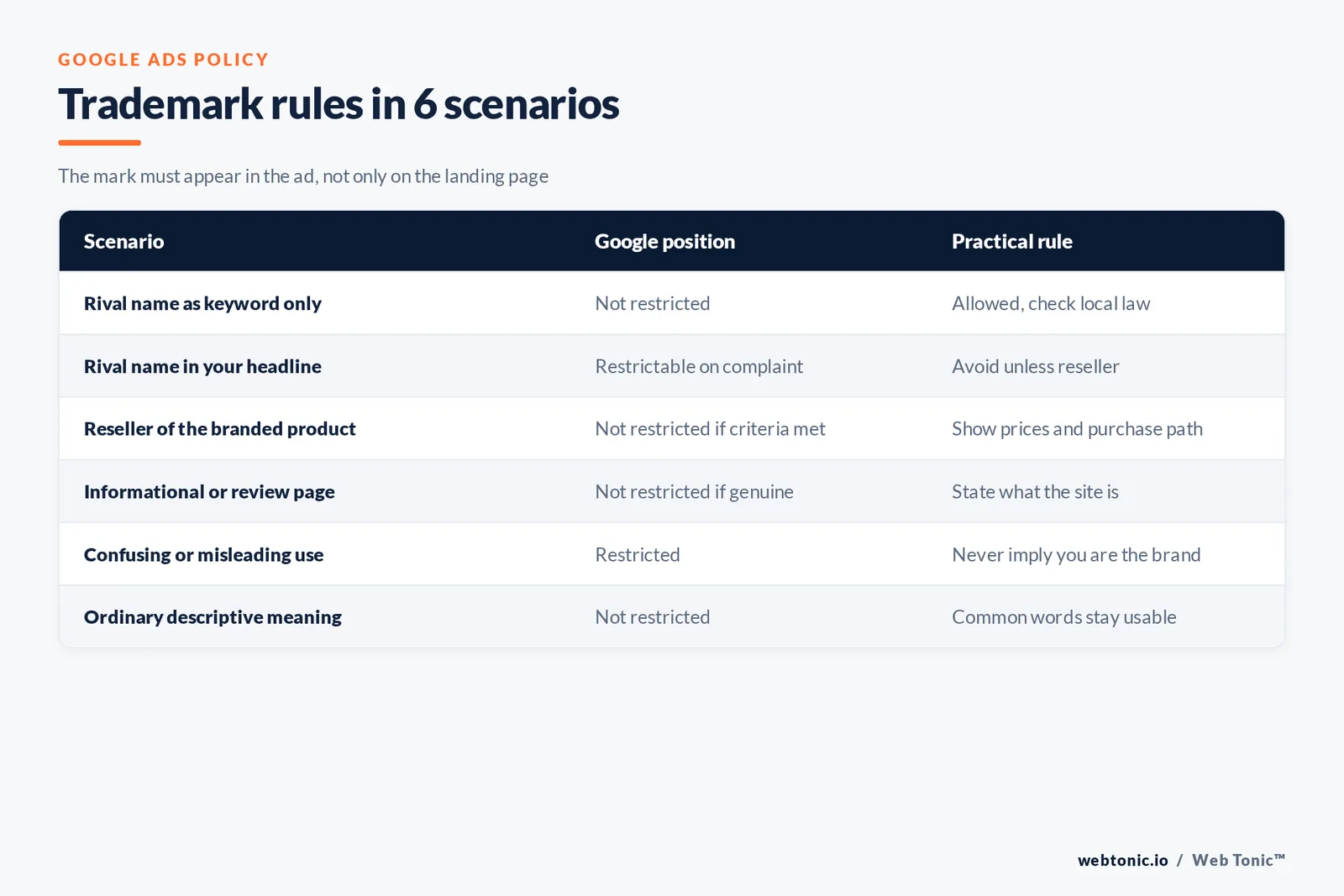
Google's trademark policy is more permissive than most marketers assume, and its key sentence is about placement: when a complaint is reviewed, the trademark must be used in the ad, not only on the landing page. Bidding on the term as a keyword is not itself the trigger.
| Scenario | Google position | Practical rule |
|---|---|---|
| Rival name used only as a keyword | Not restricted by the ad-text rule | Allowed, still check local law |
| Rival name inside your headline | Restrictable on complaint | Avoid unless you are a reseller |
| Reseller selling the branded product | Not restricted if criteria are met | Show prices and purchase path |
| Informational or review page | Not restricted if genuinely informative | Be explicit about what the site is |
| Confusing or misleading use | Restricted | Never imply you are the brand |
| Descriptive ordinary-meaning use | Not restricted | Common words stay usable |
Two operational details matter. Complaints are accepted only against specific advertisers identified by URL, within the countries and industries where the owner has demonstrated rights, and restrictions then apply to any ad using the same second-level domain. And because warnings precede suspension by 7 days or more, the realistic worst case for a copy error is a disapproval, not a dead account.
Trademark law sits above ad policy, so verify status before you write anything: the USPTO trademark basics pages explain what a registration covers, and the USPTO search tool confirms whether a name is registered in the relevant class. Comparative claims fall under advertising law generally, summarised in the FTC guidance on online advertising: any comparison must be truthful and substantiated.
Why the clicks cost more: the auction math
You are bidding on a query where the brand owner has an unbeatable relevance advantage. Quality Score is reported at keyword level on a 1-10 scale built from expected click-through rate, ad relevance and landing page experience, each graded against advertisers who showed for that same query in the last 90 days. On a rival's name, all 3 components work against you.
| Auction factor | Brand owner | You, conquesting | Consequence |
|---|---|---|---|
| Expected click-through rate | Very high, name matches ad | Low, name is absent | Higher cost per click for you |
| Ad relevance | Exact, page equals brand | Partial at best | Below-average label likely |
| Landing page experience | Their own homepage | Your comparison page | Fixable, the only lever you own |
| Bid needed for a top slot | Modest | Materially higher | Ad Rank gap must be bought |
| Conversion rate | High, loyal traffic | Lower, switching required | Longer payback |
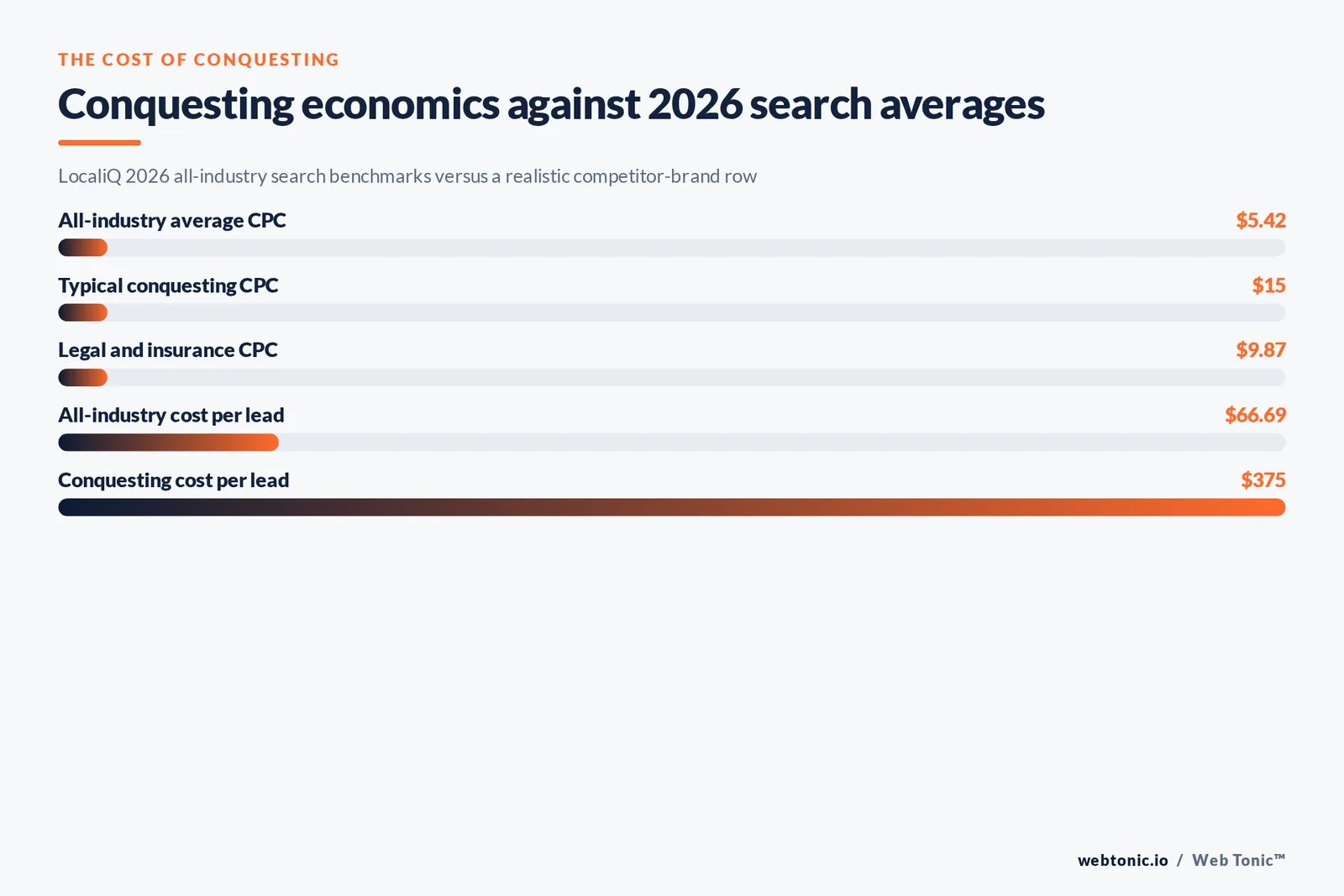
Against LocaliQ's 2026 all-industry search averages of $5.42 CPC, 6.64% CTR, 8.18% conversion rate and $66.69 cost per lead (LocaliQ benchmarks), a realistic conquesting row runs a CPC of $11 to $22 with a click-through rate nearer 1.5% to 3%. At a 4% conversion rate, 250 clicks at $15 is $3,750 for 10 leads, or $375 each — roughly 5.6x the all-industry cost per lead. That is the number to compare against your customer lifetime value, not against your account average. Legal and insurance advertisers, where CPCs already reach $9.87, feel it hardest; the pattern is visible in our breakdown of the most expensive keywords.
When conquesting is worth it, by situation
| Situation | Verdict | Why |
|---|---|---|
| High lifetime value, contract-based service | Test it | One win pays for many wasted clicks |
| Rival has a public outage or price rise | Test it now | Switching intent spikes briefly |
| You genuinely win a feature comparison | Strong fit | Comparison page can carry the click |
| Low-margin ecommerce under $50 orders | Skip | Payback maths rarely works |
| Market leader with 10x your brand demand | Skip the bare name | Bid on alternatives and versus queries only |
| Your own brand terms are unprotected | Fix that first | Cheaper conversions sit unclaimed |
| Small local market with 3 rivals | Careful yes | Volume is thin, escalation risk is high |
Building the campaign in 7 steps
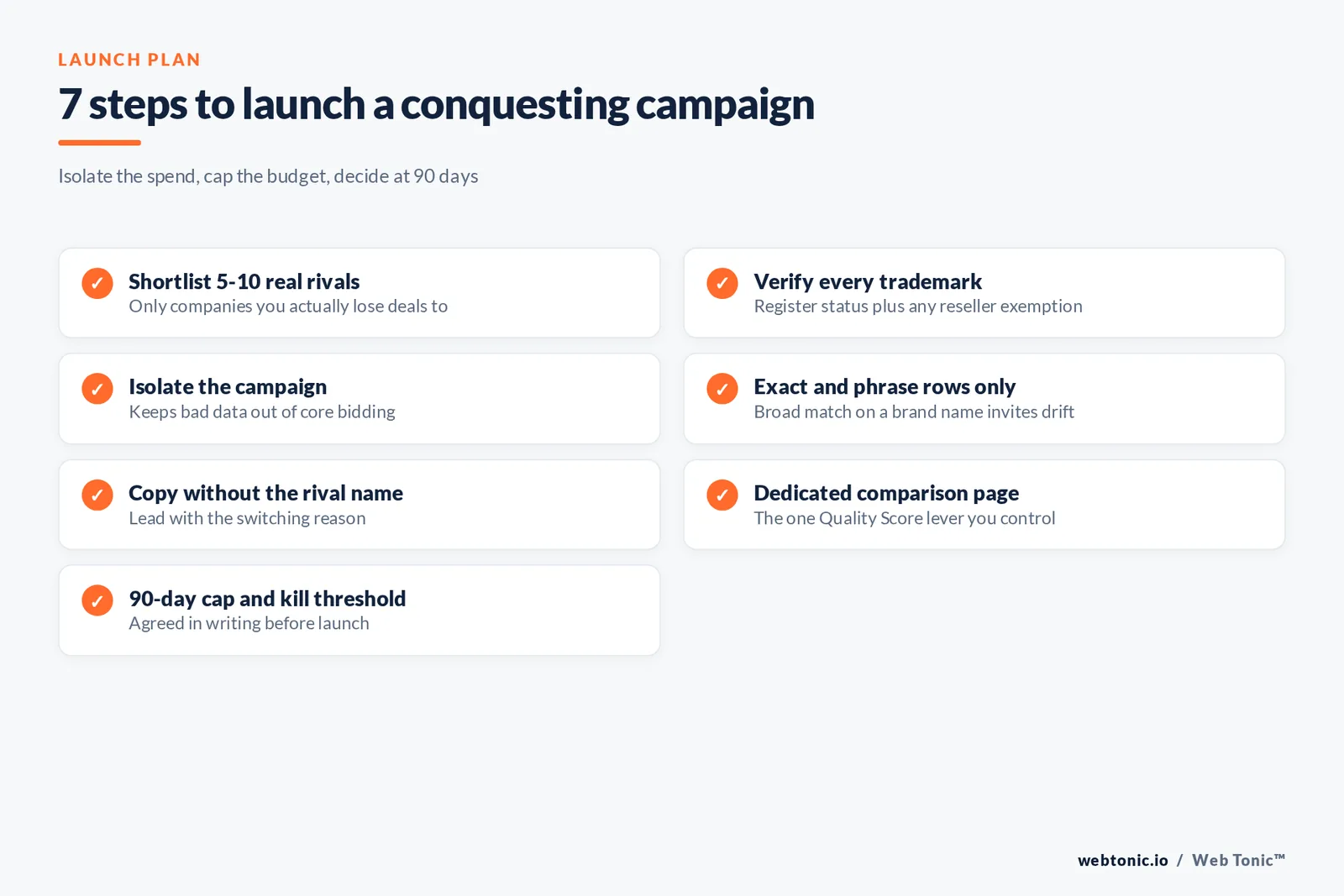
- Shortlist 5-10 rivals you actually lose deals to, not everyone in the category.
- Verify each mark in the trademark register and note any reseller or informational exemption that applies to you.
- Isolate the spend in its own campaign so a bad month cannot distort your core budget or bidding data.
- Use exact and phrase rows only; broad match on a brand name invites variant expansion into irrelevant queries. See match type documentation and our guide to negative keywords for the exclusions this needs.
- Write copy without the rival name — lead with the switch reason, and follow the text ad requirements for length limits.
- Build a dedicated comparison page, because landing page experience is the one Quality Score component you fully control.
- Set a 90-day budget cap and a kill threshold in writing before launch.
| Step | Owner | Time needed | Deliverable |
|---|---|---|---|
| Rival shortlist | Sales plus marketing | 1 to 2 hours | Ranked list of 5-10 names |
| Trademark check | Marketing | 1 hour | Cleared list with notes |
| Campaign build | Paid media | 2 to 3 hours | Isolated campaign, exact rows |
| Copy set | Copywriter | 2 hours | 3 ads per ad group, no rival names |
| Comparison page | Web plus content | 1 to 2 weeks | Fair, sourced comparison |
| Measurement setup | Analytics | 1 hour | Separate reporting view |
| 90-day review | Whole team | 1 hour | Scale, hold or stop decision |
Copy rules for competitor terms
The ad has to earn a click from someone who typed another company's name. Naming that company is the tempting shortcut and the one clear policy risk, so the craft goes into the switch reason.
| Angle | Example headline | Works because |
|---|---|---|
| Switch friction removed | Free migration in under 48 hours | Answers the real objection |
| Pricing transparency | Flat pricing, no setup fee | Attacks a common irritation |
| Proof of scale | Trusted by 1,200 teams | Borrowed credibility |
| Direct comparison invite | Compare features side by side | Matches comparison intent |
| Service promise | Human support answering in 5 minutes | Differentiates without naming anyone |
| Risk removal | 30-day trial, cancel anytime | Lowers the cost of trying you |
Three rules keep this safe and effective: never use the rival name in headlines or descriptions unless a documented exemption applies, keep every claim substantiated per the FTC guidance above, and send the click to a page that acknowledges the comparison honestly instead of pretending the searcher was looking for you.
Defending your own brand terms
Conquesting is a two-way street, and the defensive half usually earns more. If rivals bid on your name, an unclaimed top slot means paying nothing and losing a customer who was already asking for you by name.
| Defensive move | Effort | Effect |
|---|---|---|
| Always-on brand campaign | Low | Protects the highest-intent query you have |
| Brand plus reviews and pricing rows | Low | Captures comparison intent early |
| Sitelinks to pricing and support | Low | Occupies more of the results page |
| Monitor auction insights monthly | Low | Detects new attackers within weeks |
| File a trademark complaint on ad text | Medium | Only works if your mark is in their copy |
| Rank the comparison page organically | High | Earns the click without paying for it |
Google's own advice on showing among top ads applies with full force here: relevance is on your side for your own name, so defence is cheap. Skipping it to save a few hundred dollars is the most common false economy in Google PPC accounts.
Measuring a conquesting test properly
| Metric | Read it as | Warning level |
|---|---|---|
| Cost per acquisition versus target | The only pass or fail metric | Above 2x target after 90 days |
| Click-through rate | Message resonance, not quality | Under 1% means the copy is wrong |
| Conversion rate | Switching willingness | Under 1.5% means the offer is weak |
| Search terms report | Match hygiene | Any non-rival query drift |
| Assisted conversions | Delayed influence | Ignore below 30 conversions of data |
| Impression share lost to rank | Whether you are simply outbid | Above 60% means rethink, not rebid |
| Payback period | Cash reality | Longer than 12 months for a subscription |
Give it a fixed window. 90 days or 300 clicks per rival, whichever comes first, is enough to see a pattern; anything shorter and you are reading noise. Track it in a separate campaign so the numbers never blend into your category performance.
Escalation risk and how to avoid a bidding war
| Risk | What it looks like | Mitigation |
|---|---|---|
| Mutual retaliation | Rival starts bidding on your name | Model the cost of both sides before launching |
| Brand-term inflation | Your own brand CPC doubles | Keep defence funded and separate |
| Legal letter | Cease and desist over ad text | Keep names out of copy, keep records |
| Reputation cost | Public callout in your niche | Comparison must be fair and sourced |
| Data pollution | Smart Bidding learns from bad clicks | Isolated campaign and tight exclusions |
| Team distraction | Weekly obsession with 1 rival | Fixed review cadence, fixed budget |
The asymmetry to remember: a rival who retaliates on your brand name gets your cheapest, highest-converting query, while you got their expensive one. If your brand demand is materially larger than theirs, starting the fight is a bad trade even when your conquesting row looks profitable in isolation. WordStream's write-ups on conquesting and on finding competitor keywords walk through the scenarios where it goes wrong, and Search Engine Land's Google Ads library tracks the policy changes worth watching.
Six mistakes that make conquesting look worse than it is
- Broad match on a brand name. Variant expansion pulls in unrelated demand and buries the test in noise.
- Sending traffic to the homepage. The landing page is the only Quality Score component you control; wasting it costs on every click.
- Mixing it into an existing campaign. Blended data hides the real cost per acquisition and confuses automated bidding.
- Judging it in 14 days. Brand-name volume is thin; fewer than 100 clicks proves nothing either way.
- Naming the rival in the headline. The one action that turns a legal tactic into a policy complaint.
- Leaving your own brand undefended. Attacking while your cheapest query is unclaimed is the wrong order of operations.
FAQ
Is paid search conquesting legal?
Bidding on a competitor name as a keyword is generally permitted, and Google's trademark policy only restricts use of a mark when it appears in the ad itself, subject to a complaint from the owner. Trademark law still varies by country and industry, so verify registration and avoid any use that could confuse a searcher about who is advertising.
How much more does conquesting cost than normal paid search?
Plan for 2-4x your usual cost per click and a much lower click-through rate, because expected click-through rate and ad relevance both work against you on a rival's name. Against a $5.42 all-industry average, conquesting rows commonly land between $11 and $22 per click.
Can I mention a competitor in my ad copy?
Only if a documented exemption applies, such as a reseller selling the branded product with prices and a clear purchase path, or a genuinely informational site. Otherwise keep the name out of headlines and descriptions, and lead with your switching advantage instead.
How do I measure whether a conquesting campaign worked?
Isolate it in its own campaign and judge it on cost per acquisition against target over 90 days or 300 clicks per rival. Click-through rate and impression share only tell you why the result happened; they are not the pass or fail test.
Will a competitor retaliate if I bid on their brand?
Often, yes, and the trade is usually unfavourable to whoever starts it, since your own brand terms are the cheapest and highest-converting query in your account. Model both sides of the cost before launching, and keep your defensive brand campaign funded first.

Sources
Google Ads policy: trademarks. Google Ads Help: Quality Score, keyword matching options, text ad requirements, showing among top ads. USPTO: trademark basics and trademark search. FTC business guidance on online advertising and marketing. LocaliQ 2026 search advertising benchmarks. WordStream on paid search conquesting and competitor keywords. Search Engine Land Google Ads library. All URLs verified live in August 2026. Want the maths run on your own account before you launch? Talk to our growth marketing team or get in touch.