Table of contents

The most expensive keywords in Google Ads are the ones attached to the biggest lifetime customer value: insurance, legal, loans, treatment and enterprise software. Single clicks on the priciest terms are quoted above $100, and industry head terms average $27 to $55.
Key Takeaways
- Ahrefs' July 2026 ranking puts the top high CPC keywords at $100.00-$105.00 per click, on search volumes as low as 500/month.
- WordStream's classic 20 most expensive keywords list is led by "insurance" at $54.91 and "gas/electricity" at $54.62.
- Across 23 categories the all-industry average CPC is $5.42, so the expensive keywords sit roughly 10x above the market.
- Cost per click is set by competition, commercial intent and Quality Score — not by search volume.
- Small business advertisers beat high CPC keywords with long tail phrases, tight negative keywords and geographic narrowing rather than bigger bids.
What makes a keyword expensive
Google Ads runs an auction for every search. You are never charged your maximum bid: the actual cost per click is the minimum needed to beat the Ad Rank of the advertiser below you. That mechanic explains why expensive keywords cluster in a handful of industries — the price rises until the last profitable advertiser drops out, and profitability depends on what a converted customer is worth.
Rule 1 — a keyword is expensive when a single closed deal is worth hundreds or thousands of dollars, so a $50 click still returns money. An "accident lawyer" click competes for a case fee; a "socks" click competes for a $12 order.
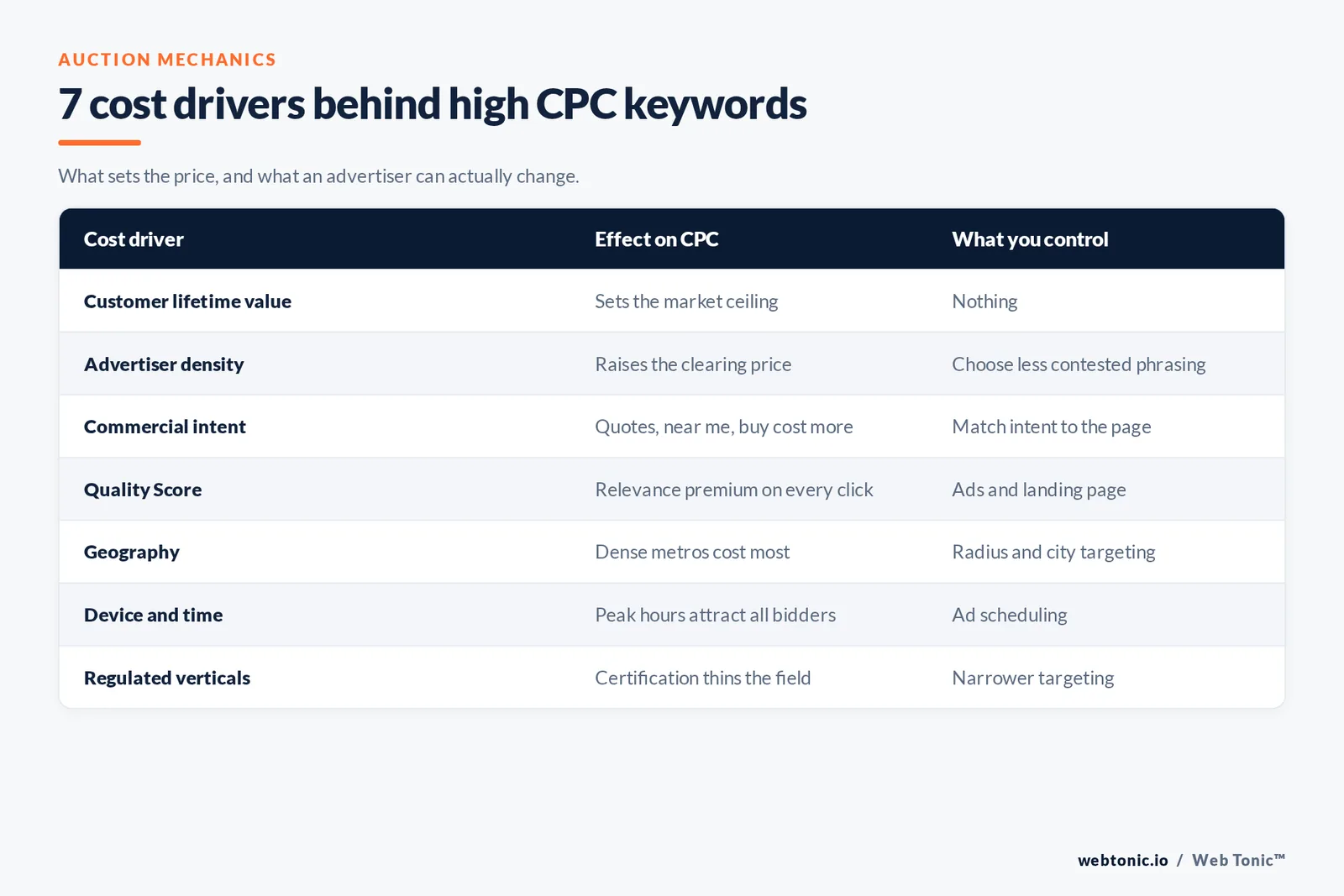
| Cost driver | Why it pushes CPC up | What you control |
|---|---|---|
| Customer lifetime value | High-value services can pay $50+ per click and still profit | Nothing — it sets the market price |
| Advertiser density | More bidders per auction lifts the clearing price | Choose less contested phrasing |
| Commercial intent | "quotes", "near me", "buy" signal readiness to transact | Match intent to the right landing page |
| Quality Score | Low relevance means you pay a premium for the same position | Ad relevance, expected CTR, landing page experience |
| Geography | Los Angeles, New York and Texas legal auctions are the densest in the US | Radius, city and state targeting |
| Device and time | Peak business hours attract every competitor at once | Ad scheduling and device bid adjustments |
| Regulated verticals | Rehab, legal and finance carry certification costs that thin the field but raise stakes | Certification, then narrower targeting |
The mechanic itself is standard pay-per-click pricing, and our breakdown of how Quality Score is calculated covers the one lever that reduces your price without reducing your position.
The most expensive keywords in Google Ads right now
Fact 1 — Ahrefs' 100 most expensive keywords study (July 2026) found the ceiling sits at roughly $100 per click, with a single outlier above it. Note how low the search volumes are: expensive keywords are almost never high-volume keywords.
| Keyword | CPC | Monthly US volume | Vertical |
|---|---|---|---|
| chordee repair | $105.00 | 800 | Medical / surgery |
| mesothelioma attorney chicago | $100.00 | 1,200 | Legal |
| lawsuit mesothelioma | $100.00 | 900 | Legal |
| los angeles slip and fall attorney | $100.00 | 500 | Legal |
| truck wreck lawyers | $100.00 | 500 | Legal |
| houston injury attorney | $100.00 | 600 | Legal |
| maritime law firm | $100.00 | 600 | Legal |
| global eor | $100.00 | 900 | B2B software |
| interstitial ads cpm | $100.00 | 600 | Adtech |
| nyc tax refund status | $100.00 | 500 | Finance |
Fact 2 — 7 of those 10 terms are legal or medical-legal. Personal injury, asbestos litigation and maritime law are the most expensive PPC keywords in the world because a single signed case can be worth six figures.
The 20 most expensive keyword categories by average CPC
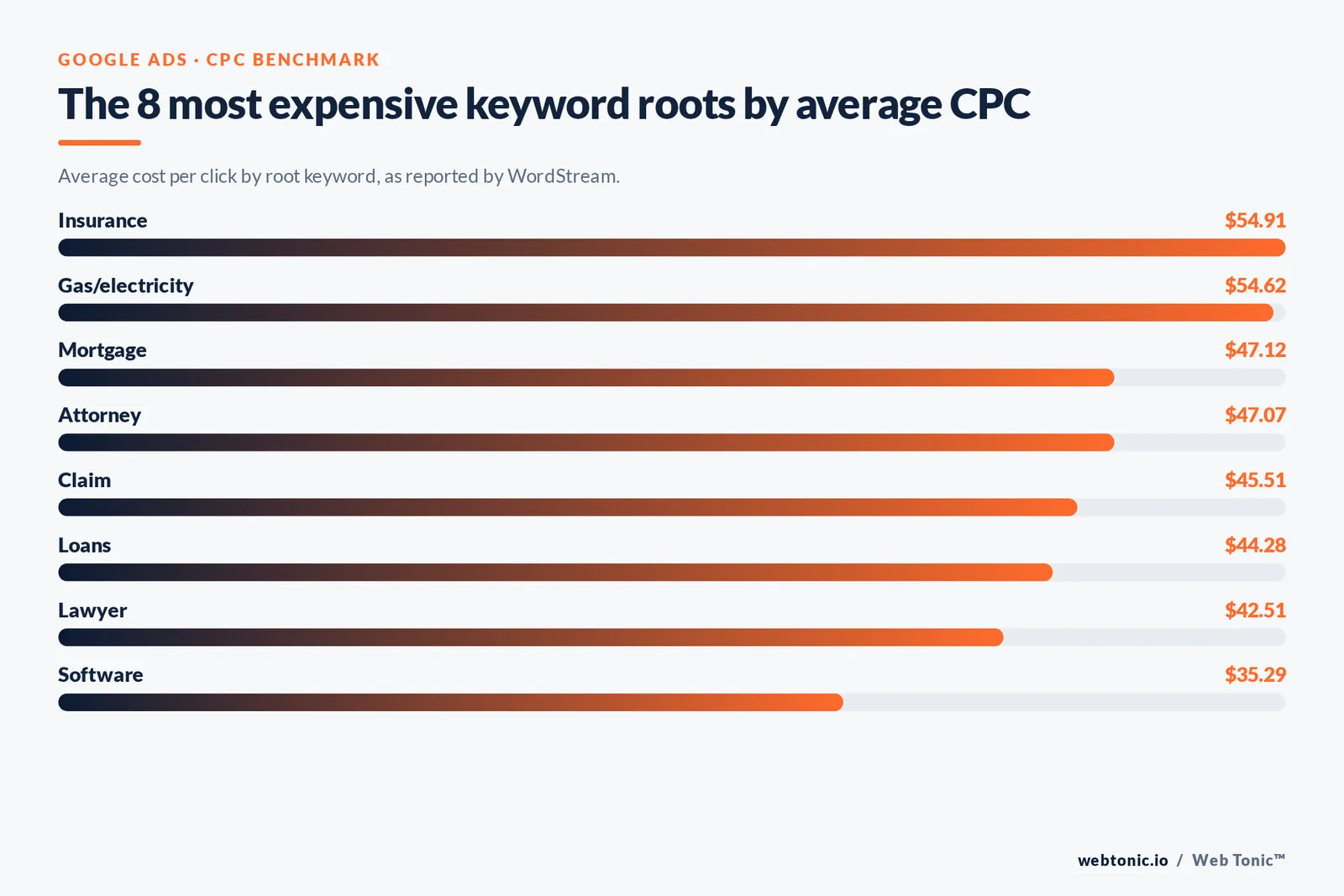
Individual long phrases spike, but marketers plan against head terms. WordStream's most expensive keywords in Google Ads analysis groups spend by root word — the most useful view for budgeting, because every keyword containing that root inherits some of the price.
| Root keyword | Average CPC | Root keyword | Average CPC |
|---|---|---|---|
| Insurance | $54.91 | Claim | $45.51 |
| Gas/electricity | $54.62 | Loans | $44.28 |
| Mortgage | $47.12 | Lawyer | $42.51 |
| Attorney | $47.07 | Conference call | $42.05 |
| Donate | $42.02 | Recovery | $42.03 |
| Degree | $40.61 | Treatment | $37.18 |
| Credit | $36.06 | Software | $35.29 |
| Classes | $35.04 | Rehab | $33.59 |
| Trading | $33.19 | Hosting | $31.91 |
| Transfer | $29.86 | Cord blood | $27.80 |
Rule 2 — if your service contains one of those 20 roots, assume the market price of an unqualified click before you build the account, then design the campaign to avoid the root and target the qualifier.
Expensive keywords by industry, in context
Average CPC across the whole of Google and Bing search sits at $5.42 with an average click-through rate of 6.64% and a conversion rate of 8.18%, per the search advertising benchmarks published on WordStream's benchmark hub. That is the number to compare any quoted CPC against.
| Industry | Typical CPC band | Cost pressure | Best structural response |
|---|---|---|---|
| Legal services | $9.87 average, head terms $40-$100 | Highest of all 23 benchmarked categories | Practice-area campaigns, city-level radius, call tracking |
| Home improvement | $8.33 average | High, seasonal peaks | Service + city keywords, dayparting to office hours |
| Insurance and finance | $27-$55 on head terms | Very high, aggregator-driven | Product-specific long tail, not "insurance quotes" |
| B2B / enterprise software | $20-$100 on category terms | High, low volume | Competitor and use-case terms, gated demos |
| Addiction and medical treatment | $33-$40 | High plus certification requirements | Facility-level geography and condition terms |
| Education and degrees | $35-$41 | High, enrolment-cycle spikes | Programme-level keywords, not "degree" |
| Ecommerce retail | $1-$3 | Low CPC, thin margins | Shopping and Performance Max on feed quality |
Fact 3 — the average cost per lead across search sits near $66.69, so a $50 click is only irrational if your close rate is low — the expensive keyword is a symptom of the funnel behind it. Semrush's Google Ads cost breakdown reaches the same conclusion from a different data set.
How to find high CPC keywords in your own market
Published lists are useful for orientation only. The keywords that will drain your budget are specific to your geography and your competitors' bids.
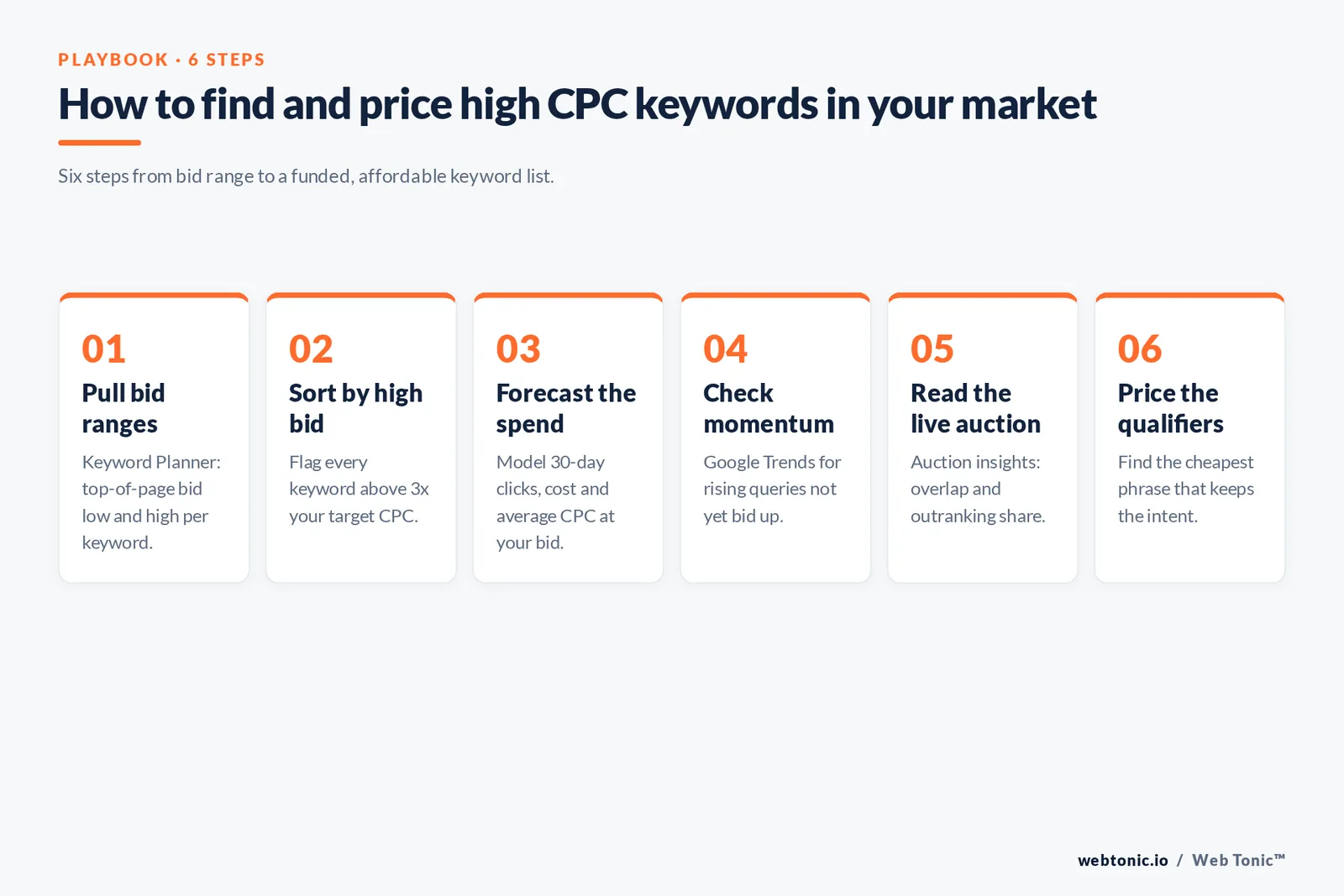
| Step | Where to look | What to record |
|---|---|---|
| 1. Pull bid ranges | Google Keyword Planner, Discover new keywords | Top-of-page bid low and high per keyword |
| 2. Sort by high bid | The same export, descending | Every keyword above 3x your target CPC |
| 3. Forecast the spend | Get search volume and forecasts | 30-day clicks, cost and average CPC at your bid |
| 4. Check momentum | Google Trends | Rising queries that have not been bid up yet |
| 5. Read the live auction | Auction insights, search terms report | Overlap rate and outranking share by competitor |
| 6. Price the qualifiers | Keyword Planner, filtered to 4+ word phrases | The cheapest phrase that keeps the intent |
The full column-by-column walkthrough lives in our guide to the AdWords keyword tool, which is still the only source of Google's own auction bid data.
7 traps that make expensive keywords worse
| Trap | What it costs | Fix |
|---|---|---|
| Trap 1 — bidding the bare root | Pays $40+ for research traffic | Bid the qualified phrase, add the root as a negative |
| Trap 2 — broad match with no negatives | Up to half of spend on irrelevant terms | Weekly negative keyword pass |
| Trap 3 — one landing page for everything | Low landing page experience raises CPC | One page per intent cluster |
| Trap 4 — nationwide targeting | Competes with the densest metro auctions | Radius or city targeting only where you serve |
| Trap 5 — ignoring Quality Score | A relevance premium on every click | Rebuild ad groups around a single theme |
| Trap 6 — budget too thin to learn | Under 10 clicks a day teaches Smart Bidding nothing | Fewer keywords, funded properly |
| Trap 7 — counting clicks, not calls | Optimises to the wrong outcome | Import offline conversions and value |
Limit 1: no bidding tactic makes a $100 keyword cheap. The only reliable saving is a different keyword or a better conversion rate.
Cheaper alternatives to the most expensive keywords
Rule 3 — for every expensive head term there is a longer phrase with the same buying intent at a fraction of the cost per click. Swapping down the ladder is the single highest-leverage change in a high CPC account.
| Expensive term | Cheaper substitute with the same intent | Why it costs less |
|---|---|---|
| insurance | small business liability insurance {city} | Aggregators do not bid city-level SMB terms as hard |
| car accident lawyer | rear-end collision claim time limit {state} | Question intent, far fewer bidders |
| software small business | {competitor} alternative for 5 users | Comparison intent, lower density |
| water damage restoration | burst pipe cleanup {neighbourhood} | Neighbourhood terms sit below aggregator radii |
| degree | part-time msn programme accreditation | Programme specifics filter out browsers |
| sell house fast | sell inherited house {county} probate | Situation terms are under-bid |
| rehab programs | outpatient programme insurance coverage {state} | Coverage questions convert and cost less |
Our guide to long tail keywords covers how to build these lists at scale, and Think with Google's consumer journey research explains why the question-shaped queries still sit inside a buying path.
Budgeting a campaign around high CPC keywords
Work backwards from the deal, not forwards from the bid. This is the arithmetic that decides whether an expensive keyword is affordable for your business.
| Input | Example value | What it tells you |
|---|---|---|
| Average CPC | $45 | The market price of one visit |
| Landing page conversion rate | 8% | Cost per lead = $562 |
| Lead-to-client rate | 20% | Cost per client = $2,810 |
| Average client value | $9,000 | Gross return of 3.2x |
| Minimum monthly budget | $4,500 | 100 clicks — enough for a signal, barely |
| Break-even conversion rate | 2.5% | The floor before the keyword loses money |
Limit 2: at $45 a click, a $1,000 monthly budget buys about 22 clicks — statistically useless. Under-funding an expensive keyword is more wasteful than skipping it.
Where to spend instead when the auction is unaffordable
| Channel | Cost profile | When it beats the expensive keyword |
|---|---|---|
| Organic search and content | Fixed production cost, compounding | When the same term has a weak organic SERP |
| Local SEO and Google Business Profile | Low, operational | Service businesses inside one metro |
| Paid social prospecting | $0.50-$3 CPC equivalents | Demand generation ahead of the search |
| Email and CRM reactivation | Near-zero marginal cost | You already have the list |
| Referral and partnership | Revenue share | High-value professional services |
| Remarketing on branded terms | $1-$4 CPC | Closing traffic you already paid for |
Fact 4 — improving conversion rate from 4% to 8% halves your cost per lead without touching a single bid, which is why our growth marketing team audits the page before the auction. More paid search playbooks sit on the Web Tonic blog.

How to keep the price down once you are live
| Lever | Action | Realistic effect on CPC |
|---|---|---|
| Quality Score | Single-theme ad groups, keyword in headline and H1 | Meaningful discount at equal Ad Rank |
| Negative keywords | Weekly search-terms review, exact-match negatives | Removes the most expensive waste first |
| Match types | Phrase and exact for head terms, broad only with tROAS | Prevents root-term leakage |
| Ad scheduling | Concentrate spend in answering hours | Better conversion rate at the same CPC |
| Geographic tiering | Separate campaigns for dense metros | Stops cheap regions subsidising costly ones |
| Conversion value | Import offline deal values into Smart Bidding | Bids follow revenue, not form fills |
Google's documentation on Quality Score confirms it is diagnostic rather than a bid multiplier, so treat the three component scores as a to-do list: expected CTR, ad relevance, landing page experience.
FAQ
What is the most expensive keyword in Google Ads?
In Ahrefs' July 2026 study the highest cost per click was "chordee repair" at $105.00, followed by a large group of legal terms — mesothelioma and slip-and-fall attorney phrases — clustered at $100.00 per click.
Which industry has the highest CPC keywords?
Legal services. It leads the benchmarked categories on average CPC at $9.87, and its head terms — attorney at $47.07 and lawyer at $42.51 — are the priciest root keywords in search advertising.
Why are insurance keywords so expensive?
Because a policyholder is worth years of premium, so comparison aggregators and carriers can profitably pay above $50 a click. "Insurance" averages $54.91, the highest root keyword on WordStream's list.
Do expensive keywords have high search volume?
Rarely. Most of the $100-per-click terms draw only 500 to 1,500 US searches a month. Price is set by the value of the customer and the number of bidders, not by how many people search.
How can a small business compete for high CPC keywords?
Trade the root term for four- and five-word qualified phrases, target only the areas you serve, run a weekly negative keyword pass, and raise landing page conversion rate. That combination usually beats a bid increase.
Sources
Ahrefs — 100 Most Expensive Keywords for Google Ads, July 2026 · WordStream — The 20 Most Expensive Keywords in Google Ads and search advertising benchmarks · Google Ads Help — average cost per click, Quality Score, negative keywords · Google Ads — Keyword Planner product page · Google Trends · Semrush — how much Google Ads costs · Think with Google — consumer journey insights · Wikipedia — pay-per-click. All figures as reported by the cited sources and verified live at publication.