Table of contents
US store brand sales hit a record $282.8 billion in 2025, and the growth driving that record is now explicitly strategic rather than purely price-driven - private label stopped being "the cheap option" and became a margin and loyalty lever retailers are actively building around.
Key Takeaways
- US store brand revenue hit a record USD 282.8 billion in 2025 (PLMA/Circana).
- That is an increase of more than USD 9 billion over 2024.
- Store brands accounted for 47% of all 2025 dollar sales gains in US retailing.
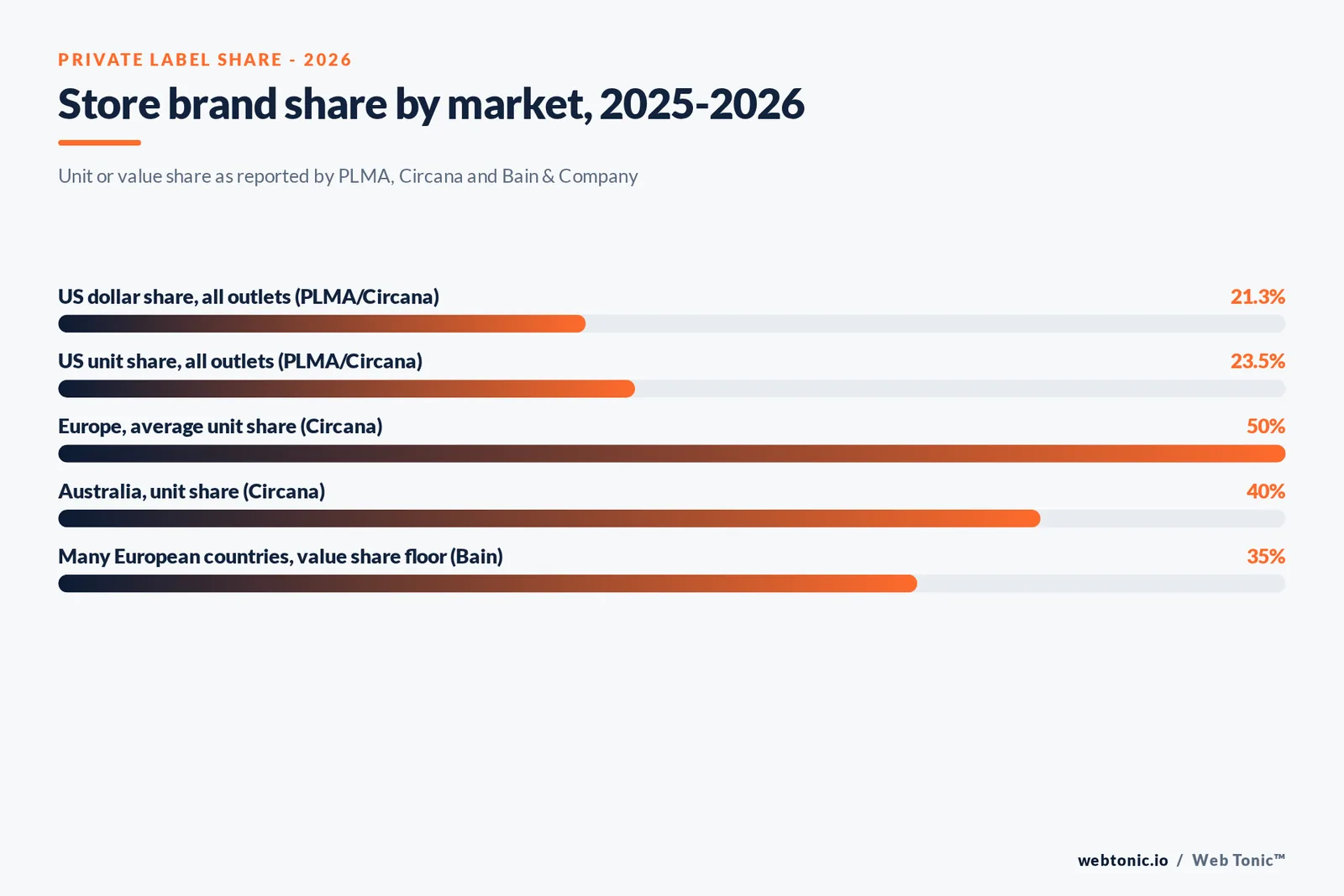
- Dollar share reached an all-time high of 21.3%; unit share hit 23.5%.
- Store brand unit volume rose to 68.7 billion units, also a record.
- National brands lost 1.43 billion units over the same period.
- US private label CPG sales reached USD 330 billion, a 24% unit share (Circana).
- 92% of US grocery shoppers now have store brand products at home (FMI), up from 89%.
- 94% would keep buying store brands even if grocery prices decline.
- Nearly half of shoppers increased private brand purchases in the past year.
- Only 31% increased national brand purchases in the same period.
- 56% say their store's private brand selection matters to where they shop.
- Private brands exceed 35% market share in many European countries (Bain).
- Private label holds roughly 40% unit share in Australia (Circana).
- 65% of CPG executives expect even more private-label competition ahead (Deloitte).
- Carrefour grew its private-label revenue share from 25% to 38%, targeting 40%.
The US number that sets the baseline
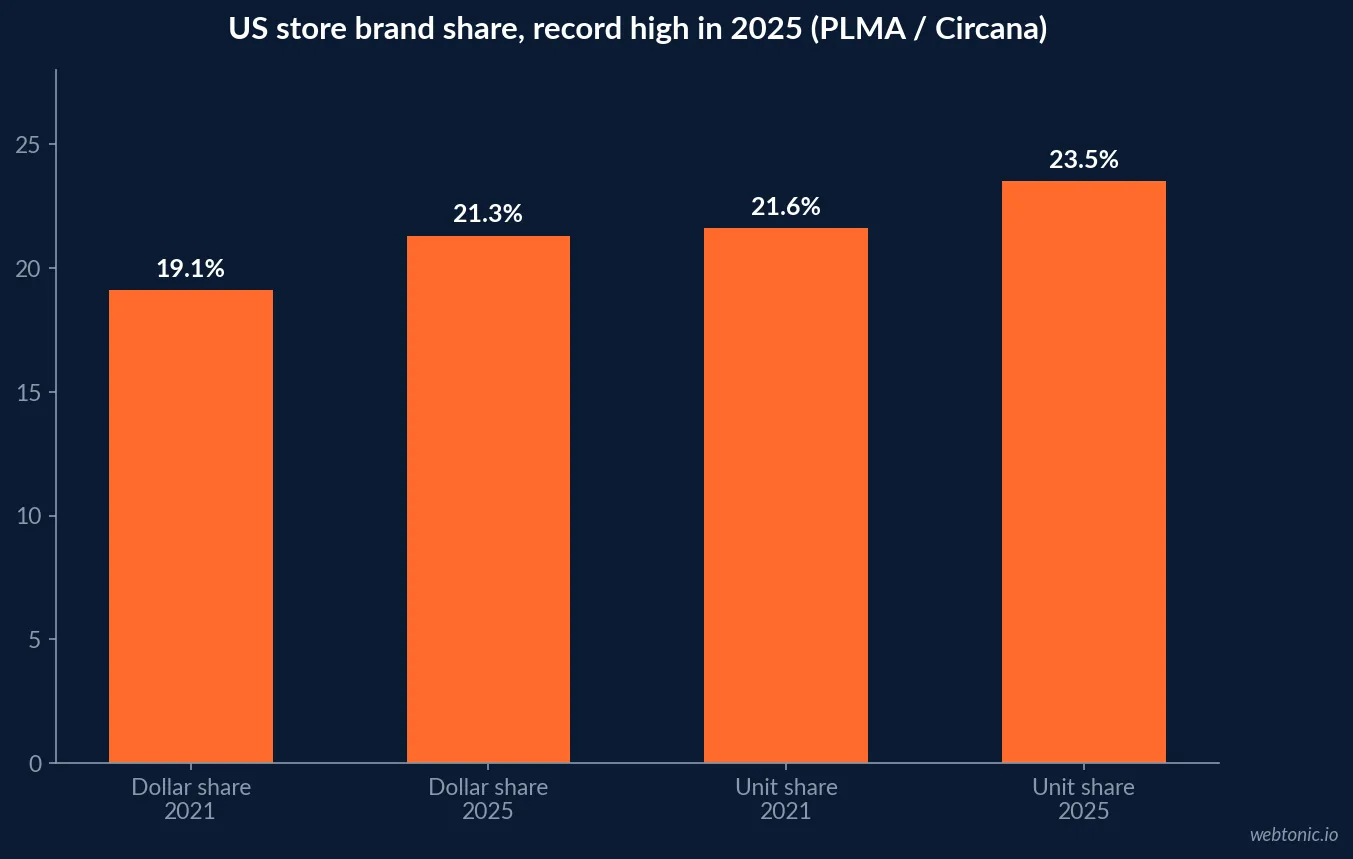
PLMA's 2026 Private Label Report, "Store Brands: A Bright Beacon," built on Circana Unify+ data, puts US store brand revenue at a record USD 282.8 billion for the 52 weeks ending December 28, 2025 - an increase of more than USD 9 billion over 2024 and the second consecutive year total store brand revenue has cleared a quarter trillion dollars. Unit volume climbed to 68.7 billion units, also a record, while national brands lost 1.43 billion units over the same window. Dollar share rose to an all-time high of 21.3% and unit share to 23.5%.
The growth-share number that matters most for anyone modeling category strategy: store brands accounted for 47% of all 2025 dollar sales gains across US retailing - roughly USD 9 billion of the industry's total USD 19.4 billion in growth - despite representing a much smaller share of total shelf revenue. See the full breakdown in PLMA's report summary.
| PLMA 2026 report metric (52 wks to Dec 28, 2025) | 2025 figure | vs. 2024 / 5-year |
|---|---|---|
| Total store brand dollar sales | USD 282.8 billion | +3.3% YoY, +30% over 5 years |
| Store brand dollar share | 21.3% | Up from 19.1% in 2021 |
| Store brand unit sales | 68.7 billion units | +0.6% YoY, +4% over 5 years |
| Store brand unit share | 23.5% | Up from 21.6% in 2021 |
| Share of 2025 dollar sales gains | 47% | ~USD 9B of USD 19.4B industry growth |
The broader CPG read, and where the growth is concentrated
Circana's separate March 2026 research sizes the total US private label CPG market at USD 330 billion, capturing a 24% unit share and 23% dollar share of the total market once categories beyond PLMA's outlet scope are included. Within food and beverage specifically, private label already holds a 24% value share. Club channels are the current growth engine, accounting for nearly half of all private brand growth as value-conscious shoppers concentrate their spend there.
| Circana March 2026 CPG data | Figure |
|---|---|
| US private label CPG sales | USD 330 billion |
| Unit share of total market | 24% |
| Dollar share of total market | 23% |
| Food & beverage value share | 24% |
| Share of private brand growth from club channels | ~50% |
Why shoppers say they are buying more, and it is not just price
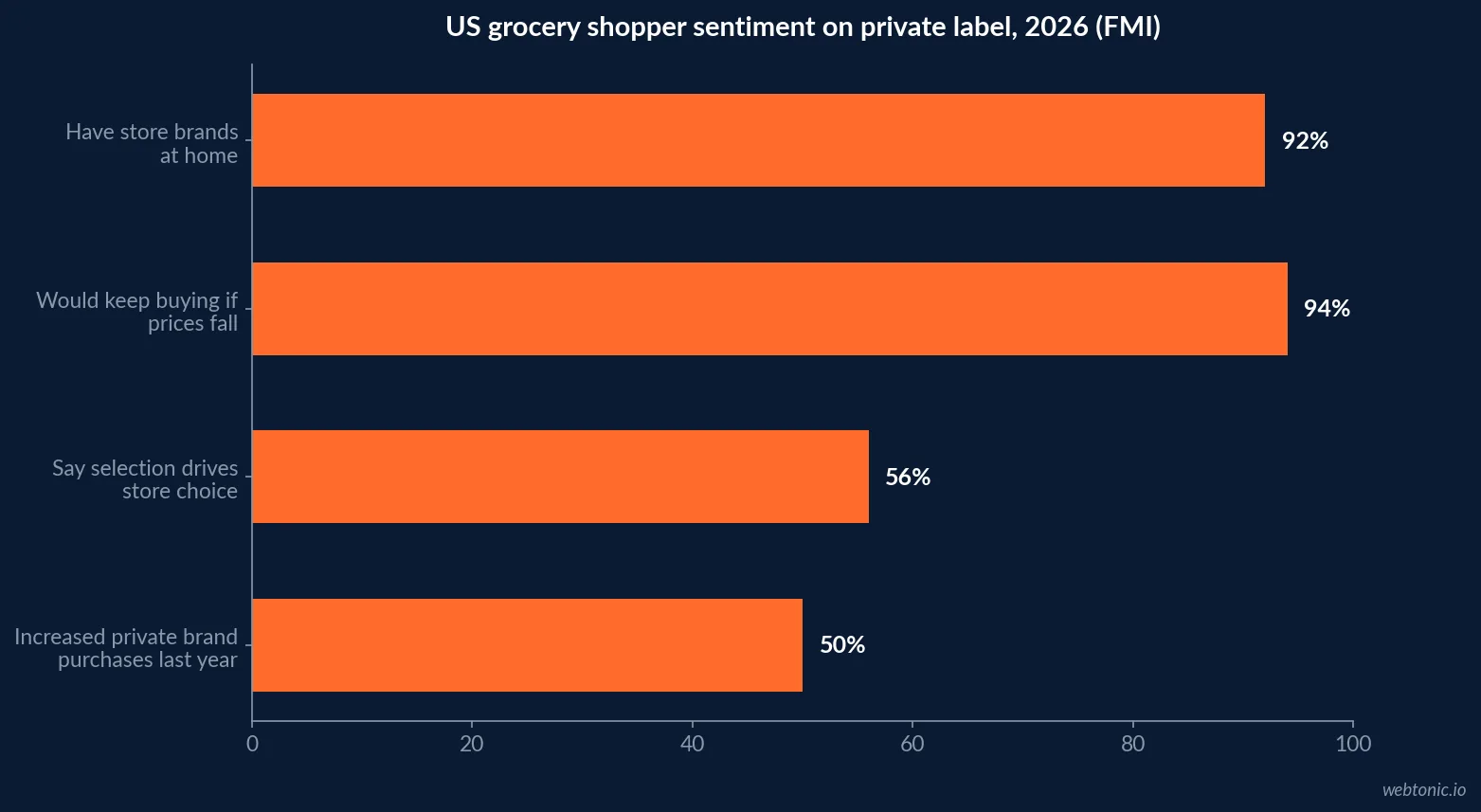
FMI's Power of Private Brands 2026 report, based on a nationally representative survey of 1,495 US grocery shoppers, found 92% currently have store brand products in their homes, up from 89% the prior year. Nearly half of shoppers increased their private brand purchases over the past year, against just 31% who increased national brand purchases in the same window. The most telling number for anyone who assumes this is purely a recession trade-down story: 94% say they would keep buying store brands even if grocery prices decline, and 56% say their store's private brand selection is very or extremely important to their decision to shop there at all.
| FMI 2026 survey (n=1,495 US grocery shoppers) | Figure |
|---|---|
| Have store brand products at home | 92% (up from 89%) |
| Increased private brand purchases in past year | ~50% |
| Increased national brand purchases in past year | 31% |
| Would keep buying store brands even if prices fall | 94% |
| Say private brand selection matters to store choice | 56% |
Why this stopped being a "cheap option" story
NielsenIQ's Consumer Outlook to 2026 is blunt about the mechanism: "the pricing playbook is over" - consumers are tapped out and will not absorb further price hikes, so growth now depends on volume captured through sharper assortments, innovation and private label strategy rather than repeated repricing. NielsenIQ frames private label explicitly as a loyalty lever now, not a discount bin, giving retailers margin while pressuring national brands to prove they still belong in the basket.
Deloitte's 2026 Global Consumer Products Industry Outlook, surveying 300 senior consumer-products executives, found 65% expect even more private-label competition ahead, and identifies retailers' growing control of consumer data - the foundation for retail media - as a compounding advantage layered on top of the private-label share gains.
The story outside the US is bigger, not smaller
Bain & Company's 2026 consumer products research finds private brands' market share now exceeds 35% in many European countries, and that insurgent and local brands drive roughly 80% of growth in Asia-Pacific markets specifically. Circana's global data shows private label at roughly half of all unit sales in Europe and nearly 40% unit share in Australia. PLMA International's Mosaic of Markets 2026 report adds a concrete retailer example: Carrefour has grown its private-label revenue share from 25% to 38% in recent years and is targeting 40%, backed by roughly 4,000 product innovations a year.
| Region / retailer | Private label metric | Source |
|---|---|---|
| Many European countries | Value share exceeds 35% | Bain & Company 2026 |
| Europe (overall) | ~50% of unit sales | Circana global data |
| Australia | ~40% unit share | Circana global data |
| Asia-Pacific | ~80% of category growth from local/insurgent brands | Bain & Company 2026 |
| Carrefour (retailer-specific) | 38% of revenue, targeting 40% | PLMA International 2026 |
The margin story behind the growth
Private label's appeal to retailers has always included a margin advantage over national brands, but the 2025-2026 data shows that advantage compounding rather than staying flat. PLMA's finding that store brands captured 47% of all 2025 dollar sales gains while holding just over a fifth of total category revenue means the category is growing roughly twice as fast as its current share would predict. Combined with NielsenIQ's read that the "pricing playbook is over" for national brands, retailers have both a margin and a growth-rate incentive to keep expanding private label shelf space rather than defending it as a niche value tier.
That combination - outsized growth plus retailer margin incentive plus consumer trust that is no longer price-contingent per FMI's 94% figure - is what makes this a structural shift rather than a cyclical, inflation-driven blip that reverses once grocery prices stabilize.
What this means for brands competing against store labels
A private label competitor in 2026 is no longer competing on price alone, and treating it that way is the fastest way to lose the shelf. The data across every source in this piece points to the same three levers retailers are actually pulling: assortment sharpness, visible quality investment, and loyalty-building rather than promotional depth. A national brand's best defense is differentiation that a store label structurally cannot copy - proprietary formulation, category-defining innovation, or a brand story a retailer's own label has no reason to tell.
Our growth marketing team builds that kind of differentiation-first positioning for CPG and retail clients navigating exactly this shift, and our data and analytics practice tracks share erosion by category before it shows up as a quarterly revenue surprise. Talk to us if private label is already eating into a category you compete in.
| Signal | What it rules out | What it confirms |
|---|---|---|
| 94% would keep buying if prices fall (FMI) | Pure inflation trade-down theory | Trust-driven, sticky demand |
| 47% of 2025 dollar gains from store brands (PLMA) | Flat, proportional growth | Outsized, compounding growth |
| 65% of CPG execs expect more competition (Deloitte) | A US-only or temporary blip | A structural, global shift |
| Carrefour 25%->38% share (PLMA International) | Passive category drift | Deliberate retailer strategy |
The takeaway going into 2026
Every large, named dataset in this space - PLMA, Circana, FMI, NielsenIQ, Bain, Deloitte - agrees on direction even where the exact percentages differ: private label is growing faster than the category around it, the growth is driven by trust and assortment rather than pure discounting, and retailers are treating their own labels as a strategic asset rather than a defensive price tool. That shift is now global, not a US-specific artifact of inflation.
Frequently Asked Questions
How big is the US private label market now?
A record $282.8 billion in annual sales for the year ending in late 2025, according to PLMA's 2026 Private Label Report built on Circana Unify+ data - up more than $9 billion over 2024 and the second consecutive year store brand revenue has topped a quarter trillion dollars. Circana's separate CPG analysis puts total US private label sales at $330 billion once broader CPG categories are included, with a 24% unit share and 23% dollar share of the total market.
Is private label still just the cheap alternative to national brands?
No, and that is the central shift going into 2026. NielsenIQ's Consumer Outlook describes the 'pricing playbook' as over, with growth now depending on sharper assortments and private label strategy rather than repeated price hikes. FMI's 2026 research backs that up directly: 94% of shoppers say they would keep buying store brands even if grocery prices decline, which would not be true if price were the only driver.
How many households actually buy private label products?
The large majority. FMI's Power of Private Brands 2026 report, based on a nationally representative survey of 1,495 US grocery shoppers, found 92% currently have store brand products at home, up from 89% the prior year. Nearly half of shoppers increased their private brand purchases over the past year, compared with 31% who increased national brand purchases in the same period.
Is private label growth a US-only story?
No. Bain & Company's 2026 consumer products research finds private brands now exceed 35% market share in many European countries, and Circana's global data shows private label accounting for roughly half of all unit sales in Europe and nearly 40% unit share in Australia. PLMA International's Mosaic of Markets report adds that Carrefour has grown its own private-label revenue share from 25% to 38% in recent years, targeting 40%.
What is driving retailers to invest more in their own brands?
Margin and loyalty, not just price competition. Deloitte's 2026 Global Consumer Products Industry Outlook, based on a survey of 300 senior consumer-products executives, found 65% expect even more private-label competition ahead. Store brands now accounted for 47% of all 2025 dollar sales gains in US retailing per PLMA - meaning retailers are capturing outsized growth from a category that also carries better margins than national brands.
Sources
PLMA - 2026 Private Label Report, Store Brands: A Bright Beacon
PLMA - 2026 Private Label Report summary
Circana - US private label CPG sales reach USD 330 billion
FMI - Power of Private Brands 2026: Consumer Trends
NielsenIQ - Consumer Outlook to 2026
Bain & Company - The Road Forward to Value Creation in Consumer Products
Deloitte - 2026 Global Consumer Products Industry Outlook
PLMA International - Mosaic of Markets 2026