Table of contents
Google PPC is pay-per-click advertising bought through Google Ads: you bid on search queries and other placements across Google's properties, your ad enters an auction each time someone searches, and you are charged only when a user clicks. Impressions are free; the click is the billable event.
Below: how the auction decides your price, where the ads appear, what a click costs, and the vocabulary you need to read your own account.
Key Takeaways
- Google carries 91.25% of global search traffic, which is why Google PPC is usually the first paid channel a business tests.
- Ad position is decided by Ad Rank — bid plus ad quality and landing page experience — so the highest bidder does not automatically win.
- Quality Score runs 1–10 per keyword, and Google states it is a diagnostic, not an input in the auction itself.
- The average search click costs $5.42 with an 8.18% conversion rate and $66.69 cost per lead across 23 industries.
- There is no minimum spend, but daily costs can reach 2x your average daily budget, capped monthly at daily budget × 30.4.
- AdWords was renamed Google Ads in 2018; "Google PPC", "Google AdWords" and "paid search" all describe the same buying model today.
What Google PPC means, precisely
Google PPC refers to any advertising bought inside the Google Ads platform on a cost-per-click basis. The advertiser selects keywords or audiences, sets a bid or a performance target, and pays a variable fee each time a user clicks through to their site. Ads may appear on Google Search, Maps, Shopping, YouTube, Gmail, Discover and millions of partner sites.
Three labels get used interchangeably, and the difference is worth pinning down because it changes what you are actually discussing:
| Term | What it actually refers to | Use it when |
|---|---|---|
| Google PPC | The billing model — paying per click inside Google Ads | Talking about cost and how you are charged |
| Google Ads | The platform itself, including non-click billing like CPM video | Talking about the product, campaigns or the interface |
| Google AdWords | The platform's former name, retired in 2018 | Legacy documents only — Google renamed it |
| Paid search | Search-based ads on any engine, Google or Microsoft | Comparing channels rather than platforms |
So Google Ads is the shop, PPC is the price tag, and paid search is the aisle. Not every Google Ads campaign is PPC — video campaigns often bill per view or per thousand impressions — but every Search campaign is.
How the auction decides your price
The platform's own walkthrough of how the ad auction works describes four steps that run in milliseconds every time somebody searches:
- Match. The system finds every ad whose keywords match the query closely enough.
- Filter. Ineligible ads drop out — wrong country, disapproved creative, paused campaigns.
- Threshold. Ads below the minimum Ad Rank thresholds are removed entirely, even if the bid is high.
- Order. Survivors are ranked by Ad Rank: bid amount, ad and landing page quality, the thresholds, auction competitiveness and the context of the search.
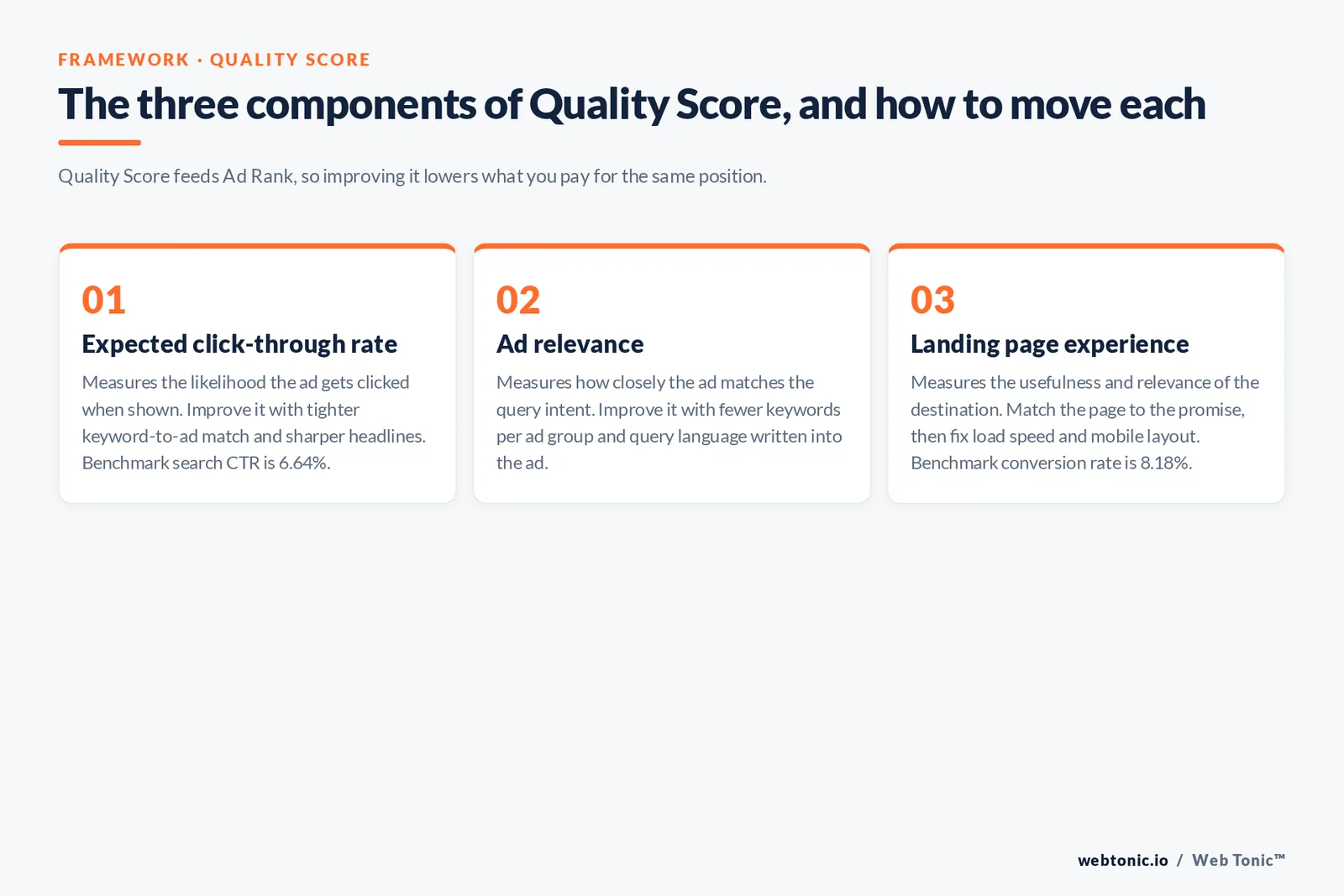
The quality half of that equation is summarised in the keyword-level Quality Score diagnostic, built from three components: expected click-through rate, ad relevance and landing page experience. The documentation is explicit that the score itself is not an auction input — it reports on the signals that are.
| Quality Score component | What is measured | How you improve it |
|---|---|---|
| Expected click-through rate | Likelihood the ad gets clicked when shown | Tighter keyword-to-ad match, sharper headlines |
| Ad relevance | How closely the ad matches the query intent | Fewer keywords per ad group, query language in the ad |
| Landing page experience | Usefulness and relevance of the destination page | Match the page to the promise, fix load speed and mobile layout |
The practical consequence: two advertisers in the same position can pay very different amounts per click. Quality work is a permanent discount, and it is the only lever that lowers cost without lowering ambition.
Where Google PPC ads actually appear
Choosing the wrong campaign type is the most expensive early mistake in a new account, because each one buys a different kind of attention. The how-it-works overview is the starting map; here is the decision version.
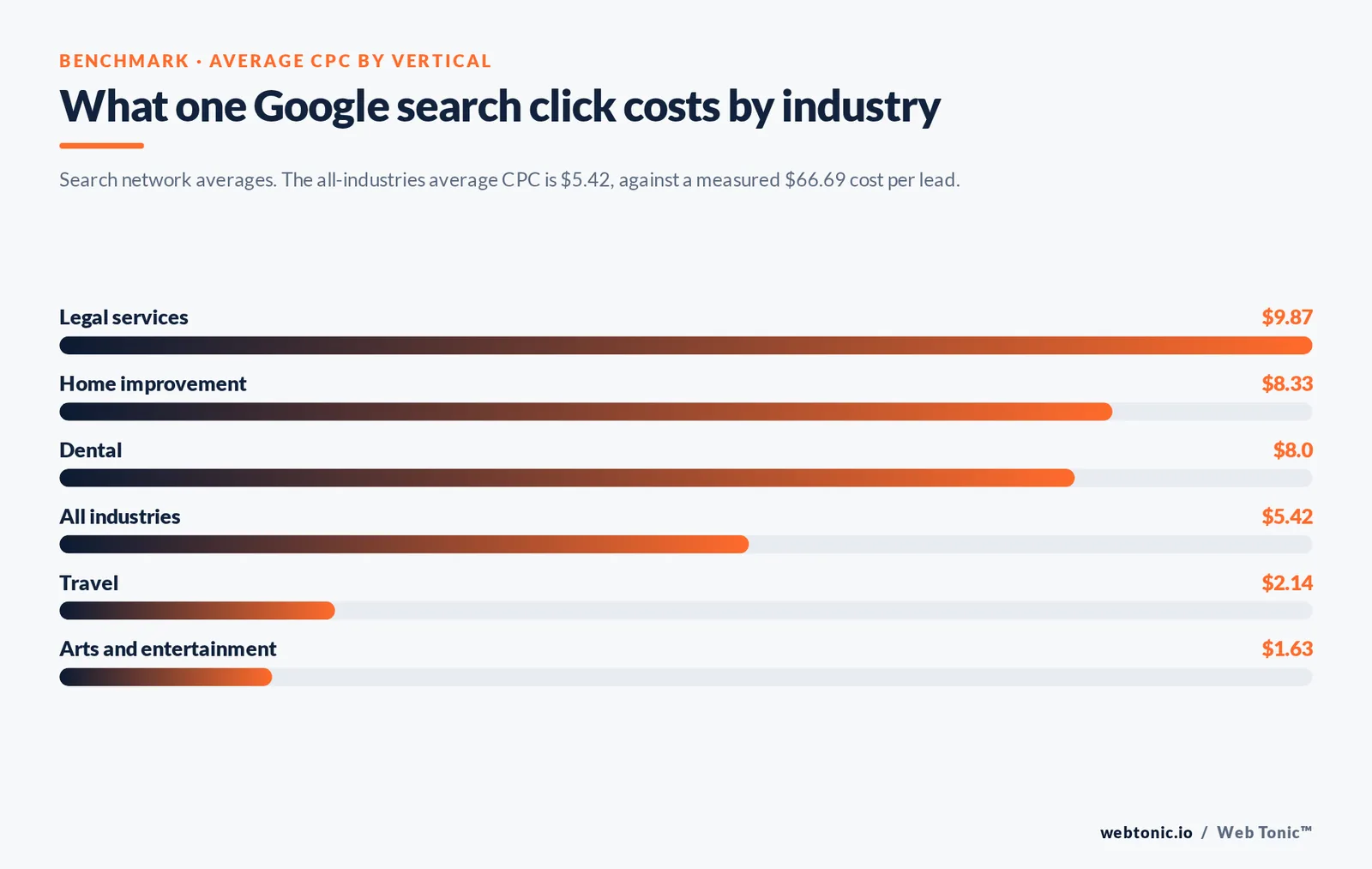
| Campaign type | Where it shows | Intent captured | Best used for |
|---|---|---|---|
| Search | Google results pages, search partners | Highest — an active query | Harvesting existing demand, lead generation |
| Shopping | Shopping tab, Search, Images | High — product-specific | Ecommerce with a clean product feed |
| Performance Max | All Google channels at once | Mixed | Accounts with solid conversion tracking and volume |
| Display | Partner sites and apps | Low — browsing | Remarketing and cheap reach, not cold acquisition |
| Video | YouTube and video partners | Low to medium | Demand creation across six video ad formats |
| Demand Gen | Discover, Gmail, YouTube feeds | Low — visual discovery | Creative-led prospecting at scale |
For a first account the sequence is nearly always the same: start on Search with your strongest commercial terms, add remarketing once there is traffic worth chasing, and only move into Performance Max or Demand Gen when conversion tracking is trustworthy enough to feed automation. Our growth marketing engagements follow that order deliberately.
What it costs to advertise
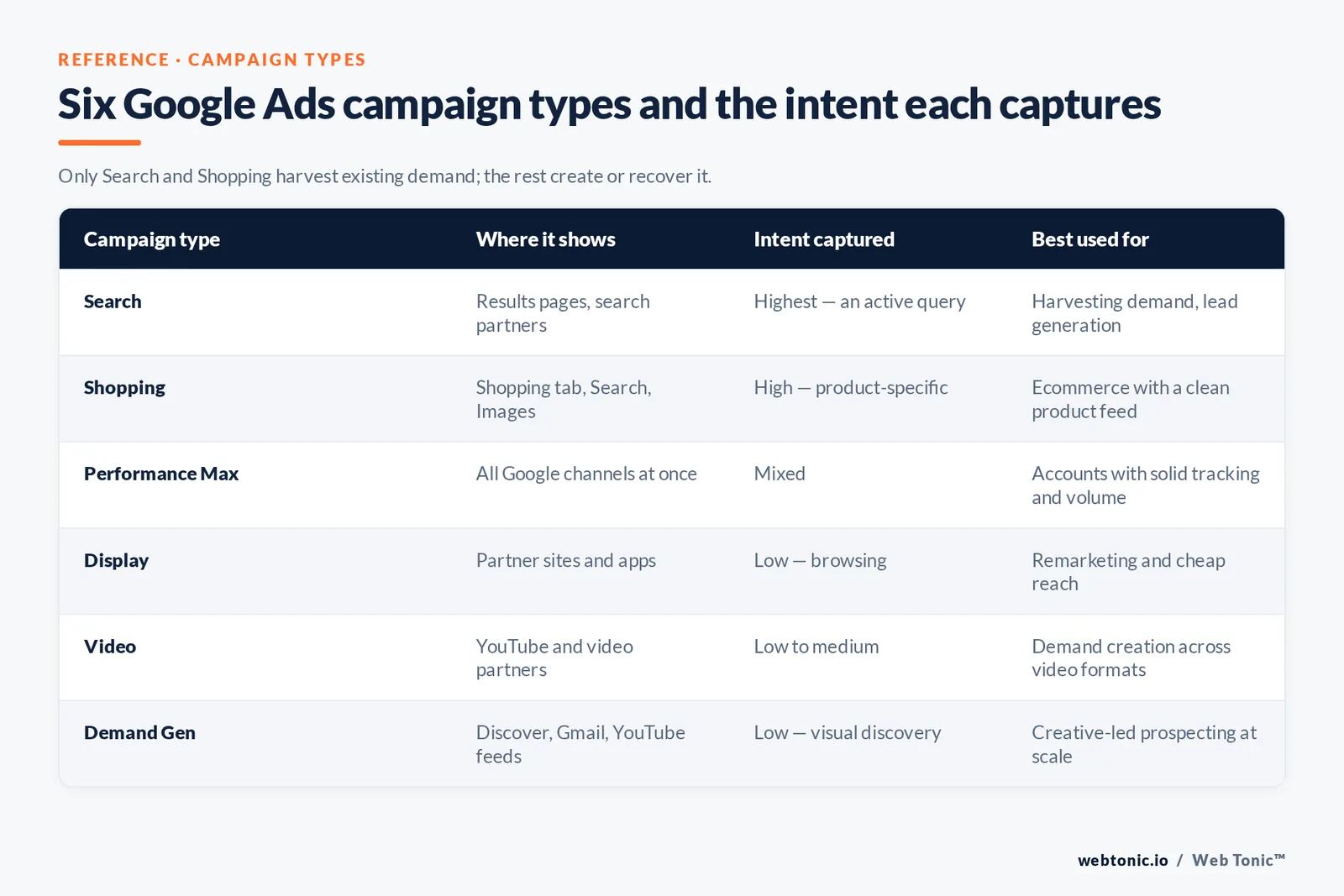
There is no entry fee and no minimum contract. Your cost is the sum of clicks bought, and that price is set per auction. Benchmarks across 23 categories put the all-industry average at $5.42 per click, 6.64% click-through rate, 8.18% conversion rate and $66.69 per lead — with a 6x spread between the cheapest and most expensive verticals.
| Vertical | Average CPC | Cost per lead at benchmark conversion |
|---|---|---|
| Legal services | $9.87 | About $123 |
| Home improvement | $8.33 | About $104 |
| Dental | $8.00 | About $100 |
| All industries | $5.42 | $66.69 measured |
| Travel | $2.14 | About $27 |
| Arts and entertainment | $1.63 | About $20 |
Budgets are set per campaign per day, not per month, and the mechanics surprise people. Per the official guidance on managing your spend, a single day can cost up to 2x your average daily budget, while the monthly charging limit is your average daily budget multiplied by 30.4. A $60 daily budget therefore means up to $120 on a busy Tuesday and no more than $1,824 for the month.
Independent cost analysis of what Google Ads really costs reaches the same structural conclusion: your industry sets the floor on click prices, and your account quality decides how far above that floor you land.
Setting up a first paid search campaign
A workable first build takes an afternoon and about six decisions:
- Define one conversion. A form submit, a call, a purchase. Without it, bidding optimises toward nothing useful.
- Pick 15–30 commercial keywords. Terms with buying language, not research language. Skip anything you cannot answer with a dedicated page.
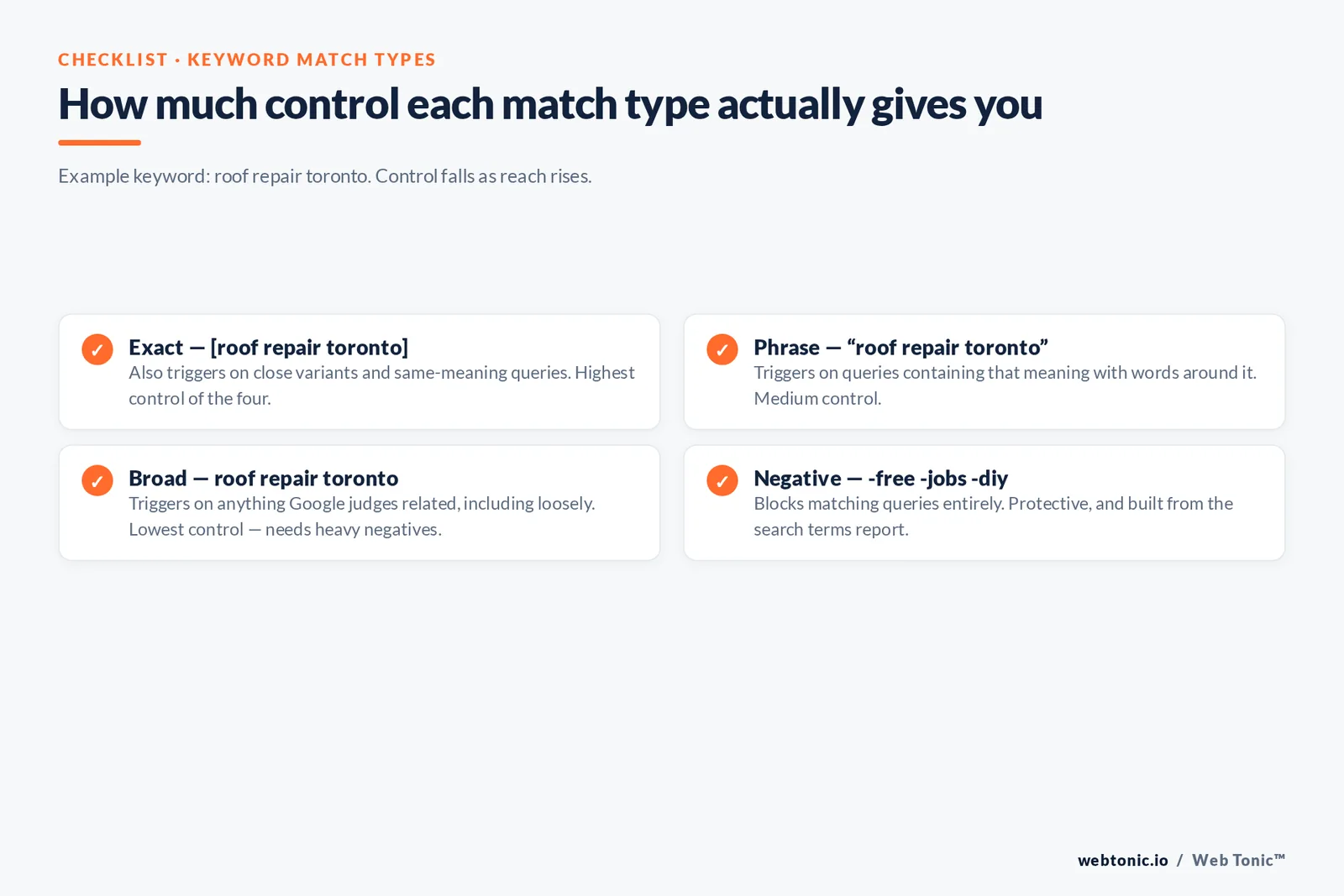
- Choose match types. Start on phrase and exact; keyword matching options determine how far the system may stray from your term.
- Build negatives from day one. "Free", "jobs", "DIY", competitor names you do not want — a starter list of 50 negatives is normal.
- Write responsive search ads properly. The responsive search ad best practices ask for varied headlines rather than repeated keyword stuffing.
- Set a bid strategy that fits your data. With under 30 conversions a month, manual or maximise-clicks with a CPC ceiling beats target-CPA; the bid strategy selection guide maps strategies to goals.
Then leave it alone for two weeks. At the benchmark click price, a $50 daily budget buys roughly 280 clicks a month, and reacting to the first 20 is noise-chasing, not optimisation.
| Match type | Example keyword | Also triggers on | Control level |
|---|---|---|---|
| Exact | [roof repair toronto] | Close variants and same-meaning queries | Highest |
| Phrase | "roof repair toronto" | Queries containing that meaning, with words around it | Medium |
| Broad | roof repair toronto | Anything Google judges related, including loosely | Lowest — needs heavy negatives |
| Negative | -free -jobs -diy | Blocks matching queries entirely | Protective |
Why paid search matters even if you rank organically
Paid and organic are not substitutes. Google's 91.25% share of global search against Microsoft's 4.68%, per search engine market share tracking, means one platform holds nearly all of the query demand — and ads sit above the organic results on the queries with the clearest commercial intent.
Three situations where PPC earns its place regardless of rankings: launching something new with no ranking history, defending brand queries against competitors bidding on your name, and testing message-market fit in weeks instead of the months organic requires. Paid data also feeds the rest of the programme — search term reports are the cheapest keyword research available, and pairing them with proper data intelligence reporting is what stops platform-reported conversions from quietly diverging from booked revenue.
The vocabulary that matters
| Term | Definition | Why it matters |
|---|---|---|
| CPC | Cost per click — what one click actually cost | Usually below your maximum bid |
| Ad Rank | The score that orders ads on the page | Combines bid, quality, thresholds and context |
| CTR | Clicks divided by impressions | Benchmark is 6.64% on search |
| Impression share | Share of eligible auctions you appeared in | Shows whether budget or rank is the constraint |
| Conversion rate | Conversions divided by clicks | Benchmark is 8.18%; the main efficiency lever |
| Target CPA / ROAS | Automated bidding goals | Needs consistent conversion volume to work |
| Search terms report | The real queries that triggered your ads | Source of both negatives and new keywords |
| Ad group | A cluster of keywords sharing ads | Tighter groups lift ad relevance |
Learn those eight and the interface stops being intimidating. Ongoing coverage of platform changes is worth following too — Search Engine Land's Google Ads library tracks releases as they ship, and we cover the ones that change tactics on the Web Tonic blog.
Common ways paid budgets get wasted
- Broad match without negatives. An unqualified theme can absorb 20–40% of a small budget within a week.
- Sending paid clicks to the homepage. You paid for specific intent, then answered it generically.
- Automated bidding on thin data. Under 30 monthly conversions, target-CPA has too little signal to learn from.
- Five campaigns on a $600 budget. Five thin datasets beat none, but one readable dataset beats five.
- Never reading search terms. Weekly review is the highest-return 15 minutes in the account.
- No tracking audit. Duplicate or missing conversion tags misprice every decision downstream.
None of those are exotic; they are simply what happens when an account is launched and left. If you want yours reviewed against the benchmarks above, our service overview explains how we work, and you can book a look at the account.
FAQ
What is Google PPC, in simple terms?
It is advertising on Google where you pay only when someone clicks your ad. You choose the searches or audiences you want to reach, set a bid or performance target, and the platform runs an auction each time a matching search happens. Showing the ad is free; the click is what you are billed for.
Is pay-per-click the same as Google Ads?
Not exactly. Google Ads is the platform; PPC is one way it charges you. Search campaigns bill per click, while some video and display formats bill per view or per thousand impressions. In everyday use the phrase nearly always means Search campaigns inside the platform.
How much does it cost per month?
There is no minimum. Practically, one campaign needs 50 to 100 clicks a week to produce readable data, which at the $5.42 average click price is roughly $1,000 to $2,000 a month. Your monthly ceiling is fixed by formula: average daily budget multiplied by 30.4.
Can I run paid search campaigns myself?
Yes, for a small single-service account, provided you define one conversion, keep to 15 to 30 exact and phrase keywords, and review search terms weekly. The work that usually needs help is measurement setup, bid strategy migration and landing page quality — the three things that most affect what a click costs you.
Does a higher bid guarantee the top ad position?
No. Ads below the minimum Ad Rank thresholds are removed from the auction regardless of bid, and position among the survivors depends on ad and landing page quality alongside the bid. A relevant advertiser with a good landing page can outrank a higher bidder and pay less per click.
Sources
Google Ads Help — the ad auction, Quality Score for Search campaigns, manage your spend, keyword matching options, responsive search ad best practices, bid strategy selection, Google AdWords is now Google Ads · Google Ads how-it-works overview · LocaliQ search advertising benchmarks (23 categories) · Semrush, Google Ads cost analysis · StatCounter global search engine market share · Search Engine Land, Google Ads library. Figures current as of August 2026.