Table of contents
An online review checker is any tool or manual process used to judge whether the reviews on a product, service or local business are genuine. The honest answer for 2026 is that the consumer-facing fake review checker era has largely ended, and the reliable methods are pattern-based checks plus platform-side reputation management software.
Key Takeaways
- 97% of consumers read online reviews for local businesses, and 41% now read them every time, up from 29% a year earlier.
- Consumers consult an average of 6 review sites before deciding, so single-platform monitoring is no longer enough.
- 47% will not use a business with fewer than 20 reviews, and 74% only care about reviews from the last 3 months.
- The FTC's final rule, 16 CFR Part 465, bans buying or selling fake reviews and allows civil penalties against knowing violators.
- The strongest authenticity signal consumers use is corroboration: 56% trust a review more when other reviews echo it.
- Generative AI is now the third most popular source of local business recommendations, at 45% usage versus 6% the previous year.
What an online review checker actually does
Two very different products share the name. A consumer fake review checker scores a product page and estimates what share of its reviews look manipulated. A business review checker monitors every platform where your brand is reviewed and flags new, missing or suspicious activity. Buyers searching for one usually need the other.
| Tool category | Primary user | What it checks | Realistic accuracy |
|---|---|---|---|
| Consumer fake review checker | Shopper | One product page at a time | Directional only |
| Reputation management software | Business owner | All platforms, continuously | High on collection, not authenticity |
| Platform trust systems | Google, Amazon, Tripadvisor | Account and device signals | Highest, but invisible to you |
| Manual pattern review | Anyone | Timing, wording, reviewer history | Good for obvious cases |
Rule 1 — no external checker sees the data that matters. Device fingerprints, IP clusters and purchase records live inside the platform, which is why Google publishes removal volumes in its Transparency Report but never exposes per-review scores.
Why the browser-extension era of fake review checkers ended
Fakespot was the best-known fake review checker and browser extension, covering companies including Amazon, Walmart and Best Buy. The service was wound down after acquisition, and fakespot.com no longer serves a review checker at all. ReviewMeta, its closest analogue, is similarly unavailable to most visitors.
| Tool | Status in 2026 | What replaced it | Practical alternative |
|---|---|---|---|
| Fakespot | Discontinued | Nothing equivalent | Manual pattern checks |
| ReviewMeta | Unreliable access | Nothing equivalent | Cross-platform comparison |
| Amazon badge filters | Active | Verified purchase filter | Sort by recent, verified only |
| Reputation platforms | Active and growing | Monitoring, not detection | Alerts plus response workflow |
Limit 2: expect roughly 0 free tools that can prove a single review is fake. That is not a gap in the market so much as a data problem — the evidence sits with the platform.
How to check online reviews manually: 9 signals
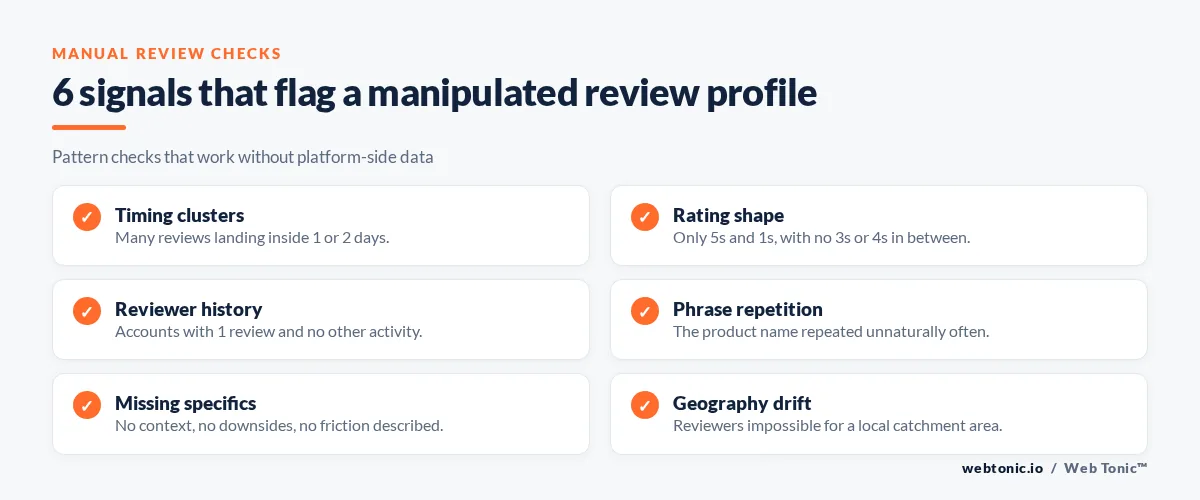
Bad actors leave patterns even when individual reviews read well. The signals below are the ones consumers and fraud teams both use, and they work on product reviews and local reviews alike.
| Signal | What to look for | Why it works | Weight |
|---|---|---|---|
| Timing clusters | Many reviews in 1 or 2 days | Real reviews arrive unevenly | High |
| Rating shape | Only 5s and 1s, no middle | Genuine curves have 3s and 4s | High |
| Reviewer history | One review, one product | Bought accounts have thin history | High |
| Phrase repetition | Identical product-name wording | Scripted or AI-generated text | Medium |
| Missing specifics | No context, no downsides | Real users mention friction | Medium |
| Version mismatch | Review describes another product | Merged or hijacked listings | Medium |
| Incentive language | Free product in exchange | Often a rule violation | Medium |
| Geography drift | Reviewers far from a local business | Impossible customer base | High |
| Owner silence | No replies anywhere | Weak account governance | Low |
Rule 3 — corroboration beats intuition. BrightLocal's Local Consumer Review Survey 2026 found the top trust factor is a review being backed by other reviews with similar sentiment, cited by 56% of consumers, ahead of a high star rating at 42%.
What consumers actually require before they buy
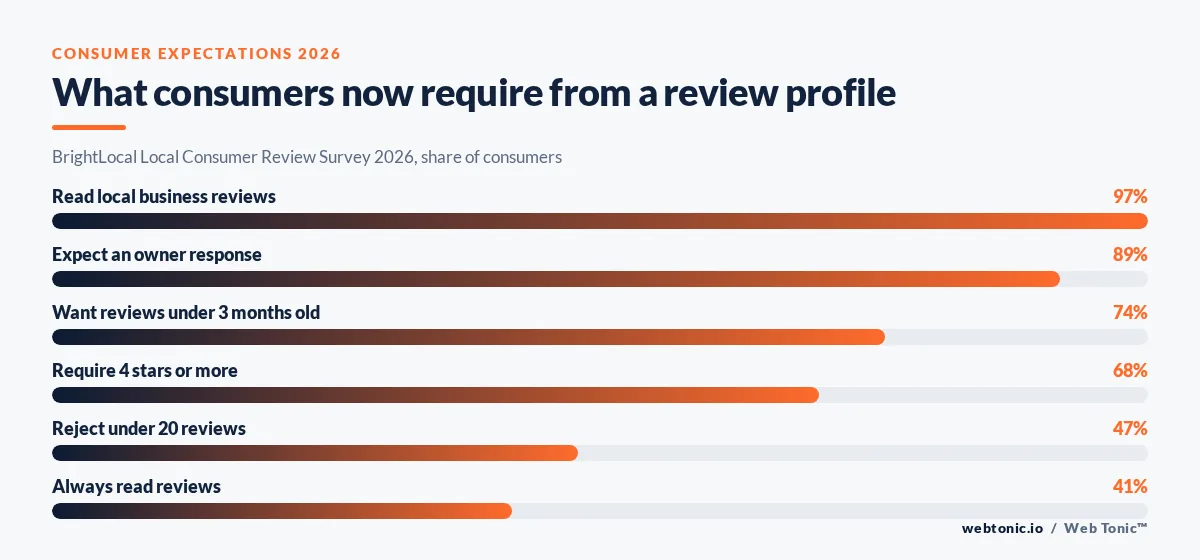
Checking reviews is only half the job. The same survey shows how fast expectations have hardened, and those thresholds are what your review profile is graded against.
| Consumer requirement | 2026 figure | Prior year | Business implication |
|---|---|---|---|
| Read reviews for local businesses | 97% | Stable | Review profile is the shopfront |
| Always read reviews when browsing | 41% | 29% | No unmonitored platforms |
| Require 4.5 stars or more | 31% | 17% | Small rating drops now cost sales |
| Require 4 stars or more | 68% | 55% | Recovery below 4.0 is urgent |
| Reject fewer than 20 reviews | 47% | Rising | Volume is a gate, not a bonus |
| Want reviews under 3 months old | 74% | Rising | Recency needs a steady flow |
| Expect owner responses | 89% | Stable | Response workflow is mandatory |
| Expect a reply within a week | 81% | Rising | Service-level target |
Limit 4: only 10% of consumers insist on a perfect 5-star rating, so a 4.6 average with recent, answered reviews outperforms a suspiciously flawless 5.0.
The rules bad actors are breaking
Fake reviews are not merely against platform terms. The Federal Trade Commission announced its final rule banning fake reviews and testimonials in August 2024, published as 16 CFR Part 465. It explicitly covers AI-generated reviews from people who do not exist.
| Prohibited practice | Who it catches | Common disguise | Where to report |
|---|---|---|---|
| Selling or buying fake reviews | Sellers and brokers | Review exchange groups | FTC |
| Insider reviews without disclosure | Staff and relatives | Anonymous accounts | FTC and platform |
| Compensation tied to sentiment | Incentive campaigns | Gift card for 5 stars | FTC |
| Fake negative reviews of rivals | Competitors | Burner accounts | Platform and FTC |
| Suppressing genuine negatives | Brands and platforms | Selective publishing | FTC |
The FTC's endorsements and reviews guidance and its guide for platforms set out the disclosure standard. Financially motivated review fraud can also be filed with the FBI's Internet Crime Complaint Center, and consumer-facing scams with the BBB Scam Tracker.
Reporting fake reviews on the platforms that matter
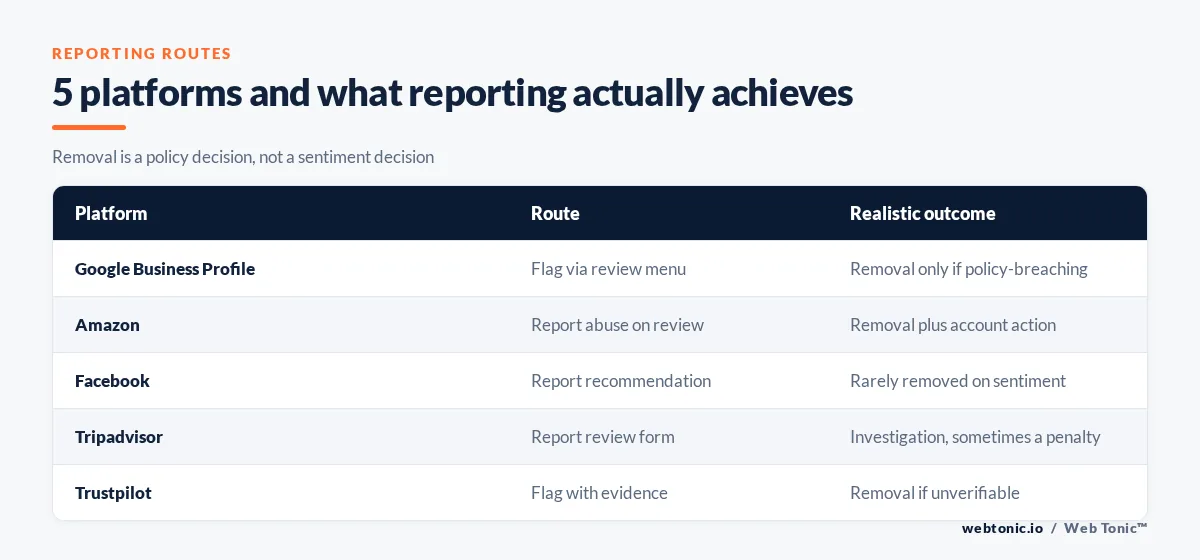
Removal is a platform decision, and each one applies its own content policy. Google's prohibited and restricted content policy is the standard applied to Business Profile reviews, and the manage customer reviews page is the route for flagging one.
| Platform | Reporting route | Typical outcome | Realistic timeline |
|---|---|---|---|
| Google Business Profile | Flag via review menu | Removal only if policy-breaching | Days to weeks |
| Amazon | Report abuse on the review | Removal plus account action | Weeks |
| Report the recommendation | Rarely removed on sentiment | Days to weeks | |
| Tripadvisor | Report review form | Investigation, sometimes penalty | Weeks |
| Trustpilot | Flag with evidence | Removal if unverifiable | Days |
Rule 5 — report on policy grounds, never on sentiment. A negative but genuine review will not be removed, and a rejected report weakens the next one you file. Our step-by-step walkthrough for one of the harder platforms is here: how to delete spam reviews on Facebook.
Building a review checker workflow for your own business

The practical version of an online review checker for a brand is a weekly routine, not a subscription. It costs about 45 minutes a week and catches almost everything a paid tool would.
- Step 1 — list every platform where you are reviewed; assume at least 6.
- Step 2 — set alerts for each so new reviews reach a real inbox.
- Step 3 — log volume, average rating and response rate weekly.
- Step 4 — screenshot anything suspicious before you report it.
- Step 5 — reply to every review, within 7 days at worst.
- Step 6 — audit the last 90 days of reviews monthly for clusters.
- Step 7 — keep a steady request cadence so recency never lapses.
| Weekly metric | Target | Warning threshold | Action if breached |
|---|---|---|---|
| New reviews | 4 or more | Under 2 | Restart request cadence |
| Average rating | 4.5 or higher | Below 4.0 | Service review, not more asking |
| Response rate | 100% | Below 80% | Assign a named owner |
| Response time | Under 48 hours | Over 7 days | Add a daily check slot |
| Suspicious reviews | 0 | 3 or more in a week | Escalate to the platform |
Volume and recency come from asking properly, not from tooling — the mechanics are in our guide on how to ask for reviews. Local visibility rules are summarised in Google's local ranking guidance.
Choosing reputation management software
Most vendors in this category sell collection and response, then market it as detection. Score them on what they can actually prove.
| Capability | Ask the vendor | Green flag | Red flag |
|---|---|---|---|
| Platform coverage | How many sites are monitored | 6 or more, named | Google only |
| Alert latency | How fast is a new review surfaced | Under 1 hour | Daily digest only |
| Response workflow | Can replies be sent in-tool | Yes, with approvals | Copy-paste only |
| Fraud detection claim | What evidence is used | Pattern flags, clearly labelled | Claims certainty |
| Review gating | Are negatives filtered out | Refuses to gate | Offers gating |
| Exportability | Can data leave the tool | Full CSV or API | Locked dashboards |
Limit 6: any vendor offering review gating is selling you an FTC problem, because selectively suppressing genuine negative reviews is one of the practices the rule targets.
What AI changed, on both sides
Generative AI made convincing fake reviews cheap and made review reading conversational. BrightLocal recorded generative AI usage for local recommendations rising to 45% from 6% in one year, making it the third most popular recommendation source, while 40% of consumers say they trust AI platforms for business recommendations.
| Shift | Effect on fake reviews | Effect on businesses | Response |
|---|---|---|---|
| Cheap generated text | Volume rises sharply | More noise to monitor | Weekly cluster audits |
| AI summaries of reviews | Outliers get amplified | One bad theme dominates | Fix themes, not single reviews |
| AI as a discovery channel | Manipulation targets summaries | Recency and volume matter more | Steady request cadence |
| Platform AI detection | Faster removals | Fewer false accusations stick | Report with evidence |
Google publishes periodic detail on Maps enforcement on the Google Maps blog. Rule 7 — treat 3 or more reviews naming the same failure as a process defect, not a reputation incident.
Where this fits in a marketing programme
Reviews feed local rankings, paid-ad seller ratings and AI recommendations from a single pool of data, so review health is a growth channel rather than a support task. If you want it run properly, our growth marketing and data intelligence teams cover monitoring and reporting; the full list is on our services page.
FAQ
Is there still a reliable free fake review checker?
No. Fakespot has been discontinued and ReviewMeta is largely unavailable, and neither had access to the platform-side signals that prove manipulation. Manual pattern checks on timing, reviewer history and rating shape are now the most dependable free method.
How can I tell if an online review is fake?
Look for clusters of reviews posted within a day or two, ratings that are only 5s and 1s, reviewers with a single review, repeated phrasing that names the product unnaturally often, and reviewers geographically impossible for a local business. Any two of those together is a strong signal.
What should I do if I find fake reviews about my business?
Screenshot each one with timestamps, report it to the platform on policy grounds rather than sentiment, log the case reference, and reply publicly with one short factual comment while you wait. Financially motivated campaigns can also be reported to the FTC and the FBI's IC3.
Do fake reviews break the law in the United States?
Yes. The FTC's final rule, 16 CFR Part 465, prohibits creating, selling, buying and disseminating fake or false consumer reviews and testimonials, including AI-generated reviews, and allows the agency to seek civil penalties against knowing violators.
How many reviews does a business need?
At least 20, because 47% of consumers will not use a business below that count. Recency matters just as much: 74% only value reviews written in the last three months, so a steady flow beats a one-off push.