Table of contents
You cannot delete a spam review on your own Facebook Page. Only Facebook can remove it, and only after someone reports it — so the real job is escalating it correctly, fast, and stopping the next one. Here is the exact process, the criteria Facebook applies, and what to do when nothing happens.
Key Takeaways
- Facebook Page owners have no delete button for individual recommendations. You get two levers: flag the offending item, or switch the Reviews surface off entirely — which hides all of your recommendations, not just the bad one.
- Escalate on rule-breach grounds, not on sentiment. Facebook removes content that breaks its rules on spam, harassment or misrepresentation. A negative but genuine rating stays up, and 77% of consumers say negative reviews deter them, so the answer matters more than the takedown.
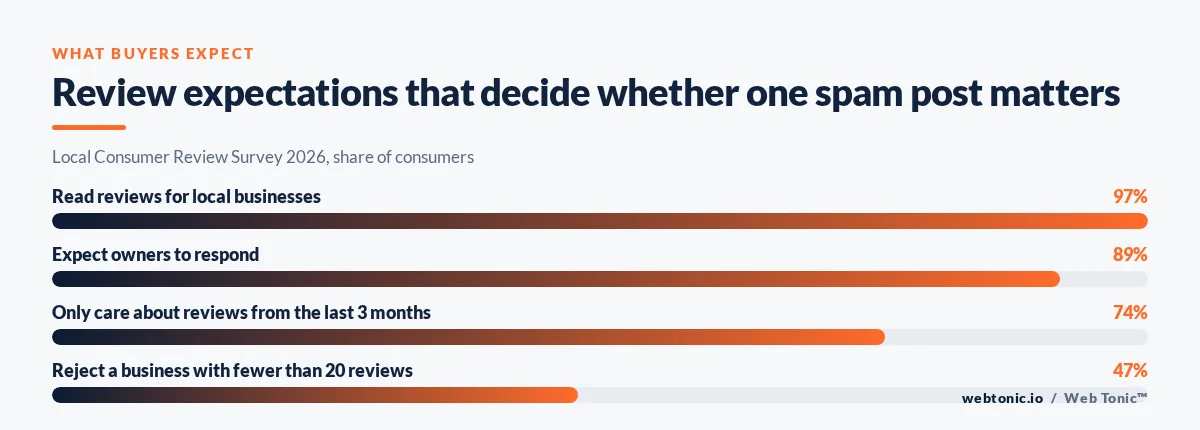
- Reviews are not a side issue: 97% of consumers read reviews for local businesses and 41% now read them every single time they look for a business, up from 29% a year earlier.
- Volume is your best defence. 47% of buyers reject anywhere with fewer than 20 reviews, and 74% only care about reviews written in the last three months — so a steady flow buries a single fake far faster than an appeal ever will.
- Respond to everything. 89% of consumers expect owners to respond, 81% expect a reply within a week, and 50% are put off by templated answers.
- Do not spread your risk across one platform. Consumers now consult an average of six review sites, and Google's share of review reading fell from 83% to 71% in a year while Facebook usage rose.
What counts as a spam review on Facebook
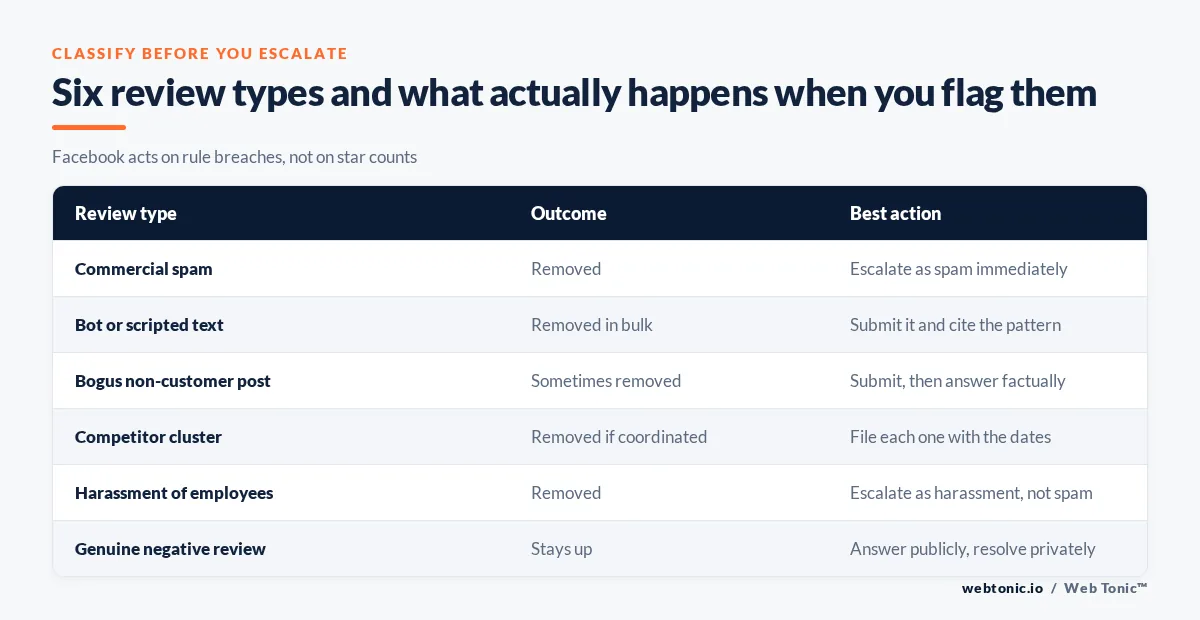
Before you flag anything, classify it. Facebook's moderation team acts on policy violations, so the category you pick decides whether the review is removed or left in place. The most common mistake owners make is reporting an unflattering but honest rating as spam, which trains the system to ignore your reports.
| Review type | What it looks like | Likely outcome | Best action |
|---|---|---|---|
| Commercial spam | Links, a phone number, or promotion for another business | Removed — clear spam violation | Escalate as spam immediately |
| Bot or scripted content | Identical wording across many local pages | Removed, often in bulk | Submit it and cite the pattern |
| Bogus rating from a non-customer | No order, no visit, no visit recorded on your side | Sometimes removed — depends on evidence | Submit, then answer factually |
| Competitor attack | Cluster of one-star ratings in a short window | Removed if coordinated behaviour is detectable | File each one, screenshot the timing |
| Harassment or hate speech | Slurs, threats, targeting of staff | Removed under community standards | Escalate as harassment, not spam |
| Genuine negative review | Specific, verifiable, unhappy customer | Stays up | Answer publicly and resolve privately |
Rule 1 — never escalate a real customer. If you can match the reviewer to an order, a booking or a service visit, the review is content to answer, not content to remove.
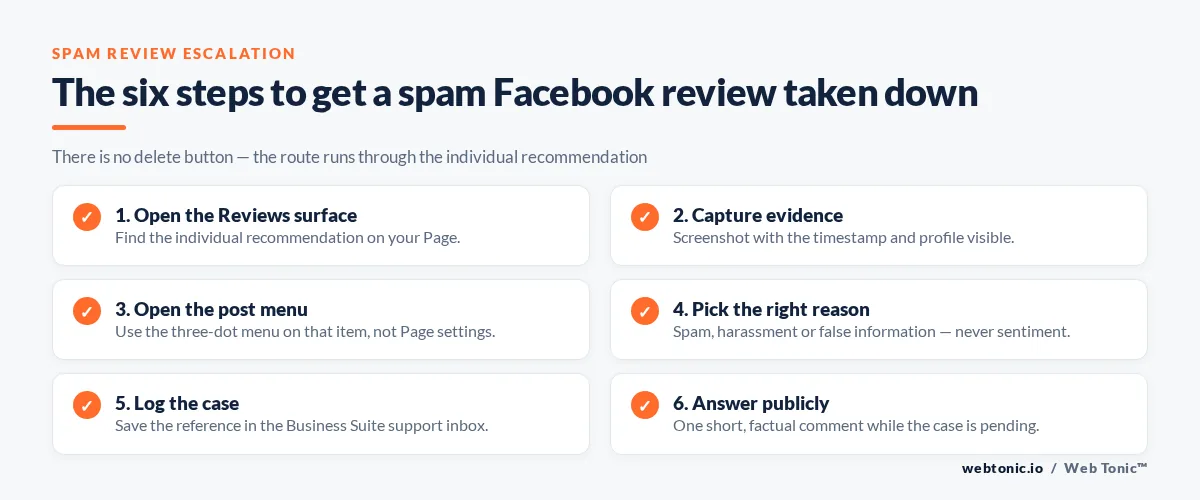
How to flag and remove spam Facebook reviews: the 6 steps
The route to removal runs through the individual recommendation post, not through your Page settings. Work through the steps in order and keep a record at each stage, because you may need it if the first submission is rejected.
| Step | Where you do it | What to click | Time needed |
|---|---|---|---|
| 1. Open the Reviews surface | Your Page, Reviews or Recommendations tab | The individual recommendation post | 1 minute |
| 2. Capture evidence | Your own device | Screenshot with the timestamp and profile visible | 2 minutes |
| 3. Open the post menu | The recommendation itself | The three-dot menu on that post | Seconds |
| 4. Choose the escalation reason | The escalation flow | Find support or report, then spam, harassment or false information | 2 minutes |
| 5. Submit and log the case | Support inbox in Meta Business Suite | Save the case reference and date | 1 minute |
| 6. Answer while you wait | Public comment on the review | One short, factual, non-defensive comment | 5 minutes |
Limit 2: expect 24 hours to 7 days for a decision, and no notification in many cases. Diarise a check rather than waiting for Facebook to tell you the outcome.
Rule 3 — one submission per offending post, from one Page admin. Multiple admins filing separately on the same item does not speed anything up; a documented pattern across several reviews does.
The criteria Facebook actually uses
Facebook's takedown decisions map to its community standards, not to whether the criticism is fair. Meta publishes its enforcement approach and rule updates through its official newsroom, and the pattern is consistent: content is judged on behaviour and authenticity signals, not on the star count.
| Signal Facebook weighs | Why it matters | How to strengthen your case |
|---|---|---|
| Authenticity of the account | New or recycled profiles are treated as suspect | Cite account age and activity in your case |
| Repetition across pages | Identical text is a spam fingerprint | Link to the same text on other business pages |
| Commercial intent | Promotion inside a review is a clear violation | Point to the link or phone number in the text |
| Targeting of individuals | Naming and abusing employees breaches the rules | Escalate as harassment instead of spam |
| Timing clusters | Coordinated behaviour is detectable at scale | Provide the dates of every item in the cluster |
| Customer relationship | Facebook cannot verify your records | State plainly that no transaction exists |
Google's local rules are stricter and more explicit about what is not allowed — its prohibited and restricted content rules and its documented takedown request process are worth reading even if your problem is on Facebook, because they show the standard of evidence platforms expect.
Turning the Reviews tab off: when it is the right call
There is one setting that removes spam Facebook reviews instantly, and it is blunt: switching the Reviews or Recommendations surface off hides every review on the Page. It is a legitimate tool in a live attack and a bad long-term choice.
| Scenario | Switch reviews off? | Reasoning |
|---|---|---|
| Coordinated attack in progress | Yes, temporarily | Stops the pile-on while reports process |
| One obvious spam post | No | You would hide your genuine trust signals too |
| Strong existing rating | No | 92% of buyers care about star ratings |
| Fewer than 5 reviews total | Possibly | Only 9% of buyers accept five or fewer ratings anyway |
| Regulated or sensitive services | Case by case | Privacy obligations may outweigh social proof |
| After the attack ends | Switch back on | A page with no reviews reads as a warning sign |
Limit 4: treat the off switch as a 72-hour measure, not a habit. Businesses that leave reviews disabled lose the trust signal that 85% of consumers respond to when they read positive feedback.
When Facebook leaves the spam item up
Reports are rejected often, and there is no appeal court. What you have instead is a sequence of escalations and a reputation strategy that makes the single bad post irrelevant.
| Escalation | How to use it | Realistic expectation |
|---|---|---|
| Resubmit with new evidence | Add the cross-page pattern or account details | Moderate chance on genuine spam |
| Meta Business Suite support inbox | Open a support case referencing the earlier escalation | Slow, but creates a paper trail |
| Verified or advertiser support channel | Available to some paying accounts | Fastest human review you can get |
| Flag the account, not the item | Where the profile itself is fake | Losing the account hides everything it wrote |
| Consumer protection regulators | Bogus ratings are an enforcement priority for the FTC and the UK CMA | Slow, but real for paid rating farms |
| Fraud escalation | Extortion attempts go to IC3 and BBB scam tracker | Appropriate when money is demanded |
Rule 5 — never pay to have a review taken down. Paying someone to remove or to post reviews puts you on the wrong side of the FTC's rules on soliciting and paying for reviews, which carry civil penalties per violation.
Wording that works while the case is pending
Your public comment is read by future customers long after the spam post is gone. Keep it short, factual and unbothered — and remember that generic replies actively cost you business, since templated responses put off half of all consumers.
| Situation | Approach | Length |
|---|---|---|
| Obvious spam with a link | Do not respond at all — just submit it | None |
| Bogus claim, no record of the customer | State that you cannot find a matching order and invite contact | 2 sentences |
| Mistaken identity | Note politely that this may be another business | 2 sentences |
| Real complaint inside a hostile post | Acknowledge the issue, move it to a private channel | 3 sentences |
| Attack on a named employee | Defend the employee, escalate as harassment | 2 sentences |
| Cluster of one-star ratings | One consistent answer, not six different ones | 2 sentences each |
Limit 6: respond within 24 hours where you can — 19% of consumers expect a same-day response and few wait longer than a week.
How to protect a Facebook Page from future spam reviews
Prevention is mostly configuration plus a review flow that keeps genuine feedback arriving faster than fake feedback can distort it. Our guide to asking customers for reviews covers the request mechanics; the settings below are the defensive half.
| Control | What it does | Effort |
|---|---|---|
| Profanity filter and blocked words | Hides posts containing terms you specify | 10 minutes, one time |
| Page roles cleanup | Limits who can change review settings | 15 minutes, quarterly |
| Two-factor authentication for admins | Prevents Page takeover, the worst-case scenario | 5 minutes per admin |
| Alerts on new recommendations | Lets staff respond the same day | 5 minutes to configure |
| A weekly monitor-reviews routine | Catches clusters before they set the average | 15 minutes weekly |
| Steady review generation | Dilutes any single bogus item | Ongoing, automated requests |
Rule 7 — a bogus rating is a maths problem before it is a moderation problem. Ten genuine reviews a month makes one bogus item statistically invisible; two a year makes it decisive.
Spam messages, mentions and tags: the same playbook
Review spam rarely arrives alone. The same networks push spam messages into your inbox and tag your Page in unrelated posts, and each surface has its own control.
| Surface | Typical spam | Control to use |
|---|---|---|
| Page inbox messages | Crypto, loan and "your page is at risk" phishing | Mark as junk, never click the link |
| Comments on posts | Links to other services | Blocked-words list plus hide |
| Photo and post tags | Unrelated promotional content | Turn off unreviewed tagging |
| Duplicate impostor Pages | A copy of your brand collecting reviews | Flag impersonation, then request a merge |
| Local group threads | Complaints seeded in community groups | Respond once, publicly and calmly |
| Ad comments | Off-topic clutter under paid ads | Comment moderation on the ad account |
Limit 8: phishing messages claiming your Page will be deleted are never genuine. Verify anything urgent inside Business Suite itself, and read our wider notes on Facebook marketing for small businesses before changing anything under pressure.
Rebuilding reputation after a spam attack
Once the escalations are filed, the reputation work decides the commercial outcome. Consumers do not read one review; they read a pattern, and they check recency first. Data from the 2026 Local Consumer Review Survey shows how narrow the window is: 32% of consumers look for reviews written within the last two weeks.
| Week | Action | Target |
|---|---|---|
| Week 1 | Flag, answer, screenshot everything | Every offending item submitted |
| Week 2 | Ask your 20 happiest recent customers | 8 to 12 new genuine reviews |
| Week 3 | Answer every item on the Page | 100% response rate |
| Week 4 | Automate the request at the point of service | A repeatable monthly flow |
| Month 2 | Diversify across the platforms customers use | Presence on 3 or more review sites |
| Month 3 | Feature verified reviews on your own site | Social proof you control |
If you display those reviews on your website or in ads, follow the FTC's guidance on featuring online customer reviews and its penalty offence notices on endorsements — selective display can itself be deceptive. Practical reputation-management tactics are covered well in this reputation management guide, and a wider view of how people actually behave on the platform sits in Pew Research's platform usage fact sheet. For hands-on help, our growth marketing team runs this as a managed process, or you can just get in touch.

FAQ
Can I delete spam reviews on my Facebook business page myself?
No. Facebook does not give Page admins a delete option for individual recommendations. You can flag the item so Facebook assesses it, or turn the Reviews surface off, which hides every review on the Page rather than just the spam one.
Why will Facebook not remove a spam or negative review?
Because a takedown depends on a rule breach, not on accuracy or fairness. If the post contains no promotion, no harassment and no detectable coordinated behaviour, it usually stays up — even when you have no record of the person as a customer.
How do I flag a review as spam or inappropriate on Facebook?
Open the recommendation on your Page, use the three-dot menu on that item, choose the escalation option, then pick the reason that matches the violation: spam for promotional content or a phone number, harassment for abuse aimed at your team, false information for fabricated claims.
How long does Facebook take to act on a flagged review?
Anywhere from a day to a week, and often with no notification either way. Answer publicly in the meantime, log the case reference, and resubmit with additional evidence if the post is still live after seven days.
What should I do if Facebook support never responds?
Shift from takedown to dilution: generate genuine reviews steadily, answer all of them, and spread your presence across the six review sites consumers now use on average. Where a rating farm demands payment, treat it as fraud rather than negotiating.
Can I stop spam reviews from happening again?
Not entirely, but you can make them harmless. Blocked-word filters, tightened Page roles, two-factor authentication for admins, same-day alerts and a monthly review-request flow together mean a single bogus item never moves your rating.
Sources
BrightLocal Local Consumer Review Survey 2026 · Meta Newsroom · Google Business Profile prohibited and restricted content rules and review takedown documentation · FTC business guidance blog, soliciting and paying for reviews guide, featuring online customer reviews guide, and endorsement penalty offence notices · UK Competition and Markets Authority · FBI Internet Crime Complaint Center · BBB Scam Tracker · WordStream reputation management guide · Pew Research Center platform usage fact sheet. Figures current as of August 2026.