Table of contents
Online ads are paid promotional placements delivered through internet-connected surfaces — search results, websites, apps, social feeds, video players, email inboxes and connected TV — where an advertiser buys attention from a publisher, usually through an automated auction, and pays per click, per thousand impressions, per view or per action.
Key Takeaways
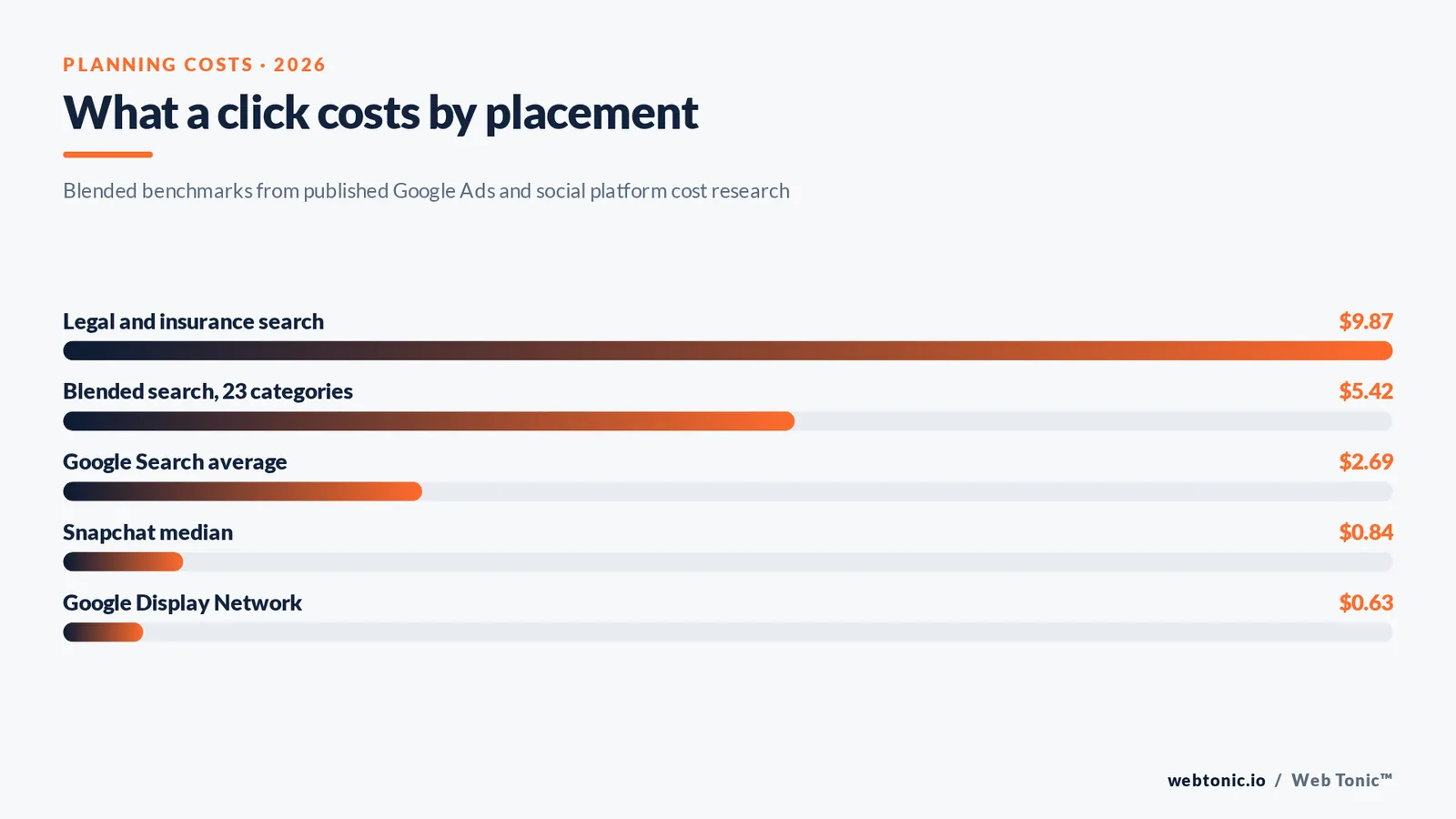
- The average cost per click across industries is $2.69 on Google Search and $0.63 on the Google Display Network, a 4.3x gap between two units bought in the same account.
- Average click-through rate on paid search sits at 4–6%, far above display, where enticing creative is doing most of the work.
- Google suggests new advertisers start at $10–$50 per day and a $1 maximum cost-per-click bid before letting the data set the level.
- The IAB retired fixed pixel sizes: its standard portfolio now defines units by aspect ratio and size range so one creative scales across screens.
- Across 23 tracked search categories, blended benchmarks land near $5.42 cost per click, 6.64% click-through rate, 8.18% conversion rate and $66.69 cost per lead.
- Uploaded HTML5 display ads require more than $1,000 in lifetime account spend plus a clean policy and payment history before Google grants access.
What counts as an online ad, and what does not
The boundary matters because budgets get mixed up. An online ad is paid, placed and measurable: you pay a platform or publisher, the placement is delivered into inventory you do not own, and delivery is counted. Content on your own website, a non-paid social post or an organic search listing is marketing, but it is not advertising.
| Activity | Paid placement | Runs on inventory you own | Classified as an online ad |
|---|---|---|---|
| Search results ad on a query | Yes | No | Yes |
| Banner on a publisher website | Yes | No | Yes |
| Sponsored social feed post | Yes | No | Yes |
| Skippable video before a clip | Yes | No | Yes |
| Promoted product listing in a marketplace | Yes | No | Yes |
| Non-paid social post to your followers | No | Partly | No |
| Blog article ranking in search results | No | Yes | No |
| Newsletter to your own subscriber list | No | Yes | No |
| Paid placement inside somebody else's newsletter | Yes | No | Yes |
Two grey zones trip teams up. Creator partnerships are advertising when money or product changes hands, which is why disclosure rules apply. Retail media placements — sponsored slots inside a retailer's own search results — are advertising for the brand buying them and owned inventory for the retailer selling them.
The ad unit reference: format by format
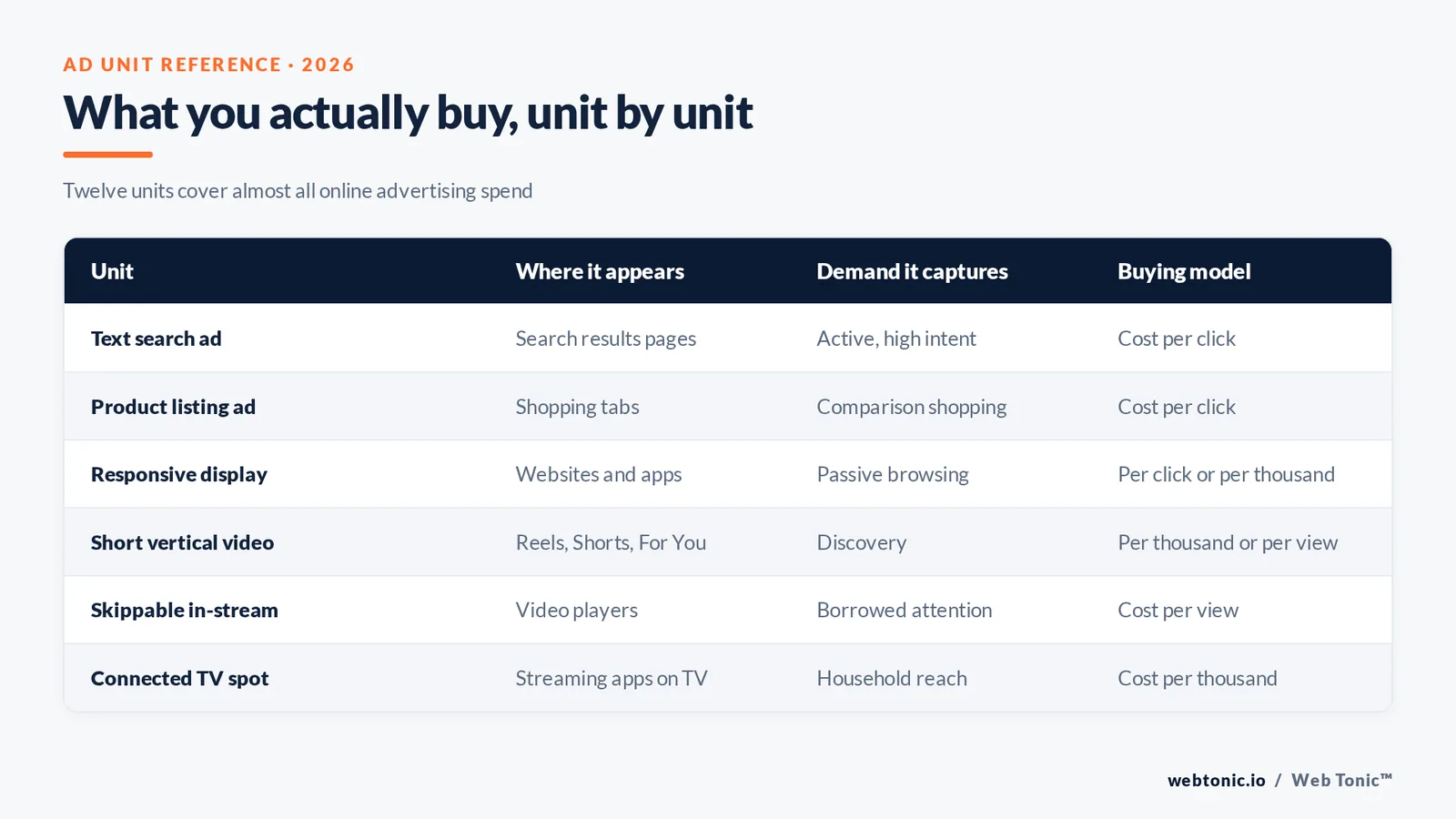
Ignore campaign names for a moment; what you actually buy is a unit. Each one answers a different question about intent, and each has its own benchmark range.
| Unit | Where it appears | Demand it captures | Primary buying model | Benchmark to expect |
|---|---|---|---|---|
| Text search ad | Search engine results pages | Active, high-intent demand | Cost per click | 4–6% click-through rate |
| Product listing ad | Shopping tabs and search results | Comparison shopping | Cost per click | Price and image drive the click |
| Responsive display banner | Publisher websites and apps | Passive browsing | Cost per thousand impressions or per click | Around $0.63 per click |
| Native in-feed unit | Inside editorial article feeds | Passive, content-aligned | Cost per thousand impressions | Higher attention, lower volume |
| Social feed image or carousel | Social platform feeds | Interest and behaviour based | Cost per thousand impressions | Creative decides delivery |
| Short vertical video | Reels, Shorts and For You feeds | Discovery and entertainment | Cost per thousand impressions or per view | Hook in the first 3 seconds |
| Skippable in-stream video | Video players before or during content | Attention borrowed from content | Cost per view | Pay only after 30 seconds or interaction |
| Non-skippable bumper | Video players | Reach and frequency | Cost per thousand impressions | 6 seconds, message-first |
| Interstitial or app-open unit | Mobile apps between screens | Interrupt-based attention | Cost per thousand impressions | High viewability, low patience |
| Sponsored search unit in a marketplace | Retailer and app store search | Purchase-ready demand | Cost per click | Closest to the transaction |
| Connected TV spot | Streaming apps on television | Household reach | Cost per thousand impressions | Sold on completed views |
| Inbox promotion unit | Email clients and inbox tabs | Passive, opt-in adjacency | Cost per click | Limited template support |
The IAB standard ad unit portfolio replaced the old Universal Ad Package and fixed pixel dimensions with flexible units built on aspect ratio and size range, alongside its LEAN principles for load weight. Practically, that means one well-built responsive creative set now covers inventory that used to need six separate banner files.
How you pay: the five buying models compared
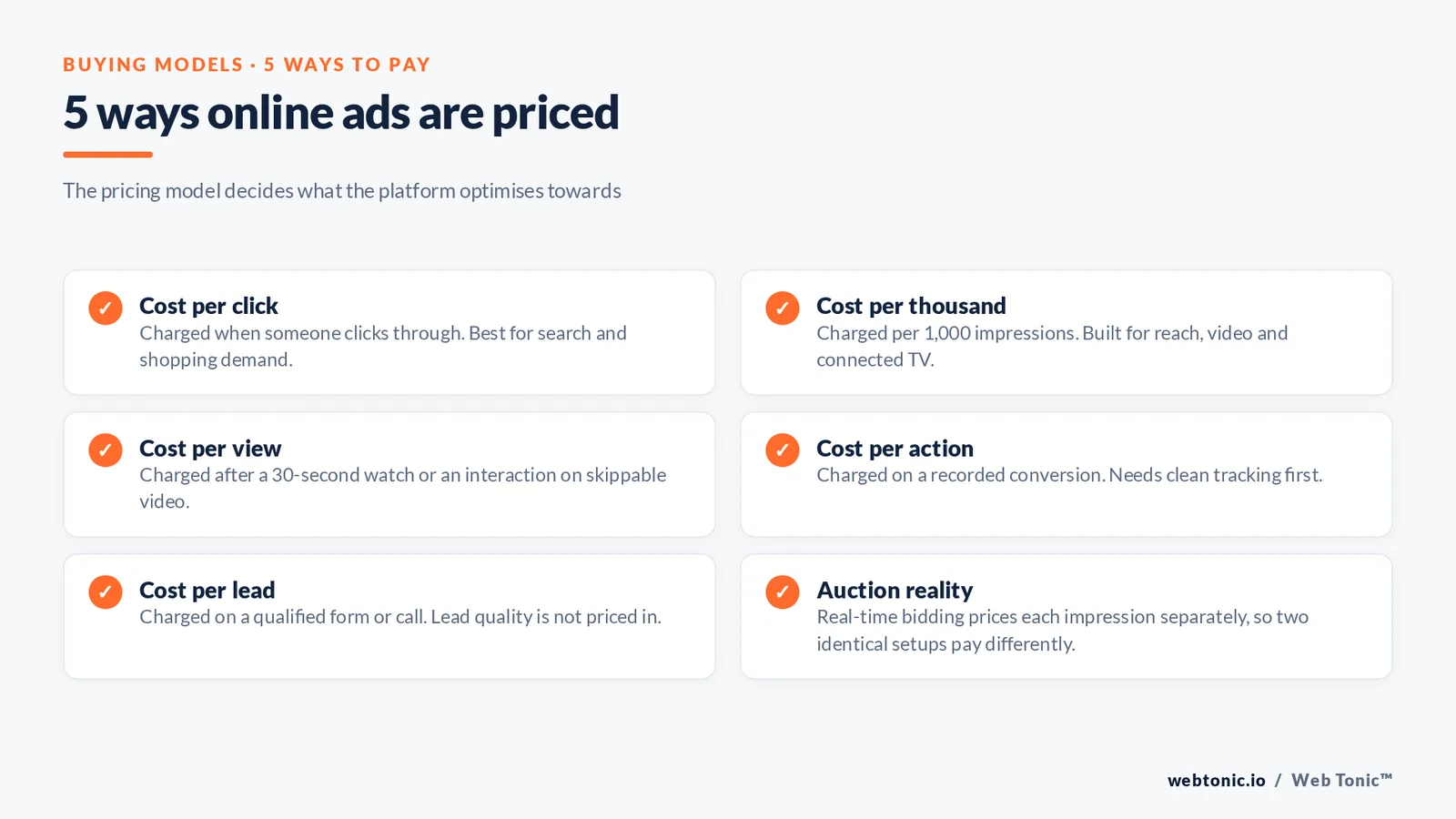
The pricing model is not an accounting detail. It decides what the platform optimises towards, and therefore what you get.
| Model | You are charged when | Best used for | Risk it carries |
|---|---|---|---|
| Cost per click | Someone clicks through to your site | Search and shopping demand capture | Clicks that never convert |
| Cost per thousand impressions | The unit is served a thousand times | Reach, awareness and video | Paying for unseen inventory |
| Cost per view | A viewer watches to a threshold or interacts | Video consideration campaigns | Cheap views from disinterested audiences |
| Cost per action | A defined conversion is recorded | Lead generation and e-commerce at volume | Needs clean conversion tracking first |
| Cost per lead | A qualified form or call arrives | Service businesses | Lead quality is not priced in |
Cost per thousand impressions is the oldest of the five. As the cost per mille definition notes, it exists to let a planner compare the price of attention across very different media, which is why connected TV, podcasts and display all still quote it. Where you have reliable conversion data, automated bidding towards a cost-per-action target beats manual clicks, because the platform is then buying outcomes rather than traffic.
What online ads cost in 2026
Plan with published benchmarks, then replace them with your own numbers after 30 days of delivery.
| Placement | Planning cost per click | Typical cost per thousand impressions | Notes |
|---|---|---|---|
| Google Search | $2.69 blended average | Not the standard model | $1–2 is common in low-competition categories |
| Google Display Network | $0.63 | Low single digits | Reach at a fraction of search prices |
| Blended search across 23 categories | $5.42 | Not applicable | With 6.64% click-through and 8.18% conversion rate |
| Snapchat | $0.84 median | About $8 | Minimum daily spend around $5 |
| Legal and insurance search terms | Up to $9.87 | Not applicable | Highest tracked category cost per click |
| Most expensive tracked keywords | $255–$1,351 | Not applicable | Single clicks in niche software and legal terms |
Three planning rules follow from that spread. First, category matters more than platform: a $9.87 legal click and a $0.63 display click can sit in the same account. Second, the published Google Ads cost research recommends starting at $10–$50 a day with a $1 maximum bid rather than guessing high. Third, the ceiling is your unit economics: if a batch of product earns $15 in profit and takes 20 clicks to sell, a bid above $0.75 loses money on every order.
How the auction decides which ad runs
Fact 1 — 5 clearing mechanisms cover essentially all online ad inventory, and only two of them let you name a price in advance.
Almost no online ad is bought at a fixed rate anymore. Two auction mechanics cover the market, and knowing which one you are in explains why your cost moved.
| Mechanism | How inventory clears | What you control | Where you meet it |
|---|---|---|---|
| Platform auction | Bid combined with predicted quality and relevance | Bids, targets, creative quality, landing page | Search engines and social platforms |
| Real-time bidding | Per-impression auction across exchanges in milliseconds | Bid rules, audience lists, inventory filters | Open programmatic display and video |
| Private marketplace deal | Negotiated floor price with a named publisher | Publisher list, price floor, share of voice | Premium editorial and connected TV |
| Programmatic guaranteed | Fixed volume at a fixed price, delivered automatically | Volume, flight dates, creative | Reserved sponsorships |
| Direct insertion order | Manual buy, invoiced | Placement and creative specifics | Niche publishers and newsletters |
Real-time bidding is why two advertisers with identical settings pay different prices: the auction is per impression, priced against whoever else wants that specific person on that specific page. On the platform side, relevance is a price lever. Quality signals discount your cost, which is why Google's own campaign guidance puts as much weight on ad and landing page relevance as on bid level.
Targeting: the data behind who sees your ad
Rule 1 — layer no more than 2 targeting types per ad set; stacking 3 or more usually cuts delivery before it improves precision.
Targeting is the difference between advertising and broadcasting, and each type carries a different privacy and performance profile.
| Targeting type | Signal it uses | Strength | Limitation in 2026 |
|---|---|---|---|
| Keyword and query | What the user typed right now | Highest intent available | Volume capped by real demand |
| Audience interest and affinity | Platform-modelled interests | Scales cheaply for awareness | Coarse and drifting |
| Customer list matching | Your own first-party data | Precise, consent-backed | Match rates below 100% |
| Website and app retargeting | Prior visits and product views | Best conversion rates on display | Shrinking cookie windows |
| Lookalike modelling | Similar profiles to your best customers | Efficient prospecting | Only as good as the seed list |
| Contextual placement | Page content and topic | No personal data required | Needs strong exclusion lists |
| Geographic and radius | Location and location intent | Essential for service businesses | Broad settings waste budget fast |
| Demographic and life stage | Declared or modelled attributes | Useful as a layer | Restricted in sensitive categories |
Two practical notes. Broad platform targeting has largely won on social feeds because the delivery models optimise better than manual segments do — but only when creative variety is wide enough to feed them. And professional platform targeting remains the exception, where firmographic layers still beat modelling for business audiences.
Creative specs that decide whether the unit performs
Format compliance gets the ad served. Craft gets it noticed. Both are cheap compared with media.
| Unit | Hard requirement | Craft rule that moves performance | Common rejection cause |
|---|---|---|---|
| Text search ad | Multiple headline and description assets | Match the headline to the query wording | Excess punctuation or capitals |
| Responsive display | Landscape, square and logo images plus text | One idea per image, readable at thumbnail size | Text-heavy images and stretched logos |
| Uploaded HTML5 banner | Approved account access and weight limits | Animate to a single message and stop | No lifetime spend history |
| Short vertical video | 9:16 frame, captions, safe zones | Hook inside 3 seconds, brand inside 5 | Text hidden behind interface elements |
| Skippable in-stream | Landscape master with clear opening | Say the offer before the skip button appears | Slow logo intros |
| Bumper | 6 seconds, no skip | One claim, one visual | Trying to fit a full script |
| Native in-feed | Headline, thumbnail, brand name | Editorial tone that fits the host page | Clickbait phrasing |
| Product listing | Clean feed with price and availability | Title front-loads the search phrase | Feed disapprovals on price mismatch |
Google's own documentation on uploaded display ad specifications is worth reading before you commission animated banners: HTML5 access requires a clean policy record, a clean payment history and more than $1,000 of lifetime spend, so young accounts should plan on responsive units instead. Video specs follow the same logic — the video ad format documentation defines exactly when a view becomes billable.
Measuring online ads: the metric stack
Limit 2 — wait for 30 conversions before judging a placement; below that, the sample is noise rather than a result.
Every layer of the funnel has one metric that matters and one that misleads. Track down the stack, not across it.
| Layer | Metric that matters | Metric that misleads | Why |
|---|---|---|---|
| Delivery | Viewable impressions | Served impressions | A served unit may never enter the screen |
| Attention | Completion or hold rate | Total views | A 3-second view proves nothing |
| Interest | Click-through rate against the format norm | Raw clicks | Formats differ by an order of magnitude |
| Cost | Cost per click and cost per thousand together | Either one alone | Cheap clicks can hide terrible reach |
| Outcome | Cost per action and cost per lead | Conversion count | Volume without cost context is noise |
| Value | Return on ad spend and contribution margin | Return on ad spend alone | Margin, not turnover, pays the bills |
| Incrementality | Geo or holdout test results | Platform-reported conversions | Every platform claims the same sale |
Viewability is where money quietly disappears in display and video, which is why independent accreditation exists at all: the Media Rating Council audits measurement vendors against published standards. Ask any programmatic partner which of their metrics are accredited before you approve the plan.
The honest benefits and drawbacks
Trap 3 — a 100% paid mix means demand stops the day billing does, which is the single most common structural weakness we audit.
| Benefit | What it means in practice | Matching drawback |
|---|---|---|
| Precise targeting | Reach a defined audience instead of a broad population | Narrow settings raise costs and cap volume |
| Fast feedback | Performance data within hours | Encourages over-reacting to small samples |
| Budget control | Start at $10 a day and pause instantly | Easy to spend continuously with no compounding asset |
| Measurable outcomes | Clicks and conversions counted per placement | Attribution disputes between platforms |
| Format variety | One offer expressed as text, image, video or feed | Creative production cost multiplies |
| Scale on demand | Add budget the day demand appears | Costs rise as you push past the efficient audience |
| Auction access for small budgets | No minimum media commitment on most platforms | You compete against advertisers with far deeper pockets |
The structural trade-off is worth stating plainly: paid placements stop the day the card stops. That is why we treat paid media as the demand-capture layer next to non-paid search and owned email, not as the whole plan. Our wider explainer on how digital advertising works covers the channel strategy side, and our click-through rate benchmarks give you the format-by-format yardstick.
Choosing units by objective
Start from the business objective and let it pick the unit. Running the reverse — picking a platform first — is the most expensive mistake in the category.
| Objective | First unit to buy | Second unit | Model | Signal that it is working |
|---|---|---|---|---|
| Sell an existing in-demand product | Text search ad on branded and category terms | Product listing ad | Cost per click | Cost per action below margin |
| Launch a product nobody searches for yet | Short vertical video on social feeds | Native in-feed unit | Cost per thousand impressions | Branded search volume rising |
| Fill a local service diary | Search ad with radius targeting | Local map placement | Cost per lead | Cost per booked job |
| Generate business leads | Professional platform feed ad | Retargeting display | Cost per lead | Sales-accepted lead rate |
| Recover lost visitors | Website retargeting display | Dynamic product unit | Cost per click | Assisted conversion rate |
| Build category awareness | Connected TV or skippable in-stream | Bumper for frequency | Cost per thousand impressions | Incremental lift in a holdout test |
| Grow an app user base | App install campaign | Interstitial unit | Cost per action | Retained users at day 7 |
Whatever the objective, the sequence is the same: verify conversion tracking, buy the highest-intent unit available, prove the unit economics, then widen. If you want that mapped against your own margins, our team is happy to walk through the plan, or read how we structure paid programmes inside growth marketing engagements.

Online advertising platforms compared
Six platforms take the overwhelming majority of online advertising budgets. Each one sells a different kind of attention, so compare them on the demand they hold rather than on interface quality.
| Advertising platform | Best used for | Targeting basis | Entry budget | Planning cost per click |
|---|---|---|---|---|
| Google Ads search | Capturing high intent from people already searching | Keywords and search queries | $10–$50 per day | $2.69 blended |
| Google Display Network | Cheap reach and retargeting across websites and apps | Audiences, contextual topics, remarketing lists | $10 per day | $0.63 |
| Social media platforms (Meta family) | Discovery, products people did not know existed | Interests, behaviour, customer lists, lookalikes | $5–$20 per day | $0.50–$2.00 |
| YouTube and video | Brand awareness with attention held by content | Audiences, topics, keywords, channel placements | $10 per day | Bought per view or per thousand |
| Professional platform (LinkedIn) | Business audiences and long sales cycles | Job title, company, industry, seniority | $25 per day | Highest of the six |
| Short-form video platforms (TikTok) | Younger audiences and creator-led formats | Interests, behaviour, creator adjacency | $20–$50 per day | $0.50–$1.50 |
| Marketplace and retail media | Shoppers with a card already out | Product, category and search terms | Varies by retailer | Closest to the sale |
| Snapchat | Reach against a young mobile audience | Interests, location, lookalikes | About $5 per day | $0.84 median |
Platform choice is reversible; measurement is not. Set up conversion tracking on your website before the first campaign goes live, then judge each advertising platform on cost per action rather than on the clicks it reports. TikTok publishes its own advertiser onboarding documentation if short-form video is where your audience actually spends its attention.
Examples of online advertising in practice
Abstract format lists do not help you plan. These eight worked examples show which unit different businesses buy, what the offer looks like, and the number that proves it worked.
| Business | Unit bought | Offer in the ad | Targeted audience | Number that proves it worked |
|---|---|---|---|---|
| Plumbing company | Search ad with a 15-mile radius | Same-day emergency call-out | People searching a service phrase now | Cost per booked job under $85 |
| Fashion retailer | Social media carousel of 6 products | Free returns within 30 days | Lookalikes of past customers | Return on ad spend above 3.0 |
| Software business | Professional platform feed ad | Free 14-day trial, no card | Job titles at target companies | Sales-accepted lead rate above 25% |
| Meal-kit brand | Short vertical video, 12 seconds | First box discount | Broad interest audience on mobile | Cost per new customer below margin |
| Local dental practice | Local map placement plus search ad | New patient exam price | Users within 5 miles | Calls per $100 of spend |
| Online electronics store | Product listing ads from a clean feed | Price plus free delivery | Comparison shoppers on category terms | Revenue per click above product margin |
| Membership gym | Retargeting display banner | 7-day free pass | Website visitors from the last 14 days | Sign-ups per 1,000 impressions |
| Boutique hotel | Connected TV plus bumper for frequency | Direct-booking rate guarantee | Households in two feeder cities | Branded search volume and direct bookings |
The pattern across all eight: one unit, one offer, one audience definition, one number. Campaigns fail far more often from stacking three offers into one ad than from choosing the wrong platform.
Where online advertising fits next to SEO and email marketing
Paid placements buy attention now; search engine optimization and owned email compound it. The three work as a system, and the revenue maths only closes when you treat them that way.
| Channel | What you are buying | Time to first result | Cost behaviour over time | Role in the mix |
|---|---|---|---|---|
| Online advertising | Immediate, rented attention | Hours to days | Rises as you scale past the efficient audience | Demand capture and testing |
| Search engine optimization | Non-paid visibility you keep | 3–6 months | Falls per visit as content compounds | Durable acquisition |
| Email marketing | Access to an audience you own | Immediate once the list exists | Near zero marginal cost | Conversion and repeat revenue |
| Organic social media content | Audience relationship and proof | Weeks | Creative time rather than media | Trust and retargeting pools |
| Creator partnerships | Borrowed credibility | Weeks | Variable per deal | Awareness with proof attached |
Use advertising to find out which messages and products convert, then feed the winners into your content and email programme where each conversion costs nothing incremental. Test messages in a paid ad for two weeks, and the answer becomes the title of the article and the subject line of the campaign.
Mobile advertising: what changes on a phone
Most online ads are now seen on a phone, which changes the creative brief more than the media plan. Design for a thumb, a small frame and a distracted user.
| Constraint on mobile | What breaks | Fix |
|---|---|---|
| Small frame | Fine detail and long headlines vanish | One idea, large type, high contrast |
| Sound off by default | Voice-over carries the message | Burn in captions on every video |
| Interface safe zones | Text hidden behind platform controls | Keep copy inside the safe area |
| Slow connections | Heavy creative never renders | Respect lightweight ad weight limits |
| Thumb-sized targets | Users miss the call to action | Large tap targets and short forms |
| Fast scrolling | Brand appears too late | Brand inside the first 5 seconds |
FAQ
What are online ads and how do they work?
Online ads are paid placements delivered on internet surfaces you do not own: search results, websites, apps, social feeds, video players and streaming television. An advertiser sets a budget, a targeting basis and creative; the platform runs an auction each time a matching opportunity appears; and the winning ad is served and billed per click, per thousand impressions, per view or per action.
What types of online advertising exist?
Twelve units cover almost all spend: text search ads, product listing ads, responsive display banners, native in-feed units, social feed image and carousel ads, short vertical video, skippable in-stream video, non-skippable bumpers, app interstitials, marketplace sponsored listings, connected TV spots and inbox promotions.
How much do online ads cost?
Blended averages are $2.69 per click on Google Search and $0.63 on the Google Display Network, with an all-category search benchmark near $5.42 per click and $66.69 per lead. Costs are set by category competition rather than platform: legal terms reach $9.87 a click while the most expensive tracked keywords exceed $1,000.
Which platform is best for running online ad campaigns?
The one that matches your demand type. If people already search for what you sell, start with search and shopping units. If they do not yet know the product exists, start with short vertical video on social feeds. For business audiences, professional platform targeting is usually worth its higher cost per click.
Are online ads worth it for a small business?
Yes, if the arithmetic clears before you launch. Most platforms have no minimum commitment and Google suggests starting at $10 to $50 a day. The test is whether your profit per order can absorb the category cost per click at your real conversion rate; if it cannot, fix conversion or margin before buying media.
Sources
Semrush Google Ads cost and cost-per-click research · WordStream average click-through rate benchmarks · Google Ads Help: about Google Ads, automated bidding, uploaded display ad specifications · YouTube Help video ad formats · IAB Tech Lab New Ad Portfolio creative guidelines · Media Rating Council · LinkedIn Marketing Solutions advertising documentation · Wikipedia: online advertising, real-time bidding, cost per mille. All figures verified August 2026.