Table of contents
Digital advertising is paid promotion delivered through internet-connected media — search results, social feeds, websites, video, retail sites, email and connected TV — where each impression is bought through an auction and measured against a business outcome.
What makes it different from traditional advertising is not the screen. It is that targeting, bidding and measurement happen in real time, on data, for every single impression.
Key Takeaways
- More than 6 billion people now use the internet, and monthly AI-tool users have passed 1 billion — the addressable pool for digital ads keeps widening.
- Google handles 91.25% of worldwide search traffic against Bing's 4.68%, which is why search ads remain the anchor channel.
- Social platforms reach 5.66 billion users who average 2 hours 40 minutes a day on social media across roughly 6.75 platforms each month.
- Social ad spend alone is tracked at about $317 billion, growing near 10.9% a year toward 2030.
- Digital advertising is bought on five main pricing models: CPC, CPM, CPV, CPA and CPL — the model you choose changes the campaign, not just the invoice.
- Google Ads runs an auction on every single search, where Ad Rank combines your bid with ad quality and expected impact, so higher quality can beat a higher bid.
- The average display click-through rate sits well under 1%, while high-intent search campaigns routinely run several times higher — never benchmark one against the other.
How digital advertising actually works
Every digital ad you see is the output of an auction that resolved in milliseconds. Four things happened: a platform identified an available impression, matched it against advertisers whose targeting fit, ranked those advertisers by bid and expected quality, and rendered the winner.
In paid search, Google explains the mechanics in its own documentation on the Google Ads auction: an auction runs for every query, and position is decided by Ad Rank — your bid, ad and landing page quality, ad rank thresholds, context and expected impact from extensions. That is why the highest bidder frequently loses. Google's guidance on how quality affects cost is blunt about it: better relevance lowers what you pay for the same position.
Programmatic display, video and connected TV work the same way through exchanges rather than a single platform, with standards and formats maintained across the industry by the IAB's research and guidelines. Microsoft's search network follows a parallel model documented in the Microsoft Advertising guides, with a smaller but often cheaper inventory pool.
Two consequences follow from the auction model, and they shape everything below. First, ad quality is a price lever, not a vanity concern. Second, because bids are set per impression, budget alone never determines results — the pairing of audience, creative and landing experience does.
The main types of digital advertising
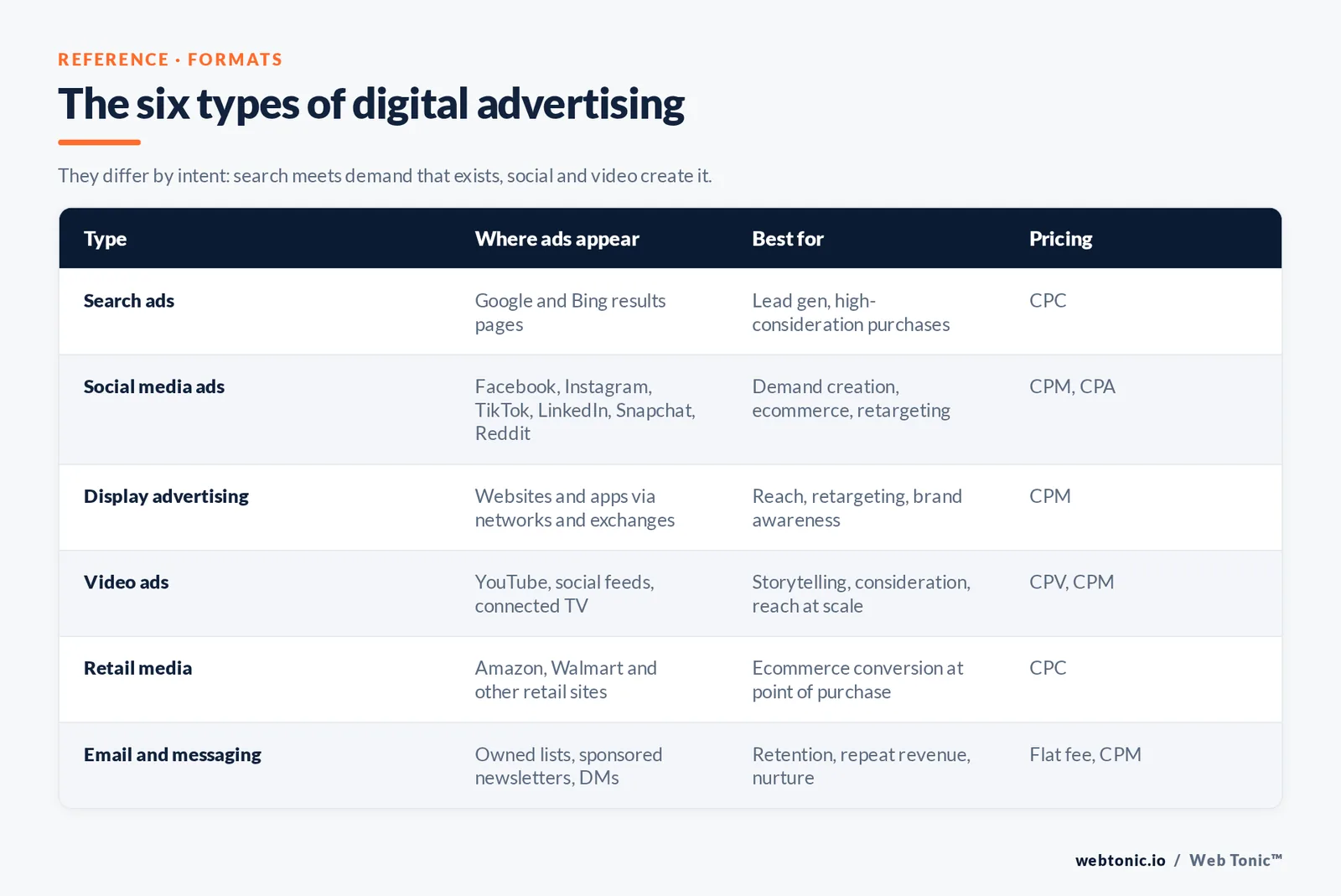
Six formats cover almost all spend. They differ by intent: search ads meet demand that already exists, while social, display and video ads create it.
| Type | Where ads appear | Buys | Best for | Typical pricing |
|---|---|---|---|---|
| Search ads | Google and Bing results pages | Existing intent by keyword | Lead gen, high-consideration purchases | CPC |
| Social media ads | Facebook, Instagram, TikTok, LinkedIn, Snapchat, Reddit | Interests, behaviours, lookalikes, broad | Demand creation, ecommerce, retargeting | CPM, CPA |
| Display advertising | Websites and apps via networks and exchanges | Audiences, placements, contextual signals | Reach, retargeting, brand awareness | CPM |
| Video ads | YouTube, social feeds, connected TV | Audiences and content adjacency | Storytelling, consideration, reach at scale | CPV, CPM |
| Retail media | Amazon, Walmart and other retail sites | Product and category intent | Ecommerce conversion at the point of purchase | CPC |
| Email and messaging | Owned lists, sponsored newsletters, DMs | Permissioned audiences | Retention, repeat revenue, nurture | Flat fee, CPM |
Most durable programmes run at least three of these. Search captures the demand you already have, social and video ads build the demand you do not yet have, and display or retail media close the gap in between. Sprout Social's social media statistics and DataReportal's Digital 2026 report are the two most reliable places to check where audience attention currently sits before you split a budget.
Digital advertising vs traditional advertising
Traditional advertising buys audiences in blocks: a page, a spot, a billboard for a month. Digital advertising buys individual impressions with a measurable response attached. The practical differences compound.
| Dimension | Digital advertising | Traditional advertising |
|---|---|---|
| Buying unit | Single impression, auctioned in real time | Slot, page or panel, negotiated in advance |
| Targeting | Intent, behaviour, geography, first-party data | Broad demographic estimates |
| Minimum viable budget | Often $5–$50 per day | Thousands per placement |
| Speed to launch | Hours | Weeks to months |
| Measurement | Impression-level, conversion-linked | Panel, survey and modelled reach |
| Creative iteration | Continuous testing, same-day changes | Fixed for the flight |
| Main weakness | Attribution complexity and privacy limits | Weak feedback loop and slow optimisation |
The honest version of this comparison is not that digital wins. It is that digital media gives you a feedback loop, and brands that use the loop compound faster than brands that only buy reach. Google's own video marketing research makes the case that upper-funnel video and lower-funnel search work best measured together, not against each other.
Audience targeting: the part that decides performance
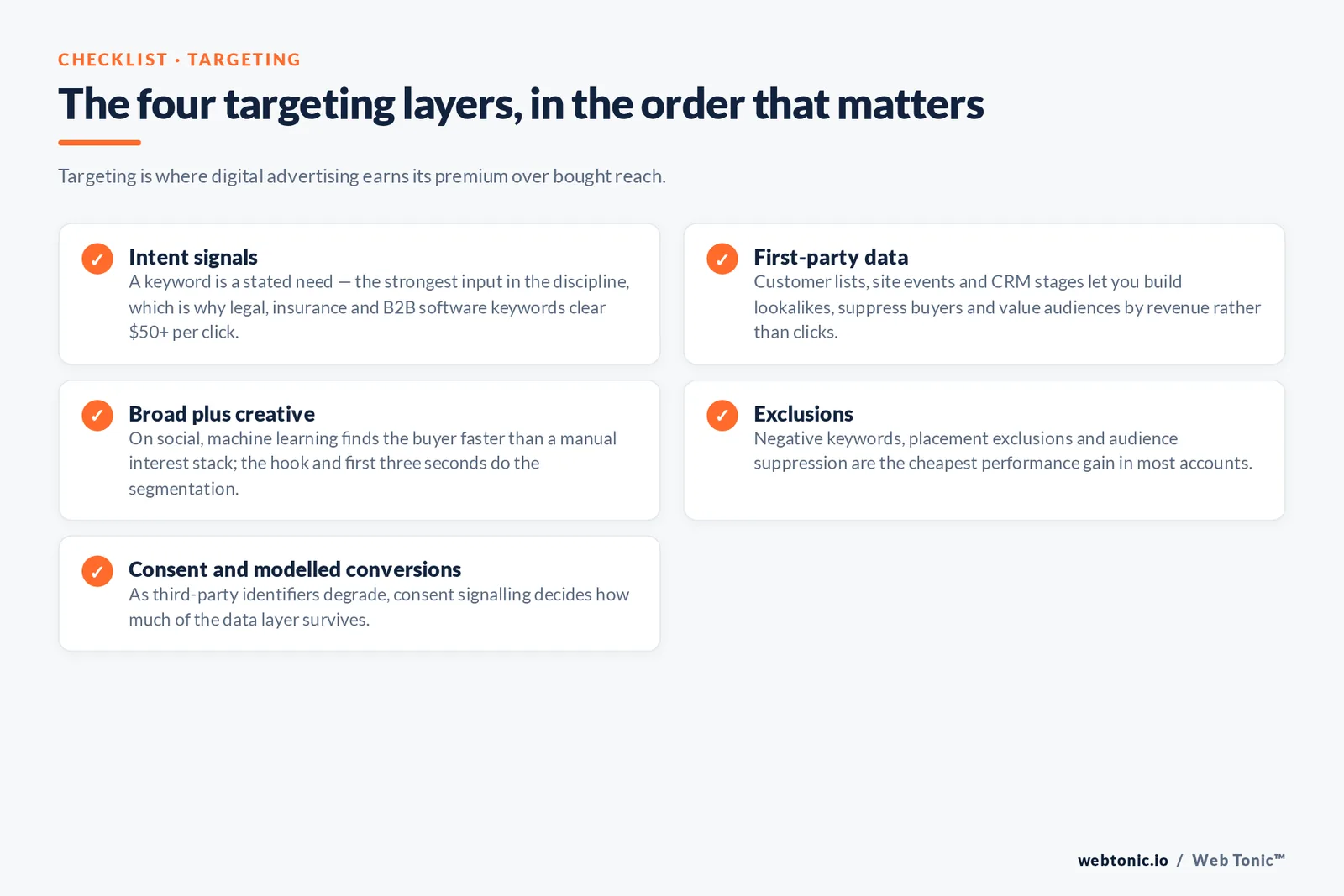
Targeting is where digital advertising earns its premium. Four layers matter, in this order.
1. Intent signals. A keyword is a stated need. It is the strongest targeting input in the entire discipline, which is why competitive commercial keywords can clear $50+ per click in categories like legal services, insurance and B2B software.
2. First-party data. Customer lists, site events and CRM stages let you build lookalikes, suppress existing buyers and value audiences by revenue rather than clicks. As third-party cookies and identifiers keep degrading, this layer is the durable one — Google's advertising privacy documentation sets out how consent and modelled conversions now interact.
3. Broad plus creative. On social platforms, machine learning finds the buyer faster than a manual interest stack in most accounts. The targeting decision migrates into the creative: the hook, the offer and the first three seconds do the segmentation.
4. Exclusions. The cheapest performance gain in most accounts is negative keywords, placement exclusions and audience suppression. Nothing else removes waste as fast.
Where the budget goes across those layers is a strategy question rather than a platform one — our growth marketing and performance creative pages set out how we split media and creative responsibility, and data intelligence covers the measurement layer underneath.
Metrics and pricing models you are actually buying
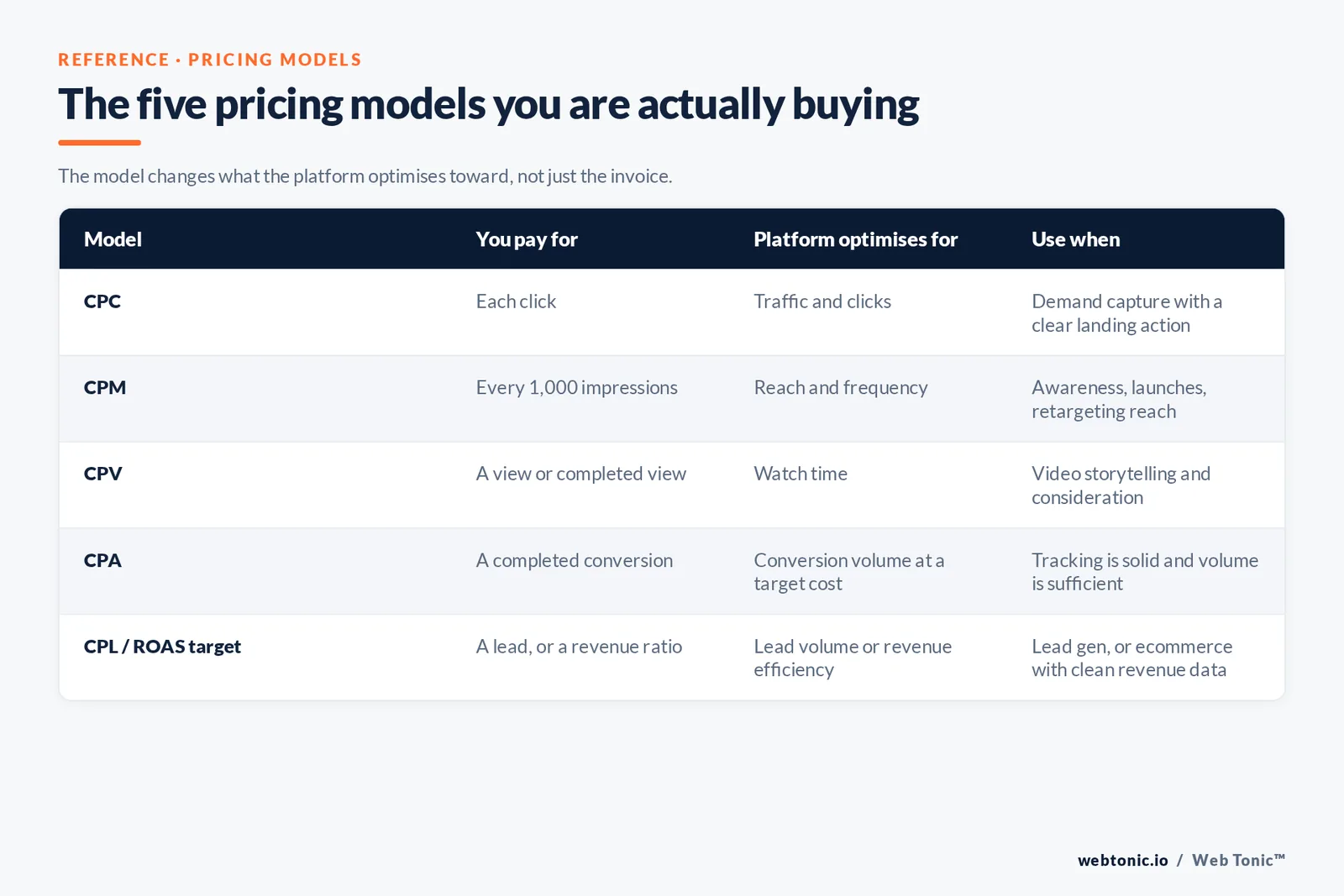
Every digital advertising campaign is priced on one of five models, and each model changes what the platform optimises toward.
| Model | You pay for | Platform optimises for | Use when |
|---|---|---|---|
| CPC | Each click | Traffic and clicks | Demand capture with a clear landing action |
| CPM | Every 1,000 impressions | Reach and frequency | Awareness, launches, retargeting reach |
| CPV | A view or completed view | Watch time | Video storytelling and consideration |
| CPA | A completed conversion | Conversion volume at a target cost | Tracking is solid and volume is sufficient |
| CPL / ROAS target | A lead, or a revenue ratio | Lead volume or revenue efficiency | Lead gen, or ecommerce with clean revenue data |
Two rules keep this honest. Never compare CPMs across formats — a Snapchat CPM near $8 and a connected TV CPM several times that buy entirely different attention. And never optimise to a metric your business cannot bank: click-through rate is diagnostic, revenue and qualified pipeline are the score. Category-level benchmarks and forecasts are tracked by EMARKETER's digital advertising insights and Statista's advertising market outlook.
How to structure a digital advertising campaign
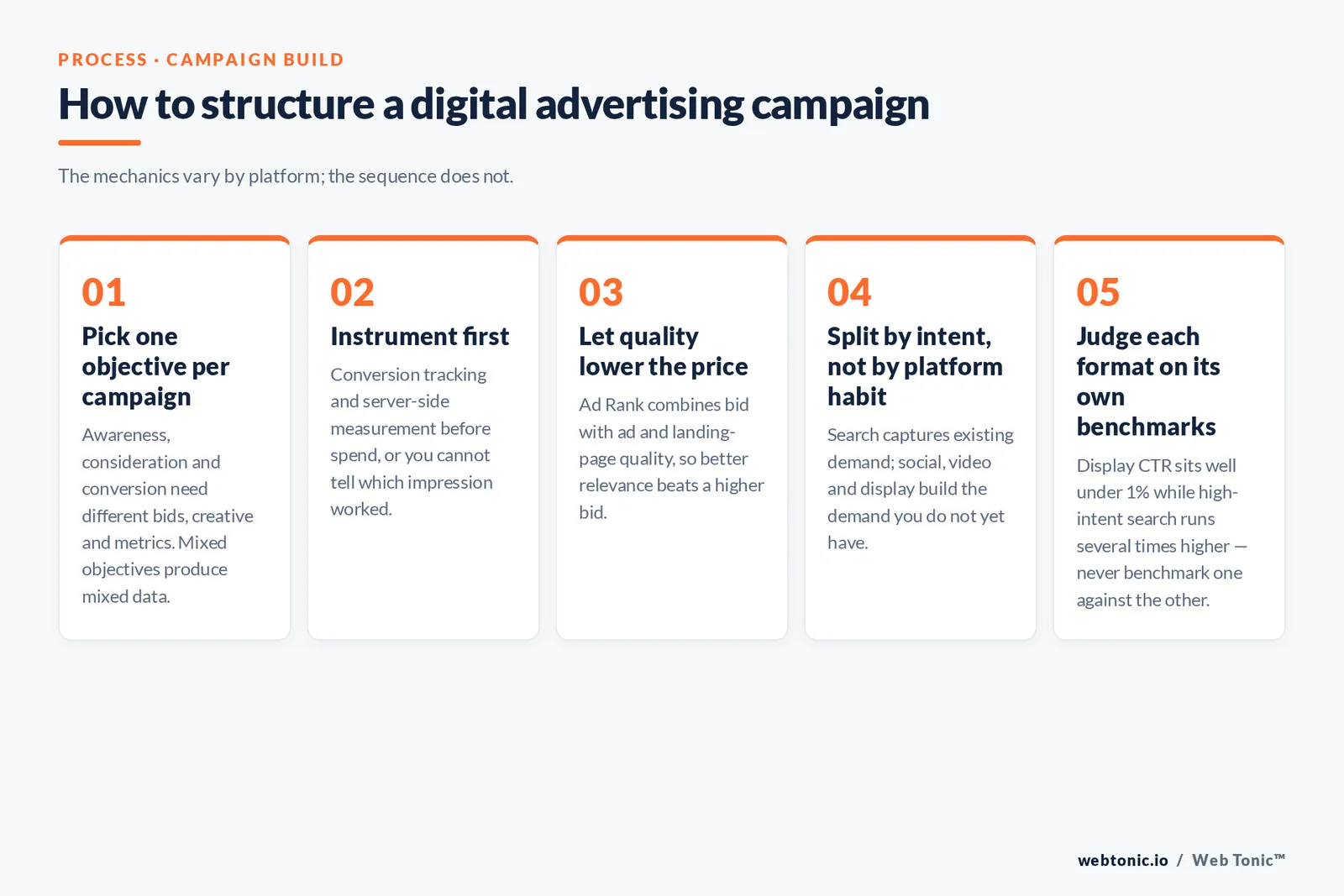
The mechanics vary by platform; the sequence does not.
- Pick one objective per campaign. Awareness, consideration and conversion need different bids, creative and success metrics. Mixed objectives produce mixed data.
- Instrument first. Conversion tracking, server-side events and offline imports go live before the first ad. Campaigns launched blind waste the entire learning period.
- Structure for signal, not tidiness. Consolidate similar audiences so bidding algorithms get enough conversions — most need roughly 30–50 conversions per campaign per month to stabilise.
- Build creative for the placement. Vertical 9:16 video for feeds and Stories, square for in-feed, responsive assets for search and display. Repurposed TV cutdowns underperform native builds.
- Set a learning budget. Plan for 7–14 days of unoptimised spend on any new campaign type before judging it.
- Test one variable at a time. Hook, offer, format or audience — not all four.
- Review on a cadence. Weekly for pacing and creative, monthly for structure, quarterly for channel mix.
Landing experience belongs in that list too. Ad platforms score it, users judge it in seconds, and it is usually the cheapest conversion gain available — see our web development work for how the page and the media plan connect.
What is changing in digital advertising now
Three shifts are reshaping the discipline, and all three are already priced into the platforms.
Automation moved from bidding to everything. Budget allocation, placement selection, audience expansion and creative assembly are increasingly platform-side. The advertiser's remaining levers are inputs — data quality, creative volume and the objectives you set. That makes measurement discipline the real competitive advantage.
Privacy rebuilt measurement. Consent frameworks, signal loss and modelled conversions mean platform-reported numbers and business numbers diverge. Serious teams triangulate with blended efficiency ratios and holdout tests rather than trusting one dashboard.
AI surfaces are becoming media. With more than 1 billion people using AI tools monthly, answer engines are starting to intermediate discovery that used to begin on a search results page. Search share still sits overwhelmingly with Google at 91.25% per Statcounter, but the shape of the query is changing: fewer, longer, more conversational, with the ad opportunity moving closer to the moment of decision.
The strategic response is unglamorous. Own your first-party data, produce more creative than feels comfortable, keep a clean measurement stack, and hold channels to business outcomes. If you want that mapped against your own account, get in touch or browse the Web Tonic blog.
FAQ
What is digital advertising in simple terms?
It is paid advertising delivered on internet media — search engines, social platforms, websites, apps, video and connected TV — bought through auctions and measured against a defined action. The core difference from traditional advertising is that targeting and measurement happen per impression, in real time.
What are the main types of digital advertising?
Search ads, social media ads, display advertising, video ads, retail media and email or messaging. Search ads capture existing intent; social, display and video ads create demand; retail media converts at the point of purchase.
How much does digital advertising cost?
It scales with competition, not with an entry fee. Most major platforms let you start from roughly $5–$50 per day, while clicks in competitive commercial categories can exceed $50 each. Cost per result is set by your targeting, creative quality and landing page, which is why identical budgets produce very different outcomes.
Is digital advertising better than SEO?
They solve different problems. Paid media buys immediate, controllable volume and stops when the budget stops; organic search compounds over 6–12 months and keeps delivering. Most efficient programmes run both, using paid campaigns to validate messages and organic content to lower blended acquisition cost.
How do you measure digital advertising performance?
Start with the business metric — revenue, qualified leads or pipeline — then read platform metrics as diagnostics. Track cost per acquisition and return on ad spend alongside a blended efficiency ratio across all channels, and validate incrementality with holdout tests rather than assuming platform-reported conversions are additive.
Sources: Google Ads Help (ad auction, quality and cost) · Microsoft Advertising guides · IAB research and guidelines · DataReportal Digital 2026 Global Overview Report · Sprout Social social media statistics · Statcounter Global Stats, search engine market share, June 2026 · EMARKETER digital advertising insights · Statista advertising market outlook · Think with Google video research · Google advertising privacy documentation.