Table of contents

A link building strategy is a repeatable method for earning links from relevant sites you do not control. The tactics below are white hat, still work in 2026, and are ordered by how much link value they return per hour of work.
Key Takeaways
- 12 link building strategies cover almost every campaign, and only 4 of them need outreach volume above 100 emails a month.
- Google's spam policies treat any link intended to manipulate rankings as a link scheme, including exchanges and paid links without
rel=sponsored. - Unlinked brand mentions convert at the highest rate of any tactic here — often 20-40% of requests — because the publisher already named you.
- Count referring root domains, not raw links: 50 links from 5 sites is a weaker profile than 12 links from 12 sites.
- A first campaign should budget 90 days before judging results, because indexing plus re-evaluation is rarely instant.
What separates a link building strategy from a link building tactic
A tactic is one motion — send a broken link email, pitch a guest post. A strategy is the choice of which tactics fit your niche, your content, and the amount of outreach you can actually sustain. Most failed link building is a good tactic run against the wrong site list.
Google's position is public and narrow. Its spam policies documentation defines link spam as links intended to manipulate rankings, and names exchanges, paid links, large-scale article campaigns with keyword-rich anchor text, and low-quality directory submissions. Everything in this guide stays on the other side of that line: you offer a publisher something genuinely useful, and the link is their editorial decision.
| Test | White hat signal | Link scheme signal |
|---|---|---|
| Who chose the anchor text | The publisher, in their own words | You dictated exact-match anchor text |
| What changed hands | Information, data, or a fixed page | Money or a reciprocal link |
| Relevance of the site | Same niche or adjacent audience | Any site that will publish anything |
| Would the link exist without SEO | Yes — it helps their reader | No — it only helps your rankings |
| Scale of the campaign | Dozens of considered pitches | Thousands of templated blasts |
Rule 1 — if a link would embarrass you in a manual review, it is not part of a strategy, it is a liability. Google also asks publishers to mark links they cannot vouch for, which its guidance on qualifying outbound links spells out with nofollow, sponsored and ugc.
The 12 link building strategies that still work
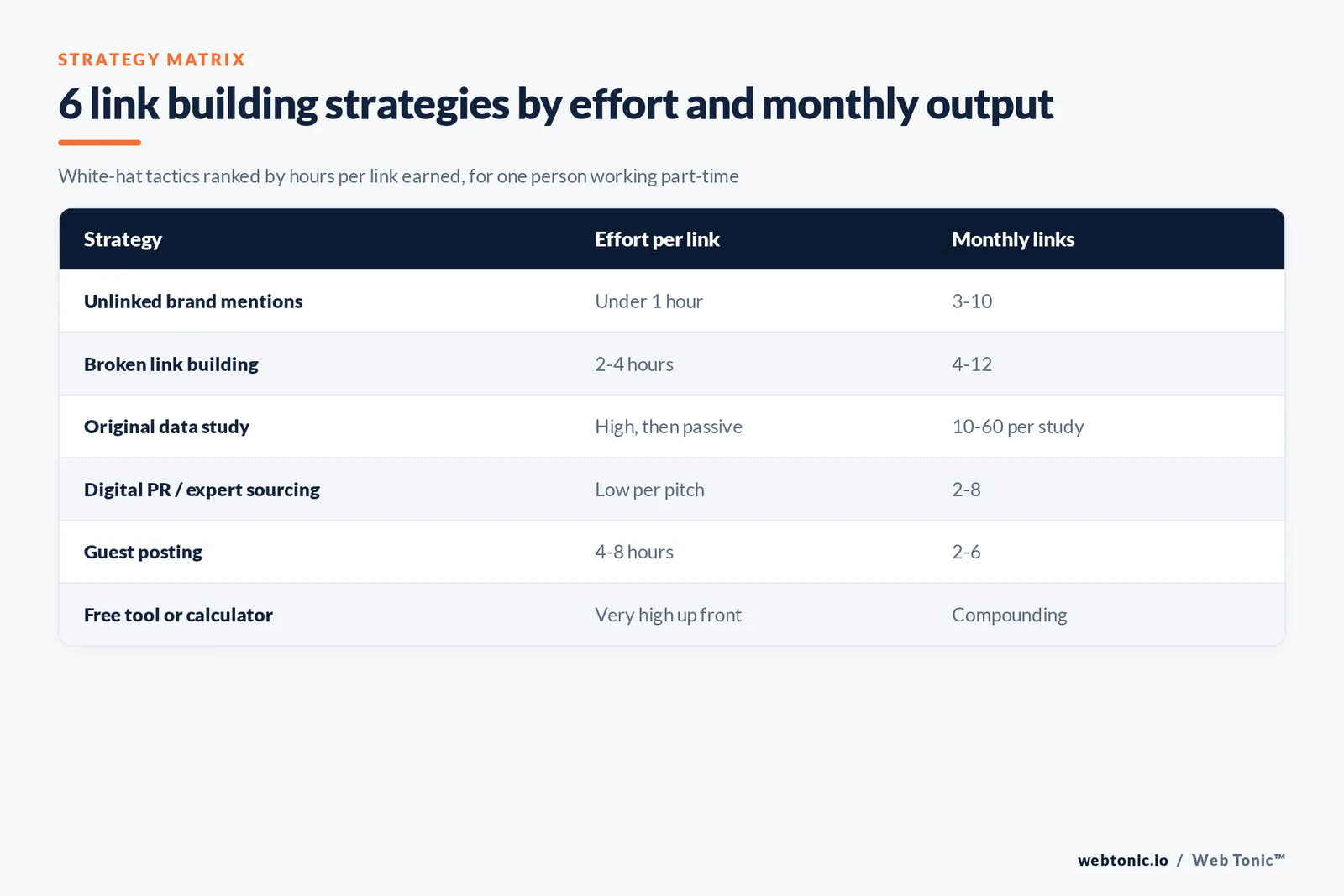
Effort is hours per link earned; volume is a realistic monthly output for one person working part-time on link building.
| Strategy | How the link is earned | Effort per link | Realistic monthly volume |
|---|---|---|---|
| 1. Unlinked brand mentions | Ask a publisher who already named you to link the mention | Low — under 1 hour | 3-10 links |
| 2. Broken link building | Offer a live replacement for a dead resource they link to | Medium — 2-4 hours | 4-12 links |
| 3. Original data studies | Publish a number nobody else has; journalists cite it | High up front, then passive | 10-60 links per study |
| 4. Digital PR and expert sourcing | Answer a reporter's question with a usable quote | Low per pitch, low hit rate | 2-8 links |
| 5. Guest posting on relevant sites | Contribute a genuinely useful piece of content | High — 4-8 hours | 2-6 links |
| 6. Free tools and calculators | People link to the tool because it saves them work | Very high up front | Compounding, 5-40 links a year |
| 7. Resource page link building | Get added to a curated "best resources" list | Medium | 3-8 links |
| 8. Embeddable charts with embed code | Bloggers reuse your visual and keep the attribution link | Medium, then passive | 2-15 links |
| 9. Podcast and webinar appearances | Show notes link to your site | Low — 1 hour per recording | 2-6 links |
| 10. Industry associations and sponsorships | Membership or event pages list members | Low, but costs money | 1-5 links |
| 11. Product or expert roundup inclusion | A writer covering your category adds you | Medium | 2-6 links |
| 12. Internal link consolidation | No outreach — redistribute the authority you already hold | Low, one-off audit | Dozens of improved paths |
Fact 1 — strategies 3, 6 and 8 are the only ones on the list that keep earning links while you sleep; everything else stops the day the outreach stops. That is the whole argument for spending at least 30% of a link building budget on assets rather than emails.
Broken link building, step by step
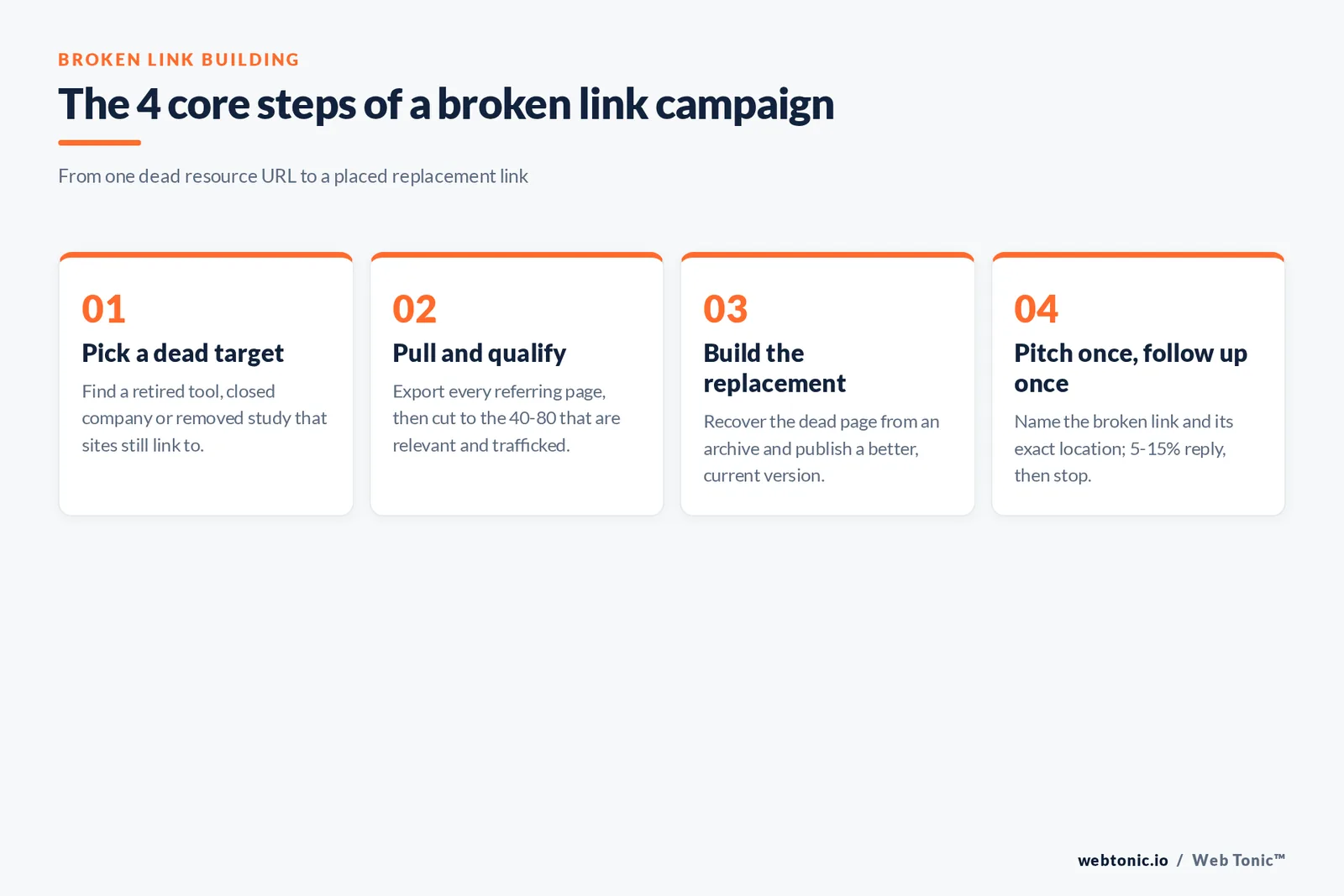
Broken link building is the most reliable outreach tactic because the publisher has a real problem — a dead link on a live page — and you are handing them the fix. Ahrefs' own broken link building walkthrough covers the tooling side; the sequence below is the operational version.
| Step | What you do | Output |
|---|---|---|
| 1. Pick a dead target | Find a retired tool, closed company, or removed study in your niche | One dead URL with links pointing at it |
| 2. Pull the link list | Export every referring page for that dead URL | 50-500 prospect pages |
| 3. Read the dead page | Recover the original content from a web archive | A clear brief for the replacement |
| 4. Build the replacement | Publish a better, current version on your site | One live, linkable page |
| 5. Qualify prospects | Drop sites with no traffic, no editor, or no topical relevance | Shortlist of 40-80 pages |
| 6. Email the page owner | Name the broken link, its exact location, and your replacement once | 5-15% reply rate |
| 7. Follow up once | One short nudge after 5-7 days, then stop | Roughly a third of total wins |
Limit 1: one follow-up. A second and third chase adds spam complaints far faster than links. Trap 1 — replacing a dead page with a thin sales page kills the tactic; the replacement has to be a genuine resource, which is the same standard Google describes in its helpful content guidance.
How to find relevant sites worth pitching
Prospecting quality decides everything downstream. A good list of 40 relevant sites beats a scraped list of 4,000 every time.
| Prospecting source | Method | Signal that it is worth pitching |
|---|---|---|
| Competitor backlink gaps | Export the referring domains of 3-5 competitors, keep the overlaps | Links to two rivals but not you |
| Search operators | Niche term plus "resources", "recommended tools", "further reading" | A curated outbound list already exists |
| Your own brand mentions | Alerts on your brand, product and founder names | Mention published in the last 30 days |
| Journalist request platforms | Daily queries from writers who need a source | Deadline inside 48 hours, topic in your lane |
| Podcast directories | Shows in your niche publishing weekly | Show notes contain outbound links |
| Local and trade bodies | Chambers, licensing boards, trade associations | A public member directory |
| Niche forums and communities | Watch what practitioners actually cite | Recurring demand for a resource you can build |
| Suppliers, clients, partners | Ask the businesses already in your orbit | They publish case studies or a partner page |
Free tooling gets you further than most people assume: Google Trends tells you which angle is rising, Search Console shows which of your pages already attract links, and the Internet Archive recovers dead pages for step 3 above. Practitioner communities are a fast read on which tactics are currently getting responses this quarter.
Guest posting that survives editorial review
Guest posting is not dead; industrial guest posting is. The difference is whether a real editor would run the piece if the link were removed.
| Attribute | Guest post worth doing | Guest post that risks a penalty |
|---|---|---|
| Site audience | Readers who could become customers | No audience, only advertisers |
| Topical fit | One clear niche | Casino, crypto, health and roofing on one blog |
| Anchor text | Branded or descriptive, chosen by the editor | Exact-match commercial keyword you supplied |
| Author byline | A named person with a real bio | "Admin" or a stock-photo persona |
| Link placement | One contextual link where it helps the reader | 3-5 links to unrelated money pages |
| Price | Your writing time | A published rate card |
Fact 2 — a paid placement is legitimate advertising as long as the link carries rel=sponsored; it simply stops passing ranking signals, which is exactly the trade-off Google intends. Trap 2 — buying "editorial" links and hoping they pass value is the single most common way agencies waste a client's budget.
Linkable assets: content people cite without being asked
Outreach converts a list; assets create demand. Each asset type below has a different citation trigger.
| Asset type | Why a publisher links to it | Build cost | Link half-life |
|---|---|---|---|
| Original survey or dataset | It is the only source for the number | High | 2-4 years |
| Free calculator or tool | Saves their reader manual work | High | Indefinite |
| Benchmark report by industry | Gives their reader a yardstick | Medium-high | 1 year, then refresh |
| Chart or map with embed code | Drop-in visual with attribution built in | Low-medium | 1-3 years |
| Definitive glossary or spec page | A stable reference to point at | Low | Indefinite |
| Template or checklist pack | Practical, downloadable, no gate | Low | 1-2 years |
| Annotated teardown or case study | Real numbers from a real project | Medium | 1-2 years |
An embeddable chart deserves a literal embed code box under it — a snippet of HTML containing the image and a credit link, so the attribution survives the copy-paste. Keep the destination page live forever; a linkable asset that 404s converts every earned link into a broken one. Our data intelligence team builds most client link assets from first-party data for exactly this reason.
Unlinked brand mentions and expert sourcing
These two tactics share a mechanic: someone is already writing about your topic, so the ask is tiny.
| Channel | How it works | Cost | Best for |
|---|---|---|---|
| Unlinked mention outreach | Find your brand named without a link, ask once for the link | Free | Brands with any press footprint |
| Reporter query platforms | Journalists post a question, you answer with a quote | Free to mid | Founders and named specialists |
| Expert commentary networks | Structured answers get bundled into round-ups | Free tier available | Consultants and agencies |
| Newsjacking | Publish data or comment within 24 hours of a story | Free, needs speed | Regulated and fast-moving niches |
| Award and list submissions | Enter credible industry lists that publish winners | Free to high | Established businesses |
Query platforms such as Connectively and Featured replaced the old Help a Reporter Out workflow, though "HARO" (Help a Reporter Out) is still the shorthand most SEOs use. Fact 3 — pitches under 150 words that answer the exact question asked outperform long company pitches, because the writer can paste the quote straight into a draft.
Qualifying a link opportunity: a 10-point check
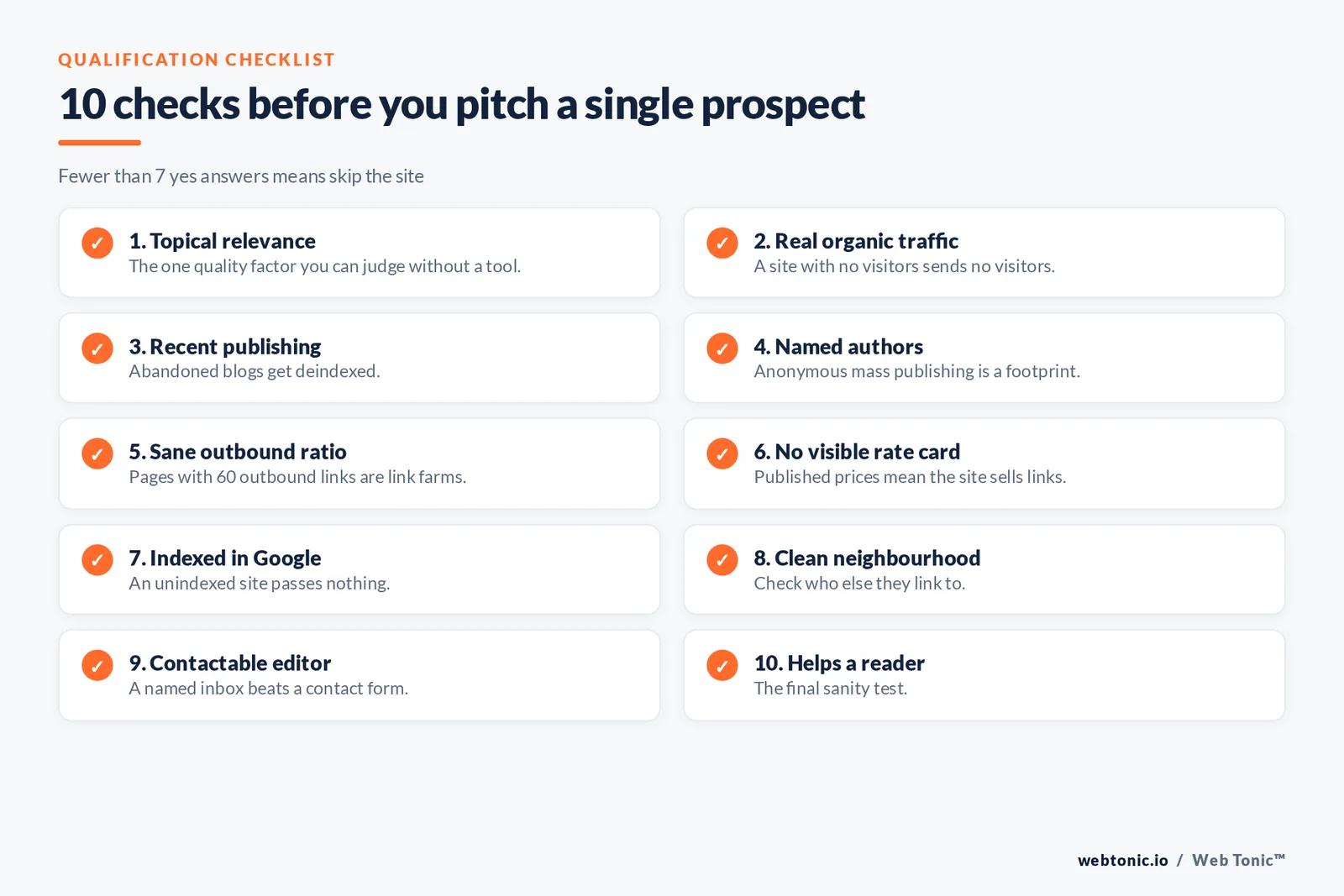
Run this before you spend an hour on any prospect. Fewer than 7 yes answers means skip it.
| Check | Why it matters |
|---|---|
| 1. Topical relevance | Relevance is the one quality factor you can judge without a tool |
| 2. Real organic traffic | A site with no visitors sends no visitors |
| 3. Recent publishing activity | Abandoned blogs get deindexed |
| 4. Named authors | Anonymous mass publishing is a footprint |
| 5. Sane outbound link ratio | Pages with 60 outbound links are link farms |
| 6. No visible rate card | Published prices mean the site sells links |
| 7. Indexed in Google | An unindexed site cannot pass anything |
| 8. Clean neighbourhood | Check who else they link to |
| 9. Contactable editor | A named inbox beats a contact form |
| 10. Link would help a reader | The final sanity test |
Anchor text and link mix for a healthy profile
You rarely control the anchor text of an earned link, and that is the point. A natural profile is dominated by branded and URL anchors.
| Anchor type | Healthy share of inbound links | Where it comes from |
|---|---|---|
| Branded | 40-60% | Citations, press, directories |
| Naked URL | 10-25% | Forums, references, footnotes |
| Partial match or descriptive | 15-30% | Editorial mentions in body copy |
| Exact match commercial | Under 10% | Rare editorial coincidence |
| Generic ("read more") | 5-15% | Round-ups and listings |
Internal links are the anchor text you do own, and they cost nothing. Our deeper breakdowns of anchor text in SEO and what backlinks actually are cover the mechanics; Moz's beginner's guide to link building and Backlinko's link building guide are the two most-cited practitioner references on the same ground. Whatever you build, the link has to be a crawlable <a href=...> element rather than a JavaScript click handler.
Which link building strategy fits your business
The same tactic list produces very different plans depending on what you sell.
| Business type | Lead strategies | Skip |
|---|---|---|
| Local service business | Trade associations, chambers, local sponsorships, supplier pages | Data studies, embeddable charts |
| Ecommerce brand | Product round-up inclusion, buying guides, unlinked mentions | High-volume guest posting |
| SaaS product | Free tools, original data, integration and partner pages | Directory submissions |
| B2B services | Expert sourcing, benchmark reports, podcasts | Broad consumer PR |
| Publisher or media site | Newsjacking, original reporting, charts with embed code | Resource page outreach |
| New site, no authority | Broken link building, niche communities, one strong asset | Digital PR at national outlets |
If you would rather run this as a managed programme than an internal project, our growth marketing service pairs link acquisition with the content that earns it, and a short call is usually enough to tell which two tactics fit your niche. Full method write-ups live on the Web Tonic blog.
Link building tools, and what each one is actually for
| Job | Free option | Paid option | What you get |
|---|---|---|---|
| See your own links | Search Console links report | Ahrefs, Semrush, Majestic | Referring root domains and top anchors |
| Competitor gap analysis | Limited free tiers | Link intersect tools | Sites linking to rivals, not you |
| Find broken pages | Archive lookups, crawler free tier | Site audit crawlers | Dead targets and their backlinks |
| Monitor brand mentions | Google Alerts | Media monitoring suites | Unlinked mentions within days |
| Find contacts | Site bylines and about pages | Email finders | A named editor to pitch |
| Run outreach | Your own inbox | Outreach CRMs | Sequencing and reply tracking |
| Validate opportunity quality | Manual review | Traffic estimators | Traffic before you pitch |
Limit 2: no tool qualifies a site for you. Domain-level scores are third-party estimates, not Google metrics, and a DR 70 site with no relevance is worth less than a DR 25 site your buyers actually read.
8 traps that waste link building budgets
| Trap | What it looks like | Fix |
|---|---|---|
| 1. Chasing domain scores | Buying by DR, ignoring topic | Qualify on relevance and traffic first |
| 2. Templated outreach at scale | 2,000 identical emails, 3 replies | Cut the list by 90%, personalise the first line |
| 3. Link exchanges | "I'll link you if you link me" | Named as a scheme in Google's policies — decline |
| 4. Pointing every link at the homepage | No deep links to money or resource pages | Give each campaign one target URL |
| 5. No linkable asset | Outreach with nothing to link to | Build one asset before any campaign |
| 6. Ignoring internal links | Earned authority stuck on one page | Link from the strong page to the target |
| 7. Letting linked pages die | Redesign 404s an asset with 40 links | Redirect or restore, then reclaim |
| 8. Judging results in week 2 | Cancelling a programme after 14 days | Review on a 90-day cycle |
5 link building examples from real campaigns
Each example below is a shape you can copy, not a one-off stunt. The common factor: the website owner on the other side got something they wanted.
| Example | What the campaign did | Why it earned a backlink |
|---|---|---|
| Example 1 — the retired-tool replacement | Rebuilt a discontinued free tool and emailed every website still linking to the dead page | The editor was fixing a broken page, not doing you a favour |
| Example 2 — the annual benchmark | Published conversion benchmarks by industry from first-party client data | Writers needed a citable number and no rival published one |
| Example 3 — the founder quote engine | Answered 3 reporter queries a week for a quarter with 120-word quotes | The journalist filed on deadline with a named expert |
| Example 4 — the infographic with embed code | Turned one dataset into a single-screen infographic plus a copy-paste embed snippet | Bloggers reused the visual and the attribution link came with it |
| Example 5 — the supplier ecosystem sweep | Asked 30 suppliers, clients and partners to list the business on their partner pages | The relationship already existed; only the page was missing |
Fact 5 — across those 5 examples, 4 of the 5 reused an asset that already existed, which is why an asset audit should come before any new production.
Outreach email templates: subject line, body and the follow-up
Write the subject line last and keep it under 7 words. Do not open with your own company; open with their page.
| Tactic | Subject line that gets opened | First line of the body | What not to do |
|---|---|---|---|
| Broken link | Dead link on your resources page | Name the page title and the exact dead URL | Do not list 5 replacement options |
| Unlinked mention | Quick fix to your [topic] article | Quote the sentence where you are named | Do not ask for extra links elsewhere |
| Guest post pitch | Pitch: [specific working title] | One title, one outline, one reason it suits their audience | Do not send 3 vague topic ideas |
| Data study promotion | New data: [headline number] | Lead with the single most surprising figure | Do not attach a PDF press release |
| Resource page add | Suggestion for your [topic] list | Say which entry yours sits beside and why | Do not claim your website is "the best" |
| Follow-up (once) | Re: original subject, unchanged | Two sentences, restate the fix, then stop | Do not send a third email |
Limit 3: 2 emails maximum per prospect. A short, specific pitch beats any outreach template library: 2 sentences of context, 1 clear ask, nothing else.
Infographic and visual link building, done properly
Visual assets earn links when they are easier to reuse than to rebuild. The title on the graphic matters as much as the data.
| Visual format | Best subject matter | Attribution mechanism | Typical links |
|---|---|---|---|
| Single-stat infographic | One surprising number with its source | Embed code plus a credit line in the image | 3-12 |
| Process diagram | A workflow people teach from | Watermarked title and website URL | 2-8 |
| Comparison matrix | Tools, plans or tactics side by side | Embed code with a canonical link | 4-15 |
| Interactive map or chart | Data that varies by state or industry | iframe embed pointing at your page | 5-30 |
| Annotated screenshot | A real example with callouts | Credit line under the image | 1-5 |
Trap 3 — a 4,000-pixel infographic with no HTML version earns fewer links than a plain table, because nobody can quote it. Publish the numbers as text on the same page and let the visual be the shortcut.
How to measure a link building strategy
Count outcomes, not activity. Ahrefs' strategy round-up and Search Engine Journal's link building guide both land on the same short metric list.
| Metric | What good looks like | Review cadence |
|---|---|---|
| New referring root domains | Net positive every month | Monthly |
| Links per campaign hour | Improving as prospecting sharpens | Per campaign |
| Reply and placement rate | 5-15% reply, 2-5% placement | Weekly |
| Rankings for the target URL | Movement inside 90 days | Monthly |
| Referral sessions from links | Any real traffic proves relevance | Monthly |
| Lost links | Under 10% annual attrition | Quarterly |
| Phase | Weeks 1-4 | Weeks 5-8 | Weeks 9-12 |
|---|---|---|---|
| Assets | Build one linkable asset | Add an embeddable chart | Refresh and re-promote |
| Prospecting | Competitor gap export | Broken link targets | Resource pages and round-ups |
| Outreach | Unlinked mentions only | 40-60 pitches | 60-80 pitches plus reporter queries |
| Measurement | Baseline referring domains | Reply rate by template | Ranking and referral review |
Fact 4 — a 90-day first cycle with 12-25 new referring domains is a realistic target for a small site with one person on the work, and it beats any promise of 100 links a month.

FAQ
What link building strategies still work in 2026?
Unlinked brand mentions, broken link building, original data studies, expert sourcing for journalists, selective guest posting, free tools, resource page inclusion and embeddable charts all still earn links. What stopped working is anything that scales without a human editor: bulk directory submissions, link exchanges, private blog networks and templated mass outreach.
How many backlinks do I need to rank?
There is no fixed number. The useful comparison is the referring root domains of the pages currently ranking for your target keyword; matching their relevance and count is a reasonable goal. Twelve links from twelve relevant sites usually outperforms fifty links from five.
Is buying links against Google's guidelines?
Paying for a link that passes ranking signals is a link scheme under Google's spam policies. Paying for a link is fine as advertising as long as it carries rel=sponsored or rel=nofollow, which stops it passing those signals.
How long does link building take to affect rankings?
Expect a 90-day window: Google has to crawl the linking page, index it, and re-evaluate your target URL, and competitive queries move slower than long-tail ones. Judge a campaign on new referring domains first and rankings second.
Which link building strategy should a brand new site start with?
Start with broken link building plus one strong linkable asset. Both work without existing authority, neither needs a press footprint, and the asset makes every later tactic easier because outreach finally has something worth linking to.
Sources: Google Search Central — spam policies, crawlable links, helpful content guidance; Google Search Console Help — qualifying outbound links; Moz Beginner's Guide to Link Building; Backlinko link building guide; Ahrefs broken link building and link building strategies; Search Engine Journal link building guide; Connectively; Featured; Google Trends; Internet Archive. All sources verified live at publication.