



Table of contents
Link building remains one of the most impactful — and most misunderstood — levers in dental SEO. Below, we break down the latest benchmarks, case-study data, and practitioner-reported metrics that show exactly how backlinks influence rankings, traffic, and patient acquisition for dental practices in 2026.
Key Takeaways
- Dental practices with consistent NAP citations rank 2.4 positions higher in the Local Pack than those with 5+ citation discrepancies (Flento, 2026).
- Building 3–5 high-quality local backlinks per month over 6–12 months produces measurable ranking improvements for most practices (SEO Specialist USA).
- A 6-month link campaign grew referring domains from 12 to 41 (+242%) and boosted organic traffic by 161% for one documented case study (Dentalbase).
- The median domain authority for dental practice websites is 46, with backlink diversity scores ranging widely across the niche (SEOJuice, 2026).
- Websites ranking on page one average 907 referring domains across all industries, while dental sites compete at a lower threshold due to local intent (Stacker / WebFX, 2026).
- Realistic high-quality output is 5–15 new backlinks per month for dental practices following ethical strategies (Dental SEO Expert).
- 77% of new dental patients check online reviews first, and citations that carry review signals amplify both authority and trust (BrightLocal).
- Top-performing dental practices maintain 200+ referring domains and invest in structured, long-term off-page strategies (Authority Specialist).
Dental Link Building Benchmarks at a Glance
| Metric | Benchmark / Range | Source |
|---|---|---|
| Median Domain Authority (dental niche) | 46 | SEOJuice |
| Referring domains — top dental sites | 200+ | Authority Specialist |
| Recommended monthly link velocity | 3–5 quality links | SEO Specialist USA |
| Realistic high-quality output | 5–15 links / month | Dental SEO Expert |
| Time to measurable ranking gains | 3–6 months | Dentalbase |
| Referring domain growth (6-month case) | 12 → 41 (+242%) | Dentalbase |
| Organic traffic lift (same case) | +161% | Dentalbase |
| NAP consistency ranking lift | +2.4 positions in Local Pack | Flento |
| Dofollow share — mid-authority sites | ~90% | Linkody |
| Page-one median referring domains (all industries) | 907 | WebFX / Stacker |
How Backlinks Influence Dental Practice Rankings
Search engines treat each quality backlink as a vote of confidence. For dental practices competing in local search, even a modest link profile can tip the scales. According to Linkody's 2026 analysis of 865,000 monitored backlinks, the share of dofollow links climbs from 63% on low-authority sites to nearly 90% in the mid-authority range, then dips back to 72% for DA 70+ domains. This means dental practices in the sweet spot (DA 20–50) benefit disproportionately from each new quality referral.
WebFX's 2026 study of 1,462 domains reports a median of 907 referring domains for page-one rankings across 15 industries. Healthcare and dental sit well below that median because local-intent queries require less raw authority and more relevance signals — proximity, reviews, and citation consistency.
Link Velocity and Timeline to Results
How fast should a dental practice build links? SEO Specialist USA recommends 3–5 high-quality local and directory links per month, sustained over 6–12 months, for measurable ranking improvements without manipulation risk. Dental SEO Expert confirms realistic output at 5–15 new links per month from ethical, scalable strategies.
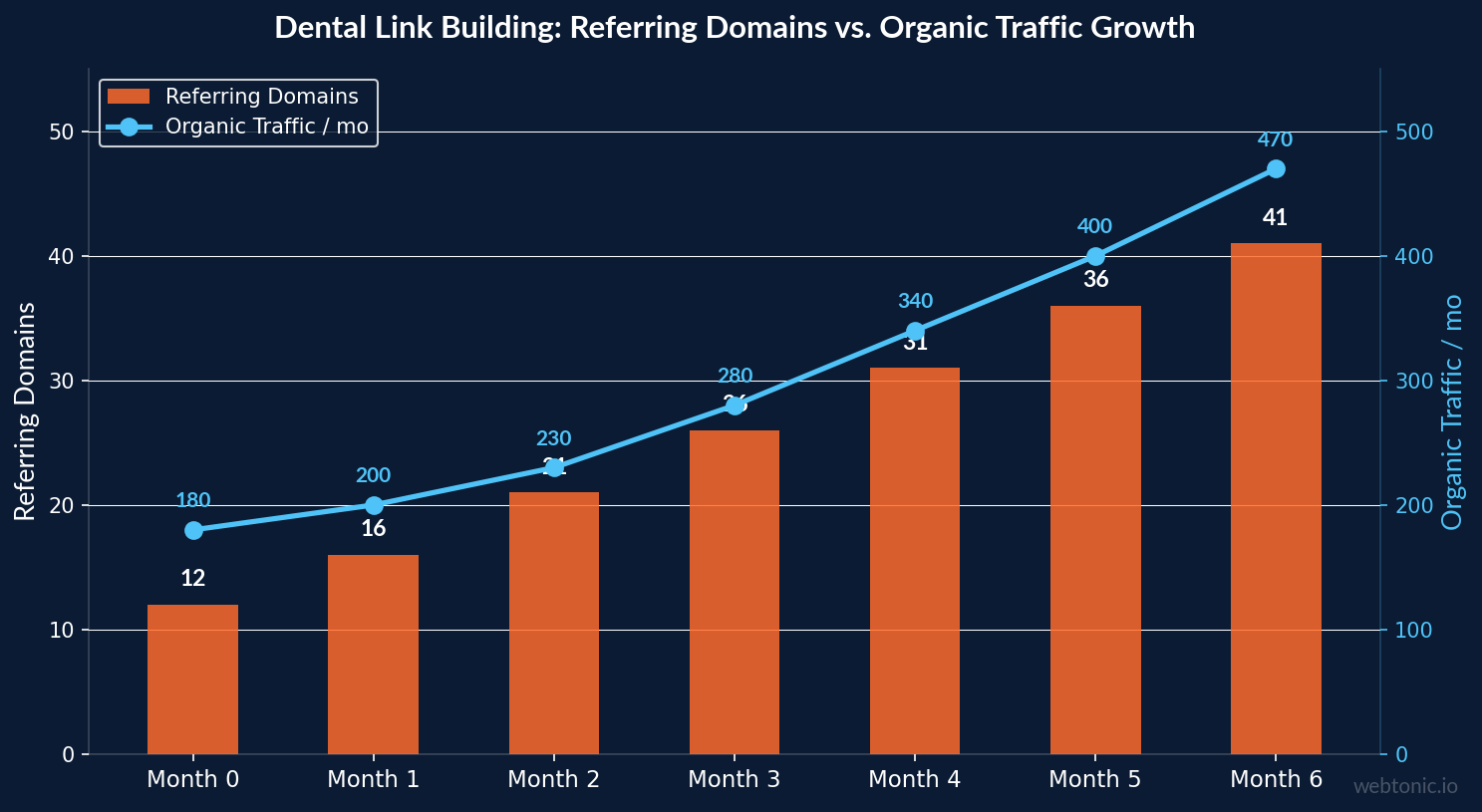
Dentalbase documents a 6-month dental link building campaign that grew referring domains from 12 to 41 — a 242% increase — with organic traffic climbing 161% and domain rating rising from 8 to 19 (+137%). Most practices see initial movement at months 3–4, with full impact between months 4–6 once Google crawls and indexes the new links.
| Metric | Month 0 | Month 6 | Change |
|---|---|---|---|
| Referring domains | 12 | 41 | +242% |
| Domain Rating | 8 | 19 | +137% |
| Organic traffic / mo | 180 | 470 | +161% |
Citation Consistency and Local Pack Performance
For dental practices, link authority and citation accuracy work together. Flento's 2026 data shows that dental practices with fully consistent NAP across their top 25 directories rank 2.4 positions higher in the Local Pack than practices with five or more citation discrepancies. Every inconsistent listing dilutes trust signals that search engines use to verify a business entity.
Pete Johnson's dental SEO guide notes that Google Business Profile signals account for 32% of Local Pack ranking weight, making GBP the single most influential ranking factor. Backlinks and citations complement GBP optimization by reinforcing the practice's entity signals across the web.
The takeaway: a dental practice that builds even a handful of authoritative, NAP-consistent citations each month compounds its local visibility significantly over 6–12 months. Internal resources like our growth marketing services and top Google Ads agencies guide outline complementary strategies for maximizing patient acquisition.
Authority Distribution Across Dental Websites
SEOJuice benchmarks reveal a median domain authority of 46 across dental practice websites, with the distribution spanning from near-zero for new sites to 80+ for multi-location DSOs and dental media properties. Backlink domain diversity — measuring how varied referring domains are — is a critical differentiator in the dental niche.
Authority Specialist's 2026 benchmark data confirms that top-performing practices maintain 200+ referring domains and invest in structured, long-term off-page strategies including guest contributions on healthcare portals, local sponsorship pages, and dental association directories.

Dental Link Building Strategies by Effectiveness
| Strategy | Link Quality | Scalability | Avg. Timeline |
|---|---|---|---|
| Local dental directories | Medium | High | 1–2 months |
| Healthcare guest posts | High | Low–Medium | 2–4 months |
| Local sponsorships & events | High | Low | 1–3 months |
| Dental association memberships | High | Medium | 1 month |
| HARO / journalist outreach | Very High | Low | 2–6 months |
| Scholarship & community pages | Medium–High | Medium | 2–4 months |
| Broken link reclamation | Medium | Medium | 1–3 months |
Case Study Data: ROI of Dental Off-Page SEO
An analysis of 340+ dental SEO case studies by SEOPals reveals that sustained Local Pack top-3 positioning for the primary commercial keyword correlates most tightly with call volume. Practices that combine consistent link acquisition with review generation see compounding returns: higher authority drives better rankings, which drive more reviews, which further reinforce trust.
77% of new dental patients check online reviews before choosing a provider, according to BrightLocal's 2025 Healthcare Consumer Survey cited by US Tech Automations. Directories and citation platforms that display review data create a dual benefit: they pass link equity AND influence patient decisions directly.
For a deeper look at how digital marketing channels work together, see our data intelligence capabilities and Meta Ads services. Leading digital marketing companies increasingly bundle search engine optimization, content marketing, and link building into unified campaigns rather than treating each as a standalone service.
Backlink Quality Indicators for Dental Practices
| Quality Signal | What It Means | Dental Benchmark |
|---|---|---|
| Domain Rating of linking site | Higher DR passes more authority | DR 30+ ideal |
| Topical relevance | Healthcare / dental context | Same-niche preferred |
| Dofollow vs. nofollow | Dofollow passes full link equity | ~90% dofollow (mid-DA) |
| Anchor text diversity | Natural mix reduces manipulation risk | 15% or less exact-match |
| Link placement | In-content links outperform sidebar | Editorial in-body |
| Geographic relevance | Local links reinforce proximity | Same city / metro |
Best Practices for Sustainable Dental Link Acquisition
- Prioritize local and healthcare-specific directories — Healthgrades, Zocdoc, WebMD, and state dental association listings carry both authority and patient referral traffic.
- Maintain perfect NAP consistency — even minor variations (Suite 200 vs. Ste. 200) create citation conflicts that dilute ranking power across all citation platforms.
- Earn editorial mentions through data-driven content — publish original survey results, patient outcome statistics, or community health data that journalists and bloggers want to cite.
- Track referring domain growth monthly — tools like Ahrefs, SEMrush, and Linkody provide real-time backlink monitoring with alerts for lost or toxic links.
- Diversify anchor text naturally — keep exact-match anchors below 15% of total; use branded, URL, and generic variations to avoid algorithmic penalties.
- Build relationships, not just links — long-term partnerships with local news outlets, dental schools, and healthcare organizations produce recurring referral traffic alongside authority.
- Monitor competitor backlink profiles — identify which directories and publications link to competing practices and target those same sources for your own outreach campaigns.
- Leverage content marketing as a link magnet — companies that publish original dental research, patient surveys, and procedure cost comparisons earn editorial backlinks naturally. A strong content strategy paired with targeted outreach transforms a website into a link-earning asset rather than a link-chasing operation.
Dental vs. Other Healthcare Niches: Authority Comparison
| Healthcare Niche | Median DA | Avg. Referring Domains (Top 10%) | Competition Level |
|---|---|---|---|
| Dental | 46 | 200+ | Moderate |
| Medical (general practice) | 52 | 350+ | High |
| Dermatology / Med Spa | 38 | 120+ | Moderate |
| Mental Health / Therapy | 42 | 180+ | Moderate–High |
| Chiropractic | 34 | 90+ | Low–Moderate |
Measuring Dental Link Building ROI
Quantifying the return on a dental link building investment requires tracking multiple metrics beyond raw referral counts. The most meaningful indicators include organic traffic growth, Local Pack position changes, phone call volume from organic sources, and new patient booking rates tied to search visibility. Practices should establish baseline measurements before launching a campaign and track progress at 30-day intervals.
A common framework involves calculating the cost per acquired link (agency fee or internal labor hours divided by links earned), then mapping that against the incremental revenue from new patients attributable to improved search rankings. For example, a practice spending approximately $1,500 per month on off-page SEO that gains 8 quality links and 3 additional patients (at $2,000 lifetime value each) achieves a 4:1 return within the first six months of compounding growth.
Tools like Google Search Console, Google Analytics, and third-party rank trackers (Ahrefs, SEMrush, BrightLocal) provide the data layer needed to connect link acquisition activity to revenue outcomes. Our performance creative team helps practices design content assets that attract both links and patients simultaneously.
SaaS Tools and Platforms for Dental Link Monitoring
Several SaaS companies have built specialized features for tracking backlink acquisition in the healthcare and dental sector. Ahrefs, SEMrush, and Moz remain the three dominant SaaS platforms for domain authority measurement and referring domain analysis, while smaller digital agencies often use BrightLocal and Whitespark for citation-specific tracking. These tools automate the monitoring of new and lost backlinks, anchor text distribution, and competitor link profiles.
For dental practices working with link building agencies, the most effective campaigns combine manual outreach with software-automated prospecting. Digital marketing companies that specialize in healthcare SEO typically manage 20–50 outreach campaigns per month across directory submissions, guest posting opportunities, and local business partnerships. The best agencies provide transparent monthly reports showing exactly which referring domains were acquired, their domain authority, and the estimated traffic impact.
Practices evaluating link building services should compare agencies based on their portfolio of healthcare-specific referring domains, their approach to content strategy, and whether they use white-hat outreach methodologies exclusively. Budget-conscious practices can start with in-house citation management using free tools like Google Search Console and Bing Webmaster Tools before scaling to paid SaaS subscriptions and agency partnerships.
Related reading
- Link Building Adoption & ROI in Allergy & Immunology: 65+ Key Stats (2026)
- 11 Best Link Building Companies: Pricing, Results & Reviews (2026)
- 5 Types of Guest Post Content That Support Your Link Building
- Link Building Services services at Web Tonic
FAQ
How many backlinks does a dental practice need to rank locally?
Most dental practices can achieve Local Pack visibility with 40–80 referring domains from relevant, local, and healthcare-specific sources. The exact number depends on market competitiveness — a single-location practice in a mid-sized city needs fewer than one competing in a major metro. Quality and relevance matter more than raw volume.
How long does dental link building take to show results?
Expect initial ranking movement within 3–4 months and full campaign impact between months 4–6, according to Dentalbase case study data. Practices starting from near-zero authority may need 6–12 months of consistent effort before seeing significant patient acquisition gains.
What is the average domain authority for a dental website?
SEOJuice benchmarks show a median domain authority of 46 across dental practice websites. New sites typically start at DA 5–15, while established multi-location practices and dental service organizations can reach DA 60–80+.
Are dental directory citations still valuable for SEO?
Yes. Flento's 2026 data shows practices with consistent citations across 25+ directories rank 2.4 positions higher in the Local Pack. Citations serve a dual purpose: they pass link equity and provide NAP consistency signals that reinforce entity verification in search algorithms.
What types of backlinks are most valuable for dental practices?
Editorial in-content links from healthcare portals, local news sites, and dental association directories carry the most weight. Guest posts on relevant health blogs and local sponsorship acknowledgment pages also provide strong authority signals. Avoid low-quality directory farms — Google's link spam algorithms devalue mass-produced submissions.
Sources
Flento — Local SEO for Dentists (2026)
SEO Specialist USA — Role of Backlinks in Dental SEO
Dentalbase — How to Build Dental Backlinks
SEOJuice — SEO Benchmarks for Healthcare: Dental
Linkody — Link Building Statistics 2026
Stacker / WebFX — 2026 Backlink Study
SEOPals — 340+ Dental SEO Case Studies
Dental SEO Expert — Dental Link Building 2026
Authority Specialist — Dental SEO Statistics 2026
US Tech Automations — Dental Review Automation ROI
Pete Johnson — The Dental SEO Guide 2026


