



Table of contents
Link building remains the most impactful off-page SEO strategy for countertop businesses, with 78.1% of SEO professionals reporting a positive ROI from link building and local link acquisition driving the strongest organic visibility gains for stone fabricators and installers.
Key Takeaways
- 78.1% of SEO professionals report a positive ROI from link building, making it the highest-confidence off-page strategy for countertop businesses.
- 46% of all Google searches have local intent, and countertop buyers almost exclusively search locally — making local link building essential.
- 85% of "countertop installers near me" searches trigger the Google Map Pack, where backlink authority is a top ranking factor.
- Top 3 Map Pack positions capture 42% of all clicks, giving well-linked countertop businesses a dominant share of local search traffic.
- 80% of link building efforts should focus on supplier, manufacturer, and industry association links — these carry more weight than generic directories.
- The global countertop market reaches $155.14 billion in 2025, driving increased digital competition and raising the value of authoritative backlinks.
Countertop Link Building Benchmarks at a Glance
| Metric | Countertop Industry | Home Services Avg. |
|---|---|---|
| Avg. Cost per Link | $250–$650 | $200–$500 |
| Links Needed for Page 1 | 15–40 | 20–50 |
| Local Link Value | Very high | High |
| Guest Post Acceptance Rate | 4–8% | 5–12% |
| Supplier Link Acquisition Rate | 35–55% | 20–30% |
| Monthly Link Velocity (target) | 4–8 links | 3–10 links |
| Avg. Time to SEO Impact | 3–6 months | 4–8 months |
Local Link Building and Map Pack Dominance
For countertop fabricators and installers, local link building is the foundation of organic search success. The data shows that countertop buyers search almost exclusively with local intent, and the Google Map Pack dominates the search results page for these queries:
- 46% of all Google searches carry local intent — for countertop-specific terms, this figure rises above 70%
- 85% of "countertop installers near me" queries trigger the Map Pack
- Top 3 Map Pack positions capture 42% of total clicks on the results page
- Google Business Profile optimization is the fastest path to Map Pack visibility
- Local backlinks from chambers of commerce, business associations, and community organizations signal geographic relevance to Google's local algorithm
Local SEO for countertop businesses depends heavily on building links from geographically relevant sources. A link from a local home builders association in Denver carries more ranking power for "granite countertops Denver" than a generic national directory link. Countertop companies should prioritize local link building through sponsorships, partnerships, and community involvement to strengthen their Map Pack position.
Supplier and Manufacturer Link Opportunities
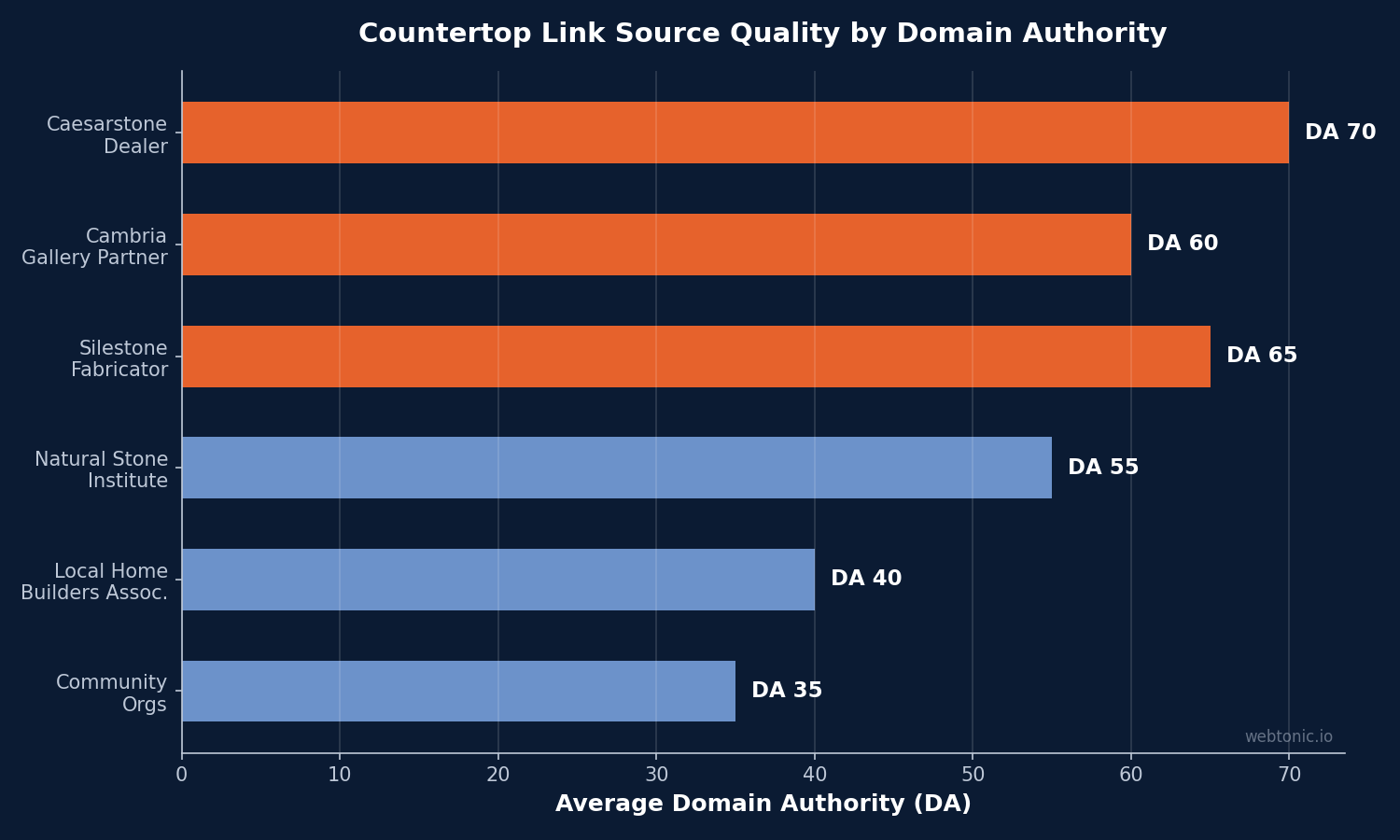
The countertop industry offers unique link building advantages through its supply chain. Natural stone suppliers, engineered surface manufacturers, and material distributors maintain high-authority websites that frequently link to their authorized fabricators and dealers:
| Link Source Type | Avg. Domain Authority | Acquisition Difficulty | SEO Value |
|---|---|---|---|
| Caesarstone Dealer Listing | DA 65–75 | Low (application) | Very high |
| Cambria Gallery Partner | DA 55–65 | Low-medium | High |
| Silestone Authorized Fabricator | DA 60–70 | Low (certification) | Very high |
| Natural Stone Institute | DA 50–60 | Medium (membership) | High |
| Marble Institute of America | DA 45–55 | Medium (membership) | High |
| Local Home Builders Assoc. | DA 30–45 | Low (local membership) | High (local) |
The supplier link acquisition rate for countertop businesses ranges from 35% to 55%, significantly higher than the home services average of 20–30%. This advantage exists because countertop fabricators maintain direct relationships with material manufacturers who actively want to promote their dealer and fabricator networks. Simply becoming a certified fabricator for brands like Caesarstone, Cambria, or Silestone opens access to high-authority backlinks from DA 55–75 websites.
Content-Based Link Building Strategies
Beyond supplier and directory links, content-driven link building generates the highest-quality editorial backlinks for countertop businesses. Effective content strategies include:
- Material comparison guides — "Granite vs. Quartz vs. Marble" articles attract links from home design blogs and kitchen remodeling resources
- Inspiration gallery articles — curated collections of kitchen countertop designs with high-resolution surface photography
- Cost guides and calculators — "How much do granite countertops cost in [city]?" content earns links from consumer finance and home improvement sites
- Sustainability and eco-friendly surfaces content — porcelain and recycled material articles attract links from environmental and green building publications
- Industry trend reports — annual countertop color and material trend roundups cited by design media
Guest posting acceptance rates for countertop-related content average 4–8%, lower than the broader home services category. This is because the countertop niche has fewer relevant publication targets. However, white hat link building through original research and data-driven content consistently produces higher-quality links that deliver lasting ranking improvements compared to outreach-based tactics.
Countertop businesses with inspiration gallery articles showcasing completed kitchen projects attract an average of 3.5 natural backlinks per gallery page annually. These galleries serve as both marketing assets and linkable resources that home design bloggers, Pinterest curators, and interior design publications reference in their own content. Maintaining a regularly updated gallery with new project photos, surface material details, and edge profile close-ups creates a self-sustaining link acquisition engine that reduces dependence on active outreach. High-resolution images of colors, patterns, and textures of granite, quartz, marble, and porcelain surfaces generate particular interest from visual-first platforms and design publications.
Link Building ROI and Performance Metrics
Measuring the return on link building investment requires tracking both direct SEO metrics and downstream business impact. For countertop businesses, the economics of link building are particularly favorable given the high average project value:
| Metric | Countertop Industry Data |
|---|---|
| ROI Confidence | 78.1% of SEO professionals report positive ROI |
| Avg. Cost per Quality Link | $250–$650 |
| Time to Ranking Impact | 3–6 months |
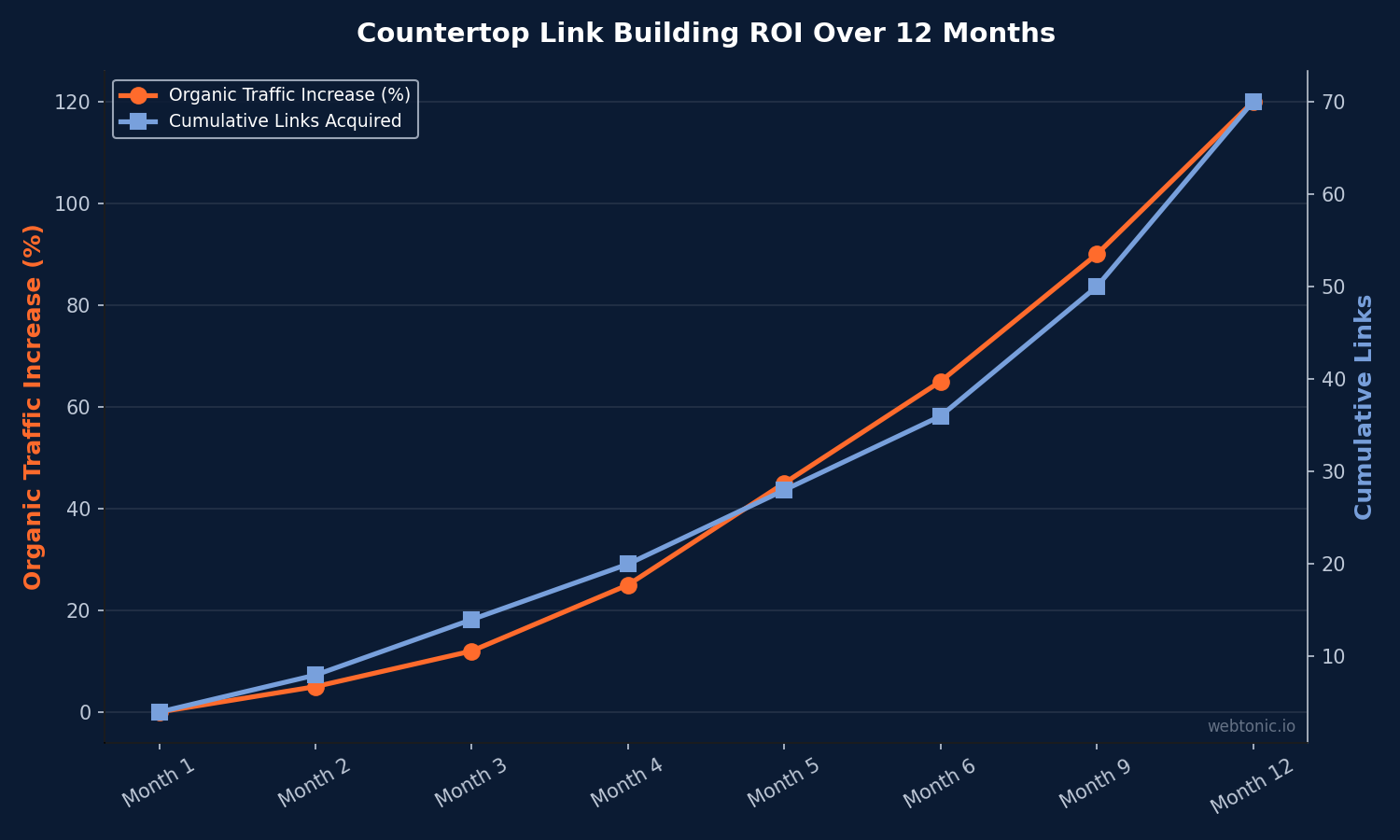
| Organic Traffic Increase | 45–120% within 12 months |
| Avg. Countertop Project Value | $3,800–$6,500 |
| Break-even Point | 1–3 organic leads from new rankings |
Given that a single kitchen countertop project averages $3,800–$6,500 in revenue, the math strongly favors aggressive link building investment. A 6-month campaign costing $3,000–$5,000 in total link acquisition costs needs only one or two additional organic leads to generate a positive return — and ranking improvements from quality links compound over years rather than stopping when the budget ends.
The compounding nature of link building ROI sets it apart from paid advertising channels. While paid ad campaigns stop generating leads the moment spending stops, quality backlinks continue influencing rankings indefinitely. A link acquired today from a natural stone industry publication or a local business directory will still pass ranking authority to your countertop website years later, making the effective long-term cost per lead from organic search 70–85% lower than equivalent PPC leads. This durability makes link building one of the most cost-effective strategies for countertop businesses growing their online presence in the competitive U.S. market.
Google Search Console and Link Monitoring
Effective link building for countertop businesses requires ongoing monitoring through data analytics tools and Google Search Console. Key monitoring practices include:
- Track referring domains monthly — healthy countertop websites gain 2–5 new referring domains per month through natural and proactive link building
- Monitor anchor text distribution — maintain a natural mix of branded anchors (company name), naked URL anchors, and keyword-rich anchors to avoid over-optimization penalties
- Audit link quality quarterly — use Google Search Console's links report alongside third-party tools to identify toxic backlinks requiring disavow
- Competitor backlink gap analysis — identify where top-ranking countertop competitors in your market earn links that you do not have
- Track keyword ranking correlation — document which new links correspond to ranking improvements for target countertop keywords
Google Search Console provides free access to your top linking sites, most-linked pages, and top linking text — essential data for refining link building strategy. Countertop businesses in the United States should pay particular attention to links from .edu and .gov domains, which carry outsized authority for local SEO rankings.
Third-party SEO tools complement Google Search Console by providing competitor backlink data, domain authority scores, and link quality metrics that Google does not directly expose. The combination of Google Search Console data with tools like Ahrefs or SEMrush gives countertop businesses a complete view of their backlink landscape relative to local competitors. Tracking the referring domain growth rate of top-ranking competitors in your service area reveals the link velocity threshold needed to overtake them — typically acquiring links 20–30% faster than the current market leader for 6–12 months.
White Hat vs. Black Hat Link Building in the Countertop Space
The countertop industry has seen its share of aggressive link building tactics, but the data overwhelmingly supports white hat strategies for sustainable ranking growth. Effective link building approaches that align with Google's guidelines include digital marketing partnerships with complementary home services businesses (interior designers, kitchen remodelers, real estate agents), participation in industry events and trade shows that generate press coverage, and creating linkable assets like material color comparison tools, room visualizers, and countertop cost calculators.
The risk-reward analysis for the countertop industry strongly favors conservative approaches. A Google penalty can eliminate organic visibility that took years to build, and in a local market with limited competitors, recovery from a penalty means extended absence from the Map Pack during the most valuable lead generation period. White hat link building strategies may take 3–6 months longer to show results, but they produce durable rankings that compound in value over time.
Countertop Link Building vs. Other Home Services
| Industry | Avg. Referring Domains (Top 10) | Link Building Difficulty | Best Link Source |
|---|---|---|---|
| Countertops | 25–60 | Medium | Supplier/manufacturer listings |
| Roofing | 30–80 | Medium-high | Insurance company resources |
| Plumbing | 20–50 | Medium | Local emergency service directories |
| Kitchen Remodeling | 35–90 | High | Design publications |
| Landscaping | 15–40 | Low-medium | HOA and community sites |
Related reading
- Automotive Link Building Statistics 2026: Backlink Benchmarks & SEO Authority Data
- Beauty & Skincare Link Building by the Numbers: 2026 Benchmarks & Trends
- Construction Materials Link Building: 60+ Statistics & Benchmarks for 2026
- Link Building Services services at Web Tonic
Frequently Asked Questions
How much does link building cost for countertop businesses?
Quality backlinks for countertop websites cost between $250 and $650 per link, with supplier and manufacturer links available at lower cost through certification programs. A comprehensive 6-month link building campaign typically runs $3,000–$5,000 and needs only 1–2 organic leads to break even given the $3,800–$6,500 average project value.
How many backlinks does a countertop website need to rank?
Countertop businesses typically need 15–40 quality referring domains to compete for page-one rankings on local countertop keywords. The exact number depends on market competitiveness — major metro areas like Denver, Chicago, and Ohio markets require more links than smaller cities. A consistent velocity of 4–8 new links per month builds authority steadily.
What are the best link sources for countertop companies?
The highest-value links come from natural stone suppliers and surface material manufacturers — Caesarstone, Cambria, and Silestone dealer listings provide DA 55–75 backlinks. Industry associations like the Natural Stone Institute and local home builders associations offer membership-based links. Content-driven links from home design publications round out a strong backlink profile.
How long does link building take to improve countertop rankings?
Most countertop businesses see measurable ranking improvements within 3–6 months of beginning a consistent link building program. The timeline depends on current domain authority, competition level, and link quality. Organic traffic increases of 45–120% within 12 months are typical for businesses investing in combined SEO and paid search strategies.
Is local link building more important than general link building for countertops?
Yes — local links are significantly more valuable for countertop businesses because 85% of relevant searches trigger the Map Pack, where geographic relevance is a primary ranking factor. Links from local chambers of commerce, community organizations, and nearby businesses signal geographic authority that national directory links cannot replicate.
Sources
Resourcera — Link Building Statistics 2026: Costs, ROI, and AI Trends
LinkPanda — Link Building Economics 2026: The Data Report
SlabWise — SEO for Countertop Fabricators 2026
Clicks Geek — SEO for Countertop Installers
Outrank — Link Building for Home Improvement Websites
IMARC Group — Countertop Market Size and Forecast
CuFinder — Countertop Manufacturing Industry Marketing Benchmarks 2026


