Table of contents
A backlink is a link on one website that points to a page on another website. Search engines treat those links as third-party signals of relevance and trust, which is why a page's link profile still helps decide where it ranks — and why most pages, with no links at all, never rank.
Key Takeaways
- 96.55% of all pages get zero search traffic from Google, and a thin or empty backlink profile is one of the most common reasons.
- There is a positive correlation between the number of websites linking to a page and the organic search traffic that page earns — measured across 10,000 analysed result pages.
- Top-ranking pages keep earning links: number-one positions gain followed backlinks from new referring domains at a pace of +5% to +14.5% per month.
- 10.6% of all backlinks to the top 110,000 websites are nofollow, while only 0.44% use
rel="ugc"and 0.01% userel="sponsored". - Link rot is severe: 66.5% of links created in the last nine years are already dead, so a link profile decays without maintenance.
- 73.6% of domains have reciprocal links, meaning some of the sites they link to link back — reciprocity is normal, not automatically manipulative.
- Anchor text matters: pages with at least one exact-match anchor attracted 5x more organic traffic than pages without one in a study by Zyppy.
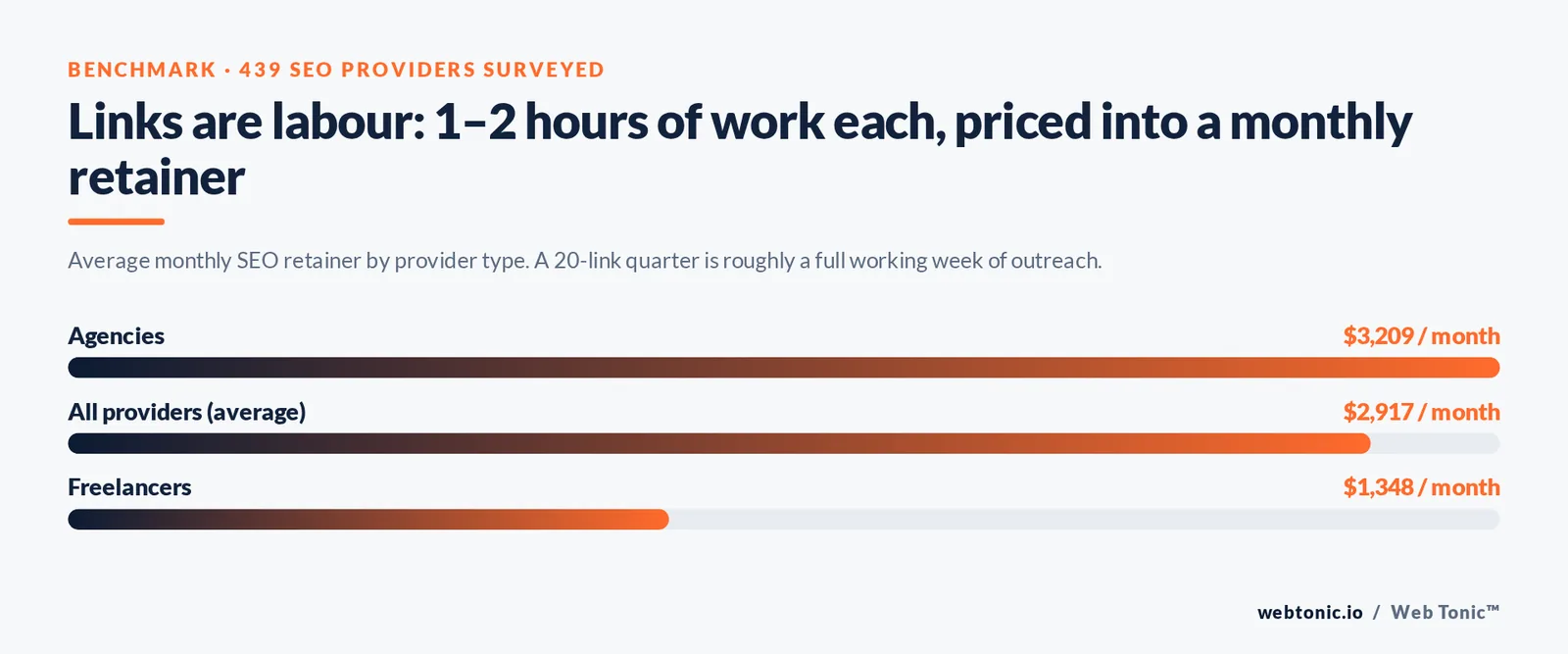
- Links are expensive to earn — practitioners report 1 to 2 hours of work per single link, and SEO retainers average $2,917 per month across 439 surveyed providers.
- Google's own documentation treats link spam as a policy violation, and Penguin has been part of the core ranking system since 2016, so devaluation is continuous rather than periodic.
What are backlinks, exactly?
A backlink — also called an inbound link or an incoming link — is created whenever website A publishes a hyperlink pointing to a page on website B. From website B's perspective that link is a backlink; from website A's perspective it is an outbound link. Nothing more complicated is happening at the technical level: it is an ordinary <a href> element.
What makes backlinks interesting is how search engines read them. A link is an editorial act: someone chose to send their own readers elsewhere. Aggregate millions of those choices and you get a rough, imperfect map of which pages the web considers worth citing. That map has been part of how Google's ranking systems work since the beginning, alongside content relevance, quality signals and page experience.
Every backlink has four components that determine how much it can help:
| Component | What it is | Why it matters for SEO |
|---|---|---|
| Source page | The specific page containing the link | Its own authority and topical relevance carry through the link |
| Referring domain | The website the link sits on | Unique domains count for more than repeat links from one site |
| Anchor text | The clickable words in the link | Describes the destination; exact-match anchors correlate with 5x more traffic |
| Link attribute | followed, nofollow, ugc or sponsored | Tells Google whether the link is an endorsement or a disclosure |
The words "link juice" or "authority" describe the practical effect: a link from a well-established, topically relevant page tends to move rankings more than a link from an unknown site with no traffic. Metrics such as Moz's Domain Authority and equivalent scores from other tools are third-party approximations of that idea, not numbers Google publishes or uses.
Why backlinks matter for SEO
Three effects sit behind the correlation between links and rankings.
Discovery. Crawlers follow links. A page with no internal or external links pointing at it may take a long time to be found and re-crawled, which is why link building and indexing are related problems. Google's SEO starter guide treats linking as a fundamental part of making a site crawlable.
Ranking. Ahrefs' large-scale studies find a consistent positive correlation between the count of linking websites and a page's organic traffic, and show that higher-ranking pages tend to acquire more new followed referring domains over time. That second finding matters more than the first: it means link profiles are dynamic. A page that stops earning links while competitors keep earning them slides even if nothing about it changed. Ahrefs' SEO statistics roundup collects the underlying numbers.
Trust and context. Where your links come from tells search engines what your site is about. A dental practice cited by dental associations, local news and health publishers has a coherent topical profile. The same practice with links from unrelated general directories does not.
The bleak counterweight to all of this is scale: 96.55% of pages get no Google traffic at all. Most of those pages are not penalised — they are simply unlinked, undifferentiated, or both.
| Backlink signal | Verified figure | Practical reading |
|---|---|---|
| Pages with zero Google traffic | 96.55% | Publishing alone is not a strategy |
| New referring domains, #1 positions | +5% to +14.5% per month | Link acquisition must be continuous |
| Nofollow share, top 110k sites | 10.6% | A healthy profile contains nofollow links |
| rel="ugc" usage | 0.44% | Few sites label user-generated links correctly |
| rel="sponsored" usage | 0.01% | Paid-link disclosure is rare in practice |
| Links dead within nine years | 66.5% | Audit and reclaim lost links regularly |
| Domains with reciprocal links | 73.6% | Mutual linking is common and not inherently risky |
| Traffic lift with exact-match anchor | 5x | Anchor text still carries real weight |
| Time to build one link | 1–2 hours | Budget links as labour, not as inventory |
Types of backlinks
The most useful classification is by link attribute, because that is what search engines act on directly.
- Followed links — the default. No attribute, full endorsement, and the type that most affects rankings.
- Nofollow links — marked
rel="nofollow". Since 2019 Google treats these as hints rather than strict directives. They still send referral traffic and still form part of a natural profile, where roughly 1 in 10 links is nofollow. - UGC links —
rel="ugc", for comments and forum posts. Used on just 0.44% of links to the largest sites. - Sponsored links —
rel="sponsored", mandatory for paid or affiliate placements, and used on a remarkable 0.01% of links, which tells you how much undisclosed paid linking exists.
Google explains the attributes and when to combine them in its guidance on qualifying outbound links.
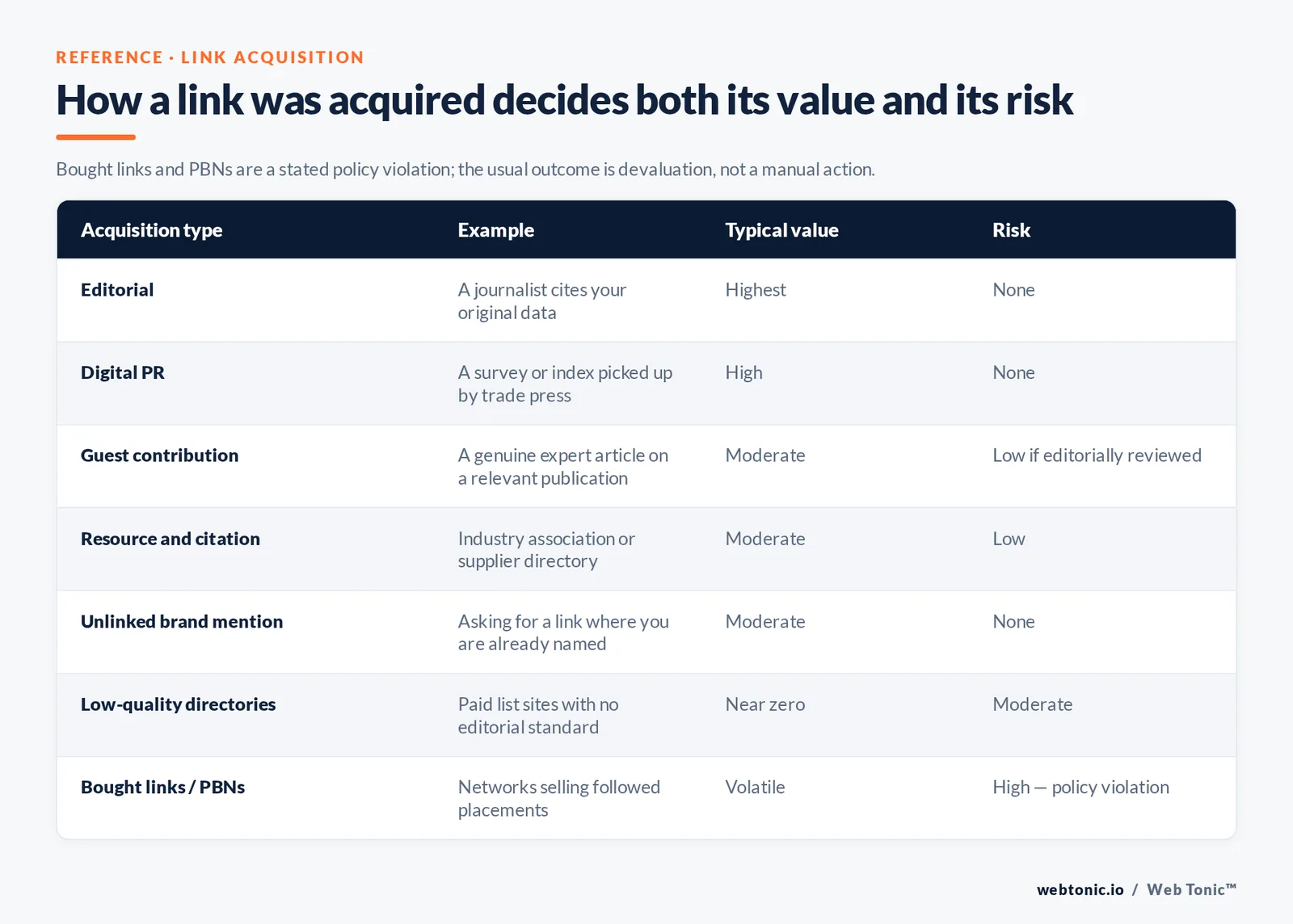
A second, softer classification is by how the link was acquired. This is the one that determines risk:
| Acquisition type | Example | Typical value | Risk level |
|---|---|---|---|
| Editorial | A journalist cites your original data | Highest | None |
| Digital PR | A survey or index picked up by trade press | High | None |
| Guest contribution | A genuine expert article on a relevant publication | Moderate | Low if editorially reviewed |
| Resource and citation | Industry association or supplier directory | Moderate | Low |
| Broken link replacement | Offering your page in place of a dead one | Moderate | Low |
| Unlinked brand mention | Asking for a link where you are already named | Moderate | None |
| Low-quality directories | Paid list sites with no editorial standard | Near zero | Moderate |
| Bought links / PBNs | Networks selling followed placements | Volatile | High — policy violation |
What makes a high-quality backlink
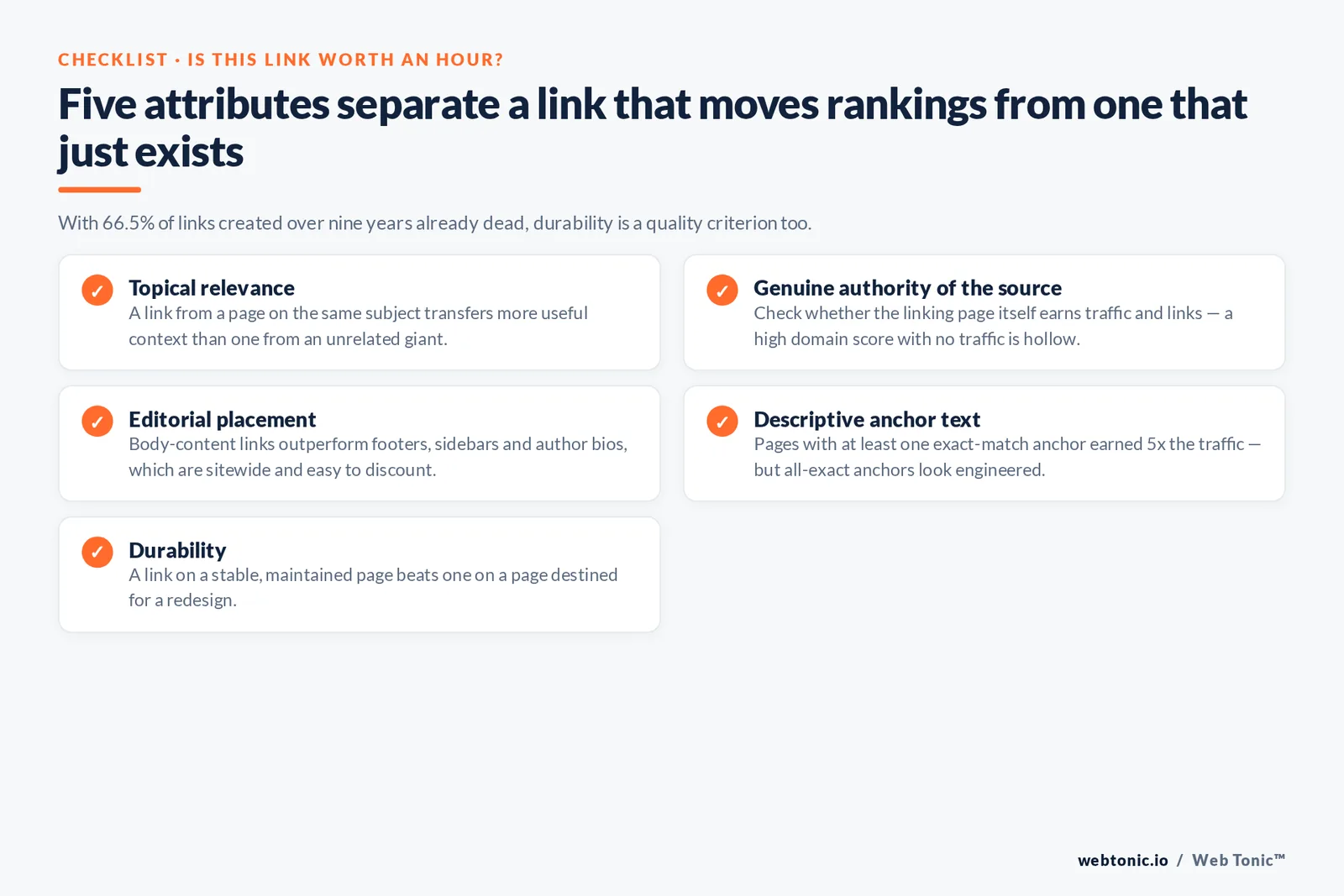
Not all links are worth the hour or two it takes to earn them. Five attributes separate a link that moves rankings from one that just exists.
- Topical relevance. A link from a page about the same subject transfers more useful context than one from an unrelated page, however large the site.
- Genuine authority of the source. Look at whether the linking page itself earns organic traffic and links. A high domain score on a site with no traffic is a hollow metric.
- Editorial placement. Links inside body content outperform links in footers, sidebars and author bios, which are sitewide and easy to discount.
- Descriptive anchor text. Anchors that describe the destination help both users and crawlers. Zyppy's research found pages with at least one exact-match anchor earned 5x the traffic of pages without — but a profile where every anchor is an exact-match keyword looks engineered.
- Durability. With 66.5% of links from the past nine years already dead, a link on a stable, maintained page is worth more than a link on a page destined for a redesign.
Semrush's primer on backlinks and Moz's beginner's guide to SEO both cover the evaluation criteria in more depth if you want a second framework to compare against.
How to get backlinks: seven methods that still work
Link building is outreach plus something worth linking to. Remove either half and it stops working.
| Method | How it works | Effort | Best for |
|---|---|---|---|
| Original data or research | Publish a survey, index or benchmark others must cite | High | Brands wanting compounding links |
| Digital PR | Pitch a newsworthy angle to journalists and trade press | High | Competitive national markets |
| Unlinked mentions | Find brand mentions without links and request one | Low | Established brands |
| Broken link building | Replace dead resources with your equivalent page | Medium | Sites with strong reference content |
| Expert contributions | Write genuinely useful pieces for relevant publications | Medium | Consultants and B2B services |
| Partnerships and suppliers | Case studies, integrations, association listings | Low | Local and B2B businesses |
| Competitor gap analysis | Find domains linking to rivals but not to you | Medium | Any site with named competitors |
Three practical notes. First, links are labour: at 1 to 2 hours per link, a 20-link quarter is roughly a full working week of outreach before you count the asset creation. Second, budget accordingly — a survey of 439 SEO providers put average retainers at $2,917 per month, with agencies at $3,209 and freelancers at $1,348. Third, prioritise the pages that convert. A link to a commercial service page usually beats a link to a blog post nobody buys from, which is why we build link targets alongside the rest of a client's service programme rather than as a separate exercise.
For method-level detail, Ahrefs' link building guide and Semrush's link building guide are the two most complete public resources.
Can backlinks hurt your site?
Yes, but less often and less dramatically than the industry folklore suggests. Google's spam policies name link spam explicitly: buying or selling links for ranking purposes, excessive link exchanges, large-scale article marketing with keyword-rich anchors, and automated link generation are all violations. The consequence is usually devaluation — the links simply stop counting — rather than a manual action.
The mechanism has been continuous since Penguin became part of the core algorithm in 2016. Before that, sites waited months for a refresh; now devaluation happens as pages are re-crawled.
Practical guidance:
- Ignore most toxic-link scores. Third-party "toxicity" metrics are heuristics. Random spam links pointing at your site are normal and Google is generally good at ignoring them.
- Use the disavow tool sparingly. Google's own advice is that it is for cases where you have or expect a manual action from links you built or paid for. If you did not build the links, leave them alone.
- Fix the anchor profile first. Over-optimised anchors across many low-quality domains are a clearer risk signal than the domains themselves.
- Check for hacked outbound links. Compromised sites often inject links out; that is a security problem with an SEO symptom.
How to check and monitor your backlink profile
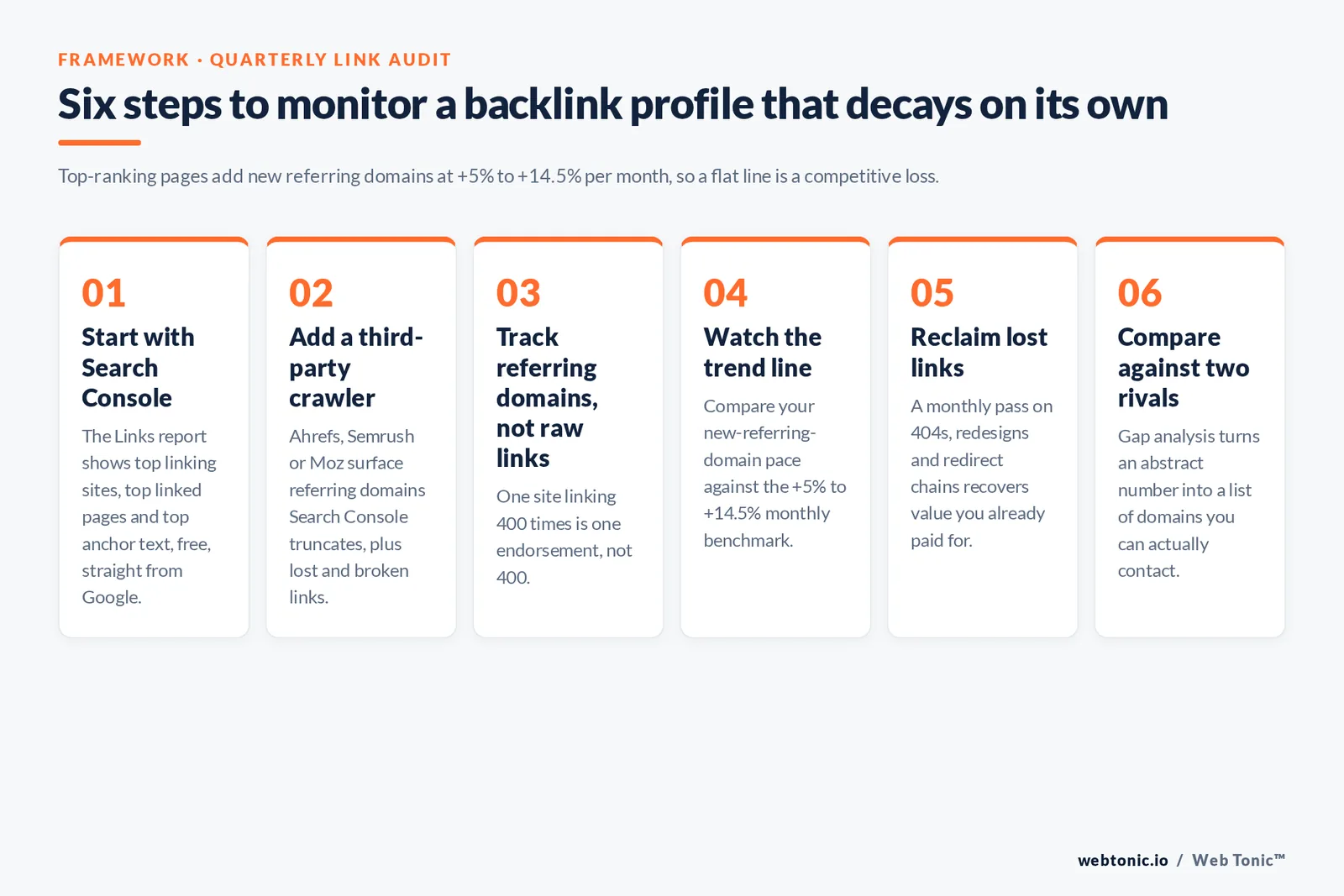
Auditing links is a quarterly job, not an annual one — link rot alone guarantees the profile you measured last year no longer exists.
- Start with Search Console. The Links report shows top linking sites, top linked pages and top anchor text straight from Google, for free.
- Add a third-party crawler. Ahrefs, Semrush or Moz will surface referring domains Search Console truncates, plus lost and broken links.
- Track referring domains, not raw link counts. One site linking 400 times is one endorsement, not 400.
- Watch the trend line. Given that leading pages gain new referring domains at +5% to +14.5% monthly, a flat line is a competitive loss.
- Reclaim lost links. With 66.5% of nine-year-old links dead, a monthly pass on 404s, redesigns and redirect chains recovers value you already paid for.
- Compare against two rivals. Gap analysis turns an abstract number into a list of domains you can actually contact.
Google documents the report itself in its Search Console links report help page, and its guidance on disavowing links is worth reading before you touch that tool. We fold this reporting into the dashboards our data intelligence team maintains, so link growth sits next to rankings and revenue rather than in a separate spreadsheet — and if you would like that built for your site, get in touch. More SEO explainers are on the Web Tonic blog.
FAQ
What exactly are backlinks in SEO?
A backlink is a hyperlink on another website that points to a page on yours. Search engines read those links as third-party signals of relevance and trust, and there is a measured positive correlation between the number of websites linking to a page and the organic search traffic it earns.
How many backlinks do I need to rank?
There is no fixed number — it depends entirely on the competition for your keyword. The useful benchmark is relative: check how many unique referring domains the pages currently ranking have, and note that top-ranking pages keep adding new referring domains at roughly 5% to 14.5% per month, so the target moves.
Do nofollow backlinks help SEO?
Indirectly, yes. Google has treated nofollow as a hint rather than a strict directive since 2019, and nofollow links still deliver referral traffic and brand exposure. They are also a normal part of any natural profile — about 10.6% of links to the largest 110,000 websites are nofollow.
Can buying backlinks get my site penalised?
Buying links to influence rankings is a stated violation of Google's spam policies. The most common outcome is devaluation — the links stop counting, so the money is wasted — with manual actions reserved for larger or repeated schemes. Paid placements must carry rel="sponsored", an attribute used on just 0.01% of links to major sites.
How do I check who links to my website?
Start with the Links report in Google Search Console for a free view of top linking sites, linked pages and anchor text, then add a crawler such as Ahrefs, Semrush or Moz for full referring-domain data, lost links and competitor gap analysis. Review quarterly, since roughly two thirds of links created over a nine-year window end up dead.
Sources: Ahrefs SEO statistics and link research (10,000 SERPs; top 110,000 sites) · Zyppy anchor text study · Aira State of Link Building · Ahrefs SEO pricing survey (439 providers) · Google Search Central documentation: SEO starter guide, ranking systems guide, spam policies, qualifying outbound links, Penguin core update announcement · Google Search Console help: links report, disavow links · Moz beginner's guide to SEO and Domain Authority · Semrush backlink and link building guides. All figures verified at time of publication.