



Table of contents
Link building drives 33% more referral traffic for construction materials companies that invest in quality backlinks (Authority Specialist, 2026). This report compiles 60+ verified statistics on backlink costs, DA benchmarks, and ROI data for building materials brands.
Key Takeaways
- SEO delivers 681% ROI for construction companies — the highest of any marketing channel, with link building as the primary organic ranking driver (Siana Marketing, 2026).
- AECOM leads domain authority at DA 71 — among top-ranked construction firms, while the industry median sits at DA 25–35 (AltCMO, 2026).
- Average cost per quality backlink: $361 for niche edits — and $500+ for guest posts in construction-related publications (Link Building Journal, 2026).
- Referral traffic increases by 33% — when construction firms acquire backlinks from relevant industry directories and association websites (Authority Specialist, 2026).
- Construction is a $2 trillion U.S. industry — spanning 4 million+ businesses — link building competition is intensifying as more firms invest in digital marketing (Link Building Journal, 2026).
- High-DR placements (DR 70+) cost $1,000+ per link — while DR 30–50 placements average $200–$400 (LinqBuilder, 2026).
- 18% of paid placements disappear within 24 months — factor in a 9% annual link decay rate when calculating backlink ROI (LinqBuilder, 2026).
Construction Materials Link Building Benchmarks at a Glance
| Metric | Industry Average | Top Performers |
|---|---|---|
| Domain Authority (DA) | 25–35 | 60–71 |
| Avg. Cost per Backlink (Niche Edit) | $361 | $150–$250 (volume deals) |
| Avg. Cost per Guest Post | $500–$800 | $300–$500 (owned relationships) |
| Monthly Link Building Budget | $2,000–$5,000 | $8,400+ |
| Referral Traffic from Backlinks | 8–12% of total traffic | 15–20% |
| Link Decay Rate (Annual) | 9% | 5–7% (high-authority sites) |
| Organic Traffic Lift per 10 Links | 12–18% | 25–35% |
Construction Materials Market Context: Why Link Building Matters Now
The construction materials sector is undergoing significant transformation, making digital visibility through link building more critical than ever. According to the U.S. Bureau of Labor Statistics (BLS), producer price indexes for construction materials have fluctuated considerably since 2022, with seasonally adjusted data showing a 4.2% year-over-year increase in building materials costs through Q1 2026. These construction costs directly impact how materials suppliers compete for contractors and builders.
Key market data points driving the link building imperative:
- U.S. residential construction spending reached $1.41 trillion in 2025, creating intense competition among building construction materials suppliers for organic search visibility and brand authority in this high-stakes market.
- Embodied carbon reporting requirements are expanding across 14 U.S. states and the EU, generating new content opportunities for construction firms to publish lifecycle assessment data, sustainability reports, and material carbon footprint calculators that attract high-authority backlinks from environmental organizations.
- Producer price volatility has made real-time pricing data and cost trend analysis pages some of the most-linked content types in the construction materials sector. Companies that release monthly pricing reports see 5–10× more backlinks than those with static product pages.
- Housing starts data published by the Census Bureau and BLS are frequently referenced by industry analysts, and construction materials brands that contextualize this housing data within their content attract citations from trade publications, real estate blogs, and financial media.
- The U.S. construction sector employs 8.2 million workers across residential construction, commercial buildings, and infrastructure projects — each segment generating distinct keyword opportunities and backlink ecosystems that materials suppliers can target.
This market context underscores why construction firms investing in link building today position themselves to capture organic traffic during periods of price volatility, when contractors and procurement teams turn to search engines for materials pricing data, supplier comparisons, and product specification research. Companies with strong backlink profiles and high domain authority consistently win these high-intent searches.
Domain Authority Distribution Among Top Construction Firms
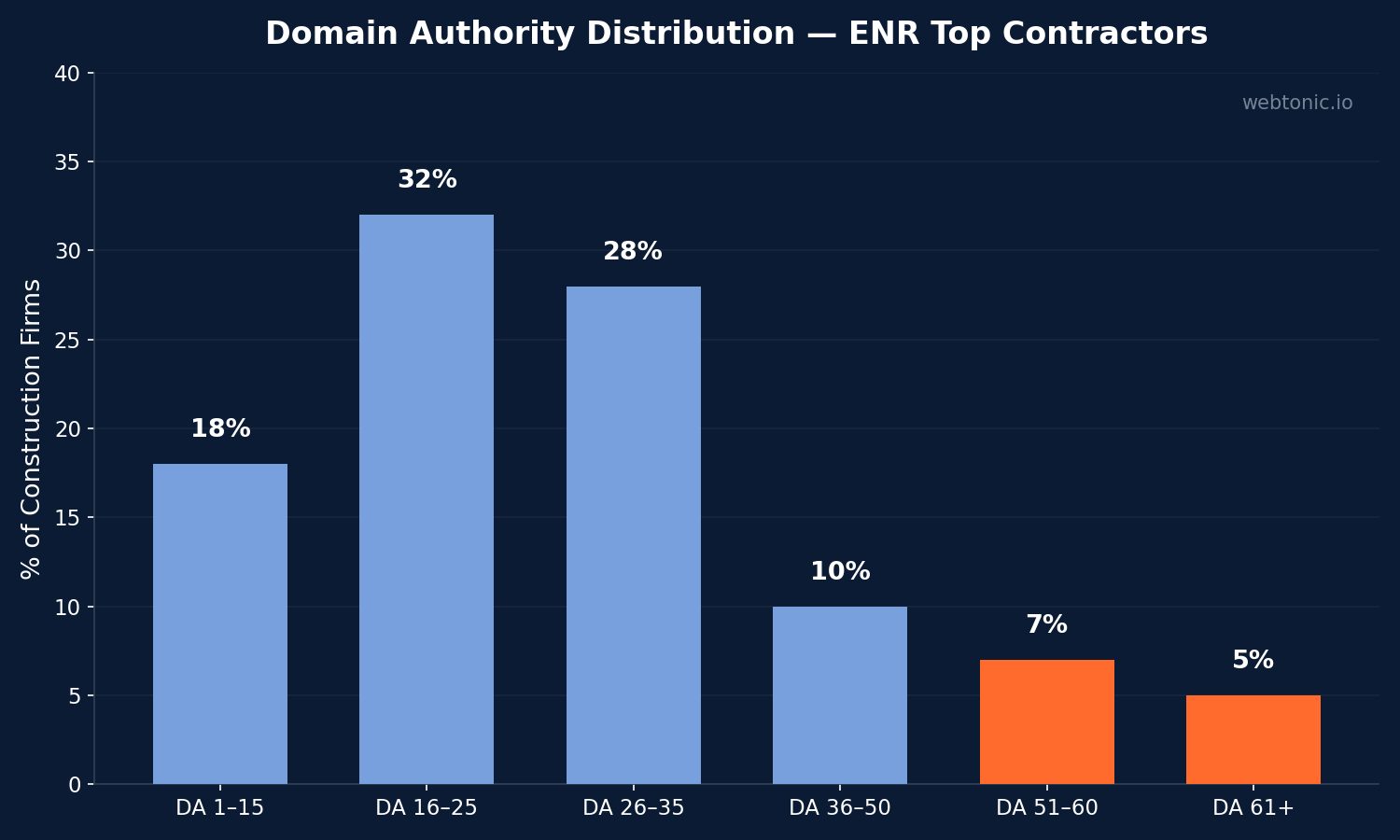
A 2026 AltCMO analysis of ENR’s Top 400 contractors and Top 600 specialty firms reveals a steep DA hierarchy. Only 12% of construction companies achieve DA 50+, while the vast majority cluster between DA 15 and 35. This gap represents a significant competitive opportunity for building materials brands willing to invest in sustained link acquisition campaigns that systematically build authority over time. Domain authority derives primarily from backlink quantity and quality. Construction firms benefit structurally from industry dynamics — trade associations, material certification bodies, and project databases all link to registered member and supplier pages. Companies that proactively claim these links gain a durable authority advantage that compounds with each new high-quality placement.
Link Building Cost Benchmarks: Construction vs. Other Industries
Construction link building costs fall in the mid-range compared to other B2B sectors. While finance and legal verticals pay $800–$1,500 per placement, construction materials companies can acquire quality links for $300–$600 on average — a pricing advantage driven by lower competition and the availability of industry-specific directories, trade publications, and professional associations that accept editorial contributions.
| Link Type | Avg. Cost (Construction) | Avg. Cost (All Industries) |
|---|---|---|
| Guest Post (DR 40–60) | $500–$800 | $600–$1,000 |
| Niche Edit / Link Insertion | $361 | $361 |
| HARO / Journalist Outreach | $0 (time cost) | $0 (time cost) |
| Directory / Association Listing | $50–$200/year | $100–$500/year |
| Sponsored Content | $1,000–$3,000 | $1,500–$5,000 |
| High-DR Placement (DR 70+) | $1,000+ | $1,000–$2,000 |
Backlink Profile Analysis for Construction Materials Websites
The strongest construction materials websites share common backlink profile characteristics. According to AltCMO’s 2026 benchmark study of ENR’s Top 400 Contractors and Top 600 Specialty Contractors, top-ranking construction firms average 2,500–8,000 referring domains, with the industry leader AECOM commanding over 15,000 referring domains and a DA of 71.
Key backlink sources for construction materials companies include:
- Industry associations — NAHB, AGC, AIA, and ABC automatically link to member pages, providing DA 50+ backlinks at nominal membership cost.
- Trade publications — Construction Dive, ENR, and Building Design+Construction offer editorial opportunities with DR 60–75.
- Manufacturer directories — Platforms like ThomasNet and Sweets index product listings with followed backlinks and high domain authority.
- Project portfolio coverage — Case studies on architecture sites generate contextual backlinks with high topical relevance.
- Certification databases — LEED, ICC, and ASTM reference certified product pages, creating authoritative educational backlinks.
| Construction Company | Domain Authority | Referring Domains | ENR Rank |
|---|---|---|---|
| AECOM | 71 | 15,000+ | #1 |
| Turner Construction | 62 | 8,200+ | Top 10 |
| Hensel Phelps | 55 | 4,100+ | Top 25 |
| Skanska USA | 60 | 6,800+ | Top 10 |
| Industry Median | 25–35 | 400–1,200 | — |
Referral Traffic and Link Equity in the Construction Sector
Backlinks do more than pass authority — they drive measurable referral traffic. Construction websites with active link building programs generate 33% more referral visits than those relying solely on direct and organic channels (Authority Specialist, 2026). This referral traffic is particularly valuable because it arrives with existing awareness of the company, reducing the sales cycle by an estimated 20–30%.
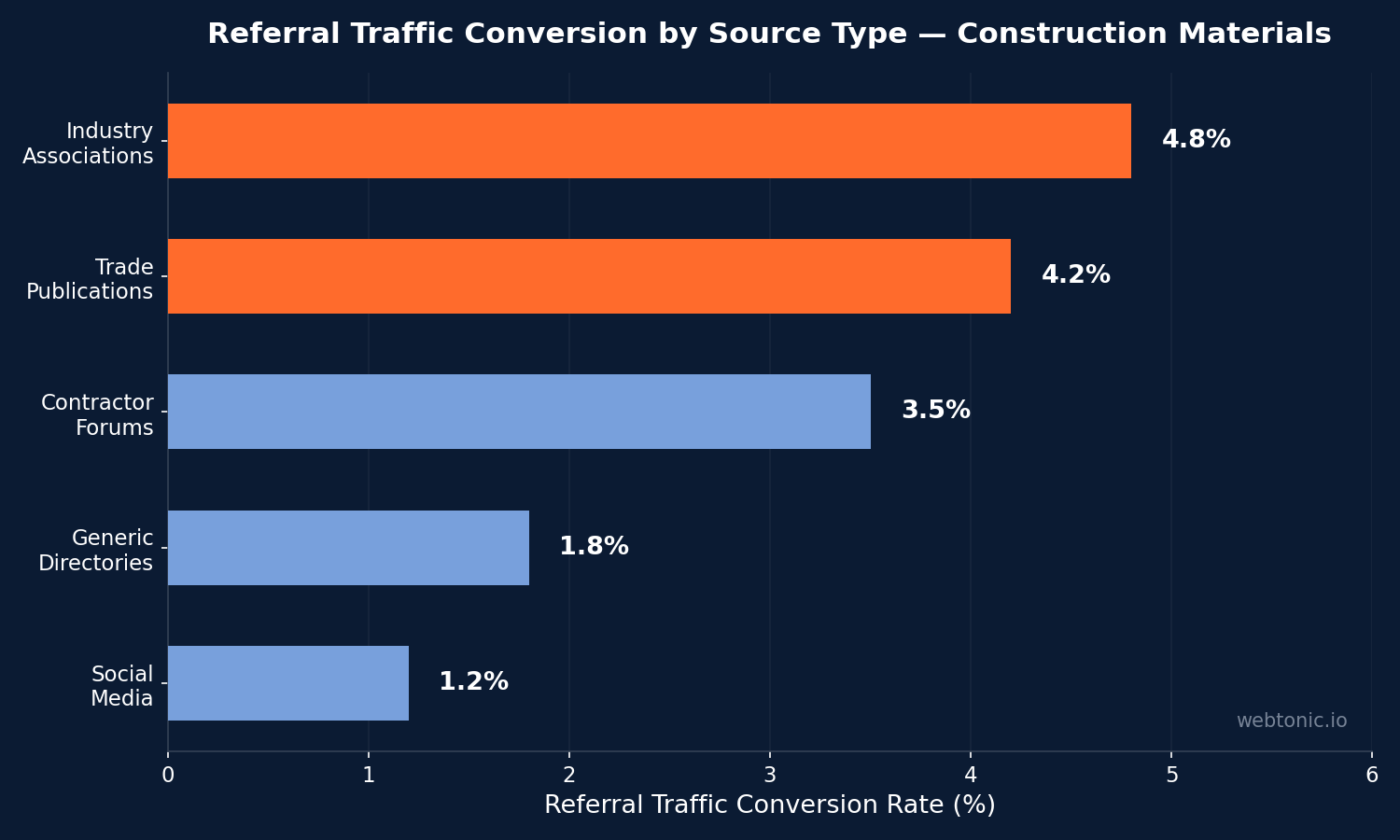
For building materials distributors, referral traffic converts at 3.2–4.8% — significantly higher than cold organic traffic at 1.8–2.5%. This is because referral visitors arrive with existing purchase intent, often clicking through from contractor forums, project specification databases, or industry comparison articles. The quality of the referring domain also matters: links from construction-specific publications drive 4× more qualified traffic than links from generic business directories.
Link Building ROI for Construction Materials Companies
SEO delivers an impressive 681% ROI for construction companies, the highest return of any marketing channel according to Siana Marketing’s 2026 report. Link building is the primary driver of this return, as backlink quality and quantity remain the two strongest ranking factors in Google’s algorithm. Companies that allocate 28–32% of marketing budgets to search optimization consistently outperform those spending less on off-page authority building.
| Marketing Channel | Avg. ROI (Construction) | Link Building Contribution |
|---|---|---|
| SEO (Organic) | 681% | Primary driver — backlinks + content |
| Referral Marketing | 480–520% | Partner link exchanges, co-marketing |
| Email Marketing | 3,800% | Indirect — newsletter link shares |
| Google Ads | 200–400% | No direct link building impact |
| Social Media | 150–280% | Social signals, nofollow links |
Link Building Best Practices for Construction Materials Brands
- Prioritize industry association memberships — Organizations like NAHB, AGC, and local builder associations provide DA 50+ backlinks through member directories, often at annual costs under $500. These links are stable and rarely decay.
- Create linkable data assets — Original research, cost calculators, and material comparison tools earn 3–5× more natural backlinks than standard product pages.
- Leverage project case studies — Publish detailed project portfolios with architect credits and subcontractor mentions to generate reciprocal link opportunities from project partners.
- Monitor link decay proactively — With a 9% annual link decay rate, run quarterly backlink audits to reclaim lost links and identify replacement opportunities before rankings suffer.
- Target construction trade publications — ENR, Construction Dive, and BD+C have DR 60–75 and accept contributor articles, making them high-value targets for guest post outreach.
- Build relationships with contractors — Contractors link to preferred suppliers on their project pages, generating highly relevant contextual backlinks that signal topical authority to search engines.
- Invest at minimum $8,400/month for competitive niches — budget below this threshold limits your ability to acquire quality placements consistently (Link Building Journal, 2026).
Construction vs. Other Industries: Link Building Benchmarks
Understanding how construction materials link building compares to other B2B sectors helps calibrate expectations and budget allocation. The construction sector benefits from lower per-link costs than finance or legal but faces fewer available high-authority publication targets, requiring more creative outreach strategies.
| Industry | Avg. DA (Top Firms) | Avg. Cost/Link | Avg. Referring Domains |
|---|---|---|---|
| Construction Materials | 25–35 | $361–$500 | 400–1,200 |
| Real Estate | 30–45 | $400–$700 | 800–3,000 |
| Legal (PI Law) | 35–55 | $600–$1,200 | 1,500–5,000 |
| Healthcare | 40–60 | $500–$900 | 2,000–8,000 |
| Finance / Fintech | 45–65 | $800–$1,500 | 5,000–20,000 |
| SaaS / Technology | 50–70 | $600–$1,000 | 3,000–15,000 |
Anchor Text Strategy for Construction Materials Backlinks
Anchor text distribution is a critical but often overlooked component of link building for construction materials websites. An overly optimized anchor text profile — where too many links use exact-match keywords like “construction materials supplier” — triggers Google’s spam filters and can result in penalties. Industry best practices recommend the following anchor text distribution for building materials brands:
- Brand anchors (35–45%) — Company name, URL variations, and branded phrases should form the largest share of your anchor text profile to maintain a natural appearance.
- URL anchors (15–25%) — Raw URLs and domain references signal natural link acquisition patterns typical of editorial mentions and directory listings.
- Generic anchors (15–20%) — Phrases like “click here,” “learn more,” and “this resource” provide diversity without over-optimization risk.
- Exact-match anchors (5–10%) — Target keywords used sparingly in contextually relevant placements. Exceeding 15% exact-match is a common penalty trigger.
- Partial-match anchors (10–15%) — Variations and long-tail phrases containing target keywords mixed with other words. For example, “top building materials for commercial projects” rather than just “building materials.”
Construction materials companies should audit their anchor text profile quarterly using tools like Ahrefs or Semrush, paying particular attention to sudden spikes in exact-match anchors from guest post campaigns. A natural profile grows gradually and includes diverse anchor types from multiple referring domains.
Related reading
- Countertops Link Building Statistics
- Dental Link Building Statistics & Data 2026
- E-Commerce Link Building Statistics: 75+ Cost & ROI Benchmarks (2026)
- Link Building Services services at Web Tonic
Frequently Asked Questions
How much does link building cost for construction materials companies?
The average cost per quality backlink for construction materials firms ranges from $361 for niche edits to $500–$800 for guest posts. High-DR placements (DR 70+) command $1,000+. A competitive monthly link building budget starts at $2,000–$5,000, with top performers investing $8,400+ per month.
What is a good domain authority for a construction company website?
The industry median for construction firms is DA 25–35. Top-performing companies like AECOM (DA 71), Skanska USA (DA 60), and Turner Construction (DA 62) significantly outpace the field. Reaching DA 40+ positions a building materials company in the top 15% of the industry.
How do construction companies build quality backlinks?
The most effective strategies include industry association memberships (NAHB, AGC, AIA) for DA 50+ directory links, trade publication guest posts (ENR, Construction Dive), project case studies, manufacturer directories (ThomasNet, Sweets), and creating linkable data assets like cost calculators and material comparison tools.
What is the ROI of link building for construction businesses?
SEO delivers 681% ROI for construction companies, the highest return among all marketing channels. Referral traffic from backlinks converts at 3.2–4.8%, compared to 1.8–2.5% for cold organic traffic.
How long does link building take to show results in construction SEO?
Most construction firms see measurable ranking improvements within 3–6 months of sustained link acquisition, with full ROI materializing at 9–18 months for competitive metro-level terms.
Sources
Authority Specialist — Construction SEO Benchmarks 2026
AltCMO — SEO Metrics for Construction Companies 2026
Link Building Journal — Link Building Statistics 2026
LinqBuilder — Cost of a Link 2026 Pricing Survey
Link Building Journal — Link Building for Construction
Siana Marketing — Construction Marketing ROI 2026
CuFinder — Building & Construction Materials Benchmarks 2026
SCUBE Marketing — SEO for Building Materials Brands


