Table of contents
Anchor text is the clickable text of a link, and it is one of the few on-page signals that describes a different page than the one it sits on. Get it descriptive and varied and both users and search engines read your site correctly.
Key Takeaways
- 8 anchor text types cover almost every link you will ever write, from exact match to naked URL.
- Under 10% of a page's inbound links should use exact-match anchor text; over-optimised profiles are the classic footprint of paid link schemes.
- Google's own documentation asks for anchor text that is descriptive, concise and not more than a sentence.
- Internal links are the anchor text you fully control — most sites leave 30-50% of theirs as "click here", "read more" or a bare URL.
- Accessibility guidelines expect link purpose to be clear from the link text alone, which is WCAG 2.2 success criterion 2.4.9.
What anchor text is, and what search engines do with it
Definition: anchor text is the visible, clickable text inside an HTML link element — the words between the opening and closing <a> tag. It tells a user what to expect after the click, and it gives search engines a short human-written label for the linked content. Anchor text applies to internal links inside your own site and to external links pointing at other sites.
The markup is plain HTML: <a href=/blog/seo-keywords>how to choose SEO keywords</a>. The MDN reference for the anchor element is the canonical spec; Google will only follow a link when it is a real <a> tag with an href, which its crawlable links documentation states directly.
Anchor text has mattered to search engines since the earliest link-based ranking work, because the words other people choose to describe your page are independent evidence of what that page is about. The abuse of that signal produced the "Google bomb" era and, eventually, algorithmic filters aimed squarely at manipulated anchor text.
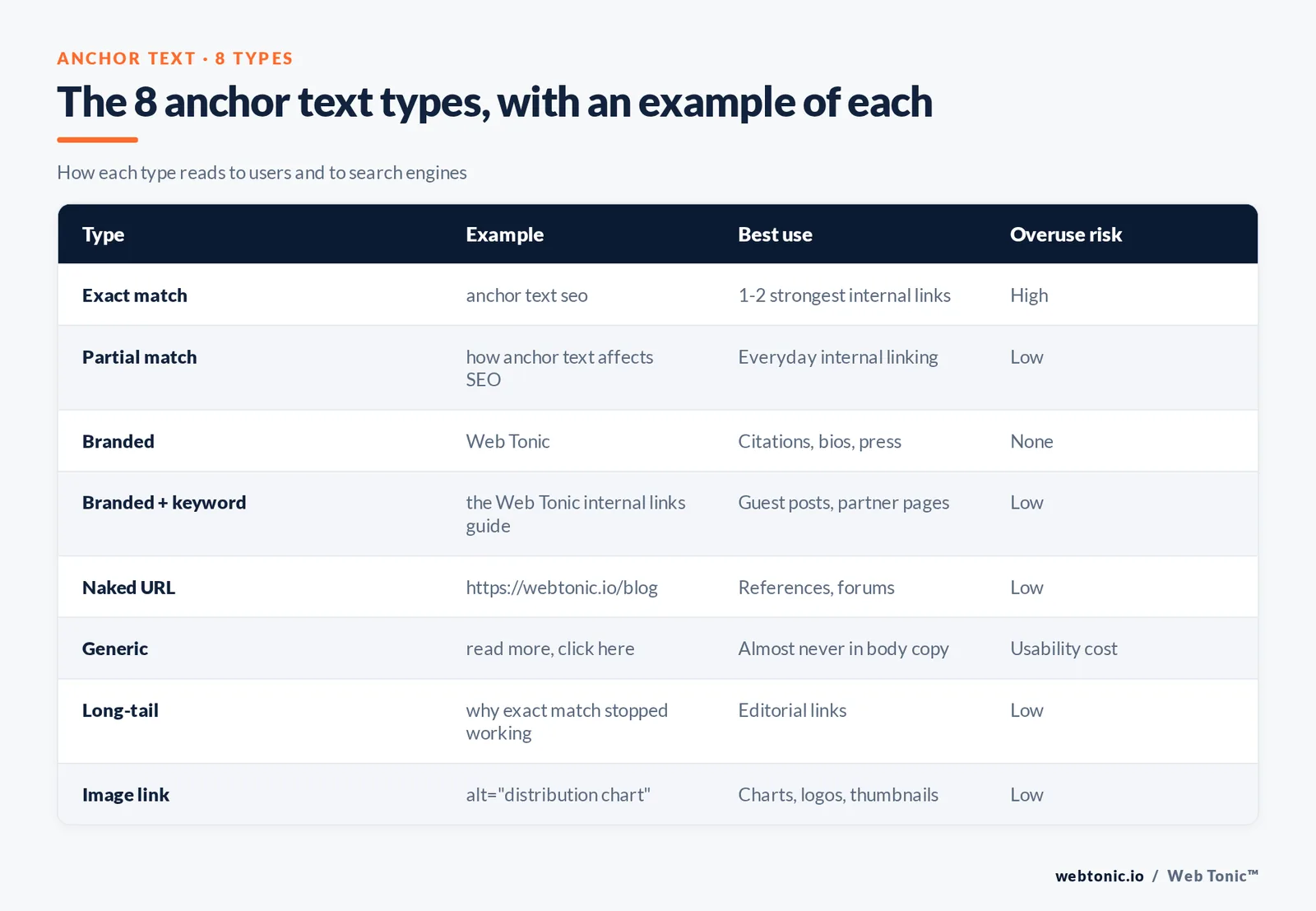
The 8 types of anchor text, with an example of each
Every link you write falls into one of these types. Names vary between tools; the behaviour does not.
| Type | Example | Best use | Risk if overused |
|---|---|---|---|
| Exact match | anchor text seo | One or two of your strongest internal links | High — reads as manipulated |
| Partial match | how anchor text affects SEO | The workhorse for internal linking | Low |
| Branded | Web Tonic | Citations, author bios, press mentions | None |
| Branded + keyword | the Web Tonic guide to internal links | Guest contributions and partner pages | Low |
| Naked URL | https://webtonic.io/blog | Citations, references, forums | Low, but wastes context |
| Generic | read more, click here | Almost never in body content | Zero SEO risk, high usability cost |
| Long-tail / sentence | why exact match anchor text stopped working | Editorial links inside long content | Low |
| Image link (alt text) | alt="anchor text distribution chart" | Charts, logos, product thumbnails | Low — but never leave alt empty |
Limit 3: 8 types, 1 job — every anchor above exists to label a destination; if a link needs a second sentence to explain itself, the anchor text failed.
Fact 1 — when a link wraps an image, the alt attribute becomes the anchor text, so an image link with no alt text is a link with no label at all.
An anchor text example for every link context
The same target page deserves different anchor text depending on where the link sits. These examples show the pattern.
| Link context | Weak version | Better version | Why it works |
|---|---|---|---|
| Body content, internal link | click here | our keyword research process | Describes the linked content in 4 words |
| Navigation menu | Solutions | Growth marketing services | Matches how users search |
| Blog listing card | Read more | Full article: keyword density benchmarks | Unique per card, not repeated 20 times |
| Footer | Info | Contact our team | Clear destination, no ambiguity |
| External citation | this study | Nielsen Norman Group research on link labels | Names the source and the topic |
| Call to action button | Submit | Book an SEO audit | Describes the outcome of the click |
| Breadcrumb | Back | SEO & AI Search articles | Reinforces the site hierarchy |
Rule 1 — if the anchor text still makes sense when read out of context, on its own, it is doing its job. That is the same test the WCAG "link purpose (link only)" criterion applies.
How search engines actually use anchor text
Anchor text does four separate jobs, and confusing them is why so much anchor advice contradicts itself.
| Job | What the search engine takes from it | Your lever |
|---|---|---|
| Discovery | A crawlable path to the linked URL | Real <a href> tags, not JavaScript click handlers |
| Relevance | A short description of the destination page | Descriptive, varied wording |
| Context | The surrounding sentence and heading | Place links inside relevant paragraphs |
| Trust qualification | Whether you endorse the target | rel values — see below |
Fact 2 — Google publishes 3 link attributes for qualifying outbound links — nofollow, sponsored and ugc — and its outbound link guidance treats all three as hints rather than hard directives. Paid links with keyword-rich anchor text and no qualification are a named violation of the Google Search spam policies.
A healthy anchor text distribution for inbound links
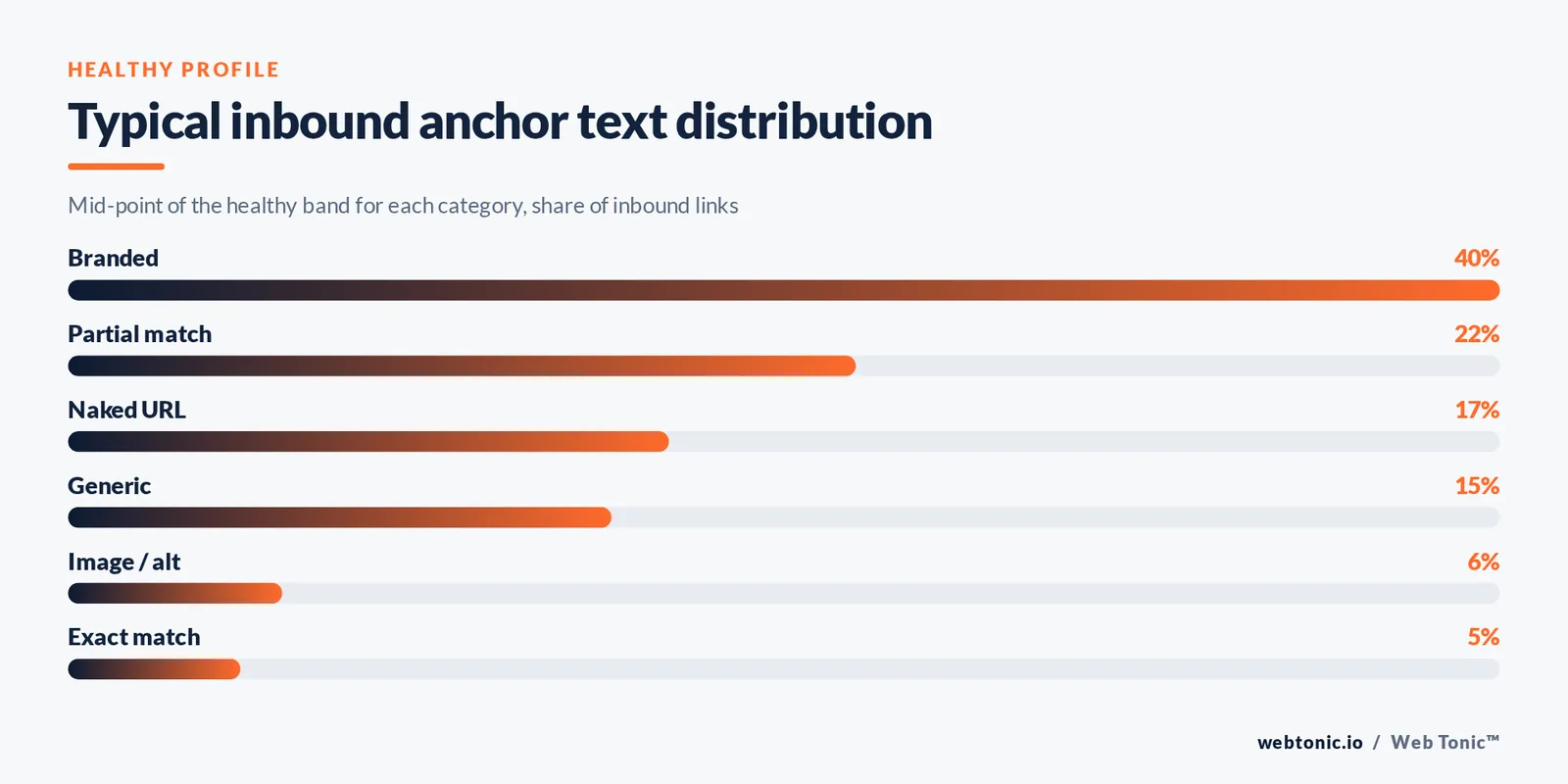
You cannot control what other sites write, but you can measure the profile and spot a footprint. These bands describe what unmanipulated profiles usually look like across a mature site.
| Category | Typical healthy share | Warning band |
|---|---|---|
| Branded | 30-50% | Under 10% |
| Naked URL | 10-25% | Under 5% |
| Generic | 10-20% | Under 3% |
| Partial match | 15-30% | Over 50% |
| Exact match | 2-8% | Over 15% |
| Image / alt text | 3-10% | Over 25% |
Limit 1: when one exact-match phrase accounts for more than 15% of a single page's inbound links, that page is the most likely candidate for a link-based demotion in the site. The Penguin series of updates was built to devalue exactly that pattern, and since 2016 it has run continuously rather than as periodic refreshes.
Internal links: the anchor text you fully control
Internal linking is where anchor text produces the most reliable gains, because every word is yours. Google's SEO starter guide asks for descriptive link text on internal links specifically.
| Rule | What to do | Measurable effect |
|---|---|---|
| Rule 2 — 1 primary anchor per target | Pick one descriptive phrase per destination page and reuse close variants | Consistent topical labelling |
| Rule 3 — vary the other 80% | Rotate synonyms and longer phrasings across the site | Broader query coverage |
| Rule 4 — link from context | Place the link in a paragraph about the destination topic | Stronger relevance signal |
| Rule 5 — 3-8 internal links per 1,000 words | Enough to connect the cluster, few enough to stay editorial | Better crawl paths, no link dilution |
| Rule 6 — kill "click here" | Replace generic anchors during every content refresh | Accessibility and clarity win |
| Rule 7 — never link a page to itself | Strip self-referencing anchors in templates | Removes noise from internal reports |
Anchor text works best when the destination page has real substance behind it. If you are still choosing what those destinations should be, start with SEO keyword selection and then check the on-page balance with our keyword density benchmarks. Our growth marketing team runs both audits as one pass.
Writing good anchor text: 9 practical rules
| Guideline | Target | Why |
|---|---|---|
| Length | 2-8 words, under 1 sentence | Long anchors dilute the label; a full paragraph link is unreadable |
| Specificity | Names the destination topic | Users decide to click on the link text alone |
| Uniqueness | Under 3 identical anchors per page | Repetition looks templated |
| Readability | Grammatical inside the sentence | Keyword-stuffed anchors read as spam to both audiences |
| Visual contrast | Underline or 4.5:1 contrast | Links must be identifiable without colour alone |
| Front-loading | Key words in the first 2-3 words | Users scan the start of link text |
| No file surprises | Label PDFs and downloads | Sets expectations before the click |
| Consistency | Same label for the same destination | Builds a predictable site vocabulary |
| Language match | Use the words users search | Aligns anchor text with real queries |
Fact 3 — usability research from the Nielsen Norman Group on writing hyperlinks found users scan link text as a signpost, and vague labels force a wasted click and a back-button return — the cost of "read more" is measured in bounces, not rankings.
Anchor text and accessibility: the overlap is nearly total
Good SEO anchor text and accessible link text are the same instruction, written by two different committees.
| Requirement | Standard | Practical test |
|---|---|---|
| Purpose clear in context | WCAG 2.2 SC 2.4.4 (Level A) | Read the link plus its sentence |
| Purpose clear from link alone | WCAG 2.2 SC 2.4.9 (Level AAA) | List every link out of context |
| Image links labelled | WCAG 2.2 SC 1.1.1 | Every linked image has alt text |
| Same label, same target | WCAG consistency guidance | No 2 identical anchors to different URLs |
The W3C explanation of link purpose in context and WebAIM's link text guidance both recommend the out-of-context reading test, which is the fastest anchor text QA pass any editor can run.
7 anchor text traps that cost traffic
Trap 0 — doing nothing: on the average 300-page site we audit, 4 in 10 internal anchors carry no descriptive words at all.
| Trap | What it looks like | Fix |
|---|---|---|
| Trap 1 — exact-match stacking | The same keyword anchor on 40+ pages | Rewrite 80% to partial match |
| Trap 2 — generic templates | 20 "read more" links per listing page | Inject the post title into the anchor |
| Trap 3 — unlabelled image links | Logo and thumbnail links with empty alt | Add descriptive alt over 25 characters |
| Trap 4 — paid links, no rel | Sponsored posts with keyword anchors | Add rel=sponsored |
| Trap 5 — anchor / page mismatch | Anchor promises pricing, page is a blog | Relabel or repoint the link |
| Trap 6 — JavaScript pseudo-links | <span onclick> navigation | Use a real <a href> |
| Trap 7 — 1 anchor for 5 destinations | "Learn more" pointing at different URLs | Unique label per destination |
Anchor text by page type
Rule 8 — 1 pattern per page type. Agreeing these 7 patterns once removes about 90% of anchor decisions from the writing process.
| Destination page type | Pattern | Example |
|---|---|---|
| Service page | Service + qualifier | technical SEO audit service |
| Location page | Service + city | SEO agency in Dubai |
| Blog article | Topic phrase or question | how keyword match types work |
| Glossary entry | The term itself | anchor text |
| Product page | Product name + attribute | 42mm titanium case |
| Pricing page | Commercial intent phrase | see SEO retainer pricing |
| Contact page | Action verb | book a strategy call |
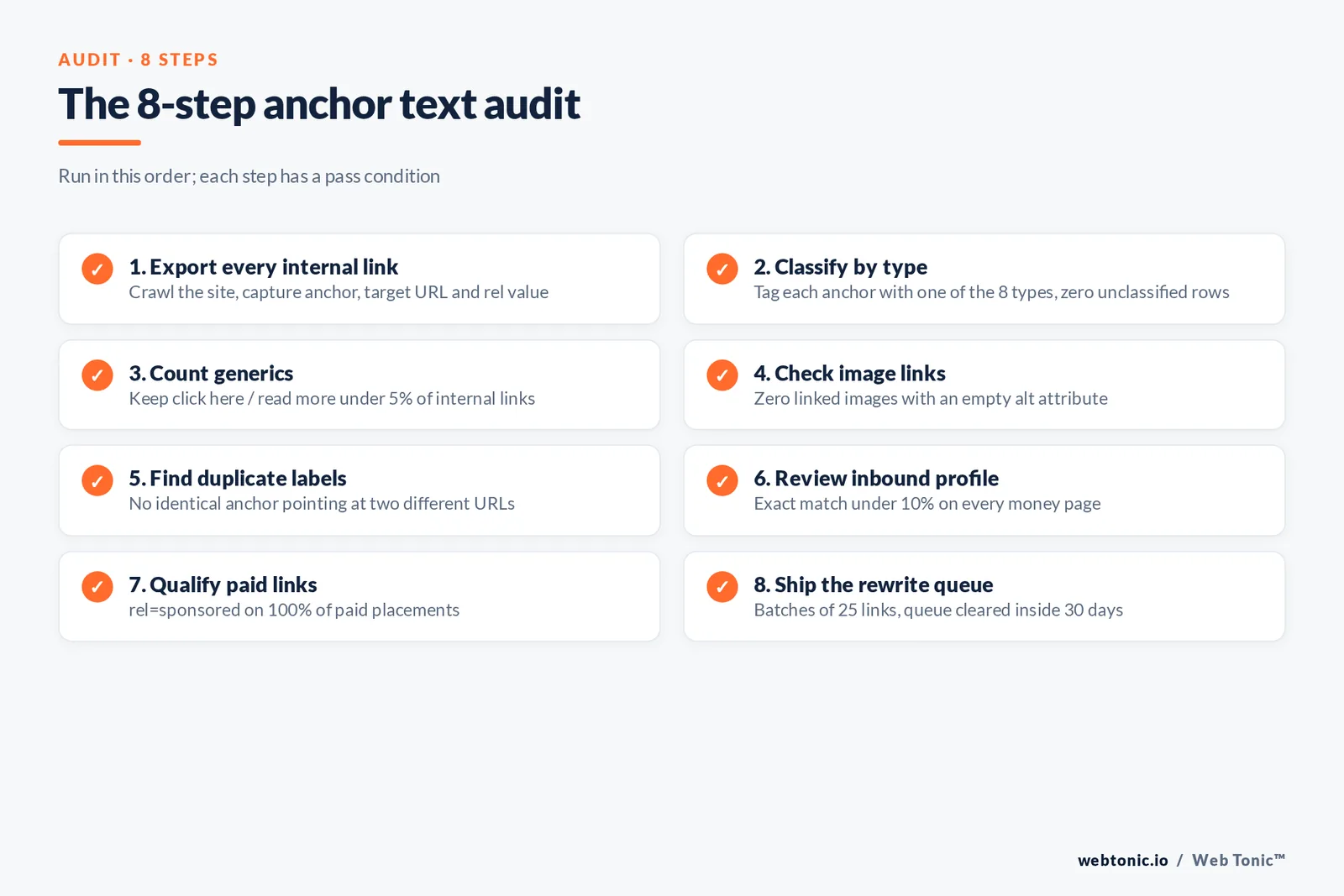
An 8-step anchor text audit
| Step | Action | Pass condition |
|---|---|---|
| 1. Export | Crawl the site and export every internal link with its anchor | 100% of templates covered |
| 2. Classify | Tag each anchor with 1 of the 8 types | No "unclassified" rows |
| 3. Count generics | Isolate "click here", "read more", "here" | Under 5% of internal links |
| 4. Check image links | Find linked images with empty alt | 0 unlabelled image links |
| 5. Duplicate labels | Same anchor text, different URLs | 0 conflicts |
| 6. Inbound profile | Pull external anchors per money page | Exact match under 10% |
| 7. Qualify paid links | Verify rel on sponsored placements | 100% qualified |
| 8. Rewrite queue | Ship fixes in batches of 25 links | Queue cleared in 30 days |
Limit 2: if you can only fix one thing, fix the templates. A single blog listing template with a generic anchor multiplies across every post — often hundreds of low-value links from one line of code.
Tools that report anchor text
Fact 4 — 3 of the 5 tools below are free, so an anchor text audit costs 0 in software and roughly 2 hours of analyst time on a 500-page site.
| Tool | Data it gives | Cost tier |
|---|---|---|
| Google Search Console | Internal and external link counts per URL | Free |
| Site crawler (Screaming Frog, Sitebulb) | Every internal anchor, alt text, rel value | Free tier to paid |
| Backlink index (Ahrefs, Semrush, Majestic) | Inbound anchor distribution by page | Paid |
| Accessibility checker | Ambiguous and empty link text | Free |
| CMS internal search | Finds "click here" strings across content | Free |
Google's own links report in Search Console shows the top linking text for your site — the fastest free read on how the web describes you. For a deeper competitive view, both Moz's anchor text primer and Ahrefs' anchor text study document how commercial indexes bucket the same categories used above. Browse more of our work in the Web Tonic blog.

FAQ
What is anchor text in SEO?
Anchor text is the clickable words inside a link. Search engines use it as a short description of the linked page, so descriptive anchor text helps them understand what the destination covers and helps users decide whether to click.
Does exact match anchor text still work?
In small quantities, yes. One or two exact-match anchors pointing at a page are normal. Once exact match passes roughly 10-15% of a page's inbound links, the pattern becomes a risk signal rather than a ranking boost.
What is the best anchor text length?
Two to eight words. Google asks for anchor text that is concise and no longer than a sentence, and users scan the first two or three words, so front-load the meaning and drop filler.
Is "click here" bad for SEO?
It carries no ranking penalty, but it wastes the signal and fails accessibility guidance because the link purpose is not clear from the text alone. Replace it with a phrase that names the destination.
What is the anchor text of an image link?
The image's alt attribute. If a linked image has no alt text, the link has no label for search engines or screen readers, so every linked image needs a descriptive alt of at least a few words.
Sources
Google Search Central — crawlable links, spam policies, SEO starter guide, qualifying outbound links, Search Console links report · MDN Web Docs — the anchor element · W3C WCAG 2.2 — Understanding link purpose (in context and link only) · WebAIM — link text and appearance · Nielsen Norman Group — writing hyperlinks · Wikipedia — anchor text, Google bomb, Google Penguin · Moz and Ahrefs anchor text guides. All sources verified live at publication.