Table of contents
An investor-ready growth plan is usually bought as a four-to-eight-week project at $12,000–$30,000, or as part of a $7,000–$15,000-a-month advisory retainer during the raise window. What you are paying for is an artefact that survives an analyst rebuilding your CAC from raw exports.
Key Takeaways
- Defined pre-raise sprints — growth plan, unit-economics rebuild, data-room marketing section — price at $12,000–$30,000 total over 4–8 weeks.
- Ongoing advisory cover through a raise runs $7,000–$12,000 a month at Series A stage, rising to $10,000–$18,000 at Series B, with fundraising specialists charging 20–40% more than generalists.
- Hourly work sits at $150–$500 with an average near $325, and the median published fractional rate across all roles is $172 an hour.
- Companies that arrive fundraising-ready reportedly raise at 20–40% higher valuations, because investors discount uncertainty.
- The work is finite: about 47 recurring diligence questions, a data room of 80–150 documents, and a bar of answering any question with verifiable evidence in 10 minutes.
- Marketing diligence recalculates your numbers rather than reading them — fully-loaded CAC, channel-level CAC, cohort retention and gross-margin-adjusted payback, with SaaS payback expected under 12–18 months.
- Timing decides the price. Preparation before the first meeting is cheap; the same work during a 3–6-week confirmatory diligence window is not.

What you are actually buying
An investor-ready growth plan is not a pitch narrative. Marketing due diligence begins after a fund says it is interested and before a term sheet, and it is run by a partner, an associate or an outside consultant on retainer against five questions: does the data match the deck, are the unit economics real, is growth diversified or fragile, is retention durable cohort by cohort, and is the attribution credible. The deliverable you buy has to answer those five with source data attached.
That fixes the contents. The marketing section of a data room is narrower and more technical than a generic checklist: a CAC and LTV calculation with formula and source data shown, channel-by-channel spend and output for the trailing 12–24 months, cohort retention tables by signup month, read-only ad-account or exported reports covering the same period the deck claims, analytics access so the funnel can be rebuilt independently, a CRM export with pipeline source and win rate, an attribution write-up including known blind spots, and a list of one-off campaigns that inflated a historical period.
| Purchase shape | 2026 price | Fits when |
|---|---|---|
| Diagnostic sprint | $12,000–$30,000 over 4–8 weeks | You have a raise window and need one defensible artefact |
| Advisory retainer, Series A | $7,000–$12,000 / mo | The plan must be maintained through the whole process |
| Advisory retainer, Series B | $10,000–$18,000 / mo | Multi-channel spend and a team already exist |
| Project fee, defined deliverable | $10,000–$50,000 | Scope is a named output such as a GTM or pricing model |
| Hourly advisory | $200–$500 / hr | Board prep, rehearsal, a second opinion on the model |
| Day rate | $1,500–$3,500 / day | A workshop to rebuild CAC with the team in the room |
The price bands, and where they come from
Three independent datasets converge. Treetop's May 2026 benchmark prices a project-based sprint — a GTM playbook, a pricing model, a pipeline audit — at $12,000–$30,000 total over four to eight weeks, and notes that these contained, outcome-linked commitments are rising in 2026 because buyers want proof before a longer retainer. RankedCMO's 2026 pricing data puts defined project fees at $10,000–$50,000+, day rates for audits and planning sessions at $1,500–$3,500, and hourly advisory at $200–$500.
For retainer cover through a raise, the relevant comparison is the finance-side band rather than the marketing one, because the buyer is usually the CEO and the audience is the investment committee. Fractional Pulse bands Series A-stage cover at $7,000–$12,000 a month for 15–25 hours and Series B at $10,000–$18,000 for 20–30 hours, and observes that operators specialised in metrics and fundraising charge 20–40% more than generalists because they have built the board deck before. Broader fee data agrees on the hourly floor: growth consultant rates run $150–$500 with an average around $325, while the Fractional Rates Index (1,774 providers, September 2026) reports a median published rate of $172 an hour and a median US monthly retainer of $5,750 — a reminder that published prices skew low and only 10.7% of providers publish at all.
Why the artefact is worth more than it costs
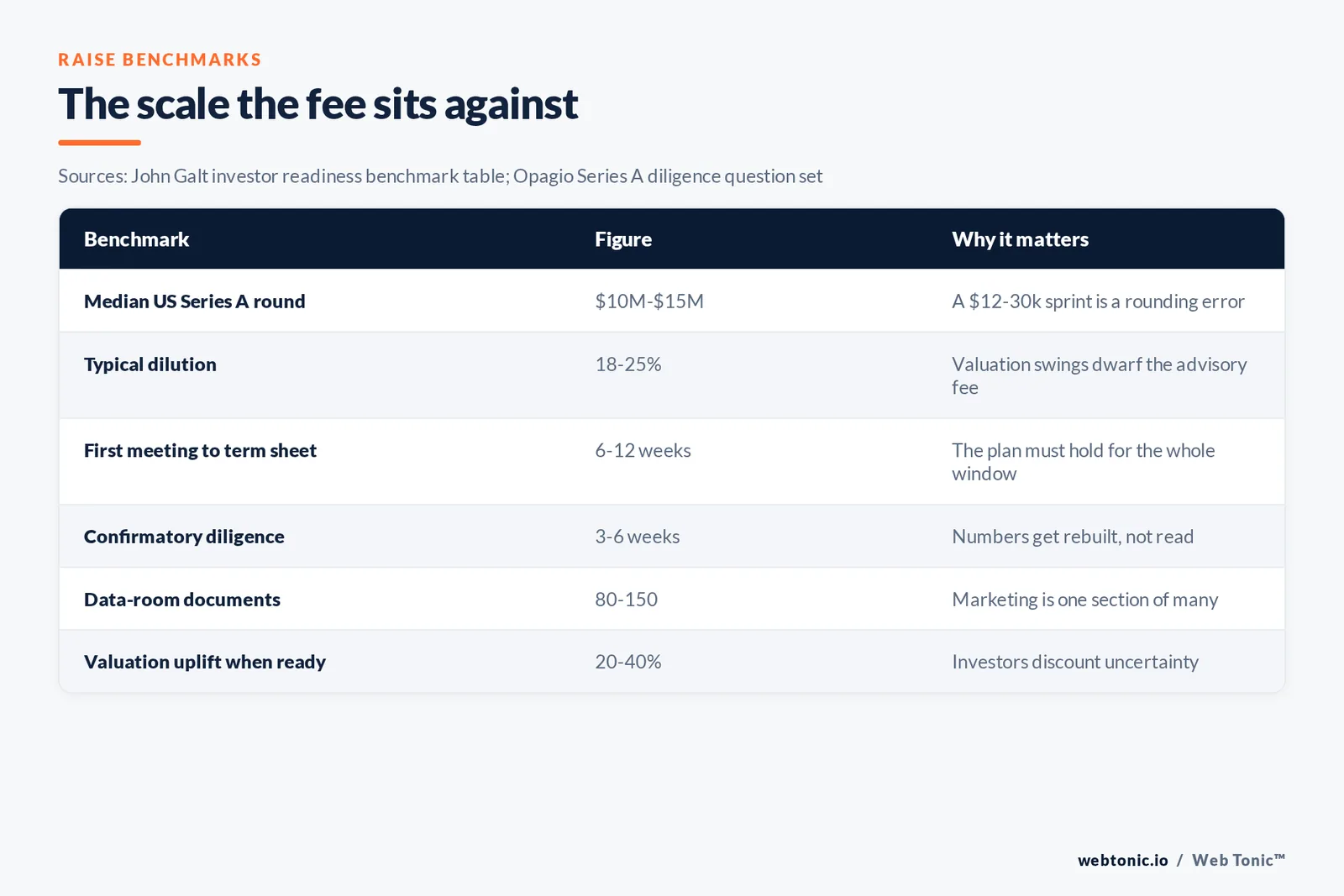
The return is priced in valuation and in time. One CFO-side readiness guide reports that companies which arrive prepared raise at 20–40% higher valuations than those learning as they go, because investors discount uncertainty, and it recommends a pre-diligence ritual: give an independent advisor read-only access for two to four weeks before going to market and have them issue a diligence report on your own company. Its benchmark table is a useful scale check — a median US Series A round of $10M–$15M, typical dilution of 18–25%, first meeting to term sheet in 6–12 weeks when it goes well, confirmatory diligence in 3–6 weeks, and a data room of 80–150 documents.
Against a round of that size, a $20,000 sprint is a rounding error, and a valuation swing of even a few points dwarfs it. The time argument is stronger still: one diligence question set counts 47 recurring questions across seven categories and sets the practical target at answering any of them with verifiable evidence inside 10 minutes, treating fewer than 10 unprepared answers as the readiness threshold. It also makes the point that the gap between a two-week diligence and a six-week one is rarely business quality — it is how fast questions convert into evidence.
| What diligence rebuilds | The expected standard | Common red flag |
|---|---|---|
| Fully-loaded CAC | Sales and marketing spend including salaries, tools and fees | Media spend only, headcount excluded |
| CAC by channel | Paid, organic, referral and sales-assisted split out | A blended number hiding one unsustainable channel |
| LTV method | Observed retention curves, cohort by cohort | Three months of data extrapolated over three years |
| Payback period | Gross-margin-adjusted, under 12–18 months for SaaS | Calculated on revenue, which flatters the number |
| Channel concentration | Two to three contributing channels | Over 60–70% of new revenue from one source |
| Marginal CAC | Cost of the next customer at current scale | Historical average used to justify a larger spend plan |
What moves the quote up or down
Four variables explain most of the spread. Instrumentation debt is the largest: if conversion tracking, channel tagging and cohort reporting do not exist, the first two weeks are repair work rather than analysis, and the sprint lands at the top of the $12,000–$30,000 band. Stage and spend complexity matter next — rebuilding twelve months of data for one paid channel is not the same job as reconciling six channels, a partner programme and a sales-assisted motion.
Audience is the quiet one. A plan written for a seed round is a narrative with evidence; the same plan for Series B has to reconcile to the financial model line by line, which pulls finance-side hours into scope. And urgency prices itself: one Series A readiness view puts realistic core preparation at 60 to 90 days — positioning clarified, website updated, dashboard built, channels documented — and warns that content authority accumulates more slowly, so work compressed into a live process costs more and proves less.
Buying it well
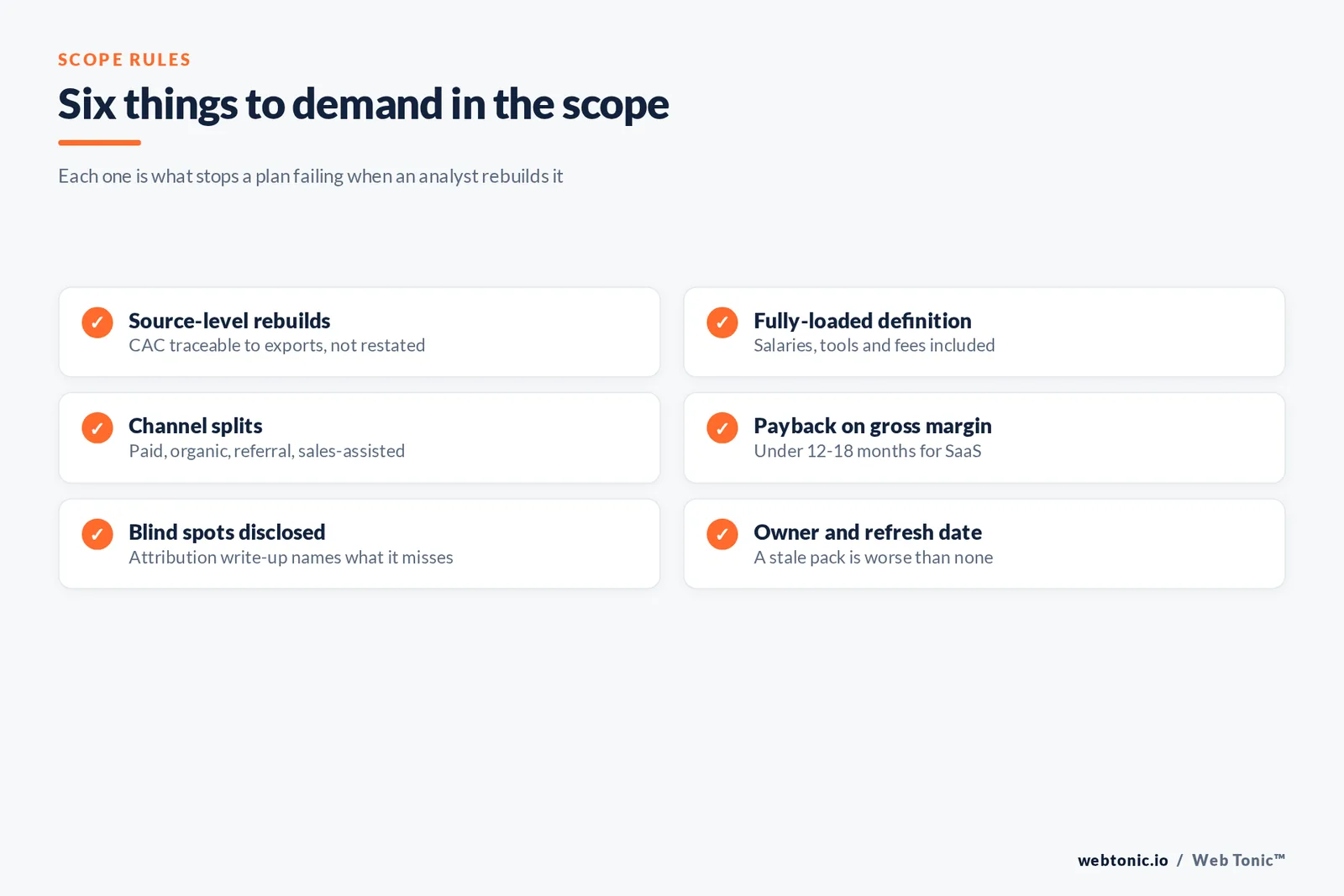
Insist on three things in the scope. First, source-level rebuilds rather than restatements: the CAC in the plan must be traceable to exports an analyst can re-run. Second, the standards your numbers will be judged against, written into the document — investor expectation benchmarks put Series A SaaS CAC payback at 12–18 months, treat a 3:1 LTV:CAC ratio as the baseline expectation, and read a single channel supplying 90% of leads as concentration risk regardless of efficiency. Third, an owner and a refresh date, because a plan that is three months stale during a raise is worse than none.
Then buy the smallest artefact that answers the five diligence questions, and keep the option to extend. A sprint that produces a defensible baseline is a better first purchase than a twelve-month retainer bought under deadline pressure. Our growth advisory page sets out how that diagnosis is scoped, data intelligence covers the measurement repair underneath it, and fractional CMO cover is the option when the plan also needs someone to run it. We do not invent a benchmark to make a plan look stronger — every figure in a diligence pack should be one an outsider can reproduce.
The cost of skipping it
Founders rarely pay for an investor-ready plan because they want one. They pay because the alternative has a price too, and it is paid at a worse moment. Series A evaluation guidance for 2026 frames the central question investors are testing as whether there is repeatable, capital-efficient growth that more money can accelerate, and lists the artefacts that answer it: CRM pipeline reports, funnel conversion history and ramp data for early sales hires. If those do not exist in a form someone else can read, the deal does not die — it slows, and slow is expensive.
The second cost is credibility. Diligence teams rebuild CAC three ways and compare, so the damaging outcome is not a weak number but a number that moves when someone else calculates it. A plan built on fully-loaded CAC, channel splits and gross-margin-adjusted payback removes that risk for a fraction of the round. The third cost is sequencing: teams that wait until the process starts end up buying instrumentation, analysis and narrative simultaneously, at the highest possible urgency premium.
A realistic budget by stage
For a seed-stage company with one or two channels and clean billing data, a $12,000-to-$18,000 sprint over four weeks is usually enough, because the evidence base is small and the questions are about discipline rather than scale. At Series A, budget the top of the sprint band or a two-to-three-month retainer at $7,000–$12,000 a month, since the plan has to hold up while several channels keep running and the model keeps changing.
At Series B the marketing plan has to reconcile to a financial model maintained by someone else, which is why cover at $10,000–$18,000 a month and 20–30 hours becomes the norm rather than a project fee. In all three cases, keep a separate small line — a day rate at $1,500–$3,500 is the usual shape — for a rehearsal session before the first partner meeting. Practising the answers to the ten hardest questions is the cheapest item on this entire list.
Fee structures, and how complexity moves the range
Advisors sell this work under three fee models, and the structure matters as much as the range. A fixed project fee is the cleanest for a bounded artefact: the scope is a named deliverable, the risk of overrun sits with the advisor, and the buyer can compare quotes on a single number. A monthly retainer is the right structure when the plan has to be maintained while the market and the model keep moving, and a flat advisory fee based on hours suits a second opinion rather than ownership of the output.
Complexity is the variable that decides which model is cheapest in practice. A single-channel business with clean billing data is a fixed-fee situation. A company with several channels, a partner programme, a services line and international revenue carries enough moving parts that a fee based on a fixed scope will either be padded or revised, and both outcomes cost more than a short retainer with a defined end date. Ask any advisor to state, in writing, which model they are quoting, what is explicitly out of scope, and what triggers a change order — the best answer to that question is usually the best market read you will get about how well they understand your situation.

Frequently Asked Questions
Is a growth plan cheaper as a project or a retainer?
A project is cheaper in absolute terms — $12,000–$30,000 once, versus $7,000–$12,000 a month. Retainers win when the plan has to be defended and updated across a 6–12-week process.
How early should the work start?
Ideally 60–90 days before the first investor meeting. That is the window readiness guidance treats as realistic for rebuilding a dashboard, documenting channels and fixing positioning.
Can our own team produce it?
Yes, if someone can own it for four to six weeks and has access to billing, ad platforms, analytics and the CRM. The reason teams buy outside help is pattern recognition on the 47 questions, not spreadsheet labour.
What makes a plan fail diligence?
Optimistic math more often than bad performance: gross rather than net CAC, LTV projected from a young cohort, or payback computed on revenue instead of gross margin. Each is recoverable if you flag it first.
Does this replace a fractional CMO or CFO?
No. The plan is an artefact; leadership is a seat. Many companies buy the 4–8-week artefact first and only then decide whether they need ongoing cover. See more in our resources or contact us.
Sources
Marketing due diligence: what VCs check before a term sheet · VC-backed startup marketing: investor expectations · 2026 fractional CMO and CRO pricing benchmark · Fractional CMO cost 2026 pricing data · Fractional executive cost guide · Growth consultant cost benchmarks · Fractional Rates Index v2.1.1 · Investor readiness guide and benchmark table · The 47 questions Series A diligence asks · Preparing marketing for a Series A · How investors evaluate Series A startups in 2026.