Table of contents

A fractional CMO for a SaaS company in 2026 costs roughly $5,000 to $25,000 a month, and the band you land in is decided by ARR stage and days per week, not by negotiation. Here is how the number is built, and how to tell a fair quote from a bad one.
Key Takeaways
- The headline market range is $5,000–$25,000 per month on retainer, or $200–$500 an hour for advisory-only work.
- For B2B SaaS between $1M and $15M ARR, most real engagements settle at $7,500–$15,000 a month for 10–20 hours a week.
- Stage moves the number predictably: about $5K–$10K a month at seed, $8K–$15K at Series A, $12K–$20K at Series B and $18K–$25K+ beyond.
- Published prices sit well below quoted prices. The median published US monthly retainer is $5,750, and only 10.7% of tracked providers publish a price at all.
- One day a week of embedded leadership is the pivot point: $8,000–$15,000 a month, versus $2,500–$6,000 for advisory-only and $22,000–$40,000 for interim ownership.
- Vertical specialists command a 10–25% premium over generalists at the same time commitment, and SaaS-plus-fundraising experience adds more.
- Against a full-time SaaS CMO at $325K–$650K total comp, the fractional route is commonly 50–70% cheaper — but it buys leadership hours, not execution capacity.
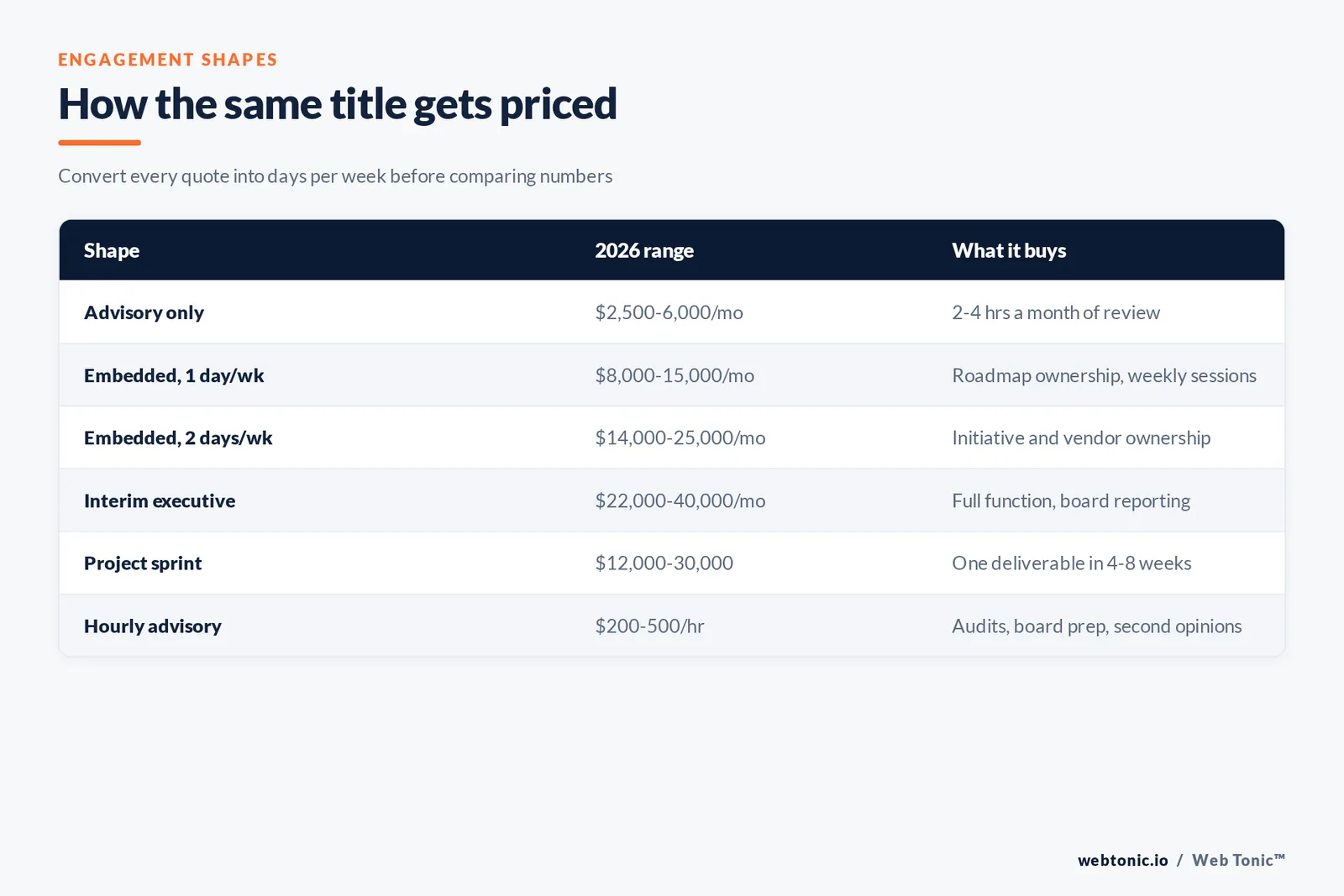
The four shapes a SaaS quote arrives in
Price confusion in this market is mostly a units problem: two quotes that look far apart are often the same rate sold in different packaging. RankedCMO's 2026 pricing guide separates five structures — monthly retainer at $5,000–$25,000, hourly at $200–$500, project fees of $10,000–$50,000+ for a defined initiative such as a GTM launch, day rates of $1,500–$3,500 for workshops and audits, and cash-plus-equity hybrids used by early-stage startups. Before comparing anything, convert every quote to the same unit: dollars per week of senior attention.
Engagement shape matters more than title. Treetop Growth Strategy's May 2026 benchmark prices the same person very differently depending on structure: advisory-only (a monthly strategy call and async review) at $2,500–$6,000, one day a week embedded at $8,000–$15,000, two days a week with initiative ownership at $14,000–$25,000, and interim executive cover at three-plus days a week at $22,000–$40,000. A defined four-to-eight-week sprint — a GTM playbook, a pricing model, a pipeline audit — runs $12,000–$30,000 total.
| Engagement shape | 2026 range | What it actually buys |
|---|---|---|
| Advisory only | $2,500–$6,000 / mo | 2–4 hours a month of review; a capable team still runs the work |
| Embedded, 1 day/week | $8,000–$15,000 / mo | Roadmap ownership, weekly sessions, light team direction |
| Embedded, 2 days/week | $14,000–$25,000 / mo | Initiative ownership, vendor management, quarterly reviews |
| Interim executive | $22,000–$40,000 / mo | Full functional ownership, team management, board reporting |
| Project sprint | $12,000–$30,000 total | One named deliverable in 4–8 weeks, no ongoing cover |
| Hourly advisory | $200–$500 / hr | Audits, board prep, short bursts of senior judgement |
What SaaS stage does to the number
Stage is a proxy for two things a pricing conversation really turns on: how much of the marketing function already exists, and how much of the next twelve months depends on getting the motion right rather than running it harder. A seed company buying $5,000 a month is usually buying decisions — positioning, channel choice, the first two hires. A Series B company at $18,000 a month is usually buying cover for a seat it has not filled, which is why those engagements are described as interim more often than fractional.
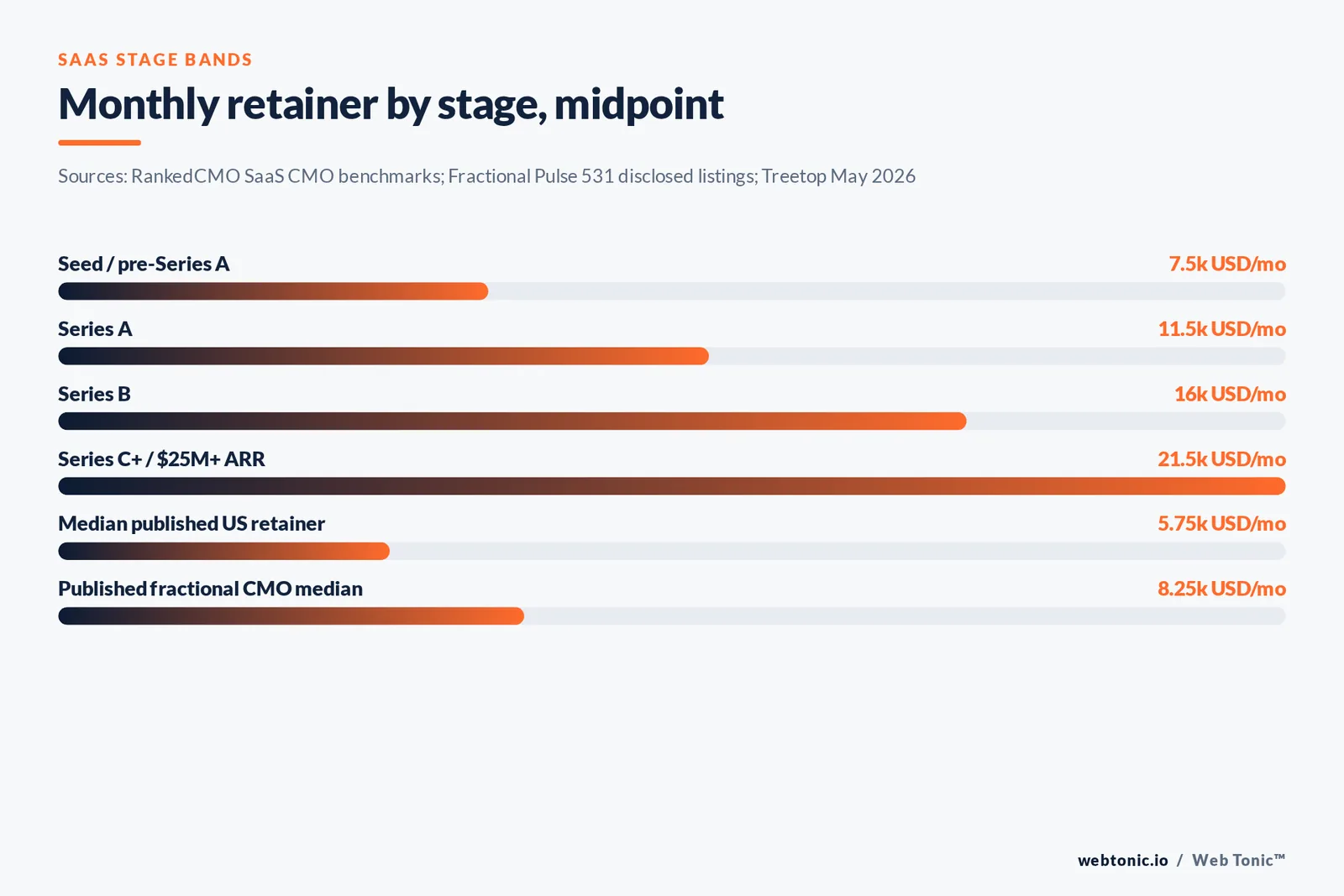
SaaS is one of the few categories with clean stage-by-stage data, because compensation for the full-time alternative is well documented. RankedCMO's SaaS CMO benchmarks put full-time total comp at $220K–$300K at seed, $300K–$425K at Series A, $400K–$550K at Series B and $500K–$650K+ later, with fractional retainers of $5K–$10K, $8K–$15K, $12K–$20K and $18K–$25K+ against those same stages. Most SaaS companies in that dataset buy fractional between seed and Series B, then convert to full-time between Series B and Series C.
ARR bands tell the same story from the seller's side. Fractional Pulse's cost guide, built from 1,049 qualified listings across 652 companies with 531 disclosing pay, bands fractional CMOs at $4,000–$8,000 a month under $2M ARR (15–20 hours), $8,000–$15,000 between $2M and $10M (20–30 hours), and $12,000–$20,000 above $10M (25–35 hours). Treetop's mid-market medians land in the same place: $10,000 a month at $3M–$10M ARR, $15,000 at $10M–$25M, $22,000 at $25M–$50M.
| SaaS stage | Fractional retainer | Full-time total comp | Usual time commitment |
|---|---|---|---|
| Seed / pre-Series A | $5K–$10K / mo | $220K–$300K | 15–20 hrs / mo to 1 day / week |
| Series A ($1M–$5M ARR) | $8K–$15K / mo | $300K–$425K | 1 day / week |
| Series B ($5M–$20M ARR) | $12K–$20K / mo | $400K–$550K | 1–2 days / week |
| Series C+ / $25M+ ARR | $18K–$25K+ / mo | $500K–$650K+ | 2–3 days / week, often interim |
Published prices are not quoted prices
Anyone budgeting from public pages will underestimate. The Fractional Rates Index (v2.1.1, September 2026, 1,774 providers tracked) finds a median published US monthly retainer of $5,750, with the middle half between $3,000 and $10,000, and a median published rate of $172 an hour across all regions and models. The critical caveat is in the same dataset: only 10.7% of provider sites publish a price at all, and the published fractional CMO group median is $8,250 a month from just 26 providers. Public numbers skew toward the operators who compete on transparency and lighter scopes.
Region moves the number as hard as stage. O-CMO's 2026 pricing report puts US retainers at $8,000–$22,000 a month against €3,000–€7,000 in Europe, with US hourly at $200–$250 for operators with 10–15 years and $300–$500 for 20-plus years with vertical depth. One independent 2026 rate benchmark notes that platform-matched advisors quote lower on paper because the platform takes 20–40%, so an apparently cheap hourly rate can hide a thinner operator.
What the retainer does not include
The most expensive misunderstanding in SaaS is buying leadership and expecting delivery. One 2026 cost breakdown is blunt about the tiering: a strategy-only fractional CMO at $10K–$25K a month sets direction, prepares board material and selects vendors, but execution still falls to an in-house generalist or a separate agency — while a full-time CMO at $400K–$550K loaded owns the function without logging into the ad account either. Budget the execution layer as a separate line, or the strategy sits on a shelf.
A 2026 SaaS-specific pricing guide reads the two ends of the range as signals rather than bargains: below $5,000 a month usually means a junior practitioner carrying three to six clients or a scope too narrow to move the business, and above $20,000 is reserved for multi-product late-stage SaaS or operators bringing board-advisory weight. Its middle band — $7,500–$15,000 for eight to fifteen years of experience and three to five clients — is where the market clears, and it puts savings against a $275K–$500K full-time package at 60–75%.
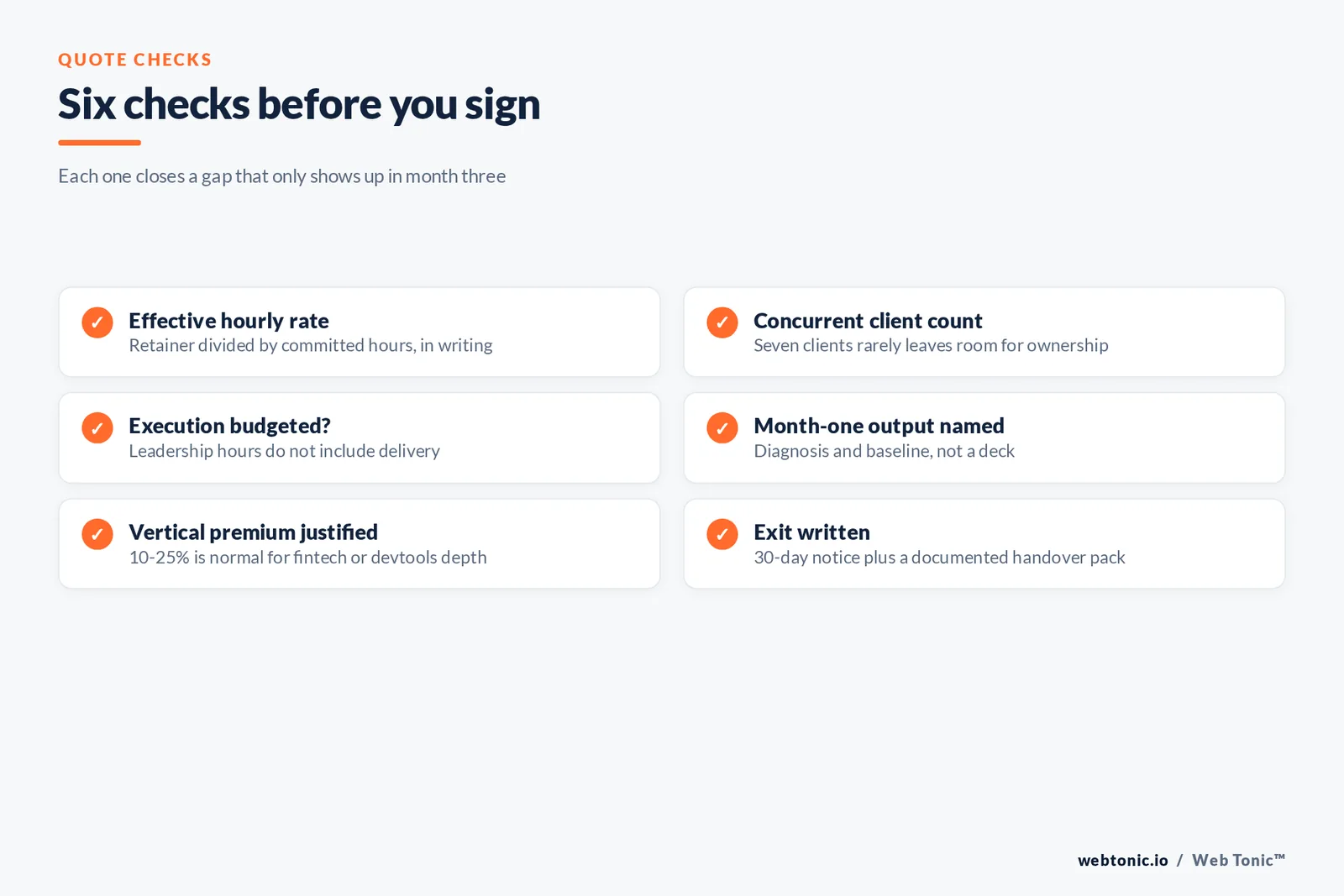
How to sanity-check the quote you have
Four checks separate a defensible quote from an expensive guess. First, divide the retainer by committed hours: if the effective rate lands far below $200 an hour for a senior operator, ask who is really doing the work. Second, ask how many concurrent clients they carry — market fee data shows senior growth consultants billing $150–$500 an hour with an average near $325, and the arithmetic of eight clients at that rate rarely leaves room for real ownership. Third, confirm what happens in month one: a diagnosis, a baseline and a named plan, or a slide deck. Fourth, price the alternative honestly — Series A budget guidance flags a $200K+ hiring mistake as the risk fractional cover is meant to remove.
Two practical guardrails. Vertical premiums are real — Treetop measures 10–25% for fintech, healthtech or devtools depth — and paying them is usually cheaper than funding a generalist's learning curve in a technical category. And keep a written exit: a 30-day notice clause plus a documented handover turns a retainer into a reversible decision. If you want the scope decision framed before you shop, our fractional CMO advisory page sets out what a leadership mandate covers, and our growth marketing services cover the execution layer that sits underneath it. We publish the market ranges we can verify and never invent a benchmark to justify a scope.
Five variables that move a SaaS quote
The spread between $5,000 and $25,000 is not arbitrary, and almost all of it is explained by five inputs a buyer controls. Days per week is the dominant one: Treetop's tiers show the same operator moving from $8,000 to $25,000 a month purely on commitment. Mandate is second — direction-setting versus owning a number changes the risk the operator carries, and priced work at $20,000+ a month normally includes profit-and-loss responsibility and board reporting rather than advice.
Motion complexity is the SaaS-specific one. A product-led company with self-serve onboarding, a sales-assisted trial and an enterprise tier is three go-to-market motions in one account, and pricing follows. Team maturity cuts both ways: with two or three marketers already in seat, one day a week of direction can be enough, while an empty function pushes you toward embedded or interim cover. Specialisation closes the list — Fractional Pulse notes that fundraising-and-metrics specialists charge 20–40% more than generalists because they shorten time to outcome, and Treetop measures vertical premiums of 10–25% in fintech, healthtech and devtools.
Two of these five are free to change. Narrowing the mandate to the two decisions that actually block growth, and putting an existing marketer in charge of delivery, together move most quotes a full tier without losing the senior judgement you are buying.
Contract terms that protect the spend
Price is only half the deal. Fix the hours in writing — a retainer expressed as "approximately one day a week" with no floor is the most common source of disputes in the second quarter of an engagement. Fix the concurrent-client ceiling too, because the difference between an operator carrying three clients and one carrying seven is entirely invisible in the quote and entirely visible in month three.
Then write down three dates. A 30-day diagnosis with a baseline you keep. A 90-day scope review where either side can resize or exit. A named handover pack — dashboards, documented processes, vendor contacts, admin access — due at the end of the engagement rather than promised verbally. Series A planning guidance is explicit that long agency-style lock-ins of six to twelve months are the wrong commitment at this stage; the same logic applies to leadership retainers. Our data and measurement work exists so the baseline in that first month is something a CFO can audit, not a screenshot.

Frequently Asked Questions
What is a realistic monthly budget for a Series A SaaS company?
Plan for $8,000–$15,000 a month for roughly one day a week of embedded leadership, which is where both RankedCMO's stage bands and Fractional Pulse's $2M–$10M ARR band land. Add an execution budget separately.
Is hourly or retainer better value?
Retainer buys continuity; hourly at $200–$500 buys judgement in bursts. Hourly suits audits, board prep and vendor selection at 5–15 hours a month. Anything requiring ownership of a roadmap belongs on a retainer.
Why do two quotes for the same title differ by 3x?
Because time commitment and mandate differ. Advisory-only at $2,500–$6,000 and interim ownership at $22,000–$40,000 are both sold as fractional CMO work. Normalise by days per week and by what the person is accountable for.
When does a full-time SaaS CMO become the cheaper option?
When you genuinely need 30+ hours a week of executive attention, or marketing is the primary growth lever at scale. Below that, $325K–$650K of loaded comp buys availability you will not use.
How long should a SaaS engagement run?
Most run 6–12 months: one quarter to diagnose and decide, two or three to operate and prove. Reviewing scope every 90 days prevents a retainer becoming permanent overhead. Read more in our marketing resources or talk to our team.
Sources
Fractional CMO cost 2026 pricing data · SaaS CMO role and cost benchmarks · 2026 fractional CMO and CRO pricing benchmark · Fractional executive cost guide, rates by role · Fractional Rates Index v2.1.1 · Fractional CMO pricing and hiring report 2026 · Fractional CMO cost for SaaS 2026 · Fractional CMO cost, B2B SaaS pricing guide · Fractional CMO rates benchmark data · Growth consultant cost benchmarks · Series A marketing strategy guide.