Table of contents

A good first quarter on an investor-ready growth plan ends with numbers an outside analyst can reproduce, not a deck. The sequence below is what that looks like, week by week, and what must exist before each gate closes.
Key Takeaways
- Realistic core preparation takes 60 to 90 days: positioning clarified, dashboard built, channels documented, website evidence upgraded.
- Days 1–20 are for access and reconstruction, not narrative. Billing, ad platforms, analytics and CRM exports first; the story last.
- Days 21–45 rebuild unit economics the way diligence will: fully-loaded CAC, CAC by channel, cohort retention and gross-margin-adjusted payback under 12–18 months for SaaS.
- Days 46–70 assemble the data room — a Series A pack runs 80–150 documents — and close the concentration gap if one channel carries over 60–70% of revenue.
- Days 71–90 are rehearsal: 47 recurring diligence questions, answered with verifiable evidence in 10 minutes each, with fewer than 10 unprepared answers as the go/no-go bar.
- Preparedness is priced. Companies that arrive ready reportedly raise at 20–40% higher valuations, and confirmatory diligence runs 3–6 weeks once a term sheet lands.
- The most common failure is optimistic math discovered by someone else — gross instead of net CAC, or LTV extrapolated from a cohort only three months old.
Why the quarter runs in this order
The order is set by what diligence does, not by what a plan looks like. Marketing diligence starts after a fund is interested and before a term sheet, and its five questions are fixed: does the data match the deck, are the unit economics real, is growth diversified or fragile, is retention durable cohort by cohort, and is the attribution credible. A quarter that starts with narrative and ends with data fails at the first question. A quarter that starts with raw exports can only get stronger.
It is also a finite exercise, which is the good news. One published diligence question set counts 47 recurring questions across seven categories and notes that the difference between a two-week and a six-week diligence is rarely business quality — it is how fast questions convert into verifiable answers. That reframes the 90 days: you are not writing a document, you are reducing the time it takes to prove each claim.
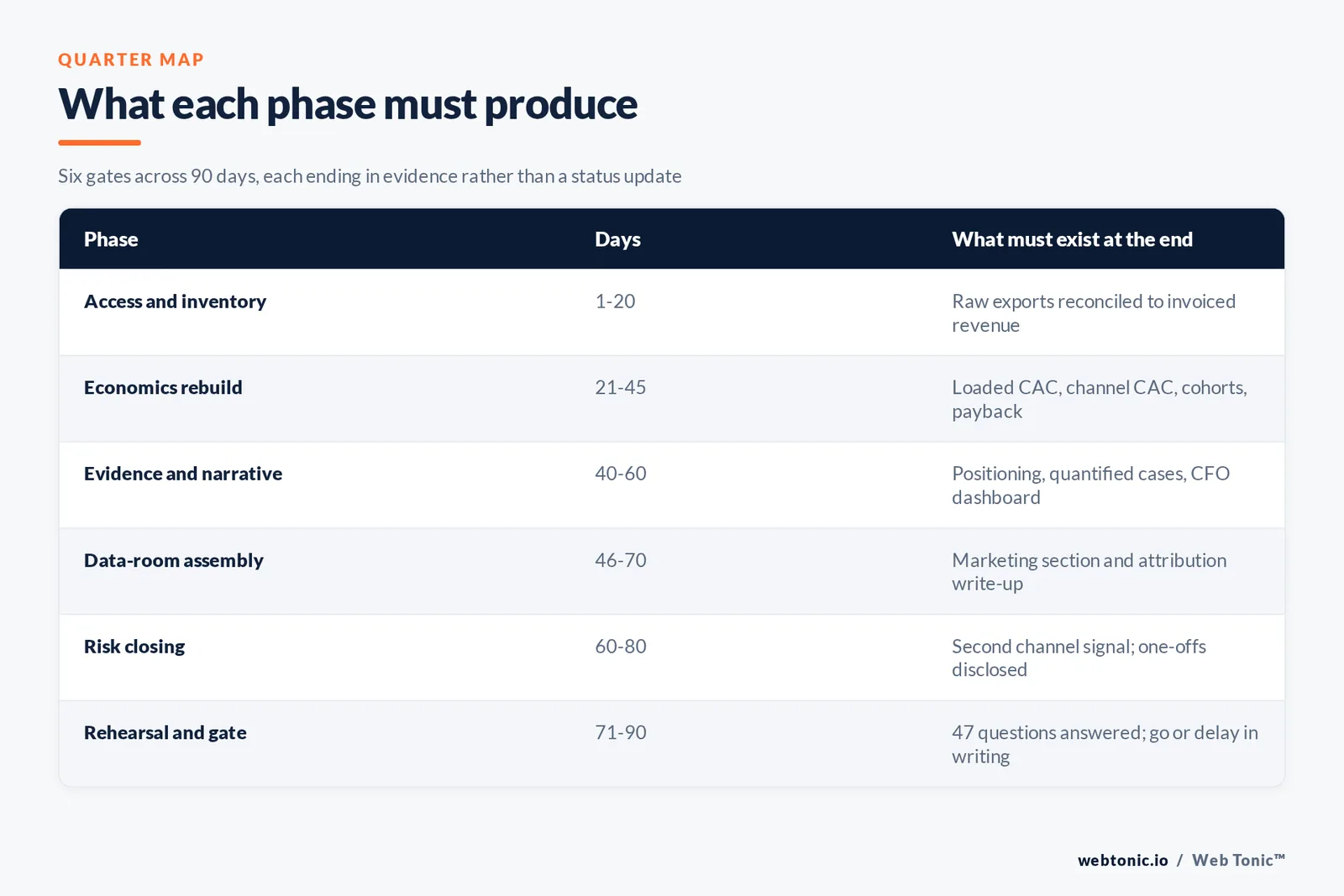
| Phase | Days | What must exist at the end |
|---|---|---|
| Access and inventory | 1–20 | Raw exports from billing, ad platforms, analytics and CRM, reconciled to revenue |
| Unit-economics rebuild | 21–45 | Fully-loaded CAC, CAC by channel, cohort retention, payback on gross margin |
| Evidence and narrative | 40–60 | Positioning, quantified case studies, dashboard a CFO can read |
| Data-room assembly | 46–70 | Marketing section complete, attribution write-up with blind spots named |
| Risk closing | 60–80 | Second channel showing signal; one-off campaigns disclosed |
| Rehearsal and gate | 71–90 | 47 questions answered in 10 minutes each; go or delay, in writing |
Days 1–20: access before analysis
The first three weeks are administrative and non-negotiable. Collect read-only access or full exports for the same period your deck claims: billing, every ad platform, product and web analytics, and the CRM. Stackmatix's list of marketing data-room artefacts is the working checklist — channel-by-channel spend and output for the trailing 12–24 months, cohort retention tables by signup month, a CRM export showing pipeline source, win rate and sales-cycle length by channel, and a list of any paused, discontinued or one-time campaigns that boosted a historical period.
Two rules save weeks later. Reconcile to billing, not to dashboards: if platform-reported conversions and invoiced revenue disagree, that gap is the first finding and it is better found by you. And write down what is missing rather than estimating around it. CFO-side readiness guidance defines readiness as the state of surviving 60–90 days of scrutiny without surprises, on the back of a monthly close by day 10 and a data room of 80–150 documents — surprises are the thing being engineered out.
Days 21–45: rebuild the economics the way they will be rebuilt
This is the core of the quarter. Diligence teams recalculate CAC three ways and compare, so build all three yourself: fully loaded (sales and marketing spend including salaries, tools and agency fees, divided by new customers), split by channel (paid, organic, referral, sales-assisted), and marginal — what the next customer costs at current scale, rather than the historical average that a bigger spend plan would inherit. Compute payback on gross margin, not revenue, and derive LTV from observed retention curves instead of an assumed churn rate.
Then check yourself against the standards. Investor expectation benchmarks put Series A SaaS CAC payback at 12–18 months, treat 3:1 LTV:CAC as the baseline (below 2:1 is hard to defend, above 5:1 raises underinvestment questions), and read 90% of leads from one channel as fragility even when it is efficient. Where you miss a benchmark, write the explanation now — a known, explained miss is survivable; a discovered one is not.
Days 40–70: evidence, narrative and the data room
Only once the numbers hold does the outward-facing work earn its place. One Series A readiness view is direct about the sequence — investors Google the company before they read the deck, and what they see in 30 seconds carries weight against months of projections. It sets three concrete standards: a homepage communicating positioning in under 10 seconds without jargon, quantified case studies ("reduced CAC by 30% in four months" rather than "helped X grow"), and 8 to 12 long-form articles showing marketing is piloted rather than randomly outsourced. It also names the operational test: marketing and sales aligned on shared quarterly objectives and one attribution model.
Data-room assembly runs in parallel. The marketing section needs the CAC and LTV calculation with formula and source data shown, not just outputs; analytics access so the funnel can be rebuilt independently; and an attribution methodology write-up that states the model, the reason for it, and its known blind spots. Disclosing blind spots reads as competence. Leaving them to be found reads as either sloppiness or spin, and diligence teams treat both the same way.
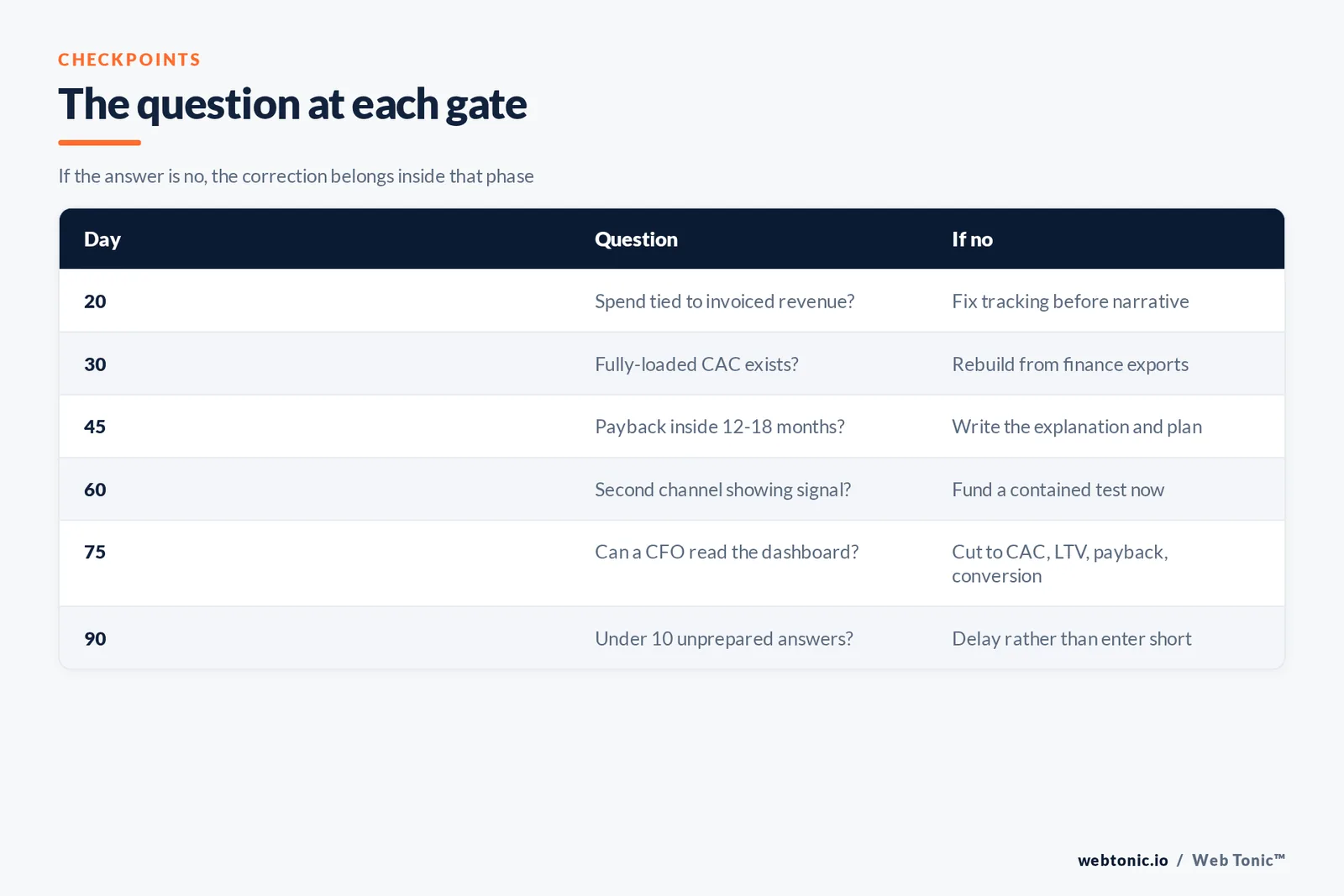
| Checkpoint | The question | If the answer is no |
|---|---|---|
| Day 20 | Can every channel's spend be tied to invoiced revenue? | Stop building narrative; fix tracking and tagging first |
| Day 30 | Does fully-loaded CAC exist with salaries and tools included? | Rebuild from finance exports, not platform reports |
| Day 45 | Is payback gross-margin-adjusted and inside 12–18 months? | Write the explanation and the plan to move it |
| Day 60 | Is there a second channel with real signal? | Fund a contained test now, not during diligence |
| Day 75 | Can a CFO read the dashboard unaided? | Simplify to CAC, LTV, payback and conversion by stage |
| Day 90 | Fewer than 10 unprepared answers across 47 questions? | Delay the process rather than enter it short |
Days 71–90: rehearse, then decide
The last three weeks are a dress rehearsal with a written outcome. Run the 47 questions with the founder and whoever owns marketing, score each as answerable with evidence in 10 minutes, answerable with preparation, or needing a week — the second and third buckets are your remaining work list. Do the same on the model: 2026 Series A evaluation guidance describes the central test as whether growth is repeatable and capital-efficient enough that more money accelerates it, and names the artefacts that answer it — CRM pipeline reports, funnel conversion history, and ramp data for early sales hires.
Then make the call explicitly. Go, with a named owner keeping the pack current, or delay a quarter and close the two biggest gaps. Timing is not a soft variable: readiness guidance reports 20–40% higher valuations for prepared companies, first meeting to term sheet in 6–12 weeks when it goes well, and 3–6 weeks of confirmatory diligence after. Entering a process with a plan you cannot defend spends the scarcest asset in a raise, which is the partner's confidence.
Six ways the quarter gets wasted
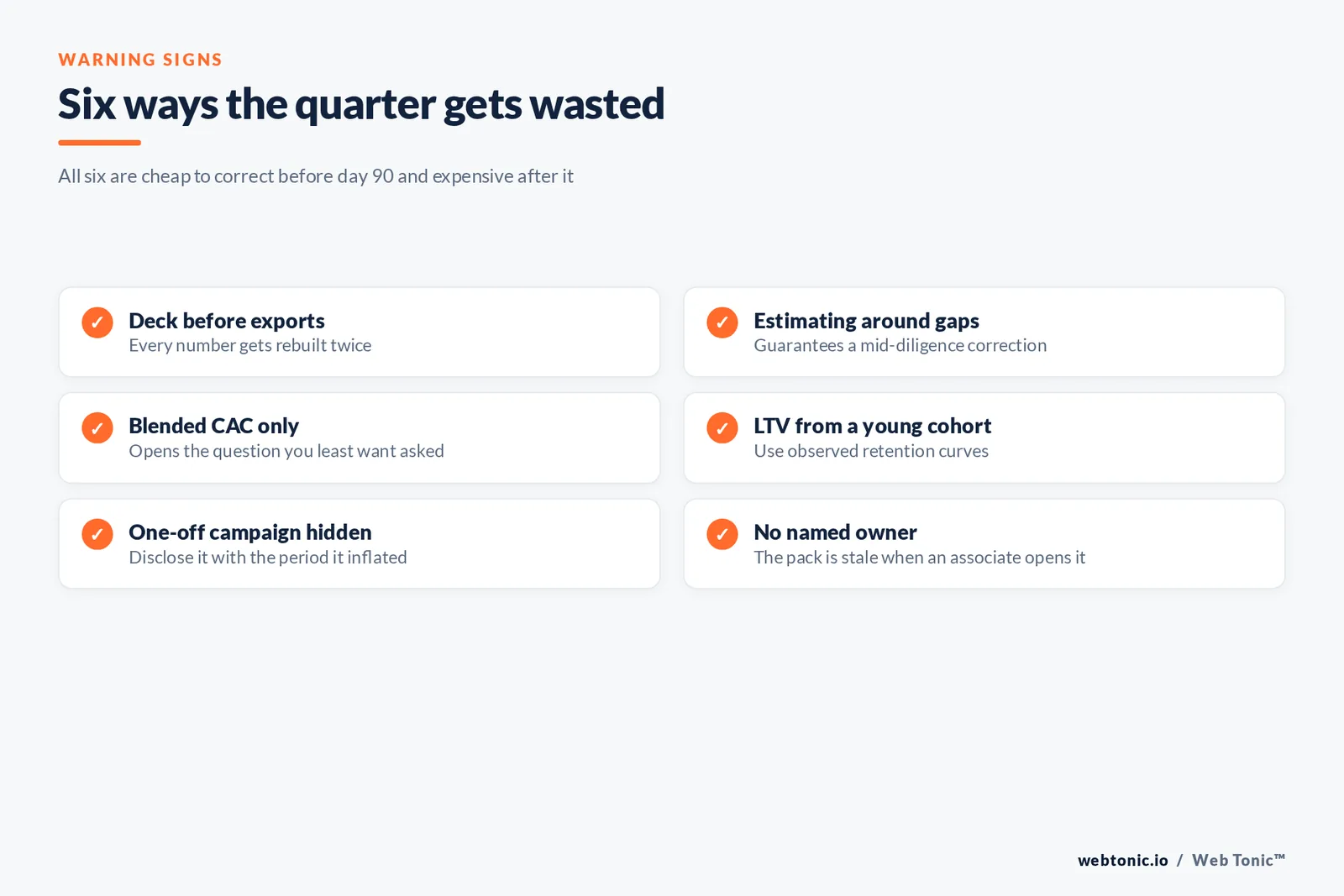
Most failures are recognisable early. Starting with the deck instead of the exports, so every number has to be rebuilt twice. Estimating around missing tracking rather than repairing it, which guarantees a mid-diligence correction. Presenting blended CAC only, which invites the one question you least want opened. Extrapolating LTV from a young cohort. Hiding a one-time campaign that inflated a quarter. And leaving no owner, so the pack is three months stale by the time an associate opens it.
The correction in every case is the same discipline: build the artefact an outsider could reproduce, and disclose the weaknesses before they are found. That is how our growth advisory engagements are sequenced, with data intelligence doing the measurement repair in the first weeks and fractional CMO cover available when the plan also needs someone to run it after the raise. We do not invent a number to make a quarter look better — a plan is only worth what an analyst can verify.
What you keep after day 90
The quarter is worth doing even if the raise slips, because almost everything it produces is operating infrastructure rather than fundraising theatre. You keep a reconciled spend-to-revenue view, a CAC definition finance agrees with, cohort tables that show whether retention is improving or decaying, and a channel-level read of what the next customer costs. Those four artefacts are how budget decisions get made for the following year, with or without an investor in the room.
You also keep a documented plan. Investor plan requirements for 2026 are specific about what counts: naming the channels, what each costs and what you expect back — "paid search at a $90 blended CAC, plus a partner programme targeting 15 agencies in Q2" rather than "we will use social media and partnerships". Founder-side guidance names the mirror-image failure, the unrealistic growth trap: claiming very large year-over-year growth with no corresponding marketing spend, which reads as not understanding your own acquisition cost.
Hours, owners and the cost of the quarter
Plan the quarter as roughly 8 to 12 hours a week of senior attention, front-loaded. The first month is the heaviest because access-gathering and reconciliation cannot be parallelised much, and the last three weeks are light but must be protected for rehearsal. Bought externally, that shape is usually sold as a 4–8-week sprint or a two-to-three-month retainer; run internally, it is closer to half a senior person for the first month.
Whoever owns it needs three permissions in writing on day one: read access to billing and the ad accounts, the ability to ask finance for salary and tooling allocations, and the authority to publish a number the founder disagrees with. The last one matters most. Diligence checklist guidance for 2026 is clear that assumptions which ignore obvious costs are immediate red flags, and the only defence against that is an owner who is allowed to report the unflattering version internally, early, while it is still cheap to fix.
Governance: who signs off on each number
A plan that will face investors needs light governance from day one, or the last three weeks turn into an internal argument rather than a rehearsal. Name one signer per number: finance signs the spend and gross-margin inputs, the marketing owner signs channel attribution, and the founder signs the forward plan and the target for the next four quarters. Write the signers into the document itself so an analyst can see who stands behind each figure, and so nobody inside the company is surprised by a report they never reviewed.
Two habits make the governance real. Keep a single change log of every restated figure with the reason and the date, because a number that quietly moves between the deck and the data room is the fastest way to lose a partner's trust in the whole startup. And run a fortnightly 30-minute review with finance for the full quarter — a fundraising process is not the moment to discover that marketing and the financial model disagree about how a capital-efficiency claim was calculated. If you have a fractional CFO, this review is theirs to chair; if not, it belongs to the founder rather than to marketing.

Frequently Asked Questions
Can this be done in 30 days?
Partially. A 30-day version can rebuild CAC and assemble exports, but positioning, case-study evidence and a second-channel signal need the full 60–90 days that readiness guidance treats as realistic.
Who should own the work internally?
One person with authority over both marketing and finance data. Split ownership is the most common reason the pack never reconciles, because nobody can resolve a disagreement between platform numbers and invoiced revenue.
What if one channel drives almost all revenue?
Say so, and start a contained second-channel test before the process opens. Concentration above 60–70% of new revenue is a flagged risk, but a documented test in progress is a far better answer than silence.
How much of this is marketing versus finance?
The rebuild is joint. CAC needs finance-grade spend data including salaries and tools; retention needs product and billing data. Treating it as a marketing-only exercise is why so many packs use media spend alone.
What is the single best use of the last week?
Rehearsal. Answering the 10 hardest questions out loud, with evidence on screen, surfaces more problems than another week of editing. Read more in our resources or talk to our team.
Sources
Marketing due diligence: what VCs check before a term sheet · VC-backed startup marketing: investor expectations · The 47 questions Series A diligence asks · Investor readiness guide and benchmark table · Preparing marketing for a Series A · How investors evaluate Series A startups in 2026 · Startup due diligence document checklist 2026 · What makes a business plan investor-ready · Business plan requirements for investors 2026.