Table of contents
A mission statement is one or two sentences that say what your company does, for whom, and why it matters. This guide gives you a 7-step process, 3 fill-in formulas, and 14 real company mission statements to model.
Key Takeaways
- A usable mission statement runs 8-25 words: long enough to name the customer, short enough for a new hire to repeat.
- Mission answers what we do now; vision answers where we are going; values answer how we behave — three separate statements, one page.
- The 7-step process below moves from raw interviews to a final sentence in about 2 weeks for a small business.
- 14 company examples in this guide, from Microsoft and Nike to IKEA and Johnson & Johnson, show how differently the same job gets done.
- Gallup's engagement research links clarity of purpose to measurable business outcomes, which is why the statement belongs in onboarding, not on a wall.
What a business mission statement is, and what it is for
Definition: a mission statement is a short declaration of an organization's core purpose — the customers it serves, the products or services it provides, and the change it intends to create. It describes the present, not an aspiration, and it exists to help employees, customers and partners make consistent decisions without asking permission.
The statement has three audiences and each one uses it differently. Your team uses it to prioritise. Your customers use it to decide whether you are for them. Your investors and partners use it to judge whether your strategy is coherent. A mission statement that reads well to only one of those three is not finished.
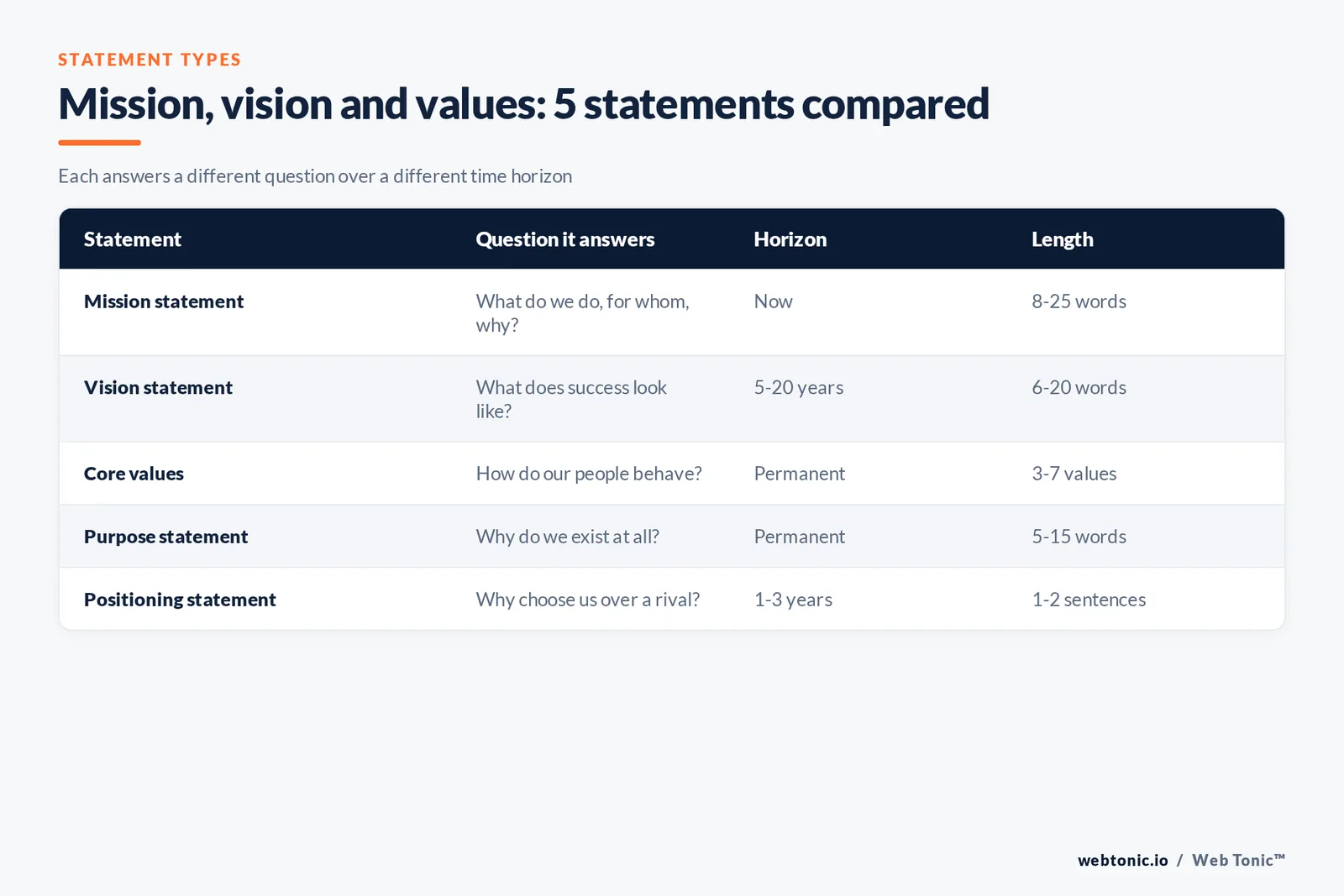
| Statement | Question it answers | Time horizon | Typical length |
|---|---|---|---|
| Mission statement | What do we do, for whom, and why? | Now | 8-25 words |
| Vision statement | What does the world look like if we succeed? | 5-20 years | 6-20 words |
| Core values | How will our people behave under pressure? | Permanent | 3-7 named values |
| Purpose statement | Why does this organization exist at all? | Permanent | 5-15 words |
| Positioning statement | Why should this buyer choose us over that rival? | 1-3 years | 1-2 sentences |
| Tagline | What do we want remembered? | Campaign length | 2-6 words |
Rule 1 — if you can swap your company name for a competitor's and the sentence still reads true, you have written a category description, not a mission statement.
Mission statement vs vision statement: the practical difference
The confusion is almost always about tense. Mission is present tense and operational; vision is future tense and directional. Written as a pair, they stop contradicting each other.
| Company | Mission-style statement (what they do) | Vision-style statement (where it leads) |
|---|---|---|
| Software company | We give small clinics scheduling software their front desk can run without training | A world where no patient waits on hold |
| Local trades business | We keep family homes dry with roofing work done right the first time | The most trusted roofer in our county |
| Retail brand | We make everyday kitchen tools that outlast their warranty | Households that buy a pan once |
| Non-profit | We teach adult literacy free of charge in three city districts | A city where every adult can read to their child |
| Agency | We grow ambitious brands with marketing that can be measured | Marketing decisions made on evidence, not opinion |
Fact 1 — most organizations write 3 documents and use 1. The mission statement earns its keep only when it appears in hiring, onboarding, and the first slide of a strategy review.
How to write a mission statement in 7 steps
This is the working process. Budget 2 weeks for a small business and 4-6 weeks if you need buy-in from a board.
| Step | What you do | Output | Time |
|---|---|---|---|
| 1. Interview the team | Ask 5-10 employees and 5 customers why the company matters to them | Raw language in their words | 3-4 days |
| 2. Name the customer precisely | Replace "businesses" or "people" with a real segment | One named audience | 1 hour |
| 3. Name what you actually provide | List the products and services a customer pays for today | A concrete offer, no jargon | 1 hour |
| 4. Name the change you create | Finish the sentence "because of us, our customers can..." | The outcome, not the activity | 1 hour |
| 5. Draft 10 versions | Use the formulas below; never stop at one draft | 10 candidate statements | Half a day |
| 6. Test on real people | Read each aloud to a new hire and a customer | 2-3 survivors | 2-3 days |
| 7. Ratify and deploy | Approve one, then put it in onboarding, the careers page and the about page | A statement in use | 1 week |
Limit 1: one sentence. If step 5 keeps producing two sentences, the second sentence is usually your vision statement trying to escape. Trap 1 — writing the statement alone in a founder's notebook guarantees the team will never repeat it; step 1 is not optional.

3 mission statement formulas you can fill in
Formulas are scaffolding. Write with them, then delete the seams so the final sentence sounds like a person.
| Formula | Template | Filled-in example | Best for |
|---|---|---|---|
| Formula 1 — customer-first | We help [customer] to [outcome] by [what you provide]. | We help independent retailers sell online by building stores they can update themselves. | Service businesses and agencies |
| Formula 2 — purpose-first | To [verb] [what] for [whom], so that [change]. | To make legal advice affordable for new founders, so that a bad contract never ends a good company. | Mission-driven and non-profit organizations |
| Formula 3 — product-first | We make [product] that [distinctive quality] for [customer]. | We make weatherproof work boots that survive a full season for outdoor crews. | Product companies and manufacturers |
Fact 2 — all 3 formulas force the same three inputs: a customer, an offer, and a consequence. Any statement missing one of the three reads as marketing filler.
14 company mission statement examples, and what each one does well
Wording drifts over time, so treat these as illustrations of technique rather than fixed quotations — the current text always lives on each company's own about page.
| Company | Technique on display | What you can copy |
|---|---|---|
| A single verb applied to a vast scope: organize the world's information | One verb, one object, no adjectives | |
| Microsoft | Empowerment framing — every person and organization to achieve more | Name the customer's achievement, not your product |
| Nike | An inclusive definition of who counts as an athlete | Define your audience generously |
| Amazon | Customer obsession stated as a standard, not a slogan | Make one principle testable |
| IKEA | Everyday life at home, better, for the many | Bound your ambition to a domain |
| Johnson & Johnson | A one-page Credo that ranks stakeholders in order | State priorities when they conflict |
| Netflix | Entertainment framed as connection, plus an explicit culture document | Pair the statement with behaviours |
| Walmart | Saving money to live better — the benefit is the mission | Lead with the customer's gain |
| Nordstrom | Service as the whole promise | Pick the one thing you will be known for |
| American Express | Backing customers, stated as a relationship | Use the verb your customers would use |
| The Walt Disney Company | Storytelling as the product and the purpose | Name your craft explicitly |
| Patagonia | A commercial mission fused with an environmental one | Only fuse causes you will fund |
| B Corp certified companies | Purpose written into the legal charter | Make the commitment structural |
| Local independent business | Named town, named trade, named standard | Specificity beats scale every time |
Read the primary sources rather than a round-up: Google's company information page, Microsoft's about page, Nike's corporate site, Amazon's about us page, IKEA's this-is-IKEA page, the Johnson & Johnson Credo, Netflix's about page, Walmart's purpose page. The Walt Disney Company's about page.
Mission statements by business type and stage
A startup and a 40-year-old manufacturer need different statements, because the mission has to survive contact with a different reality.
| Business type | Emphasis | Common failure | Length to aim for |
|---|---|---|---|
| Startup, pre-product-market fit | The problem you refuse to leave alone | Describing a product you may pivot away from | 8-15 words |
| Small local business | Trade, territory and standard of work | Borrowing corporate language that fits nobody | 10-20 words |
| Ecommerce brand | Who the products are for and what they replace | Confusing the tagline with the mission | 10-20 words |
| Professional services firm | The client outcome and the standard of judgement | Listing services instead of stating purpose | 15-25 words |
| Non-profit | Beneficiary, activity and geography | Language too abstract for a grant application | 15-30 words |
| Scaling company, 50+ employees | Decision-making guidance for teams you cannot supervise | A statement nobody can recall in a meeting | 10-20 words |
| Family business in succession | Continuity of standards across generations | Freezing the mission around a founder's biography | 15-25 words |
If you are writing this as part of a business plan, the SBA's business plan guidance puts the mission in the company description section, and the US Chamber of Commerce strategy library is a practical companion for small firms. Registered non-profits should also check how their stated purpose reads against IRS charitable organization requirements, since the language in your charter is not decoration.
A 12-point test for your draft mission statement
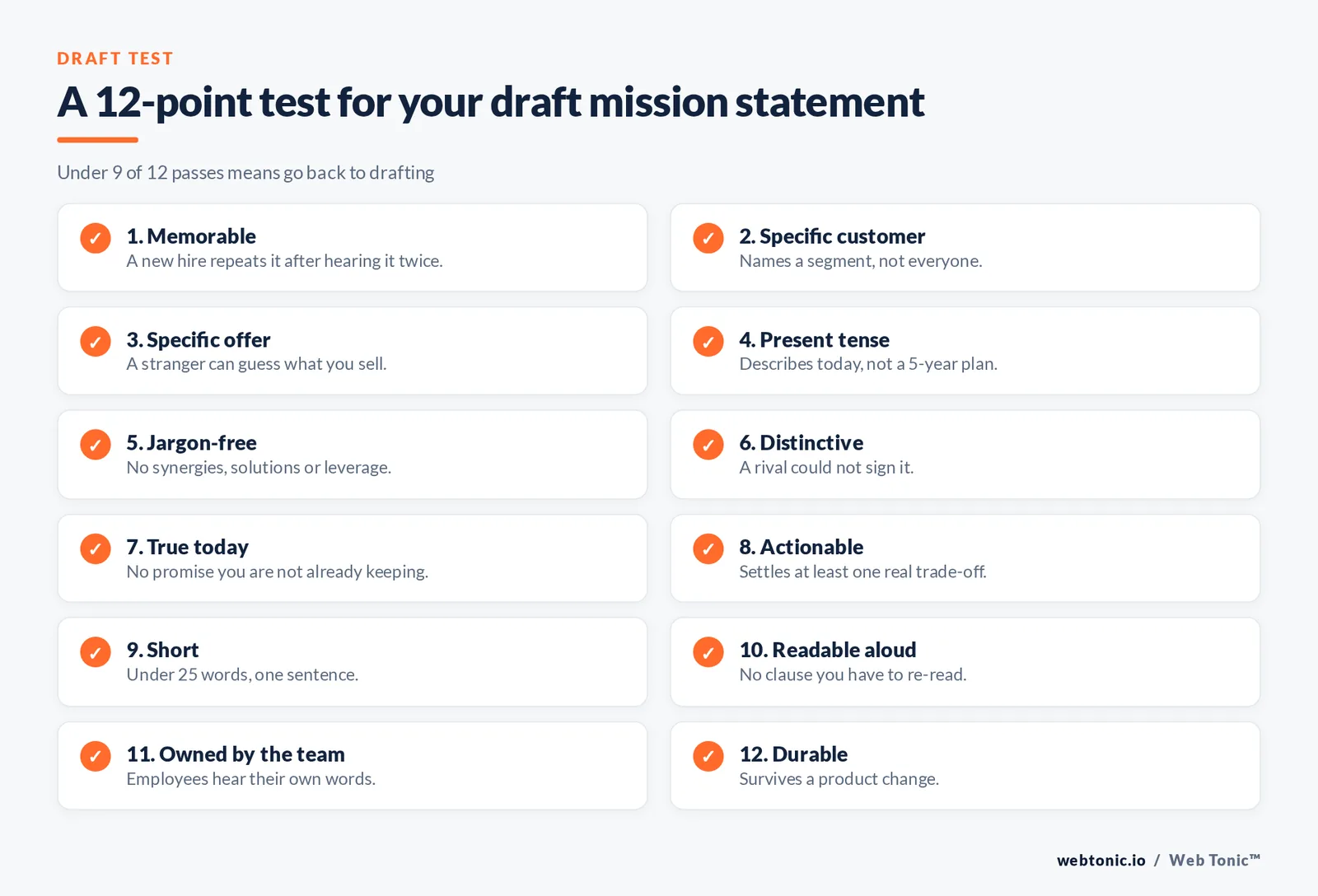
Score your best draft. Under 9 of 12 means go back to step 5.
| Test | Pass condition |
|---|---|
| 1. Memorable | A new hire repeats it after hearing it twice |
| 2. Specific customer | Names a segment, not "everyone" |
| 3. Specific offer | A stranger can guess what you sell |
| 4. Present tense | Describes today, not a five-year plan |
| 5. Jargon-free | No "synergies", "solutions" or "leverage" |
| 6. Distinctive | A rival could not sign it |
| 7. True today | No promise you are not already keeping |
| 8. Actionable | Settles at least one real trade-off |
| 9. Short | Under 25 words, one sentence |
| 10. Readable aloud | No clause you have to re-read |
| 11. Owned by the team | Employees recognise their own words in it |
| 12. Durable | Survives a product change |
Mission statement mistakes that make employees roll their eyes
| Mistake | What it sounds like | Fix |
|---|---|---|
| 1. Jargon stacking | "Delivering world-class synergistic solutions" | Replace every abstract noun with a verb |
| 2. Mission as vision | "To become the global leader in..." | Move it to the vision statement |
| 3. Values smuggled in | A 60-word sentence listing 5 values | Publish values separately |
| 4. Internal metrics | "To grow revenue 30% annually" | That is a goal, not a purpose |
| 5. Everyone as customer | "For businesses and people everywhere" | Name one segment |
| 6. Copying a famous brand | A Nike sentence on a plumbing website | Use your own team's language from step 1 |
| 7. Never used again | A framed poster in reception | Put it in onboarding and reviews |
| 8. Rewritten every year | A new mission per marketing hire | Revisit on a 3-year cycle |
Fact 3 — Gallup's long-running workplace research ties engagement to business outcomes, and clarity about what the organization is trying to do is one of the conditions it measures — a mission nobody can quote cannot contribute to it.
Where the mission statement actually gets used
| Placement | Why it belongs there | Format |
|---|---|---|
| About page on your website | First stop for buyers checking legitimacy | Statement plus 2 proof points |
| Careers page and job ads | Filters applicants before you interview | Statement plus what it means day to day |
| Onboarding, week 1 | The only reliable way it gets learned | Discussed, not read out |
| Strategy and planning decks | Tests whether the plan fits the purpose | Slide 1, unchanged each quarter |
| Sales and pitch documents | Explains why you take some projects and not others | One line in the introduction |
| Performance reviews | Connects individual work to company purpose | One reflective question |
| Investor and grant material | Shows strategic coherence | Mission, then traction |
Getting the statement onto the site properly is a content job as much as a design one — our web development team handles about and careers pages for brand launches, our growth marketing service turns the positioning into campaigns, and a short conversation is the fastest way to see what belongs where. Related reading sits on the Web Tonic blog, including our guide to choosing a business name.

FAQ
What is a mission statement in simple terms?
It is one sentence that says what your business does, who it does it for, and what changes as a result. "We help independent retailers sell online by building stores they can update themselves" is a complete mission statement: customer, offer, outcome.
How long should a mission statement be?
Aim for 8-25 words in a single sentence. The practical test is whether an employee can repeat it accurately after hearing it twice; anything longer than about 25 words rarely survives that test.
What is the difference between a mission statement and a vision statement?
The mission statement describes what the organization does now and for whom. The vision statement describes the future state it is working toward. Mission is present tense and operational; vision is future tense and directional.
Can I write a mission statement for a brand new business?
Yes, and it is easier than it looks: interview your first five customers, name the problem you refuse to leave alone, and keep the statement about the problem rather than the current product. That way a pivot in the product does not invalidate the mission.
How often should a company update its mission statement?
Revisit it roughly every three years, or when you change who you serve. Rewriting it annually signals that it was never used for decisions in the first place; leaving an inaccurate statement in place for a decade is the opposite failure.
Sources: Google company information; Microsoft about; Nike corporate; Amazon about us; IKEA this-is-IKEA; Johnson & Johnson Credo; Netflix about; Walmart purpose; The Walt Disney Company about; US Small Business Administration business plan guidance; US Chamber of Commerce strategy library; IRS charitable organizations; Gallup workplace research. All sources verified live at publication.