Table of contents
A strong introduction does three jobs in a few sentences: it earns attention, it gives the reader just enough context, and it states the thesis or main point clearly enough that the rest of the piece feels inevitable.
The structure below works for an essay, a research paper, a blog post or a pitch deck. Only the length and the tone change.
Key Takeaways
- An introduction has 4 jobs: hook the reader, establish context, narrow the topic, and state the thesis or main argument.
- Aim for roughly 5-10% of your total word count — one paragraph for a 5-page essay, two or three for a 15-page paper.
- 79% of web readers scan rather than read and only 16% read word by word, according to Nielsen Norman Group research, so online introductions must front-load the point.
- Concise writing tested 58% more usable and scannable writing 47% more usable in the same NN/g study — brevity is a measured effect, not a style preference.
- The thesis statement is usually a single sentence placed at the end of the first paragraph, and it must make a claim someone could dispute.
- Write the introduction last. You cannot introduce an argument you have not finished making, and most weak openings are first drafts that were never revisited.
- 7 reliable opening moves cover almost every piece of writing: the surprising fact, the question, the anecdote, the definition, the tension, the stakes and the direct answer.

What an introduction is actually for
An introduction is a bridge. The reader arrives carrying their own concerns and has to be carried into your topic without effort. The UNC Writing Center describes introductions and conclusions as the bridges that transport readers between their own lives and the world of your analysis — and notes that they are usually the hardest parts of a paper to write.
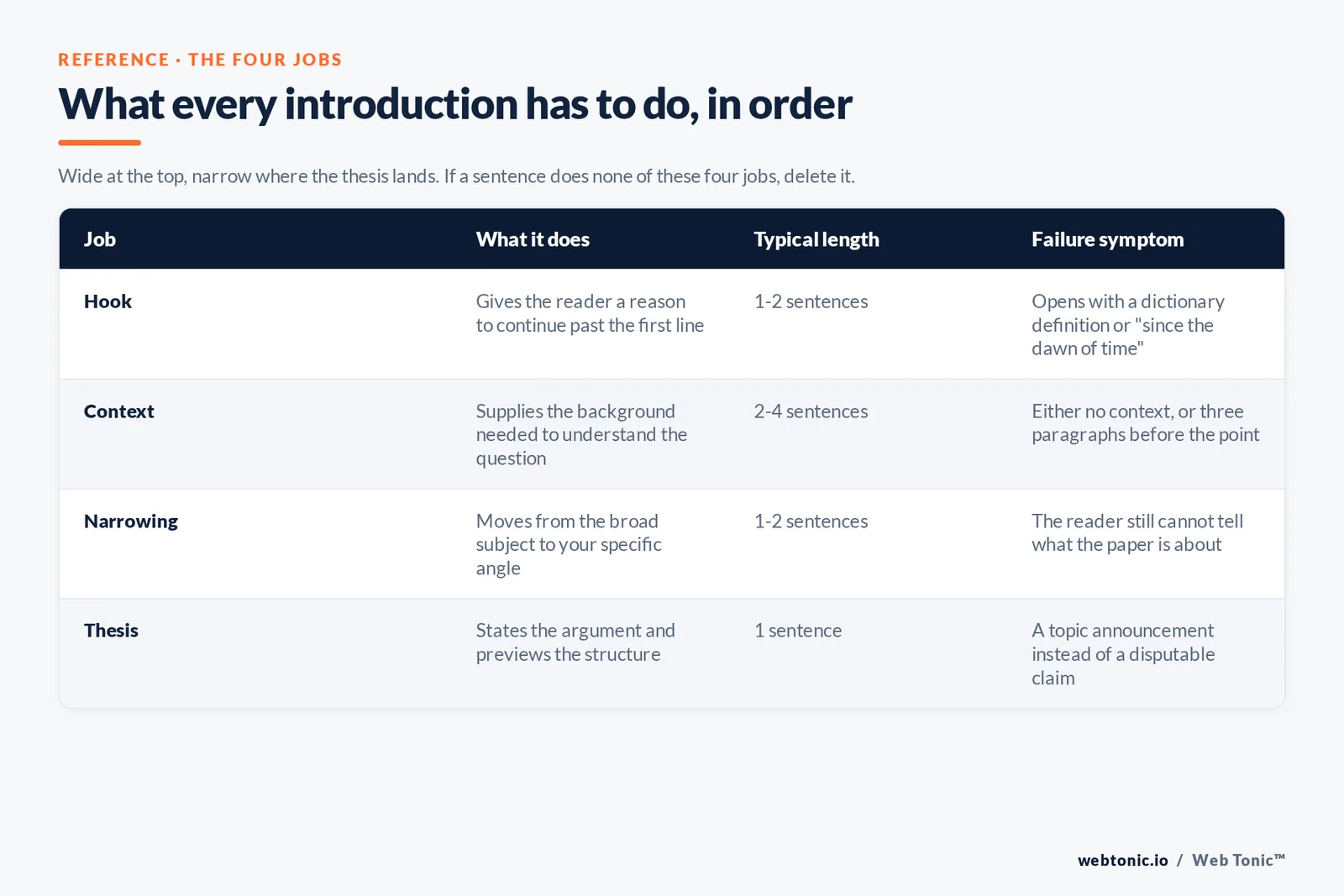
Every effective introduction, in any format, performs the same four functions in the same order.
| Job | What it does | Typical length | Failure symptom |
|---|---|---|---|
| Hook | Gives the reader a reason to continue past the first line | 1-2 sentences | Opens with a dictionary definition or "Since the dawn of time" |
| Context | Supplies the background needed to understand the question | 2-4 sentences | Either no context, or three paragraphs of it before the point |
| Narrowing | Moves from the broad subject to your specific angle | 1-2 sentences | The reader still cannot tell what the paper is about |
| Thesis or main point | States the argument and previews the structure | 1 sentence | A topic announcement instead of a claim |
That progression is often called the funnel: wide at the top, narrow at the point where the thesis statement lands. If you can delete a sentence from your introduction and lose none of those four jobs, delete it.
How long should an introduction be?
Length follows format and reader patience, not a fixed rule. A workable default is 5-10% of the finished word count, then adjusted for how quickly your reader needs the answer.
| Format | Introduction length | Where the main point goes |
|---|---|---|
| Short essay (750-1,500 words) | 1 paragraph, 50-120 words | Final sentence of the paragraph |
| Long essay or term paper (3,000-5,000 words) | 2-3 paragraphs, 200-400 words | End of the opening section, after context |
| Research paper or journal article | 400-800 words | After the literature gap, as aim or hypothesis |
| Blog post or article | 40-90 words, 2 short paragraphs | First or second sentence |
| Landing page or sales email | 1-3 sentences | Immediately, in the first clause |
| Presentation or pitch | 30-60 seconds spoken | First slide, stated aloud |
Notice the direction of travel. The more voluntary the reader's attention, the earlier the main point has to appear. An examiner will read a slow academic opening; a stranger who arrived from a search result will not.
Seven ways to open, with example first lines
Most writers own one opening move and reuse it forever. Having several available is what makes an introduction feel written for its topic instead of assembled from habit.
| Opening move | Example first line | Works best for | Risk |
|---|---|---|---|
| Surprising fact | "Only 16% of web readers read a page word by word." | Data-led arguments, business writing | A weak or unsourced statistic destroys trust immediately |
| Direct answer | "An introduction should be about 5-10% of your word count." | Search-driven articles and documentation | Can feel abrupt in academic contexts |
| Genuine question | "Why do so many strong papers open with their weakest paragraph?" | Essays, opinion pieces, talks | Rhetorical questions with obvious answers read as filler |
| Anecdote or scene | "The first draft of this paragraph took an hour and said nothing." | Narrative essays, case studies, keynotes | Runs long and buries the thesis |
| Tension or contradiction | "Everyone teaches the funnel introduction. Almost nobody reads one." | Analysis, literature reviews, critique | Needs a real contradiction, not a manufactured one |
| Precise definition | "A thesis is an interpretation of a subject, not the subject itself." | Technical and conceptual writing | Only works if the definition is genuinely contested |
| Stakes | "A vague opening paragraph costs a grade, or a reader." | Persuasive writing, proposals, fundraising | Tips into exaggeration and loses credibility |
Two moves to retire: the dictionary opening ("Webster's defines communication as...") and the cosmic opening ("Throughout human history..."). Purdue's OWL academic writing resources and every university writing center list both among the most common weak starts, for the same reason: they say nothing only your paper could say.
Writing the thesis statement
The thesis statement is the load-bearing sentence of the introduction. The UNC handout on thesis statements is precise about what qualifies: it interprets the significance of the subject, acts as a road map for the paper, directly answers the question asked, makes a claim others might dispute, and is usually a single sentence near the beginning — most often at the end of the first paragraph.
The distinction that matters most is claim versus topic.
- Topic announcement (weak): "This essay will discuss social media and teenage mental health."
- Thesis statement (strong): "Because engagement-optimised feeds reward comparison, social media harms teenage wellbeing less through screen time than through the metrics attached to it."
Test any draft thesis with three questions. Could a reasonable person disagree with it? Does it tell the reader what the body of the essay will do? Could you defend it with the evidence you actually have? A statement that fails the first is a summary; one that fails the second is a title; one that fails the third is a problem you want to find now rather than on page nine.
Research paper introductions are a different shape
An original research paper introduction is not a longer essay introduction. It follows a three-move pattern that reviewers expect, sometimes taught as "create a research space": establish the territory, identify the gap, then occupy it.
- Establish the territory (2-4 paragraphs). Summarise what is known, citing the strongest and most recent work rather than everything you read.
- Identify the niche or gap (1-2 paragraphs). Name precisely what remains unresolved, contradictory or untested. This is the sentence reviewers weigh hardest.
- Occupy the niche (1 paragraph). State the aim, hypothesis or research question, then outline the approach and, in many disciplines, the principal finding.
PLOS ONE's submission guidelines ask the introduction to place the work in context, summarise the relevant literature and state the study's aim — a compact description of exactly those three moves. Two conventions differ from essay writing: the background context is cited rather than asserted, and results usually do belong in the introduction of a research paper, because readers need the finding before they can evaluate the method.
Introductions for marketing and web writing
Online, the reader is one back-click from leaving, and the evidence on reading behaviour is unforgiving. Nielsen Norman Group's foundational study found 79% of test users always scanned a new page while only 16% read word by word, and that rewriting the same content for concision made it 58% more usable, with a scannable version testing 47% better. Their guidance on reading behaviour and the follow-up F-shaped pattern eyetracking study of 232 users both point the same way: readers work the top and the left, then leave.
So web introductions invert the academic order. Use the inverted pyramid: conclusion first, then supporting detail, then background. A reader who stops after one sentence should still have the answer. The federal plain language guidelines make the same recommendation for public-facing writing — lead with what the reader needs to do or know.
| Weak web introduction | Why it fails | Rewritten |
|---|---|---|
| "In today's fast-paced digital landscape, email marketing has never been more important." | No information; the reader has read this line 500 times | "Segmented email campaigns earn roughly twice the clicks of unsegmented ones. Here is how to build the four segments that do most of that work." |
| "This article will explore the various factors that influence website conversion rates." | Announces the topic instead of answering the question | "Three things move conversion rate before design does: page speed, form length and offer clarity. We tested all three." |
| "Have you ever wondered what SEO really means?" | Rhetorical question with an obvious answer; delays the point | "SEO is the practice of earning visibility in search results without paying for placement. It splits into four types of work." |
The same logic drives how we brief writers on the growth marketing side and how we structure page copy in performance creative: state the promise in the first line, prove it in the second, and let the reader self-select into the detail. If you want that applied to your own content, our blog works through the mechanics, or you can get in touch.
A repeatable writing process for introductions
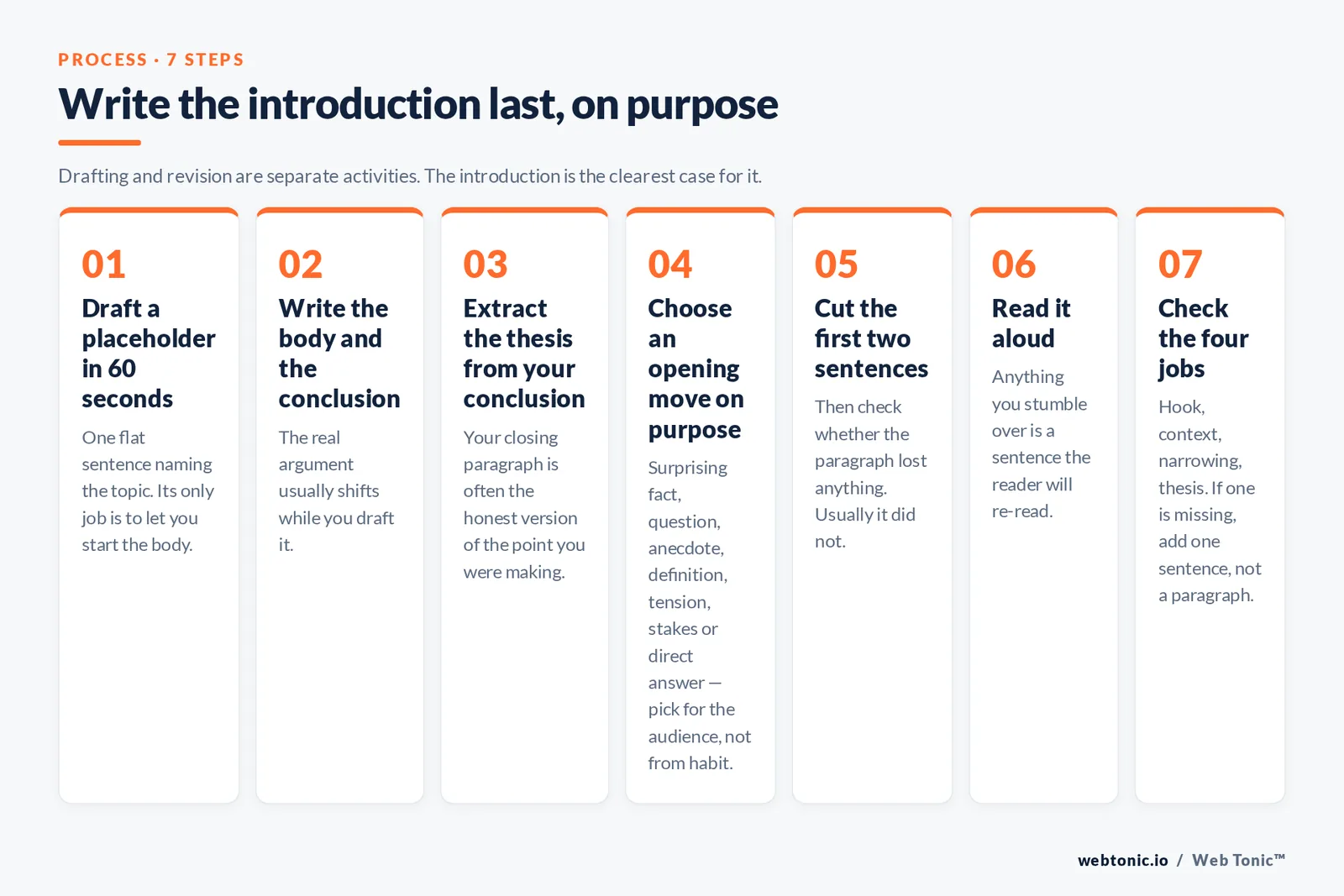
Introductions get easier when you stop treating them as the first thing you write. Wisconsin's writing process handbook and Purdue's writing process guide both treat drafting and revision as separate activities, and introductions are the clearest case for it.
- Draft a placeholder in 60 seconds. One flat sentence naming the topic. Its only job is to let you start the body.
- Write the body and the conclusion. The real argument usually shifts while you draft it.
- Extract the thesis from your conclusion. Your closing paragraph is often the honest version of the point you were trying to make.
- Choose an opening move on purpose. Pick from the seven above based on the audience, not on habit.
- Cut the first two sentences. Then check whether the paragraph lost anything. Usually it did not.
- Read it aloud. Anything you stumble over is a sentence the reader will re-read.
- Check the four jobs. Hook, context, narrowing, thesis. If one is missing, add one sentence — not a paragraph.
Common mistakes to avoid
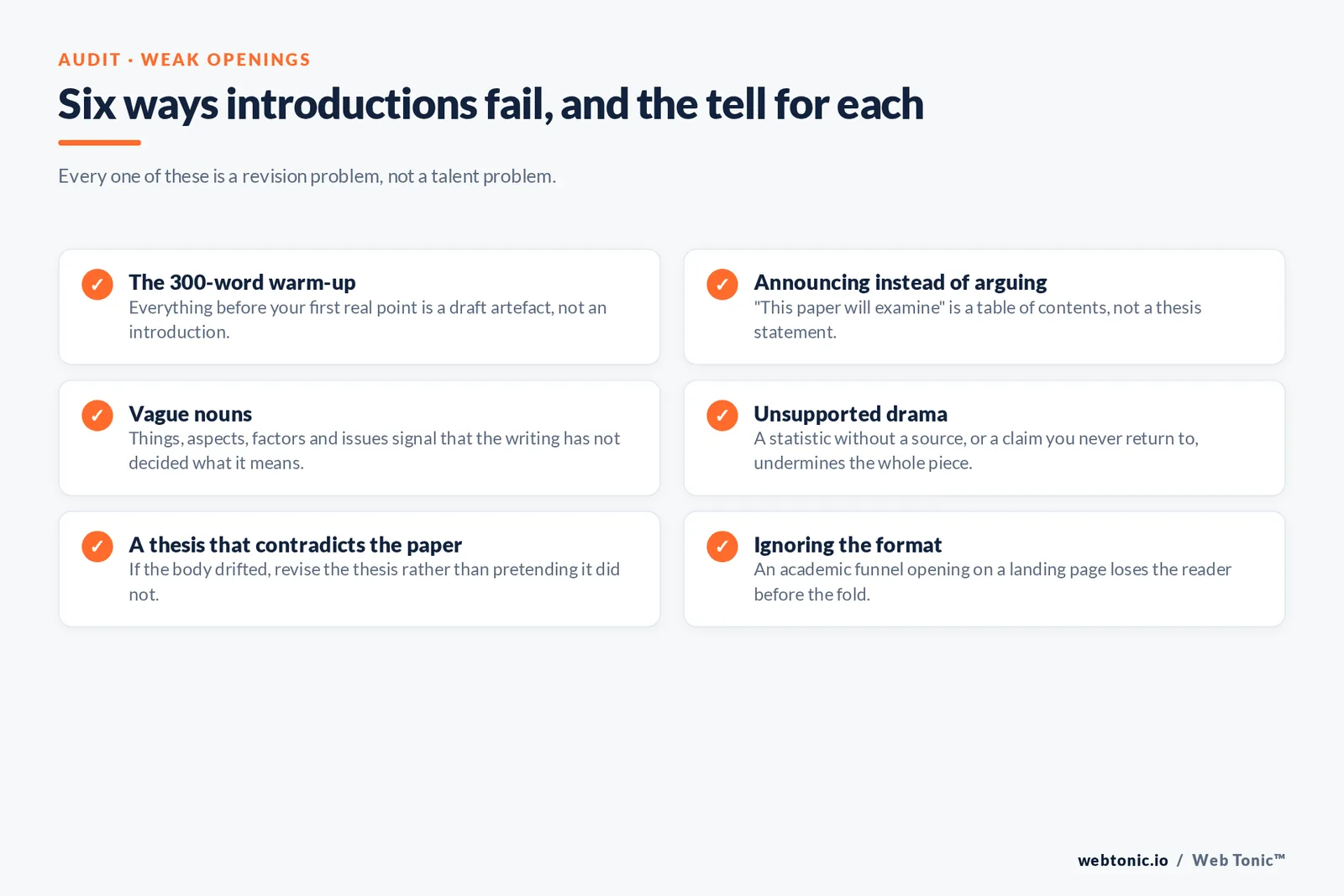
- The 300-word warm-up. Everything before your first real point is a draft artefact, not an introduction.
- Announcing instead of arguing. "This paper will examine" is a table of contents, not a thesis statement.
- Vague nouns. "Things", "aspects", "factors" and "issues" signal that the writing has not decided what it means.
- Unsupported drama. A statistic without a source, or a claim you never return to, undermines the whole piece.
- Copying the assignment prompt. Restating the question in different words adds length and no information.
- A thesis that contradicts the paper. If the body drifted, revise the thesis rather than pretending it did not.
- Ignoring the format. An academic funnel opening on a landing page loses the reader before the fold.
A worked example, three drafts
The same essay introduction, revised twice. First draft, 61 words of warm-up:
"Throughout history, cities have always been important places where people live and work. Today, urban planning is a very important topic that affects many aspects of modern life. This essay will discuss the various factors involved in urban planning and how they impact residents."
Second draft — context sharpened, but still announcing rather than claiming:
"Half of humanity now lives in cities, and planning decisions made in the next decade will shape how liveable those cities become. This essay examines zoning, transport and green space, and how they affect residents' daily lives."
Third draft — a hook with information, real context, a narrowed topic and a disputable thesis in the final sentence:
"A parking space costs a city roughly the same land as a small apartment. That trade-off, repeated across thousands of zoning decisions, explains more about housing shortages than construction costs do: cities are not short of space, they are short of permission to use it. This essay argues that minimum parking requirements, not building costs, are the binding constraint on urban housing supply."
The third version is shorter than the first two combined in intent and does four jobs the first draft did none of. That is the whole exercise.
FAQ
How do I start an introduction?
Start with information, not ceremony. A surprising and properly sourced fact, a genuine question, a short scene, or the direct answer to the question your reader arrived with. Avoid dictionary definitions and "since the beginning of time" openings — both delay the point and signal that the writing has not found its angle yet.
How long should an introduction be?
Roughly 5-10% of the total word count. That is one paragraph of 50-120 words for a short essay, 200-400 words for a long paper, 400-800 words for a research paper, and just two short paragraphs for a blog post or article.
Where does the thesis statement go?
Usually as the last sentence of the first paragraph in a short essay, and at the end of the opening section in longer work. In a research paper it appears as the aim or hypothesis, immediately after you have identified the gap in the existing literature.
Should I write the introduction first or last?
Draft a rough placeholder first so you can start writing, then rewrite the introduction properly once the body and conclusion exist. The argument almost always changes while you draft it, and an introduction written before the argument settles will promise something the paper does not deliver.
How is a blog post introduction different from an essay introduction?
Order and length. An essay builds context before the thesis; a blog post gives the answer in the first sentence and adds context afterwards, because 79% of web readers scan rather than read. Two short paragraphs is a normal ceiling online.
Sources
UNC Chapel Hill Writing Center, "Introductions" and "Thesis Statements" handouts · Purdue OWL, academic writing and the writing process · University of Wisconsin-Madison Writer's Handbook, the writing process · Nielsen Norman Group: "How Users Read on the Web" (Jakob Nielsen), "F-Shaped Pattern for Reading Web Content" (232-user eyetracking study) and "Inverted Pyramid: Writing for Comprehension" · PLOS ONE submission guidelines, manuscript introduction requirements · PlainLanguage.gov federal plain language guidelines. All sources accessed July 2026.