Table of contents
Coming up with a business name is a three-part problem: generate far more candidates than you need, test them against how customers actually read and say them, then clear the name legally and digitally before you print anything.
Founders who work in that order rarely end up renaming later. Founders who fall in love with one idea usually do.
Key Takeaways
- 531,423 business applications were filed in the United States in June 2026 alone, up 1.1% on May, so almost every obvious name in a crowded category is already taken.
- Aim for a shortlist of 40 to 60 raw candidates, cut to 8 finalists, then clear 3 in parallel — legal, domain and social.
- Names fail on four practical tests: spelling on the first hearing, pronunciation, room to grow beyond your first product, and availability.
- A trademark search is not optional. Federal registration through the USPTO gives nationwide rights; a state filing or a DBA does not.
- Business name generators are useful for volume, not for judgment — treat their output as raw material for step 1 of 6.
- Exact-match .com domains are the hardest constraint in 2026; a modified domain plus a strong name beats a weak name with a perfect domain.
- Budget 2 to 3 weeks from brainstorm to registration if you want trademark and domain checks done properly.
Start with strategy, not with words
Before you write a single name idea, write four short lines: who you serve, what you sell, what makes you different, and how you want to sound. That last line is the one most founders skip, and it is the one that decides whether "Grove Financial" or "Sprocket Money" is right for you.
Ikea, Starbucks and Apple share nothing linguistically. What they share is fit — each name matched a positioning decision made first. Apple was deliberately friendly in a market of acronyms. Starbucks borrowed a literary name that sounded nothing like a fast-food chain. If your positioning is undefined, naming becomes a taste argument, and taste arguments never end.
Write your positioning down in one sentence. If you need help pressure-testing it, our growth marketing team works through this with founders before any brand work starts.
The six naming approaches, and what each one costs you
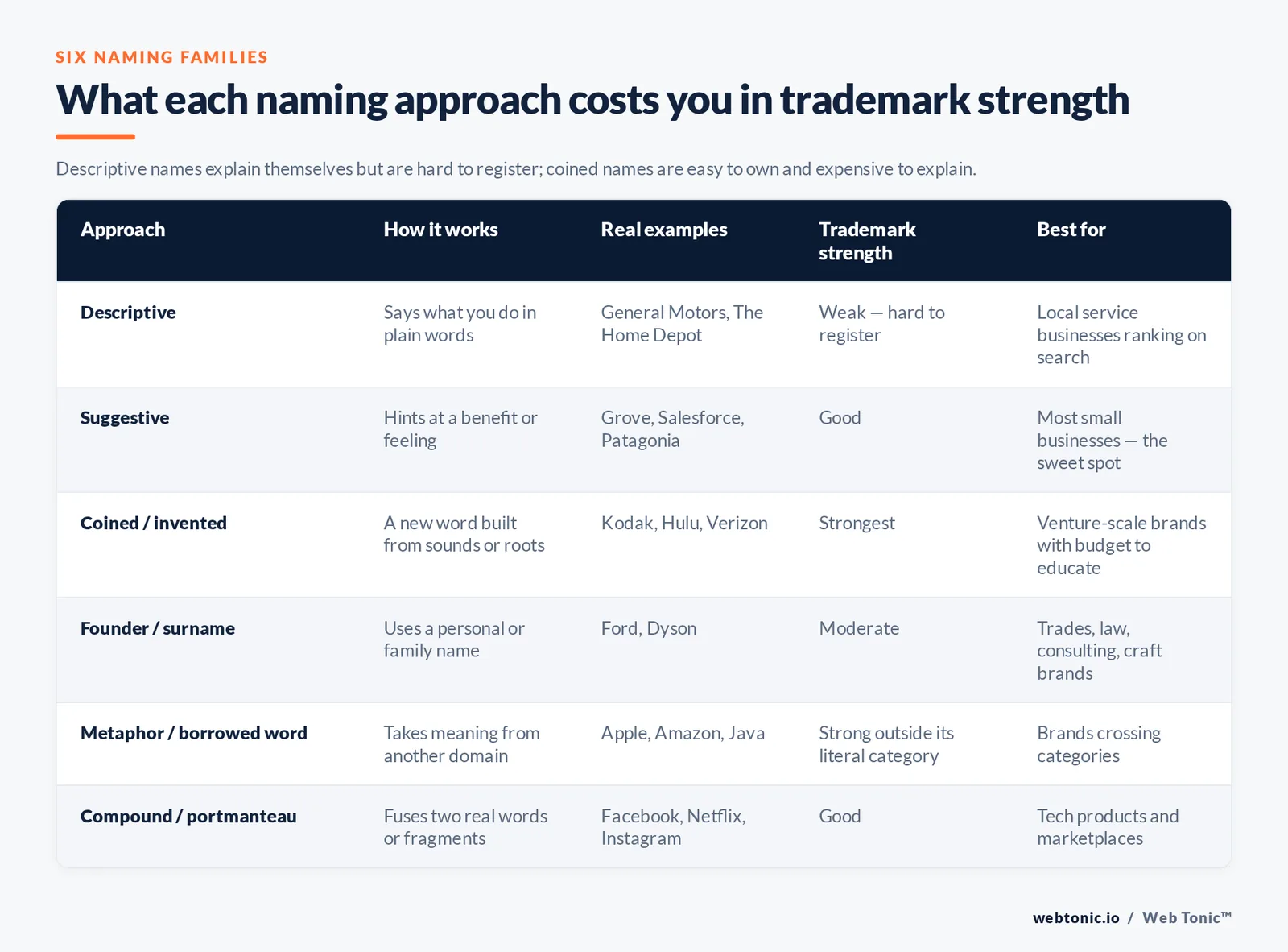
Almost every company name in the world belongs to one of six families. Each has a different trade-off between instant clarity and long-term ownability — descriptive names explain themselves but are nearly impossible to trademark, while coined names are easy to own and expensive to explain.
| Approach | How it works | Real examples | Trademark strength | Best for |
|---|---|---|---|---|
| Descriptive | Says what you do in plain words | General Motors, The Home Depot | Weak — hard to register | Local service businesses ranking on search |
| Suggestive | Hints at a benefit or feeling | Grove, Salesforce, Patagonia | Good | Most small businesses — the sweet spot |
| Coined / invented | A new word built from sounds or roots | Kodak, Hulu, Verizon | Strongest | Venture-scale brands with budget to educate |
| Founder / surname | Uses a personal or family name | Ford, Warby Parker (literary), Dyson | Moderate | Trades, law, consulting, craft brands |
| Metaphor / borrowed word | Takes meaning from another domain | Apple, Amazon, Java | Strong outside its literal category | Ambitious brands crossing categories |
| Compound / portmanteau | Fuses two real words or fragments | Facebook, Netflix, Instagram | Good | Tech products and marketplaces |
One warning about descriptive names: US trademark law treats merely descriptive marks as unregistrable without proof of acquired distinctiveness, which is exactly why "Boston Plumbing Services" is easy to rank and impossible to defend. The USPTO's own explanation of what a trademark is is worth ten minutes before you commit.
Brainstorming: how to get to 50 candidates fast
Volume is the whole game. Professional namers routinely generate several hundred options for one project. You need far fewer, but you still need more than five. Run these seven prompts for 10 minutes each and you will finish with 40 to 60 ideas in a single sitting.
- Prompt 1 — the outcome. List 20 words for what the customer gets, not what you do. "Clarity", "lift", "north", "spark".
- Prompt 2 — the metaphor. What is your business like? Write 15 nouns from that other world: navigation, farming, music, weather.
- Prompt 3 — the roots. Take your 5 best words to Latin, Greek, or another language you have a genuine tie to. Always check the translation twice, both directions.
- Prompt 4 — the place. Streets, rivers, neighbourhoods and landmarks near you. Strong for local trust, limiting if you plan to expand.
- Prompt 5 — the compound. Mash your best 10 words against a fixed suffix list: -ly, -io, -works, -lab, -co, -house, -field.
- Prompt 6 — the generator pass. Feed your top 10 seed words into 2 or 3 name generators and harvest anything usable.
- Prompt 7 — the sentence. Write your pitch in one line and pull out the nouns you accidentally repeated. Those are your category's real vocabulary.
Do not judge anything during generation. Judging while brainstorming is what caps most founders at 6 ideas, and 6 ideas is not a shortlist — it is a coin toss.
Business name generators: what they are actually good at
AI-powered generators solve one problem well — producing large volumes of pronounceable, spellable combinations quickly, often with domain availability shown inline. They are poor at strategy, category context and cultural landmines, so they belong in step 1 and nowhere near your final decision.
| Tool | Cost | Output style | Shows domains? | Watch out for |
|---|---|---|---|---|
| Shopify Business Name Generator | Free | Keyword + suffix combinations | Yes | Very literal, retail-skewed |
| Namelix | Free, paid branding add-ons | Short, coined, brandable | Yes | Many names are already in use |
| General-purpose LLMs | Free tiers available | Whatever you brief | No | Confidently suggests trademarked names |
| Registrar name search tools | Free | Domain-first variations | Yes, authoritative | Optimises for a sale, not a brand |
| Thesaurus + spreadsheet | Free | Human, category-aware | No | Slow, but produces the winners |
A practical rule: no more than 3 of your 8 finalists should come straight from a generator. The rest should come from your own prompts, where your knowledge of the customer lives.
The seven-test filter: cutting 50 ideas down to 8
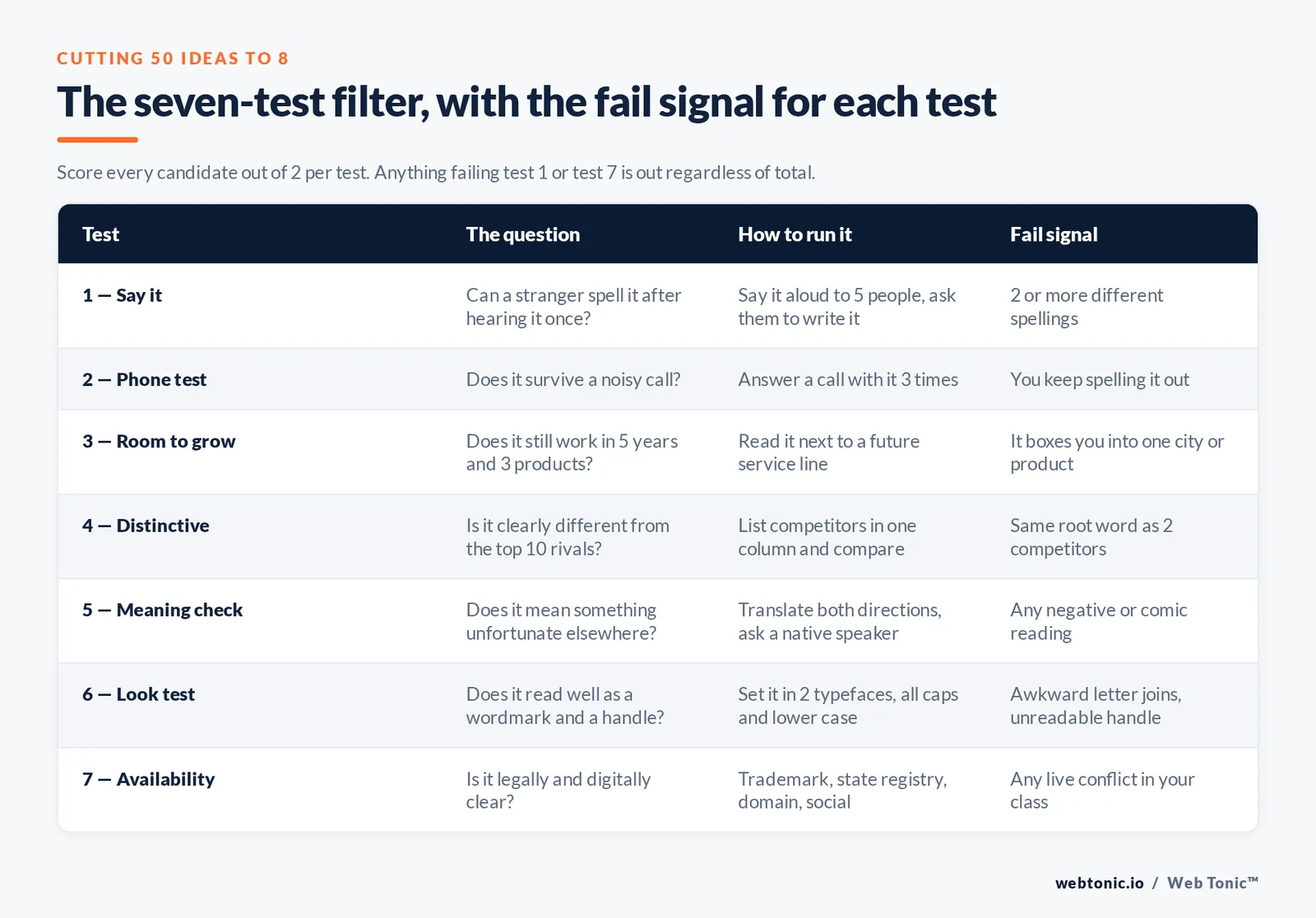
Score every candidate out of 2 on each test below, then keep the top scorers. Anything that fails test 1 or test 7 is out regardless of the total.
| Test | The question | How to run it | Fail signal |
|---|---|---|---|
| Test 1 — Say it | Can a stranger spell it after hearing it once? | Say it aloud to 5 people, ask them to write it | 2 or more different spellings |
| Test 2 — Phone test | Does it survive a noisy call? | Answer a call with it 3 times | You keep spelling it out |
| Test 3 — Room to grow | Does it still work in 5 years and 3 products? | Read it next to a future service line | Name boxes you into one city or product |
| Test 4 — Distinctive | Is it clearly different from the top 10 competitors? | List rivals in one column and compare | Same root word as 2 competitors |
| Test 5 — Meaning check | Does it mean something unfortunate elsewhere? | Translate in both directions, ask a native speaker | Any negative or comic reading |
| Test 6 — Look test | Does it read well as a wordmark and a handle? | Set it in 2 typefaces, all caps and lower case | Awkward letter joins, unreadable handle |
| Test 7 — Availability | Is it legally and digitally clear? | Trademark, state registry, domain, social | Any live conflict in your class |
Test 1 eliminates more names than the other six combined. Clever spellings feel ownable and cost you customers every day for the life of the business.
Clearing the name: trademark, registry, domain, social
Run all four checks on your top 3 finalists, in this order, before you tell anyone the name.
- Step 1 — Federal trademark search. Search the live register with the USPTO trademark database. Look for confusingly similar marks in your goods and services class, not just exact matches. When you are ready, the USPTO application process sets out fees and filing bases; if you plan to sell abroad, read the WIPO Madrid System route too.
- Step 2 — State and entity check. Your Secretary of State business registry decides whether your LLC name is available in that state. The SBA's guides to choosing a business name and registering your business explain how entity names, DBAs and trademarks differ. A DBA gives you a trading name, not exclusivity.
- Step 3 — Domain check. Search the exact match first. Domain scarcity is real: the DNS carries hundreds of millions of registrations, tracked quarterly in the Verisign Domain Name Industry Brief, and you can only register through an ICANN-accredited registrar. If the .com is gone, test a prefix ("get", "hey"), a suffix ("hq", "app", "co") or a category word before you abandon a strong name.
- Step 4 — Social handles. Check the same handle on all 4 platforms you will actually use. Consistency across handles is worth more than a perfect handle on one network.
One more habit worth copying from big brands: check how your name behaves in advertising claims. The FTC's business guidance is clear that a name implying a result ("DebtFree Solutions") can pull you into substantiation obligations you did not plan for.
What a business name does and does not do
Naming carries less weight than founders think, and different weight than they expect. The Interbrand Best Global Brands table is a useful reality check: the names at the top are worth billions because of decades of consistent delivery, not because the words are clever.
| Your name will | Your name will not |
|---|---|
| Set expectations in the first 3 seconds | Fix a weak offer or bad service |
| Make word of mouth easier or harder | Rank you on its own — content and links do that |
| Decide how defensible your brand is | Guarantee trademark protection without filing |
| Shape your visual identity options | Replace a clear positioning statement |
| Cost real money to change later | Matter more than your first 100 customers |
That last row is the argument for deciding in weeks rather than months. Business creation is running at more than half a million applications a month according to Census Bureau Business Formation Statistics, with 29,741 projected formations from June 2026 applications alone. While you deliberate, the good names keep going.
Six mistakes that force a rename
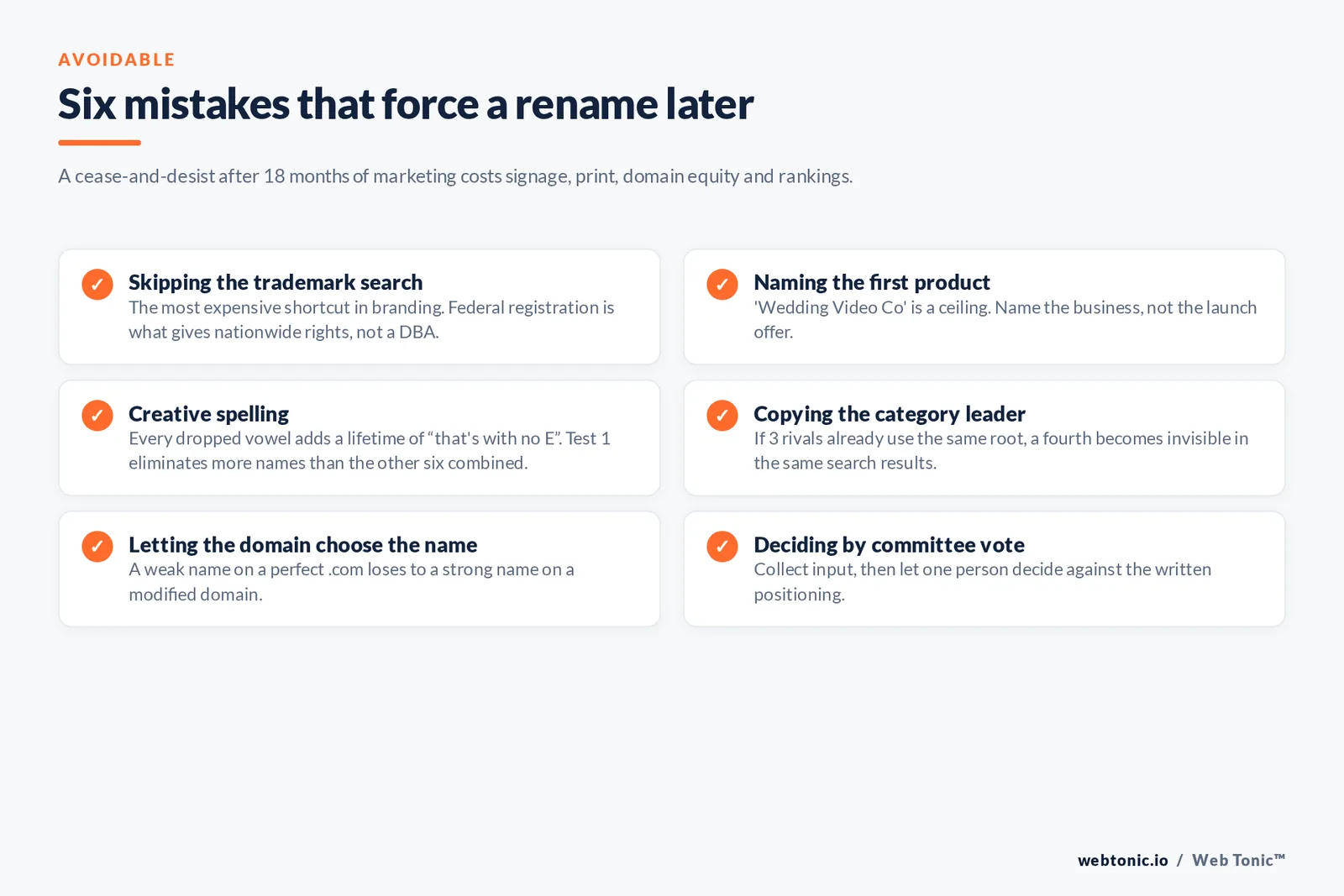
- Mistake 1 — Skipping the trademark search. The most expensive shortcut in branding. A cease-and-desist after 18 months of marketing costs signage, print, domain equity and rankings.
- Mistake 2 — Naming the first product. "Wedding Video Co" is a ceiling. Name the business, not the launch offer.
- Mistake 3 — Creative spelling. Every dropped vowel adds a lifetime of "that's with no E".
- Mistake 4 — Copying the category leader. If 3 rivals use the same root, a fourth becomes invisible in the same search results.
- Mistake 5 — Letting the domain choose the name. A weak name with a perfect .com loses to a strong name on a modified domain every time.
- Mistake 6 — Deciding by committee vote. Collect input, then let one person decide against the written positioning.
A two-week naming timeline you can actually run
| Days | What you do | Output |
|---|---|---|
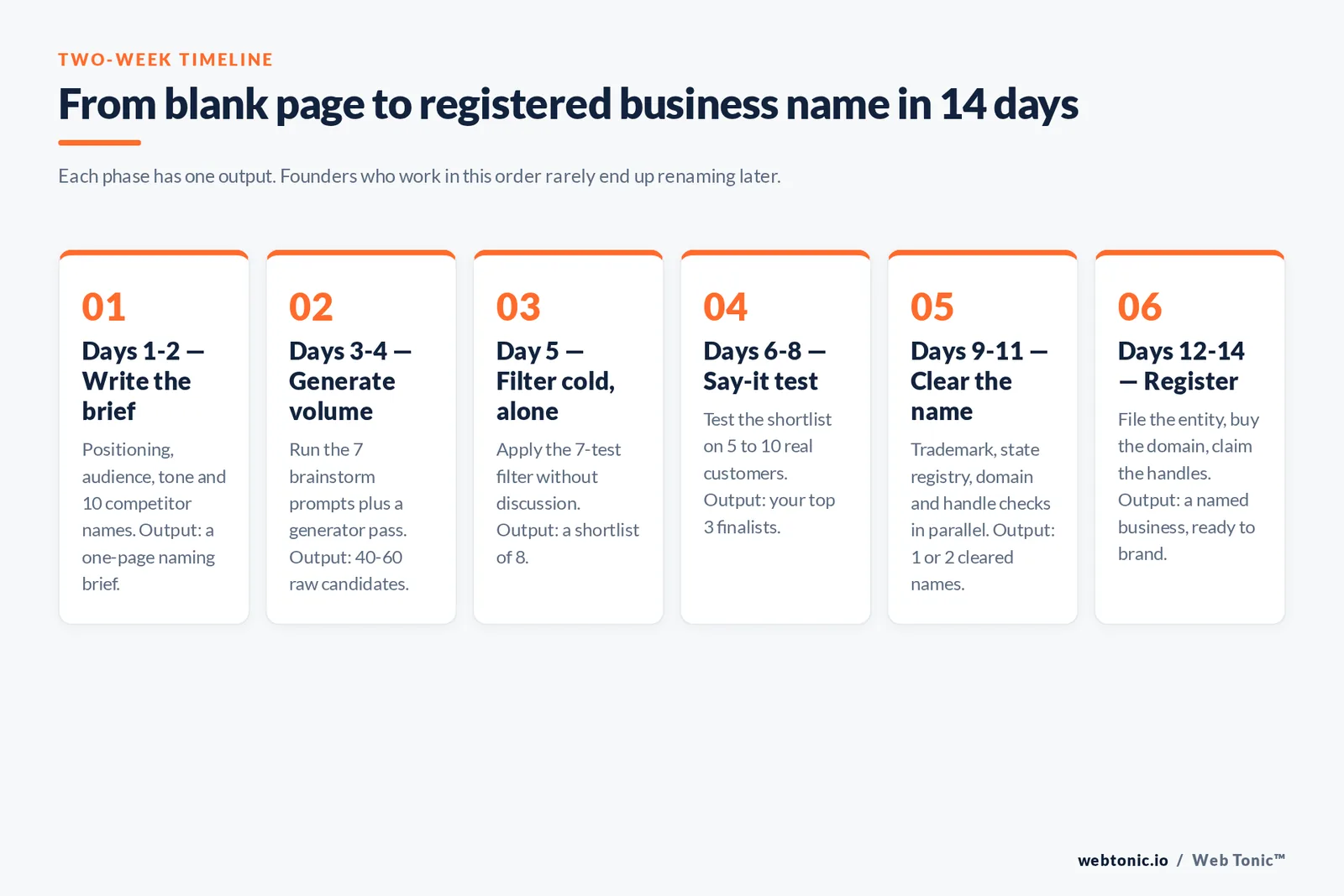
| Days 1–2 | Write positioning, audience, tone, 10 competitor names | 1-page naming brief |
| Days 3–4 | Run the 7 brainstorm prompts plus a generator pass | 40–60 candidates |
| Day 5 | Apply the 7-test filter, cold, alone | Shortlist of 8 |
| Days 6–8 | Say-it test with 5 to 10 real customers | Top 3 finalists |
| Days 9–11 | Trademark, state registry, domain and handle checks | 1 or 2 cleared names |
| Days 12–14 | Register the entity, buy the domain, claim handles | Named business, ready to brand |
Once the name is cleared, the identity work — wordmark, colour, voice, launch assets — is a separate project. Our performance creative team builds that layer, and you can see how we approach naming and brand systems across the Web Tonic blog. If you want a second opinion on a shortlist, get in touch.
Business name ideas by industry: 12 worked examples
Good business name ideas are category-aware. A great business name for a small accounting company sounds nothing like a great name for a streetwear label, because the customers are scanning for different signals — trust in one case, personality in the other. The table below shows the naming style that tends to win in each industry, plus 3 invented name ideas each so you can hear the pattern. Check any you like against the trademark register and domain search before you use them.
| Industry | What customers scan for | Name style that wins | 3 name ideas |
|---|---|---|---|
| Accounting & bookkeeping | Trust, permanence | Surname or place plus a solid noun | Grove Ledger, Northrow Accounts, Clearbook |
| Home services & trades | Local proof, availability | Descriptive plus a memorable word | Ridge & Rafter, Bright Bolt Plumbing, Halewood Roofing |
| Coffee shops & food | Warmth, story | Borrowed word or literary reference | Kestrel Coffee, Two Doors Bakery, Rivet Kitchen |
| Fashion & apparel | Attitude, taste | Short, coined, unique | Loomer, Vespera, Ninth Cloth |
| SaaS & software | Speed, capability | Compound or 2-syllable coined word | Stacklane, Nimbus Desk, Quorra |
| Fitness & wellness | Energy, belonging | Verb or metaphor | Ascend Room, Iron Meadow, Tidal Studio |
| Consulting & agencies | Competence, point of view | Suggestive noun, easy to remember | Trueline, Compass & Co, Northfield Partners |
| Beauty & salons | Craft, care | Personal or sensory word | Petal Room, Marlowe Hair, Glasswing |
| Pet products & services | Affection, humour | Playful compound | Paw Parade, Barkfield, Two Tails |
| Construction & property | Scale, reliability | Strong single syllable plus category | Keel Build, Stonefold, Anchor Yard |
| Education & coaching | Progress, clarity | Outcome word | Stepwise, Bright Path Learning, Kindling |
| E-commerce & DTC | Distinctiveness, shareability | Coined, short, handle-friendly | Havenly Goods, Otterlane, Muselo |
Notice the pattern: in every row the winning style is the one that is easy to remember and easy to say, and in 10 of the 12 industries the strongest option is suggestive rather than literally descriptive. If your first 20 ideas are all descriptive, run one more brainstorm round before you choose.
How your business name shapes brand identity and customer perception
A name is the first piece of brand identity a customer meets, and it does a surprising amount of sorting work before anyone reads a word of your website. People infer price level, seriousness, size and even location from a name alone, which is why a name that is wrong for your target audience quietly raises your marketing costs for years.
Three practical implications for small business owners:
- Perceived price. Coined and single-word names read as premium; long descriptive names read as budget and local. Choose deliberately — an unusual name plus a premium price is a coherent story, and so is a plain name plus a value promise.
- Perceived size. "& Partners", "Group" and "Global" imply scale you may not have. If 90% of your work is a 1-person operation serving local customers, a name that oversells can create expectations you will spend every sales call correcting.
- Recall in a crowded market. The test that matters is whether a customer can remember your name a week later and find you without your card. Distinct sounds and a short spelling do more for that than any tagline.
The name also decides how much of your marketing can compound. Distinctive names accumulate branded search volume, direct traffic and word of mouth; generic ones leak that demand to competitors with similar names. That is why a name that clears the trademark register is worth waiting a few extra days for — everything you spend on marketing afterwards builds an asset only you can use. Keeping the name, the website and the social media handles consistent across every touchpoint is the cheapest brand-building work you will ever do.
FAQ
How do I come up with a catchy business name?
Generate at least 40 candidates from separate prompts — outcomes, metaphors, word roots, places and compounds — then cut them with the say-it test. Catchiness in practice is mostly rhythm and spellability: 2 or 3 syllables, one clear stress, no ambiguous letters. Names that pass a spoken test with 5 strangers are the ones that travel by word of mouth.
What tools can help me generate business name ideas?
Free business name generators such as the Shopify tool and Namelix produce large volumes of brandable combinations with domain availability shown inline, and general-purpose AI models will riff on any brief you give them. Use them for raw volume in step 1, then verify everything yourself — generators frequently suggest names that are already trademarked or in active use.
How do I check if a business name is available as a domain?
Search the exact match at any ICANN-accredited registrar, and check the .com even if you prefer another extension, because customers will type it. If the exact match is taken, test 3 variants — a short prefix, a suffix such as "hq" or "co", or a category word — and confirm the same string is free as a social handle before you commit.
What legal steps should I take before choosing a business name?
Run a federal trademark search on the USPTO register for confusingly similar marks in your class, check your Secretary of State registry for entity-name conflicts, and understand that a DBA or LLC filing gives you no nationwide exclusivity. Federal registration is what protects the name across the United States, and the Madrid System extends it internationally.
Does my business name affect SEO?
Indirectly. A descriptive name containing a keyword can help local relevance, but it is weakly distinctive and hard to trademark, and no name outranks better content, stronger links and a faster site. A distinctive name is easier to build branded search demand around, which is usually the more valuable long-term asset.
Sources: USPTO trademark basics, search and application guidance; U.S. Small Business Administration business-name and registration guides; U.S. Census Bureau Business Formation Statistics (June 2026 release, published 9 July 2026); Verisign Domain Name Industry Brief; ICANN registrar resources; WIPO Madrid System; FTC business guidance; Interbrand Best Global Brands.