Table of contents
Website visibility is how often your site appears in front of people who are searching, measured in impressions and average position before a single click happens. Traffic is the consequence; visibility is the thing you can actually build and audit week by week.
Key Takeaways
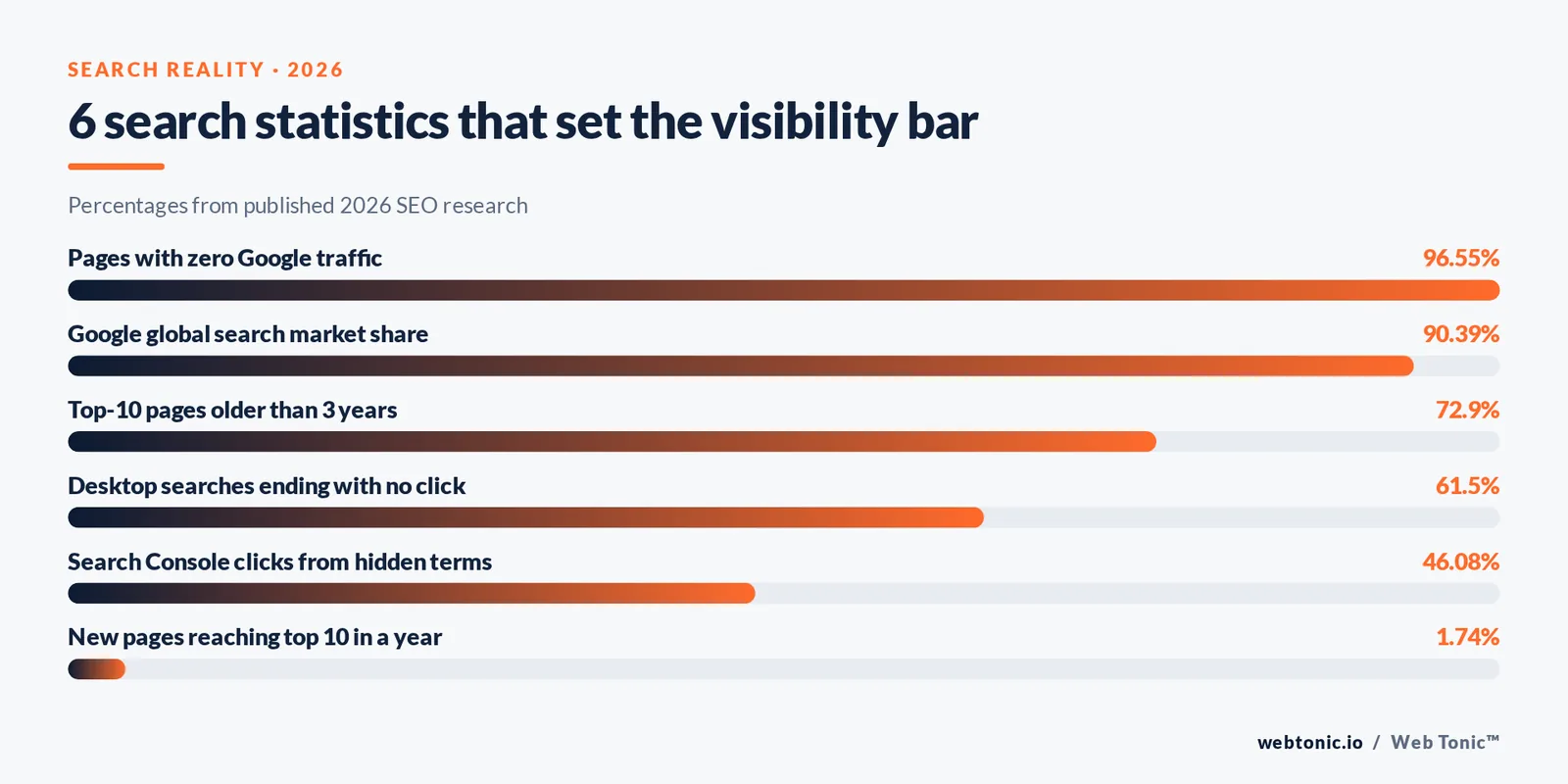
- 96.55% of all pages get zero search traffic from Google, so invisibility is the default state of a website, not a bug.
- Google holds roughly 90% of global search engine market share and indexes about 400 billion documents, which is why Google search is the first visibility surface to fix.
- Only 1.74% of newly published pages reach the top 10 search results within a year, and 72.9% of pages already ranking in the top 10 are more than 3 years old.
- Google rewrites your title tag about 33% of the time and shows the meta description you wrote only 37.22% of the time, so snippet control is partial at best.
- Local visibility now runs through reviews and AI answers: 97% of consumers read reviews for local businesses, and use of generative AI tools for local recommendations jumped from 6% to 45% in a single year.
Visibility and traffic are two different metrics
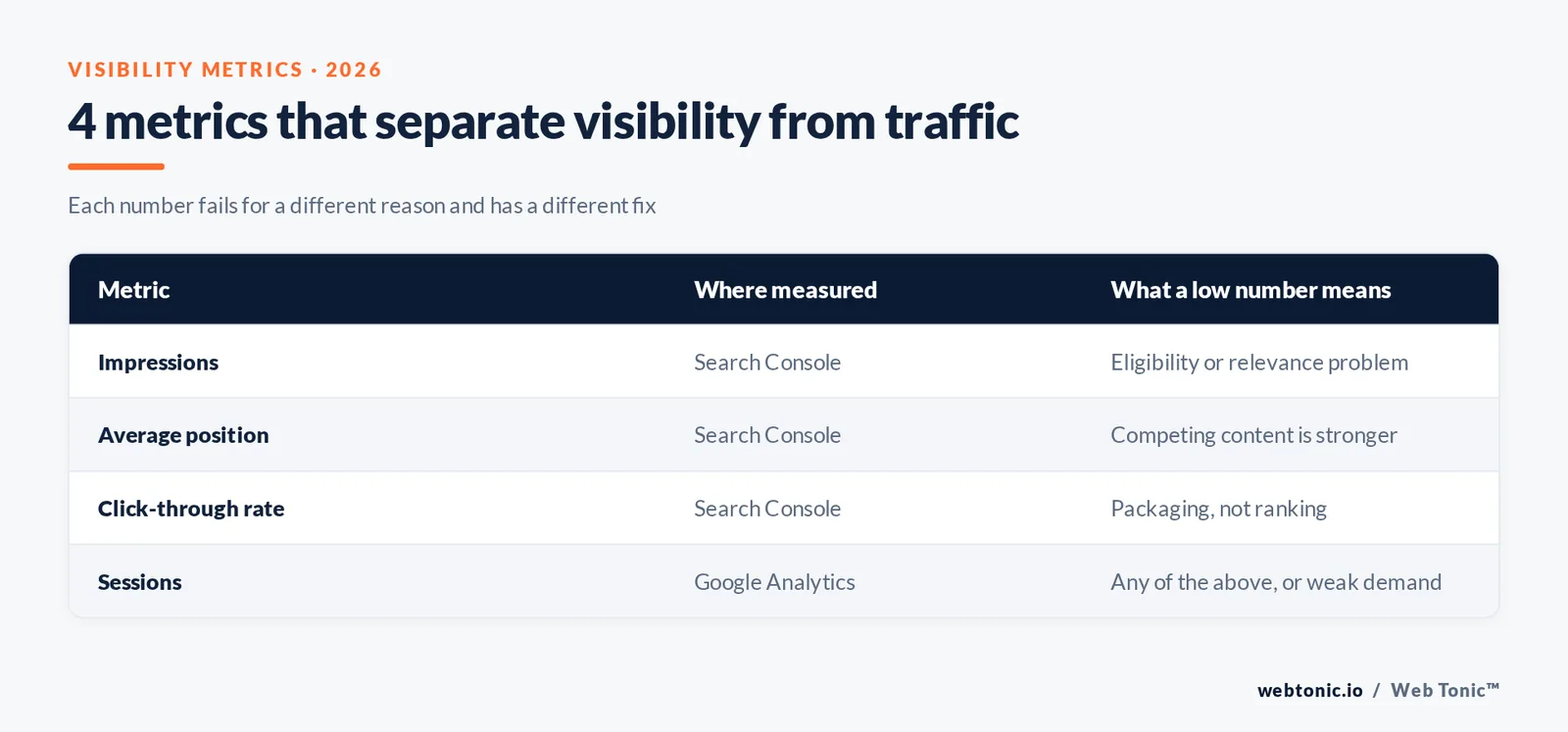
Most guides on how to increase website visibility jump straight to tactics. The faster path is to separate the four numbers that people blur together, because each one fails for a different reason and each one has a different fix.
| Metric | Where you measure it | What it proves | What a low number means |
|---|---|---|---|
| Impressions | Google Search Console, Performance report | Google search shows your site to real users | An eligibility or relevance problem |
| Average position | Search Console, per query and per page | Where you sit when you do appear | Competing content is stronger |
| Click-through rate | Search Console, per query | Your title and snippet earn the click | A packaging problem, not a ranking one |
| Sessions | Google Analytics or your CMS analytics | People arrive and behave | Any of the three above, or bad demand |
Rule 1 — if impressions are flat, no amount of work on titles or CTA buttons will increase traffic. Impressions come first in the chain, and they answer a blunt question: does Google consider your pages eligible and relevant for anything people search? If you already have impressions and no clicks, the problem is presentation, and our guide to increasing website traffic is the better read.
The eligibility layer: you cannot rank higher if you are not indexed
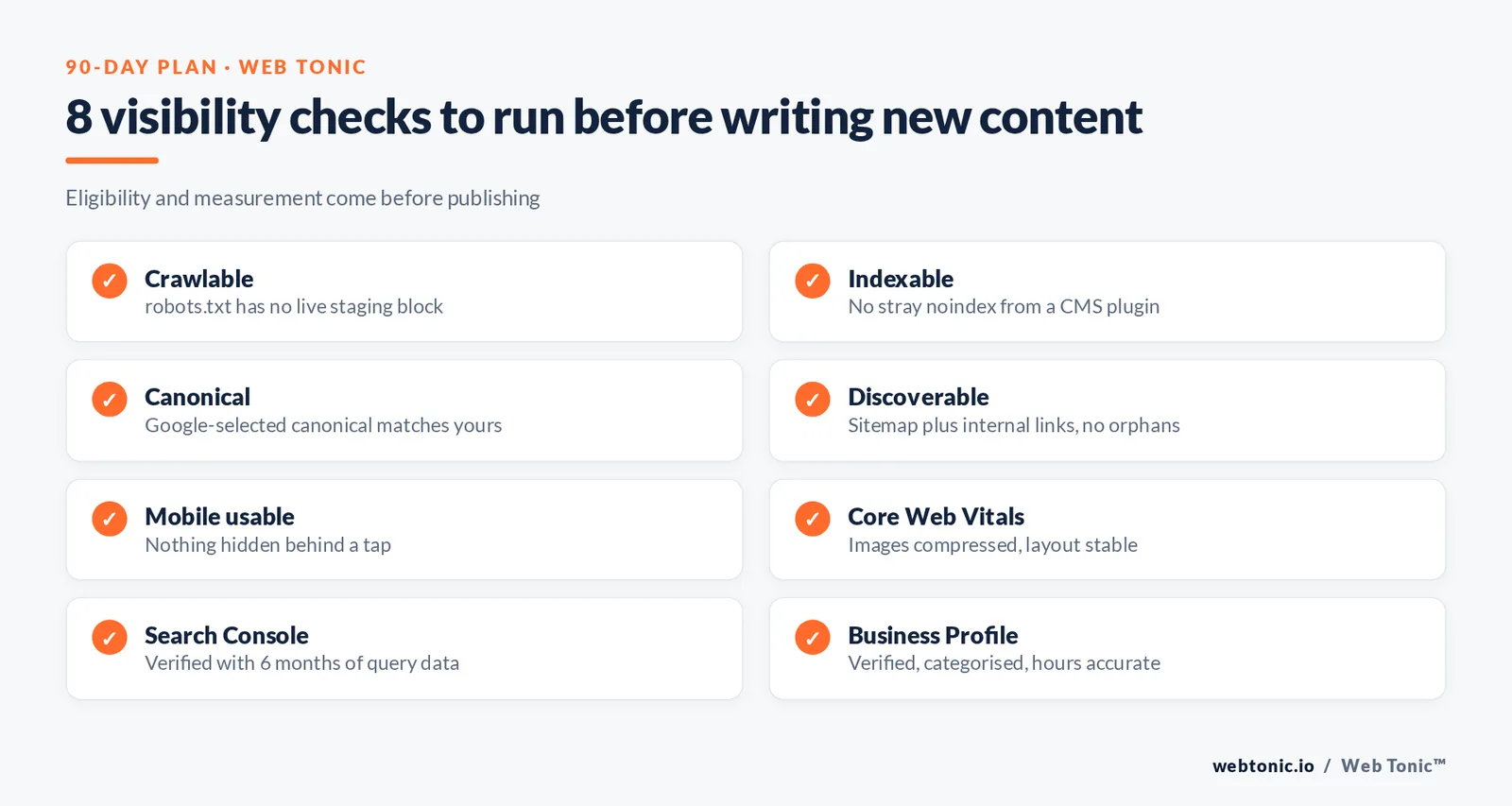
6 technical conditions decide whether a page is even allowed to appear in search engines. Check them before writing anything new, because a blog post that cannot be crawled has no visibility ceiling at all — it has no floor either.
| Condition | How to check it | Common failure | Fix time |
|---|---|---|---|
| Crawlable | robots.txt tester and server logs | A staging block left live | Minutes |
| Indexable | Search Console Page indexing report | A CMS plugin emitting noindex | Hours |
| Canonical | URL Inspection, Google-selected canonical | Parameter and duplicate URLs competing | Days |
| Discoverable | XML sitemap plus internal links | Orphan pages with no internal link | Hours |
| Mobile usable | Test the page on a phone viewport | Content hidden behind a tap on mobile | Days |
| Fast enough | Core Web Vitals in Search Console | Unoptimised high quality images | Days |
Google publishes the baseline requirements in its SEO starter guide, and the loading thresholds that matter are documented as Core Web Vitals. Limit 2: crawling and indexing are binary, so 1 stray directive can remove an entire section of a site from Google search. Do not skip Bing either — Bing Webmaster Tools is free, takes 10 minutes to verify, and now feeds AI assistants as well as its own results.
The surface map: where website visibility actually happens now
Visibility is spread across 8 surfaces, and each one has a different entry requirement. Businesses that only optimise for the classic blue links compete for the smallest slice of a page that is increasingly filled with everything else.
| Surface | Entry requirement | Where you measure it | Typical lag |
|---|---|---|---|
| Organic search results | Indexed page plus topical relevance | Search Console impressions | 3 to 9 months |
| AI answers and overviews | Clear, citable, well-structured content | Manual prompt tracking | Weeks |
| Google Maps and the local pack | A verified Google Business Profile | Profile performance report | 2 to 8 weeks |
| Rich results | Valid structured data markup | Search Console enhancements | Days |
| Google Ads and paid search | Budget plus keyword coverage | Impression share in Google Ads | Hours |
| Images and video | Descriptive filenames, alt text, transcripts | Search Console search appearance | Weeks |
| Social media and communities | Consistent posting and real engagement | Referral sessions and branded search | Weeks |
| Third-party listings and reviews | Accurate business information everywhere | Listing audits and review counts | Weeks |
Fact 3 — Google is still about 90% of the search engine market, so 1 surface earns the majority of your visibility upside. The current share split is published monthly by StatCounter. Sequence the surfaces instead of spreading yourself thin: organic search and Google Business Profile first, rich results and AI answers second, paid search and social media as accelerants.
Search Console is the visibility dashboard, and most people misread it
4 diagnostic patterns cover almost every case once you have the Performance report open with a 6-month window and the query and page tabs side by side. Google's own Search Console performance report documentation explains how impressions are counted, which matters because an impression from position 43 is technically visibility and practically nothing.
| Pattern | Reading | Root cause | Next action |
|---|---|---|---|
| No impressions | Fewer than 10 impressions per month | Not indexed or no relevant keywords | Fix indexing, then match a real query |
| Impressions, position above 20 | Visibility with no reach | Thin or off-target quality content | Rewrite against the dominant intent |
| Position 5 to 12, low CTR | You appear but are ignored | Weak title tag and snippet | Rewrite the title and meta description |
| Impressions up, clicks flat | The classic 2025 to 2026 pattern | AI answers and no-click results | Target queries that still need a visit |
Fact 4 — 46.08% of clicks reported in Search Console are attributed to hidden terms, so treat query lists as directional, not complete. Rule 5 — check 1 report weekly rather than 6 dashboards monthly: queries gaining impressions but stuck between positions 5 and 15 are the shortlist where a single content or internal-link improvement moves the most.
Choose keywords you can actually be seen for
94.74% of keywords get 10 monthly searches or fewer, and Google Keyword Planner overestimates volume about 54% of the time. That combination is why keyword research based on volume alone produces sites with beautiful spreadsheets and no visibility.
| Keyword class | Example shape | Realistic time to page 1 | Best page type |
|---|---|---|---|
| Branded | Your company name plus a product | Immediate | Home and product pages |
| Local intent | Service plus city or near me | 1 to 3 months | Location page plus business listing |
| Long-tail question | A 5-word how or why question | 1 to 4 months | Blog post with a direct answer |
| Comparison | Option A versus option B | 3 to 6 months | Decision table plus criteria |
| Commercial head term | 2-word category term | 9 to 18 months | Service or category hub |
| Informational head term | What is plus a concept | 6 to 12 months | Definitive guide with data |
Build the first 3 months of your plan out of local and long-tail queries, and note that 15% of Google searches have never been searched before — a reminder that broad topical coverage beats a fixed list. Our breakdown of how organic keywords work covers the selection mechanics, and the MDN definition of search engine optimization is a useful neutral primer to send to developers who need convincing.
Create high quality relevant content that answers one query completely
Rule 6 — 1 page should own 1 dominant intent. The average top-ranking page also ranks in the top 10 for close to 1,000 other relevant keywords, which happens because the page covers a subject properly, not because it repeats a keyword. Google's helpful content guidance is explicit that the target is people-first usefulness.
| Content element | Visibility job | Practical standard |
|---|---|---|
| Answer-first opening | Wins snippets and AI citations | 40 to 60 words, no preamble |
| Descriptive subheadings | Helps search engines understand structure | 1 question or claim per heading |
| Original data or examples | Earns links and repeat citations | At least 3 numbers a reader can check |
| Tables and lists | Machine-readable comparisons | 2 or more per long blog post |
| High quality images | Image search and engagement | Descriptive alt text over 25 characters |
| Internal links | Passes relevance to related pages | 3 to 8 contextual links per page |
| A visible update date | Freshness signal for people and models | Reviewed at least every 12 months |
Trap 7 — publishing 4 thin blog posts a month loses to 1 genuinely definitive page. Since 72.9% of top-10 pages are older than 3 years, your realistic route in is depth and specificity rather than volume, which is exactly how a content and SEO programme should be resourced.
Help Google understand your content: titles, metadata and schema
7.4% of top-ranking pages have no title tag at all and 25.02% have no meta description, so the basics are still unevenly done. But control is shared: Google rewrites titles about 33% of the time, uses your H1 instead in roughly 51% of those cases, and displays your meta description only 37.22% of the time.
| Element | Length that survives | What to include | Common mistake |
|---|---|---|---|
| Title tag | 50 to 60 characters | Primary keyword plus a differentiator | Brand name first on every page |
| Meta description | 120 to 158 characters | The benefit and a reason to click | Duplicated across a whole blog |
| H1 | 1 per page | The human version of the title | Styling headings by size only |
| URL slug | 3 to 5 words | Readable keywords, no dates | Changing slugs without redirects |
| Structured data | Valid JSON-LD | Article, FAQ, Product, LocalBusiness | Markup that contradicts the page |
| Image alt text | Under 125 characters | What the image shows and why | Keyword lists instead of descriptions |
Valid markup is what makes a result eligible for the extra real estate Google documents in its rich results gallery, and it costs nothing but implementation time. Fact 8 — 40.61% of meta descriptions get truncated, so put the reason to click in the first 120 characters and stop writing for a character counter alone.
Local SEO: your Google Business Profile is a second website
For any business with a service area or a physical address, the local pack outranks everything else in practical value. 97% of consumers read reviews for local businesses, 92% care about the star rating, and 47% will not use a business with fewer than 20 reviews, according to the BrightLocal Local Consumer Review Survey.
| Local asset | What it drives | Minimum standard | Review cadence |
|---|---|---|---|
| Google Business Profile | Maps and local pack visibility | Verified, categorised, hours accurate | Monthly |
| Reviews | Click-through and conversion | 20 or more, rating above 4.5 | Weekly |
| Review recency | Trust at the moment of choice | New reviews inside 90 days | Weekly |
| Citations and listings | Consistency signals | Name, address and phone identical everywhere | Quarterly |
| Location pages | Organic local rankings | 1 page per genuine service area | Twice a year |
| Photos and posts | Profile engagement | 5 or more new photos a month | Monthly |
Limit 9: 74% of consumers only care about reviews written in the last 3 months, which turns review generation into an operational habit rather than a campaign. Ranking factor weightings for the local pack are surveyed annually by Moz, and the volume context sits in this local SEO statistics roundup. If your profile is thin, start with our Google Business Profile optimisation checklist.
Visibility inside AI answers
This is the part of visibility that changed fastest. AI Overviews are associated with a 58% lower average click-through rate for the top-ranking organic page, 61.5% of desktop searches already end without a click, and use of generative AI tools for local business recommendations rose from 6% to 45% in one year of BrightLocal's survey.
| Lever | Why it works | How to execute |
|---|---|---|
| Extractable answers | Models quote self-contained passages | Answer in the first 60 words of a section |
| Fresh, dated data | AI-cited content is measurably fresher | Update figures and stamp the date |
| Entity clarity | Models need to know who you are | Consistent naming, About and author pages |
| Third-party corroboration | Recommendations lean on listings and reviews | Get named in credible roundups and directories |
| Structured markup | Machine-readable facts reduce ambiguity | Ship valid Article, FAQ and LocalBusiness schema |
| Prompt tracking | You cannot manage an unmeasured surface | Log 20 buying prompts monthly and record mentions |
Google documents how its AI features select and link sources, and the practical implication is uncomfortable but simple: Trap 10 — measuring only sessions will make a year of visibility gains look like 12 months of decline. Track impressions, mentions and branded search alongside clicks. We unpack the mechanics in our explainer on how Google AI Overviews work.
Off-page: links, mentions and social media raise the ceiling
Fact 11 — 68% of online experiences still begin with a search engine, but which results you are eligible to win is heavily shaped by what happens off your own site. Backlinks from reputable websites remain the clearest external signal, and top-ranking pages tend to add new referring domains at a pace of 5% to 14.5% per month.
| Off-page play | Effort | Visibility effect | Time to effect |
|---|---|---|---|
| Original data study | High | Backlinks plus AI citations | 2 to 6 months |
| Expert quotes in media | Medium | Authority and brand entity strength | 1 to 3 months |
| Industry directories | Low | Local and comparison visibility | Weeks |
| Post on social media | Medium | Distribution and branded search lift | Weeks |
| Partner and supplier pages | Low | Relevant contextual links | Weeks |
| Google Ads on head terms | Budget | Instant presence while SEO compounds | Hours |
Paid search is the only lever on that list that buys visibility the same day, which makes it the right bridge for a new site rather than a substitute for organic work. Ongoing changes to how results are built are tracked by Search Engine Land. Limit 12: 1 link from a page nobody reads is worth less than 1 mention in a roundup your buyers already check.

A 90-day plan to increase website visibility
Rule 13 — 3 months is enough to move impressions, not to win 2-word head terms. Sequence the work so that each phase unblocks the next instead of running everything at once.
| Phase | Focus | Deliverables | Metric that should move |
|---|---|---|---|
| Weeks 1 to 2 | Eligibility and measurement | Search Console and Analytics verified, indexing fixed | Indexed pages |
| Weeks 3 to 4 | Quick presentation wins | Rewrite 20 title tags and descriptions on page 1 and 2 queries | Click-through rate |
| Weeks 5 to 6 | Local and listings | Google Business Profile completed, 10 citations corrected | Maps impressions |
| Weeks 7 to 10 | Content depth | 4 definitive pages on long-tail intents, internal links added | Impressions and queries ranked |
| Weeks 11 to 12 | Authority and AI surfaces | 1 data asset, 5 outreach placements, 20 prompts tracked | Referring domains and mentions |
Fact 14 — only 1.74% of new pages reach the top 10 within a year, so judge the quarter on impressions, indexed coverage and query count. A reporting setup that separates those four numbers is what stops the programme being cancelled in month 3 for looking flat on sessions.
Mistakes that keep websites invisible
Trap 15 — 6 recurring errors explain most stalled visibility work, and none of them are exotic.
| Mistake | Why it stalls visibility | Better move |
|---|---|---|
| Chasing head keywords first | Months of work with no impressions | Win long-tail and local queries first |
| Publishing without an intent match | Google ranks a different page type | Copy the format that already ranks, then beat it |
| Ignoring the existing library | Old blog posts decay quietly | Refresh pages between positions 5 and 15 |
| Redesigning without redirects | Wipes years of accumulated visibility | Map every URL before a migration |
| Reporting sessions only | Hides real gains in AI-heavy results | Report impressions, position and mentions too |
| Treating social media as SEO | Different mechanics, different lag | Use it for distribution and demand, not rankings |
If a site was rebuilt in the last year and visibility never recovered, start with the migration audit rather than new content — that is usually a technical implementation problem, not a writing problem. Need the whole thing diagnosed against your own data? Tell us the site and the target queries.
FAQ
How long does it take to increase website visibility?
Expect indexing and snippet changes within days, local pack movement in 2 to 8 weeks, and meaningful organic impression growth in 3 to 9 months. Only 1.74% of new pages reach the top 10 within a year, so early progress shows up in impressions and query counts rather than rankings on competitive terms.
What is the fastest way to become visible on Google search?
Three things move fastest: verify and complete a Google Business Profile, fix any indexing blocks, and run Google Ads on your highest-intent keywords. The first two are free and the third buys presence the same day while organic work compounds.
Does social media improve search engine rankings?
Not directly. Social media drives distribution, branded searches and links from people who discover your content there, all of which help indirectly. Treat it as a demand channel that feeds search visibility, not as a ranking lever.
How do I know if my website is visible in AI answers?
There is no report for it yet, so build one: write down 20 prompts a buyer would type, run them monthly across the main assistants, and record whether you are mentioned or cited. Pair that log with Search Console impressions to see the full picture.
How much content do I need to publish?
Fewer, better pages win. Since 72.9% of pages in the top 10 are more than 3 years old, a new site needs depth and specificity to break in. Two genuinely definitive pages a month beats eight thin blog posts, and refreshing existing pages usually returns faster than publishing new ones.
Sources
Google Search Central, SEO starter guide, helpful content guidance, AI features documentation and rich results gallery · Google Search Console performance report help · web.dev Core Web Vitals · Bing Webmaster Tools · StatCounter Global Stats, search engine market share · Ahrefs, 107 SEO Statistics for 2026 · BrightLocal Local Consumer Review Survey 2026 · LocaliQ, 30 local SEO statistics · Moz local search ranking factors · MDN Web Docs SEO glossary · Search Engine Land SEO library. All sources verified live 2026-08-06.