Table of contents
Website traffic grows when you fix what already works before adding new channels. This guide ranks 21 tactics by realistic time-to-impact, effort and durability, so you can pick the 3 that fit your site this quarter.
Key Takeaways
- 3 channels — organic search, email and social — account for most repeatable traffic growth for small teams.
- Quick wins take 2-6 weeks: internal links, title rewrites and refreshing your top 20 declining pages.
- Compounding wins take 3-9 months: topical content clusters, digital PR and technical performance.
- 91.27% of global search runs through Google, so search fundamentals are non-optional.
- Readers scan: only about 20-28% of words on a page get read, which changes how you format for traffic that converts.
- Paid traffic buys speed, not durability — treat it as a 7-14 day test cycle, not a growth engine.
Start with a diagnosis, not a tactic list
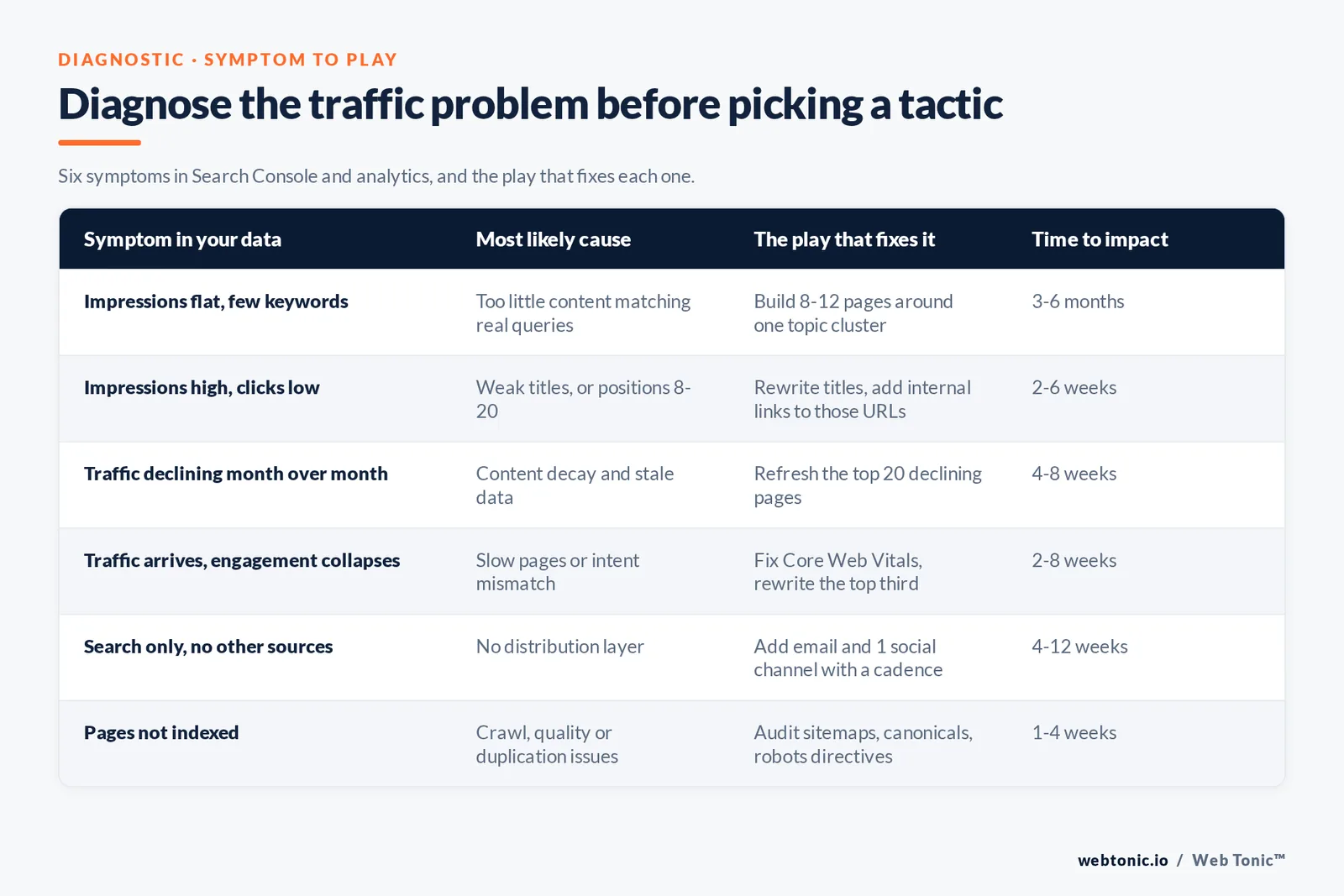
Most traffic problems are one of five things: not enough indexed pages that match demand, pages that rank on page 2, pages that used to rank and decayed, traffic arriving but bouncing, or no distribution beyond search. Diagnose first in Google Search Console and your analytics platform, then pick the matching play.
| Symptom in your data | Most likely cause | The play that fixes it | Time to impact |
|---|---|---|---|
| Impressions flat, few keywords | Too little content matching real queries | Build 8-12 pages around one topic cluster | 3-6 months |
| Impressions high, clicks low | Weak titles or positions 8-20 | Rewrite titles, add internal links to those URLs | 2-6 weeks |
| Traffic declining month over month | Content decay and stale data | Refresh the top 20 declining pages | 4-8 weeks |
| Traffic arrives, engagement collapses | Slow pages or intent mismatch | Fix Core Web Vitals, rewrite the top third of the page | 2-8 weeks |
| Search only, no other sources | No distribution layer | Add email and 1 social channel with a real cadence | 4-12 weeks |
| Pages not indexed | Crawl, quality or duplication issues | Audit sitemaps, canonicals and robots directives | 1-4 weeks |
Rule 1 — never run more than 3 traffic plays at once. Teams that run 9 simultaneously cannot attribute anything, so they repeat whatever felt busiest. Use Google's sitemap documentation for the indexing checks and GA4 traffic acquisition reports for the channel split.
21 ways to increase website traffic, ranked
| Tactic | Channel | Effort | Time to impact | Durability |
|---|---|---|---|---|
| 1. Rewrite titles on positions 5-20 | Organic | Low | 2-4 weeks | Medium |
| 2. Add internal links to priority pages | Organic | Low | 2-6 weeks | High |
| 3. Refresh decaying posts | Organic | Medium | 4-8 weeks | High |
| 4. Target long tail keywords | Organic | Medium | 2-4 months | High |
| 5. Build a topic cluster of 8-12 pages | Organic | High | 3-6 months | Very high |
| 6. Add schema markup for rich results | Organic | Low | 2-8 weeks | Medium |
| 7. Fix Core Web Vitals | Technical | Medium | 4-12 weeks | High |
| 8. Consolidate duplicate posts | Technical | Medium | 4-8 weeks | High |
| 9. Claim and optimise your Business Profile | Local | Low | 2-6 weeks | High |
| 10. Earn links with original data | Digital PR | High | 2-6 months | Very high |
| 11. Guest posts on relevant sites | Digital PR | Medium | 1-3 months | Medium |
| 12. Ship a weekly email to your list | Medium | 1-2 weeks | High | |
| 13. Re-engage lapsed subscribers | Low | 1-3 weeks | Medium | |
| 14. Publish short form video | Social | Medium | 3-8 weeks | Medium |
| 15. Answer questions in niche communities | Social | Low | 1-4 weeks | Low |
| 16. Repurpose 1 article into 5 assets | Social | Low | 2-4 weeks | Medium |
| 17. Add social share buttons and quote cards | Social | Low | 2-6 weeks | Low |
| 18. Run search ads on proven converters | Paid | Medium | Days | None without spend |
| 19. Retarget engaged visitors | Paid | Low | Days | None without spend |
| 20. Partner swaps and co-marketing | Partnerships | Medium | 3-8 weeks | Medium |
| 21. Put your best page in every bio and signature | Owned | Very low | 1-2 weeks | Low |
Trap 1 — starting at number 5 because it sounds strategic. Tactics 1 to 3 are cheap, fast and use pages you already own; they are the reason a site can add double-digit organic growth without publishing a single new article.
Organic search: where durable traffic comes from
Search is the largest addressable source for most sites, and StatCounter puts Google at 91.27% of global search. That makes three things mandatory: pages that match query intent, a crawlable site, and enough authority to compete. Google's guidance on creating helpful, people-first content is the standard your drafts should clear before publication.
| Search lever | What to change | How to verify it worked |
|---|---|---|
| Intent match | Reshape the page to the format the top 10 results use | Average position improves within 4-6 weeks |
| Long tail coverage | Add H2 sections for the 5-10 related questions you rank near | Query count per URL rises in Search Console |
| Titles and snippets | Front-load the keyword, add a specific number or year | CTR up 0.5-2 points at stable position |
| Internal links | 3-5 descriptive links from strong pages to the target | Target URL gains impressions in 2-6 weeks |
| Page experience | Improve LCP toward the 2.5-second threshold | Field data improves in PageSpeed Insights |
| Indexing | Fix sitemaps, canonicals and thin duplicates | Indexed page count rises within 1-4 weeks |
Largest Contentful Paint should land under 2.5 seconds for a good rating, and you can confirm both lab and field values in PageSpeed Insights. Limit 1: speed alone rarely adds traffic — it protects rankings you already earned and lifts conversion on the traffic you have. Our growth marketing programmes sequence content and technical work in that order for exactly that reason.
Traffic sources compared: cost, speed and ceiling
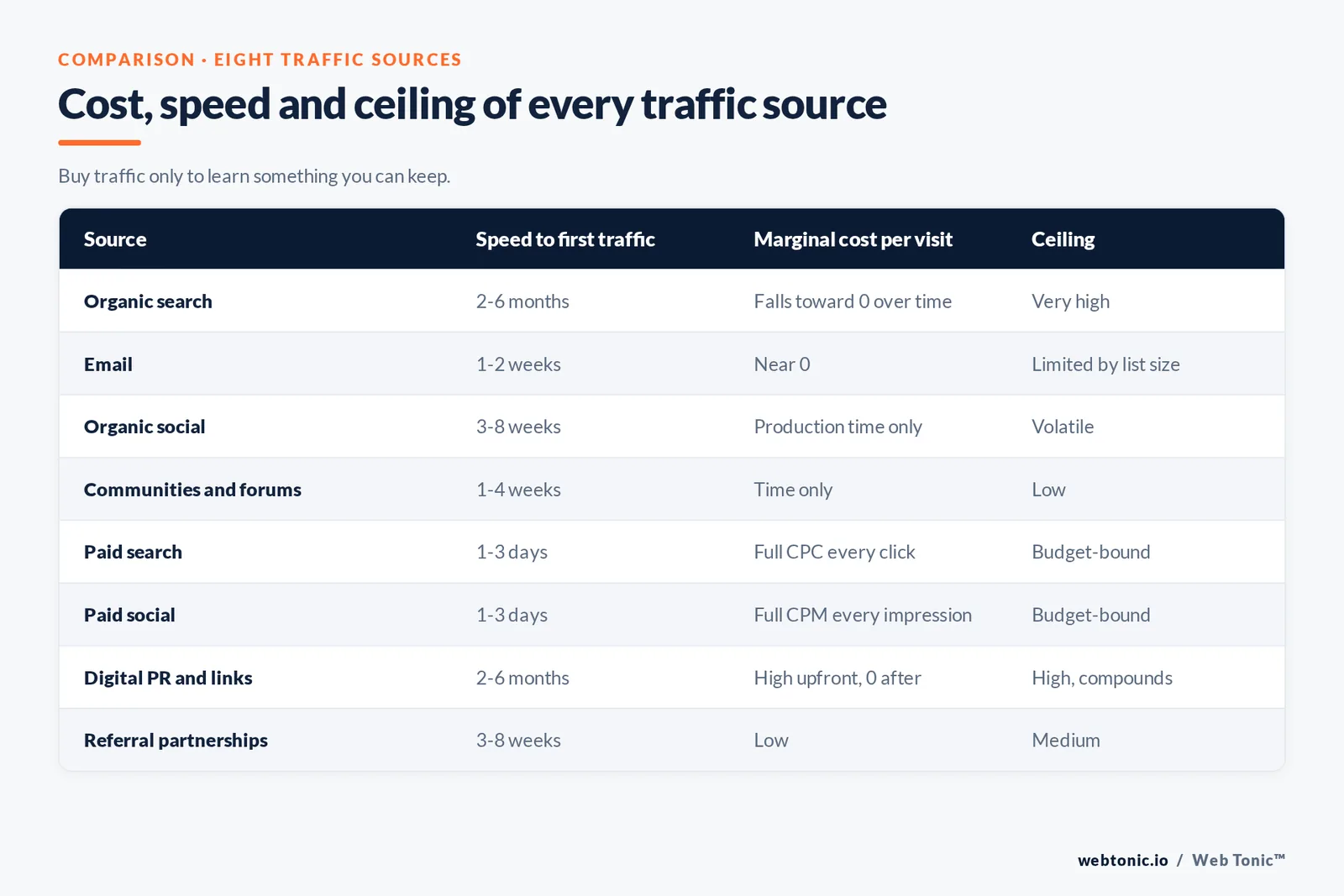
| Source | Speed to first traffic | Marginal cost per visit | Ceiling | Best for |
|---|---|---|---|---|
| Organic search | 2-6 months | Falls toward 0 over time | Very high | Evergreen demand capture |
| 1-2 weeks | Near 0 | Limited by list size | Repeat visits and revenue | |
| Organic social | 3-8 weeks | Production time only | Volatile | Discovery and brand demand |
| Communities and forums | 1-4 weeks | Time only | Low | Early validation, niche B2B |
| Paid search | 1-3 days | Full CPC every click | Budget-bound | Testing offers and keywords fast |
| Paid social | 1-3 days | Full CPM every impression | Budget-bound | Launches and retargeting |
| Digital PR and links | 2-6 months | High upfront, 0 after | High, compounds into search | Authority-limited sites |
| Referral partnerships | 3-8 weeks | Low | Medium | Complementary audiences |
Rule 2 — buy traffic only to learn something you can keep. A 14-day paid test that identifies the 5 headlines and 3 landing angles that convert makes the next 6 months of organic content sharper. Quality Score mechanics in Google Ads reward the same relevance work that helps organic pages, which is why the two programmes should share research.
Social, email and community: the distribution layer
Pew Research Center found 83% of US adults have used YouTube, making video the widest-reach organic surface available. But reach is not traffic: a click-through only happens when the content promises something the platform cannot deliver in-feed.
| Channel | Realistic cadence | What actually drives the click | Repurposing angle |
|---|---|---|---|
| Email newsletter | 1 per week | A single specific insight plus 1 link | Article summary with the data table |
| 3-5 per week | Contrarian take with your own numbers | One finding per post, 5 posts per article | |
| Short form video | 3-5 per week | A hook in the first 2 seconds and a reason to read more | Turn each H2 into a 30-second clip |
| 3-4 per week | Carousels that stop short of the full answer | Table screenshots as carousel slides | |
| 5-10 pins per week | Vertical how-to graphics with searchable text | 1 pin per checklist item | |
| Reddit and niche forums | 2-3 genuine answers per week | Answering fully first, linking second | Expand your best answer into a post |
| Podcast guesting | 1-2 per month | A memorable named framework listeners search for | Transcript into an article |
Email remains the highest-intent channel: published email benchmarks by industry give you a baseline to judge whether the problem is your list or your subject lines. Step 1 — publish the asset. Step 2 — cut it into 5 pieces. Step 3 — schedule those 5 across 2 weeks. Most teams stop after step 1 and then blame the article.
Traffic plays by business type
Limit 2: no business type wins with more than 2 primary plays per quarter. The table below assigns the highest-yield play, one supporting play and the single thing to stop doing.
| Business type | Highest-yield play | Second play | Skip this |
|---|---|---|---|
| Local service business | Business Profile plus 1 page per service and city | Review generation | National blog content |
| Ecommerce | Category page copy and product schema | Email flows plus short form video | Thin 500-word blog posts |
| B2B SaaS | Problem-led topic clusters of 8-12 pages | Comparison and alternatives pages | High-volume generic keywords |
| Publisher | Refresh the top 50 decaying URLs | Newsletter as the retention layer | Publishing more of the same |
| Marketplace | Programmatic pages with real inventory data | Internal linking from hub pages | Indexing empty facets |
| Professional services | Original data study for links and PR | Founder-led LinkedIn distribution | Broad awareness paid social |
| New site, 0 authority | 15-25 long tail pages with low competition | Communities plus 1 partner swap | Head terms above difficulty 50 |
Local businesses should start with the basics of a verified profile, since Google's own Business Profile guidance covers the fields that decide map visibility. For everything else, creative that earns attention is what makes distribution work at all.
Formatting for traffic that stays
Traffic is worthless if visitors leave in 4 seconds. Nielsen Norman Group's research on how little users read found that people read only about a fifth to a quarter of the words on an average visit. Write for that behaviour. Step 4 — measure engaged sessions, not just sessions, so a 30% traffic gain that nobody reads gets flagged instead of celebrated.
| Element | Target | Why it protects traffic |
|---|---|---|
| Answer in the first 2 sentences | Under 40 words | Cuts pogo-sticking back to the results page |
| Paragraph length | 2-4 sentences | Keeps scanning momentum on mobile |
| Subheadings | 1 every 200-300 words | Lets scanners find their question |
| Tables and lists | At least 2 per long article | Earns dwell time and shares |
| Images | 1 every 400-500 words | Breaks the wall of text; supports social previews |
| Internal links | 3-6 contextual links | Turns 1 visit into 2 pageviews |
| Update stamp | Refresh every 6-12 months | Signals currency to readers and crawlers |
A 90-day traffic plan
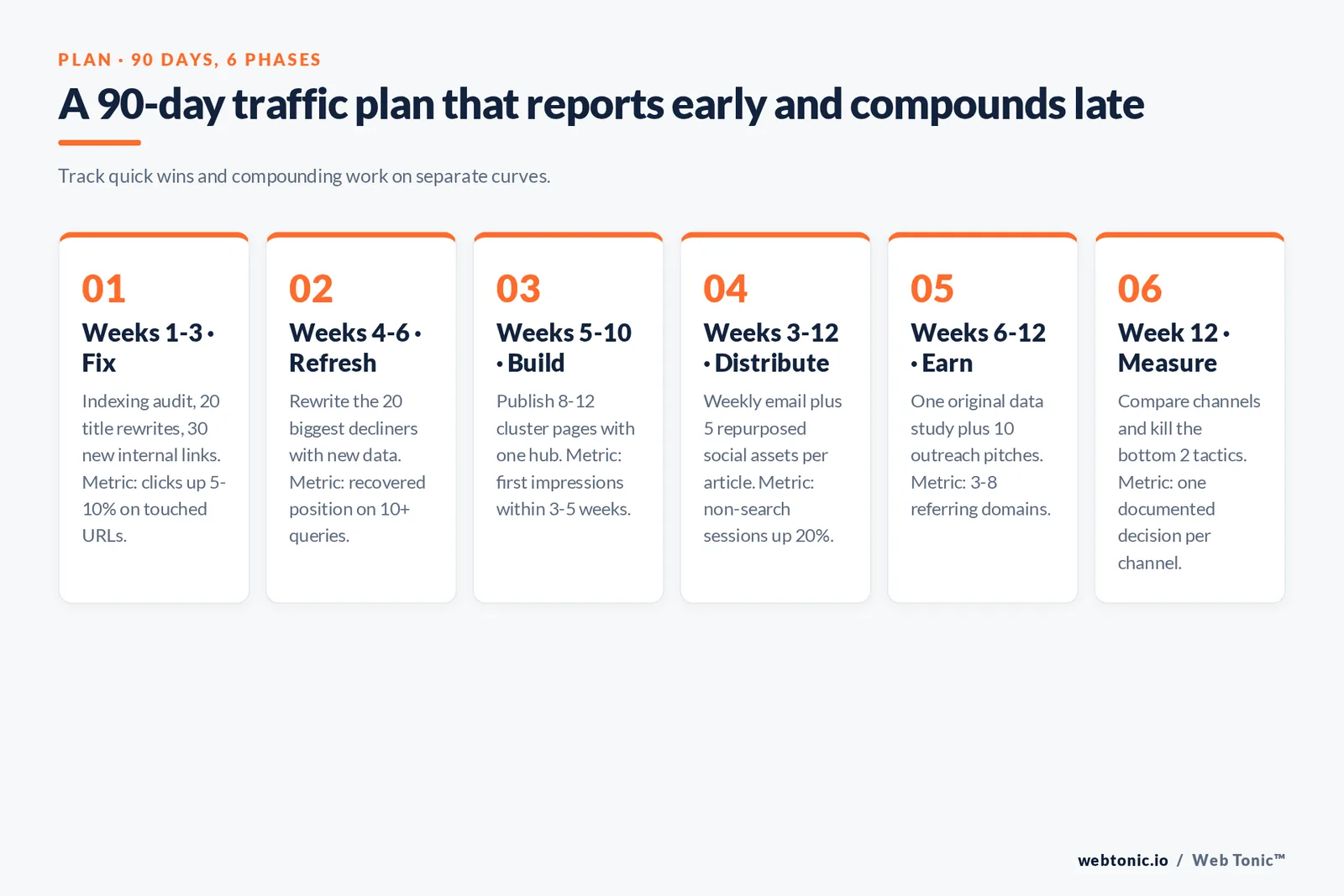
| Phase | Weeks | Actions | Success metric |
|---|---|---|---|
| Phase 1 — Fix | 1-3 | Indexing audit, 20 title rewrites, 30 new internal links | Clicks up 5-10% on touched URLs |
| Phase 2 — Refresh | 4-6 | Rewrite the 20 biggest decliners with new data | Recovered position on 10+ queries |
| Phase 3 — Build | 5-10 | Publish 8-12 cluster pages with 1 hub | First impressions within 3-5 weeks |
| Phase 4 — Distribute | 3-12 | Weekly email plus 5 repurposed social assets per article | Non-search sessions up 20% |
| Phase 5 — Earn | 6-12 | 1 original data study plus 10 outreach pitches | 3-8 referring domains |
| Phase 6 — Measure | 12 | Compare channels, kill the bottom 2 tactics | 1 documented decision per channel |
Trap 2 — judging a 90-day plan at day 30. Phases 1 and 2 report early; phases 3 and 5 need a full quarter. Track them on separate curves or you will cancel the compounding work to protect the quick wins. More step-by-step playbooks live on the Web Tonic blog.
Keyword research: finding the queries you can actually win
Traffic follows demand you can realistically rank for. Long tail keywords — the longer, more specific queries with lower volume — are where a new site earns its first organic visitors, because the top results are often weak, thin or outdated. Build a keyword list around questions your customers ask, then group them into clusters of related posts.
| Keyword type | Typical monthly volume | Competition | Realistic time to rank | Use it for |
|---|---|---|---|---|
| Head term (1-2 words) | 10,000+ | Very high | 12+ months | Hub pages only, once you have authority |
| Mid tail (3 words) | 500-5,000 | High | 6-12 months | Core service and category pages |
| Long tail keywords (4+ words) | 10-500 | Low to medium | 1-4 months | Blog posts that answer 1 question fully |
| Question queries | 10-300 | Low | 1-3 months | FAQ sections and support content |
| Comparison and alternatives | 50-2,000 | Medium | 2-6 months | High-intent commercial pages |
| Branded queries | Varies | Low | Immediate | Protecting existing demand for your brand |
| Local modifiers | 20-1,000 | Medium | 1-3 months | 1 page per service and city |
Step 5 — start with 20 long tail keywords, not 3 head terms. Twenty pages each earning 40 visitors a month is 800 monthly visits from queries with real purchase intent, and each one becomes an internal link target for the harder terms later.
Free and paid tools that find traffic opportunities
| Tool | Cost | Best question it answers | How often to check |
|---|---|---|---|
| Google Search Console | Free | Which queries are we near-ranking for right now? | Weekly |
| Google Analytics | Free | Which channels bring visitors who actually engage? | Weekly |
| Google Trends | Free | Is this topic growing or seasonal? | Per content plan |
| Google Keyword Planner | Free with an Ads account | What volume and commercial value does a keyword carry? | Monthly |
| PageSpeed Insights | Free | Are Core Web Vitals hurting our page experience? | Monthly |
| All-in-one SEO suites | $100-500 per month | Which backlinks and keywords do competitors have that we do not? | Monthly |
| Rank tracker | $20-100 per month | Did our changes move the 30 keywords that matter? | Weekly |
| Heatmap and session tools | $0-90 per month | Where do visitors give up on the page? | Per test |
Limit 3: no tool creates traffic. A free stack of Search Console, an analytics property, Trends and Keyword Planner is enough to run every play in this guide; paid suites mainly save research time and expose competitor backlinks. Start free, upgrade when the bottleneck is genuinely data and not execution.
Backlinks and authority: the ceiling on everything else
Two sites can publish the same quality of content and get very different results, because backlinks from relevant sites remain a core ranking input. If your pages are good but stuck on page 2, authority — not word count — is usually the constraint.
| Link tactic | Effort per link | Quality of links earned | Risk |
|---|---|---|---|
| Original data study or survey | High upfront, 0 per link after | Excellent — journalists cite data | None |
| Free tool or calculator | High | Excellent, compounds for years | None |
| Expert commentary and quotes | 1-2 hours per placement | Good, high relevance | None |
| Guest posts on relevant sites | 4-8 hours | Medium to good | Low if genuinely editorial |
| Digital PR around a launch | High | Good but time-bound | None |
| Partner and supplier pages | 1 email | Medium | None |
| Directory and profile listings | Minutes | Low, but useful for local trust | Low |
| Paid link networks | Money only | Toxic | High — against search engine guidelines |
Trap 3 — buying 50 links in 1 month. A sudden burst of unrelated referring domains is exactly the pattern search engines look for. Earn 3 to 8 relevant links a quarter with assets people want to cite, and the same content you already publish starts ranking higher without any extra writing.
Traffic mistakes that waste a quarter
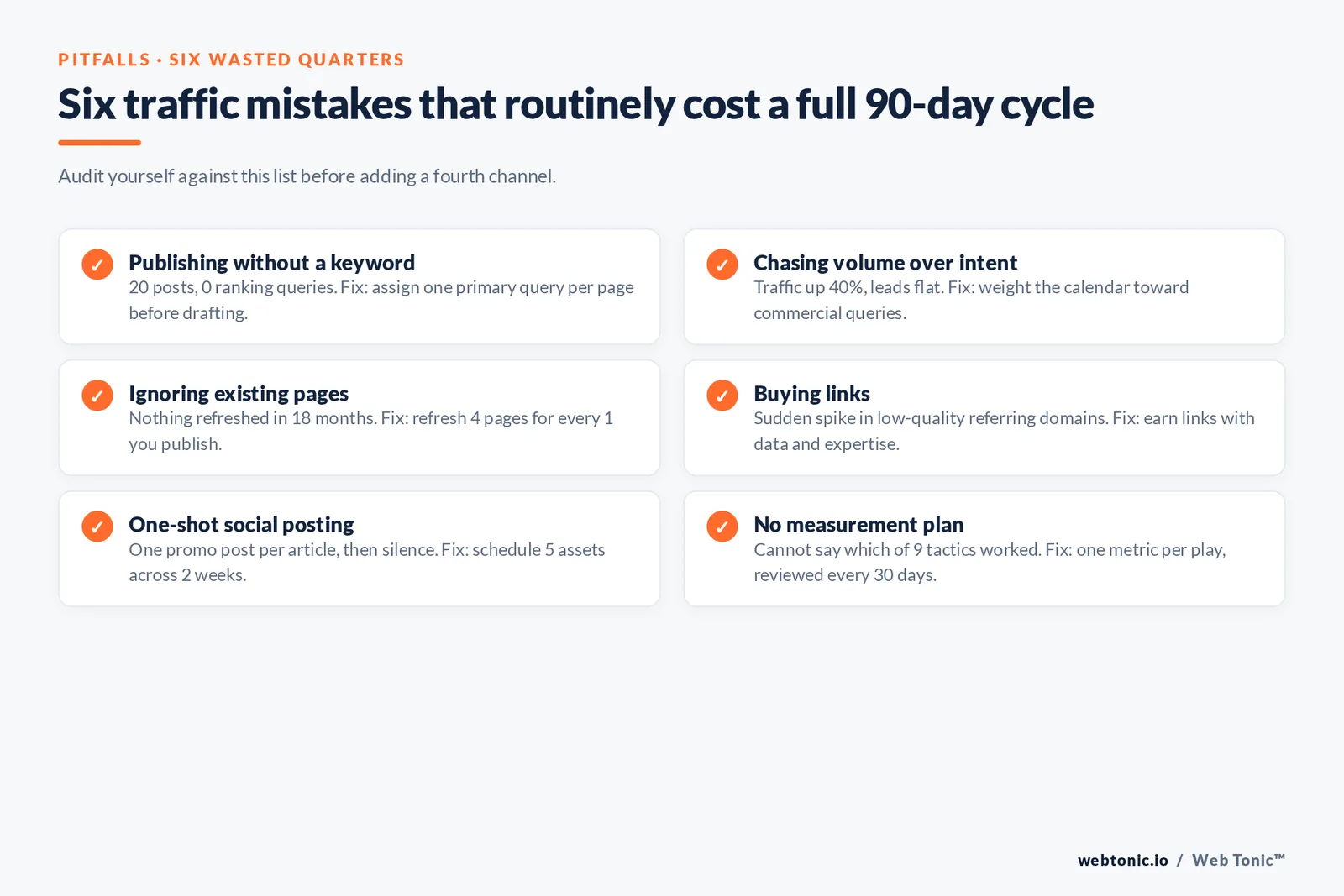
Each of these 6 mistakes routinely costs a team a full 90-day cycle. Rule 3 — audit yourself against this list before adding a 4th channel.
| Mistake | What it looks like | Fix |
|---|---|---|
| Publishing without a keyword | 20 posts, 0 ranking queries | Assign 1 primary query per page before drafting |
| Chasing volume over intent | Traffic up 40%, leads flat | Weight the calendar toward commercial queries |
| Ignoring existing pages | Nothing refreshed in 18 months | Refresh 4 pages for every 1 you publish |
| Buying links | Sudden spike in low-quality referring domains | Earn links with data and expertise instead |
| One-shot social posting | 1 promo post per article, then silence | Schedule 5 assets across 2 weeks per article |
| No measurement plan | Cannot say which of 9 tactics worked | 1 metric per play, reviewed every 30 days |
FAQ
How long does it take to increase website traffic?
Fast plays such as title rewrites, internal linking and refreshing decaying pages usually show movement in two to six weeks because the pages are already indexed. New content clusters and link-earning work typically need three to nine months before they contribute meaningful volume.
How can I increase website traffic for free?
Focus on assets you already own: rewrite titles on pages ranking between positions five and twenty, add internal links from your strongest pages, refresh outdated posts, answer questions in relevant communities, and email your existing list weekly. None of that requires a budget, only consistency.
Is paid traffic worth it if organic is slow?
Paid traffic is worth it as a learning tool and for time-sensitive launches. It buys immediate visits but stops the moment spend stops, so treat it as a way to validate offers, headlines and landing pages that your organic programme can then compound.
How much content do I need to publish?
Depth beats frequency. A cluster of eight to twelve genuinely useful pages around one topic usually outperforms forty unfocused posts, and a refresh-to-publish ratio of roughly four to one keeps existing traffic from decaying while you expand.
Which tools do I need to track traffic properly?
Google Search Console for query, click and indexing data, an analytics platform such as GA4 for channel and behaviour data, and PageSpeed Insights for page experience. That trio answers almost every diagnostic question without additional spend.
Want the plan built against your own data?
Diagnosis is the difference between a traffic plan and a wish list. If you want the 90-day version mapped to your crawl, Search Console and revenue data, tell us what you are working with or see how we run organic and paid together across our services.
Sources: Google Search Console · Google Search Central (sitemaps overview, creating helpful content) · Google Analytics Help (traffic acquisition) · Google Business Profile Help · Google Ads Help (Quality Score) · StatCounter Global Stats search engine market share · web.dev Largest Contentful Paint · PageSpeed Insights · Pew Research Center, Americans' Social Media Use 2024 · Mailchimp email marketing benchmarks · Nielsen Norman Group, How Little Do Users Read.