Table of contents
Key Takeaways
- Google AI Overviews are Gemini-powered summaries placed at the top of search results that synthesize answers from multiple web sources directly on the results page.
- These generated summaries now appear on roughly 15–30% of all queries, with informational and long-tail questions triggering them most frequently.
- Organic click-through rates dropped 8–12% on queries where an overview appears, according to monitoring studies from Semrush and BrightEdge.
- Sites cited inside an overview see up to 2× more referral clicks than those ranked in traditional positions 4–10, making inclusion a high-value SEO target.
- Structured data, clear E-E-A-T signals, and concise answer-first formatting are the three strongest ranking factors for earning a citation in the generated summary.
- Google Search Console now surfaces impression data for AI-generated summaries, giving publishers a direct window into how their pages perform in the new format.
What Are Google AI Overviews?
Google AI Overviews are AI-generated summaries that appear at the top of the search engine results page. When a user types a complex query, Google uses its Gemini model to pull information from multiple web sources, condense it into a readable paragraph, and display it above the traditional organic listings. The feature evolved from the earlier Search Generative Experience (SGE) testing phase and is now live across more than 100 countries.
Unlike featured snippets that quote a single page, these generated summaries blend citations from several publishers and include inline links to the original sources. Understanding how they work is essential for any modern growth marketing or SEO program.
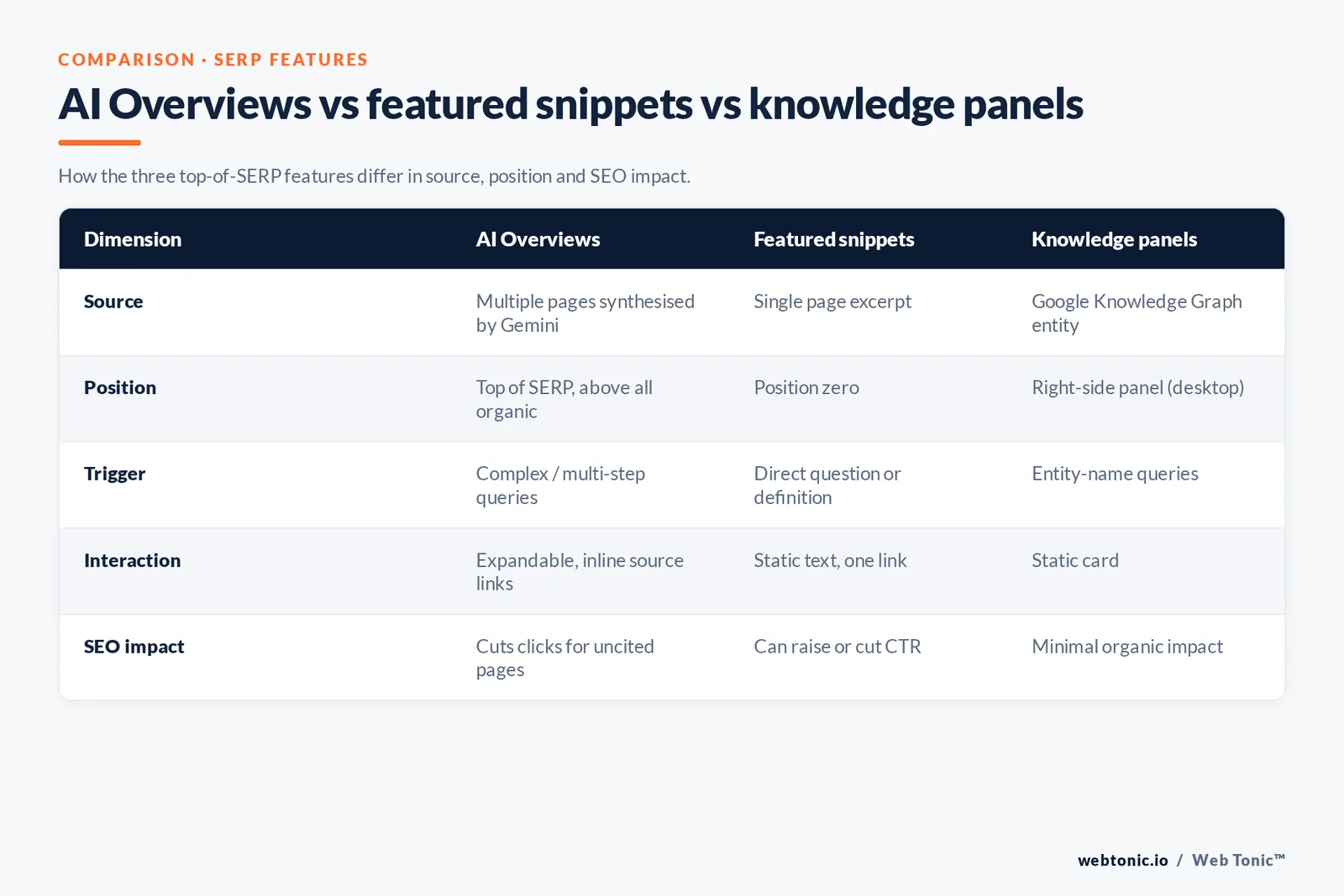
| Feature | AI Overviews | Featured Snippets | Knowledge Panels |
|---|---|---|---|
| Source | Multiple web pages synthesized by Gemini | Single page excerpt | Google Knowledge Graph entity data |
| Position | Top of SERP, above all organic results | Position zero, above organic listings | Right-side panel on desktop |
| Trigger | Complex, informational, or multi-step queries | Direct question or definition queries | Entity-name queries (people, brands, places) |
| User Interaction | Expandable with "Show more" + inline source links | Static text with a single source link | Static card, sometimes editable by the entity owner |
| SEO Impact | Reduces clicks for uncited pages, boosts cited ones | Can increase or decrease CTR by query type | Minimal direct organic traffic impact |
How Do Google AI Overviews Work?
Google retrieves a shortlist of relevant web pages for the query, then passes those pages through its Gemini large language model — fine-tuned for accurate summarization. The model extracts key claims, verifies them across sources, and generates a consolidated answer. Inline citations link back to the pages whose content informed the summary.
Not every search triggers an overview. Google's systems evaluate query complexity, topic sensitivity, and available source quality before deciding to display one. Medical, legal, and financial queries ("Your Money or Your Life" topics) face stricter thresholds because inaccurate generated summaries carry higher risk.
Which Queries Trigger Overviews?
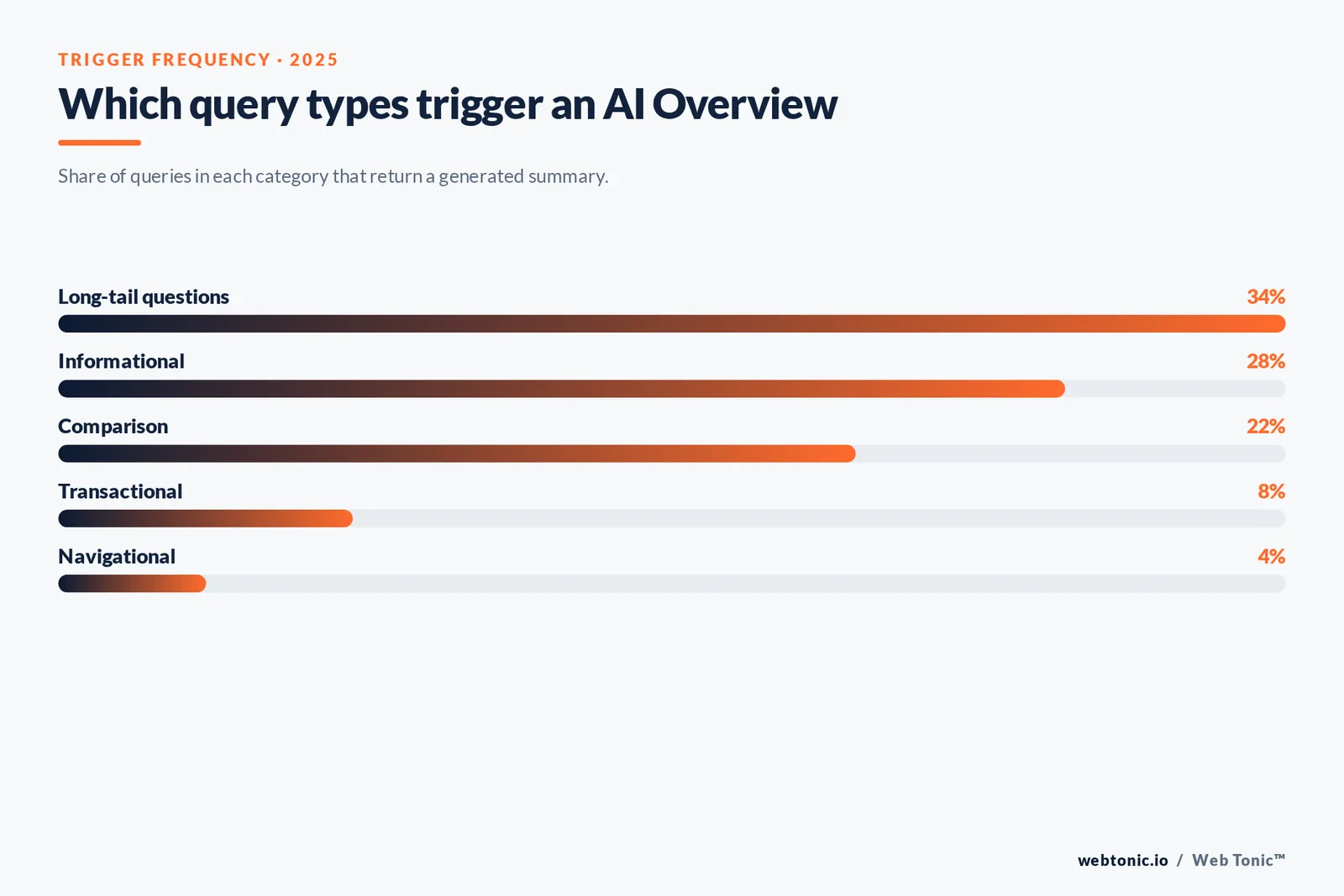
Long-tail informational queries are the strongest triggers. A search like "how does Google rank pages in 2025" is far more likely to produce an overview than a navigational query like "Gmail login." Research from Semrush (2025) found that informational queries trigger a generated summary 3.5× more often than transactional ones. Questions beginning with "how," "what," and "why" dominate the trigger set.
| Query Type | Trigger Frequency | Example |
|---|---|---|
| Informational | 28% of queries | "what causes inflation" |
| Long-Tail Questions | 34% of queries | "how to remove coffee stains from silk" |
| Comparison | 22% of queries | "react vs vue for enterprise apps" |
| Navigational | 4% of queries | "facebook login" |
| Transactional | 8% of queries | "buy running shoes online" |
Impact on Organic Search Traffic
The introduction of generated summaries at the top of Google search has forced publishers to reconsider how they measure organic visibility. When a comprehensive answer sits above all traditional links, many users never scroll further.
BrightEdge reported an 8–12% decline in CTR for pages ranked in positions 1–3 on queries where an overview appears. However, pages that are cited within the overview experience a different dynamic: they receive referral traffic from the inline source links, often outperforming their expected click share based on position alone.
The net effect is a redistribution, not elimination, of clicks. Brands investing in data intelligence and structured content see their cited pages gain while uncited competitors lose ground. A Sistrix analysis of 10 million queries found cited domains captured up to 2× the traffic of non-cited domains occupying the same organic positions.
How Google Selects Sources for Overviews
Earning a citation inside an overview is the new competitive frontier. Google's selection criteria mirror its broader quality guidelines, but three factors carry outsized weight:
- E-E-A-T signals (Experience, Expertise, Authoritativeness, Trustworthiness) — pages with named expert authors, clear credentials, and robust backlink profiles are cited more often.
- Structured data markup — schema types like Article, FAQPage, HowTo, and DefinedTerm help the model parse content accurately.
- Concise, answer-first formatting — content that leads with a direct answer in the first 100 words and uses clear H2/H3 hierarchy gets extracted more reliably.
Google's documentation in Search Central's helpful content guidelines stresses that pages should serve user intent first. For overviews, that means writing content the model can cite without heavy summarization — the model favors sources it can quote nearly verbatim.
SEO Strategies to Optimize for AI Overviews
Adapting your approach for generated summaries is no longer optional. The following tactics maximize your chances of being cited and maintaining organic traffic:
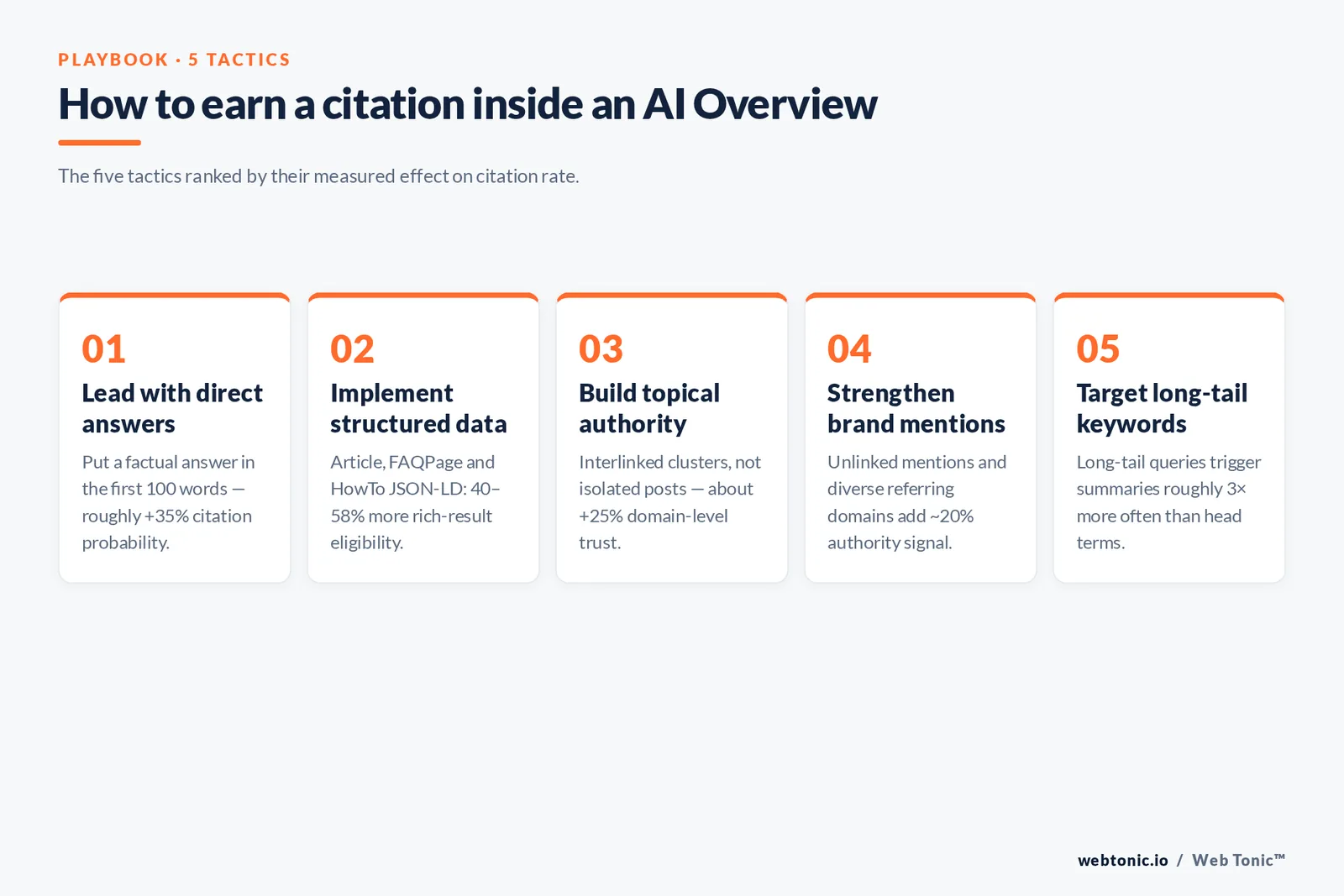
1. Lead With Direct Answers
Place a clear, factual answer within the first 100 words of every page. Google's model scans opening paragraphs first when sourcing claims for the overview. If your page buries the answer under three paragraphs of context, a competitor's answer-first page will be cited instead.
2. Implement Structured Data
Add Article, FAQPage, and HowTo schema to every eligible page. According to Yoast's structured data guide, pages with JSON-LD markup are 40–58% more likely to appear in rich results and citations. Use Google Search Console to validate your schema and monitor impression changes after implementation.
3. Build Topical Authority
Publish clusters of interlinked pages covering every angle of a subject. Google's model trusts domains that demonstrate deep expertise. A single isolated article on "SEO audit" is far less likely to be cited than a hub site covering audits, keyword research, link building, and technical fixes — all cross-linked. Strong topical authority also supports broader digital marketing services.
4. Strengthen Brand Mentions and Backlinks
Unlinked brand mentions across the web serve as trust signals for the Gemini model. According to Moz's domain authority research, domains with diverse referring domains rank higher in cited results. Earning backlinks from high-authority publishers in your niche compounds this effect.
5. Focus on Long-Tail Keywords
Because long-tail queries trigger summaries at nearly 3× the rate of head terms, they represent the fastest path to citation visibility. Identify multi-word questions using Google Search Console's query report, then create dedicated pages that answer each one comprehensively.
| Optimization Tactic | Impact on Citation Rate | Implementation Effort |
|---|---|---|
| Answer-first formatting | +35% citation probability | Low — editorial rewrite |
| JSON-LD structured data | +40–58% rich result eligibility | Medium — developer involvement |
| Topical authority clustering | +25% domain-level trust | High — sustained content investment |
| Long-tail keyword focus | 3× higher trigger frequency | Medium — keyword research + new pages |
| Brand mention building | +20% authority signal | Medium — PR and outreach |
Tracking Performance in Google Search Console
Measurement is evolving alongside the feature itself. Google Search Console now includes an appearance filter in the Performance report, letting you see impressions and clicks specifically from queries where your page appeared in (or alongside) a generated summary. Monitor these metrics weekly to gauge the real-world impact on your traffic.
Third-party tools like Semrush and Ahrefs have added overview tracking to their SERP analysis modules. These platforms flag which of your keywords trigger a summary and whether your domain appears as a cited source — critical data intelligence for adjusting your content calendar.
Common Mistakes to Avoid
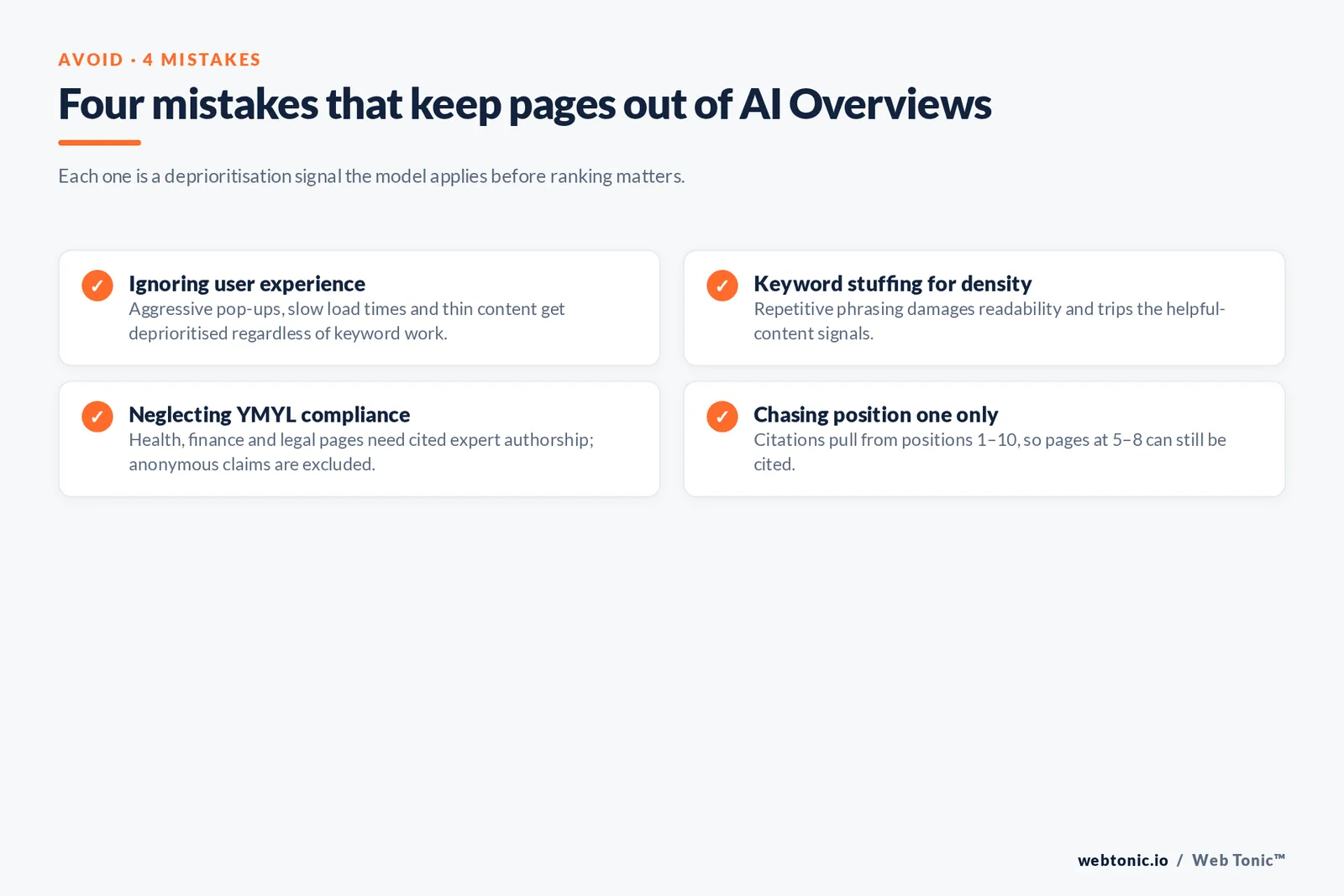
- Ignoring user experience (UX) — pages with aggressive pop-ups, slow load times, or thin content get deprioritized by the model regardless of keyword optimization.
- Keyword stuffing for density — overloading content with repetitive phrases damages readability and triggers Google's helpful content signals against the page.
- Neglecting YMYL compliance — health, finance, and legal pages require cited expert authorship. Anonymous or unsourced claims are excluded from generated summaries on these topics.
- Focusing only on position one — citations pull from pages ranked 1–10, so optimizing pages in positions 5–8 can yield citations even without reaching the top spot.
The Future of AI in Search
Google continues expanding the scope and sophistication of generated summaries. Ads are now integrated into the feature, with sponsored links appearing beneath the generated answer in select commercial queries. The advertising layer means brands can reach users even when organic citations are hard to earn.
Multimodal results — combining text, images, and video references — are rolling out for product and how-to queries. Google's roadmap suggests that by late 2026, generated answers will appear on more than 50% of all informational queries. Marketers who invest now in structured, authoritative, answer-first content will hold a durable competitive edge as search evolves. Keeping your web presence technically sound and your content expertise visible is the clearest path to sustained organic performance.
Frequently Asked Questions
What is the difference between AI Overviews and the Search Generative Experience?
The Search Generative Experience (SGE) was Google's experimental name for AI-powered summaries during the 2023–2024 testing phase. AI Overviews is the production name for the same feature after it graduated from Google Labs and rolled out globally. The underlying technology remains the Gemini large language model, but the production version has tighter guardrails, fewer hallucinations, and broader query coverage.
Do Google AI Overviews hurt website traffic?
They redistribute it. Pages that earn citations inside the overview often see increased clicks, while uncited pages in the same SERP lose 8–12% of their previous click-through rate. The net impact depends on whether your content is good enough to be cited as a source.
Can you opt out of AI Overviews?
Google does not offer a direct opt-out from having your content used in generated summaries. However, the nosnippet meta robots tag prevents Google from displaying snippets of your page, which also excludes it from the overview. The trade-off is losing all snippet visibility, including featured snippets.
How do ads appear in AI Overviews?
Google displays sponsored links within and below generated summaries for commercial-intent queries. These ads use the same auction and bidding system as standard search ads. Advertisers can reach users through performance creative placements that follow the same quality guidelines as regular search ads.
What types of content perform best in AI Overviews?
Content that is factual, well-structured with clear headings, supported by cited data, and formatted with answer-first paragraphs performs best. Pages using JSON-LD schema (Article, FAQPage, HowTo) and demonstrating strong E-E-A-T signals earn citations at the highest rate. Visit our blog for more SEO strategy guides.
Sources: Google Search Central – Creating Helpful Content (developers.google.com, 2025); Semrush – AI Overview Research Report (semrush.com, 2025); BrightEdge – Generative AI Search Impact Study (brightedge.com, 2025); Sistrix – Visibility Analysis of AI Overviews (sistrix.com, 2025); Yoast – Structured Data Schema Guide (yoast.com, 2025); Moz – Domain Authority Research (moz.com, 2025); Ahrefs – SERP Feature Tracking (ahrefs.com, 2025).