Table of contents

Increasing your online presence means being findable, credible and current on the handful of surfaces your target audience actually checks. Five surfaces do most of the work: your website, Google Business Profile, one or two social media platforms, email and reviews.
Key Takeaways
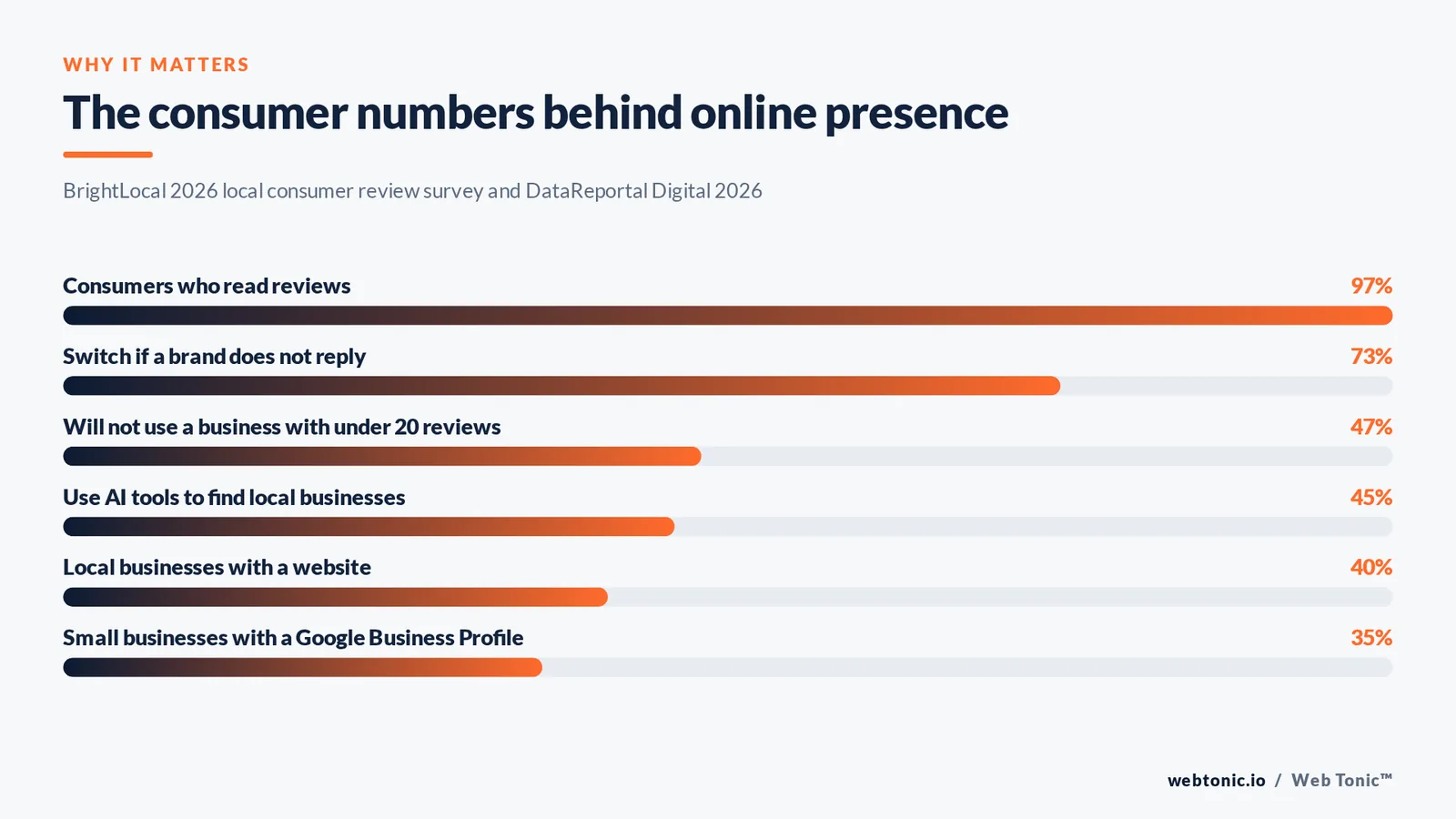
- Only 40% of local businesses have a dedicated website and just 35% have a Google Business Profile (BrightLocal 2026), so basic completeness still beats clever tactics.
- 5.66 billion people use social media for 2h40m a day across 6.75 networks each (DataReportal 2026) — presence means depth on two platforms, not accounts on all of them.
- 73% of consumers switch to a competitor if a brand does not reply, and 97% read reviews: online reputation is a visibility channel, not an afterthought.
- Score your presence out of 100 before spending anything — most businesses find 3 or 4 free fixes worth more than a new campaign.
What an online presence actually is
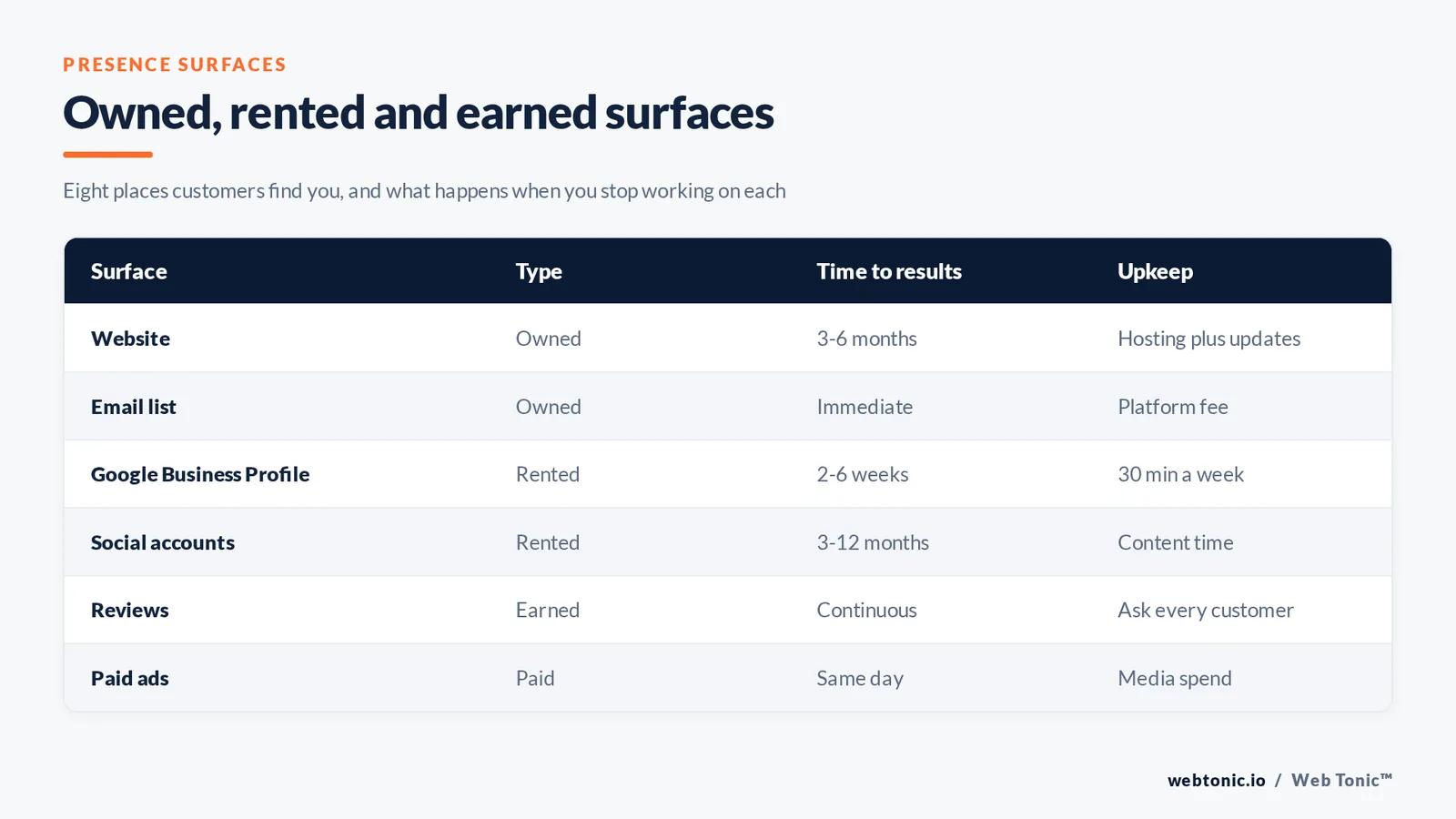
An online presence is the total set of places a customer can encounter your business without you paying for that specific impression, plus the paid ads that fill the gaps. Split it into owned, earned and rented surfaces, because each behaves differently when you stop working on it.
| Surface | Type | Who controls it | Time to results | Cost to maintain |
|---|---|---|---|---|
| Website | Owned | You | 3-6 months for organic search | Hosting plus updates |
| Email list | Owned | You | Immediate once built | Platform fee |
| Google Business Profile | Rented | 2-6 weeks | Free, 30 minutes a week | |
| Social media accounts | Rented | The platform | 3-12 months organically | Content time |
| Reviews and ratings | Earned | Your customers | Continuous | Ask consistently |
| Press and mentions | Earned | Journalists and creators | Unpredictable | Outreach time |
| Paid ads | Paid | You, while the budget runs | Same day | Media spend |
| AI assistants and answer engines | Earned | The model providers | Follows the rest | Structured, citable content |
Rule 1 — owned surfaces are the only ones that keep working at zero budget. Rented surfaces amplify; they do not accumulate. That is why a strong online presence puts the website and the email list at the centre, then uses social media and ads to feed them.
The 100-point online presence audit
Score yourself before you plan anything. Each line is either done or not done, and the whole audit takes about 40 minutes.
| Check | Points | Pass condition |
|---|---|---|
| Website loads in under 2.5 seconds on mobile | 10 | Core Web Vitals pass in Search Console |
| Every service or product has its own page | 10 | One page per offer, not one combined list |
| Google Business Profile verified and complete | 15 | Categories, hours, photos, services, 750-character description |
| 20 or more reviews, with replies | 15 | Reviews in the last 3 months |
| Consistent name, address and phone everywhere | 10 | Website, profile and top directories match |
| Two active social media platforms | 10 | Posted in the last 7 days on both |
| Email list with a monthly send | 10 | Signup form on the site, list growing |
| Content published monthly | 10 | One useful article or video per month |
| Analytics and conversion tracking live | 5 | Goals recorded, not just sessions |
| Brand searchable by name | 5 | You rank first for your own brand |
Under 50 points means fix fundamentals; 50-80 means depth and consistency; above 80 means it is time to spend money on reach. Teams that want the audit run for them can see how we scope it on our growth marketing page.
Your website: the hub every other channel points to
Social networks rent you attention. Your website converts it. BrightLocal found 54% of consumers visit a company's website after reading positive reviews, up from 32% in 2019, so the hub has to be ready before you drive traffic to it.
| Website element | Why it increases online presence | Standard to hit |
|---|---|---|
| One page per product or service | Gives search engines a rankable target per query | 300+ words, real photos, clear price signal |
| Location pages | Wins local queries you cannot win from the homepage | One per city you truly serve |
| Proof: reviews, case studies, logos | Converts the visitor a review sent you | 3 proof elements above the fold |
| Clear call to action | Turns visibility into enquiries | One primary CTA per page |
| Fast mobile experience | Mobile is over half of all sessions | LCP under 2.5 seconds |
| Blog or resource hub | Attracts non-brand search demand | Two useful posts a month |
| Structured data | Makes the site quotable by AI assistants | Organization, LocalBusiness, FAQ markup |
For the traffic side of the equation, our guide on how to increase website traffic goes channel by channel; the U.S. Small Business Administration also publishes a plain-language marketing and sales guide for first-time owners.
Google Business Profile and local service ads
For any business with a service area, the profile outperforms the website for discovery. Google ranks profiles on relevance, distance and prominence, as its own local ranking guidance states.
| Profile action | Effect on visibility | Frequency |
|---|---|---|
| Set the precise primary category | Decides which queries you appear for | Once, then review yearly |
| Complete every field | Complete profiles are seen as 2.7x more reputable (Google) | Once, then quarterly |
| Add services and products with prices | Matches long-tail service queries | Monthly |
| Post weekly updates | Keeps the profile active and clickable | Weekly |
| Upload 10+ real photos | Photo-rich profiles earn more clicks and calls | Monthly |
| Answer questions in the Q&A | Pre-empts objections in the search result | Monthly |
| Run Local Service Ads where eligible | Buys the top slot above the map pack at roughly $60 per lead | Ongoing |
Keep hours, holiday hours and the phone number accurate: 68% of consumers stop using a local business after finding incorrect information online. Google's profile guidelines define what you may and may not put in the business name field — keyword stuffing there risks suspension.
Social media platforms: choose two and go deep
Spreading across six social networks with one post a week each produces no presence anywhere. Pick the two where your target audience already spends time, then match the content format to the platform.
| Platform | Best for | Content that works | Benchmark engagement |
|---|---|---|---|
| Local services, retail, hospitality, personal brands | Reels, carousels, behind the scenes | 0.48% average engagement rate (Socialinsider 2026) | |
| TikTok | Reaching new audiences fast, younger consumers | Short demonstrations, before and after | 2.60% engagement, shares up 45% year over year |
| Local community, 35+ consumers, groups and events | Events, offers, community posts | 0.15% engagement, so treat reach as paid | |
| B2B services, recruiting, founder-led marketing | Practitioner posts, client results, hiring news | Highest B2B lead quality per post | |
| YouTube | High-consideration purchases, evergreen demand | How-to and comparison videos | Compounds like search, not like social |
| Home, wedding, food, design products | Vertical images with text overlay | Long content half-life |
Pew Research tracks which platforms different age groups actually use in its social media fact sheet, and DataReportal's Digital 2026 report puts global usage at 5.66 billion identities and 2 hours 40 minutes a day. Build the posting system before the content: Buffer's social media strategy framework is a workable template, and our social media management guide covers cadence and tooling.
Content marketing: the part of your presence that compounds
Ads stop when the budget stops. Content keeps answering questions. Over 60% of product discovery now starts on social or search rather than on a brand's own site, so publish where the question is asked and pull people back to the hub.
| Content type | Question it answers | Where it lives | Cadence |
|---|---|---|---|
| Service explainer | What exactly do I get and what does it cost? | Website page | Once, refreshed yearly |
| How-to article | Can I do this myself, and what is involved? | Blog | Twice a month |
| Comparison piece | Which option is right for me? | Blog | Monthly |
| Case study | Has this worked for someone like me? | Website | Monthly |
| Short vertical video | What does the work look like? | Instagram, TikTok, YouTube Shorts | 2-3 a week |
| Email newsletter | What is new and useful this month? | Inbox | Monthly |
| FAQ and glossary pages | Definition and process questions | Website | Batch quarterly |
HubSpot's overview of building an online presence makes the same point from the demand side: consistency beats volume. One genuinely useful article a month, promoted properly, outperforms weekly filler.
Email marketing: the audience nobody can throttle
Email is the only channel where you own the distribution list. Benchmarks give you a sanity check: average opens run near 20.7% and click-through near 2.3% across industries.
| Email asset | Purpose | Target metric |
|---|---|---|
| Welcome sequence | Convert new subscribers while intent is high | 40%+ open on email one |
| Monthly newsletter | Stay present between purchases | 2%+ click-through |
| Abandoned cart or enquiry follow-up | Recover lost revenue | 5-10% recovery |
| Review request | Feed the reputation engine | 10-20% leave a review |
| Reactivation campaign | Wake dormant customers | 1-3% reactivate |
| Signup incentive on site | Grow the list | 1-3% of visitors subscribe |
Compare your numbers against Mailchimp's industry benchmarks and read Litmus on email marketing ROI before deciding the channel is too old-fashioned for your customers.
Online reputation: reviews decide whether presence converts
Being visible and being trusted are separate problems. BrightLocal's 2026 survey found 97% of consumers read reviews, 47% will not use a business with fewer than 20 reviews, and 74% only value reviews from the last three months.
| Reputation task | Why it matters | How to run it |
|---|---|---|
| Ask every satisfied customer | Volume and recency both matter | SMS or email within 24 hours of service |
| Reply to all reviews | 80% of consumers favour businesses that reply to everything | Within 48 hours, no templates |
| Handle negative reviews publicly | 77% are less likely to use a business after negatives | Acknowledge, fix, move it offline |
| Diversify review sources | Google fell from 83% to 71% as the main source | Add industry-specific platforms |
| Monitor AI recommendations | 45% now use AI tools to find local businesses | Ask an assistant for your category monthly |
| Show reviews on the website | Converts the traffic reviews send you | Embed a live feed on service pages |
The full dataset is worth reading in BrightLocal's Local Consumer Review Survey. Reputation work also lifts brand search volume, which is the cleanest single indicator of presence — see our guide to brand awareness for how to measure it.
Social listening and customer service as visibility
Every public reply is an impression. Social listening turns customer service into a discovery channel, because prospects read how you handle other people before they contact you.
| Listening action | Tool level | What you do with it |
|---|---|---|
| Track brand and misspelling mentions | Free alerts | Reply within a day, thank or fix |
| Track competitor mentions | Paid listening tool | Spot switching intent and unmet needs |
| Track category questions | Platform search plus saved queries | Turn recurring questions into content |
| Monitor comment sentiment | Native analytics | Adjust messaging monthly |
| Respond to every DM | Manual or shared inbox | 73% switch when a brand does not reply |
| Publish the answers | Website FAQ | One customer question becomes one page |
Paid ads: buying presence while the organic version builds
Ads are the accelerator, not the engine. Use them to hold the surfaces that matter while search and reputation compound. All-industry search benchmarks sit near $5.42 cost per click, 6.64% click-through rate and $66.69 per lead.
| Ad type | Best use in a presence plan | Realistic entry budget |
|---|---|---|
| Brand search ads | Defend your own name against competitors | $150-400 a month |
| Local Service Ads | Own the slot above the map pack | Pay per lead, roughly $60 |
| Non-brand search ads | Capture in-market demand now | $1,000+ a month |
| Meta ads to a lead form | Fill the pipeline while SEO builds | $800+ a month |
| Retargeting | Convert the visitors content already earned | $200-500 a month |
| Short-video ads | Cheap reach for a new brand | $500+ a month |
Google's own research library, Think with Google, is a reasonable place to sanity-check consumer search behaviour before you set budgets. If you want the media plan built and measured properly, that is what our services exist for — get in touch with your current numbers.
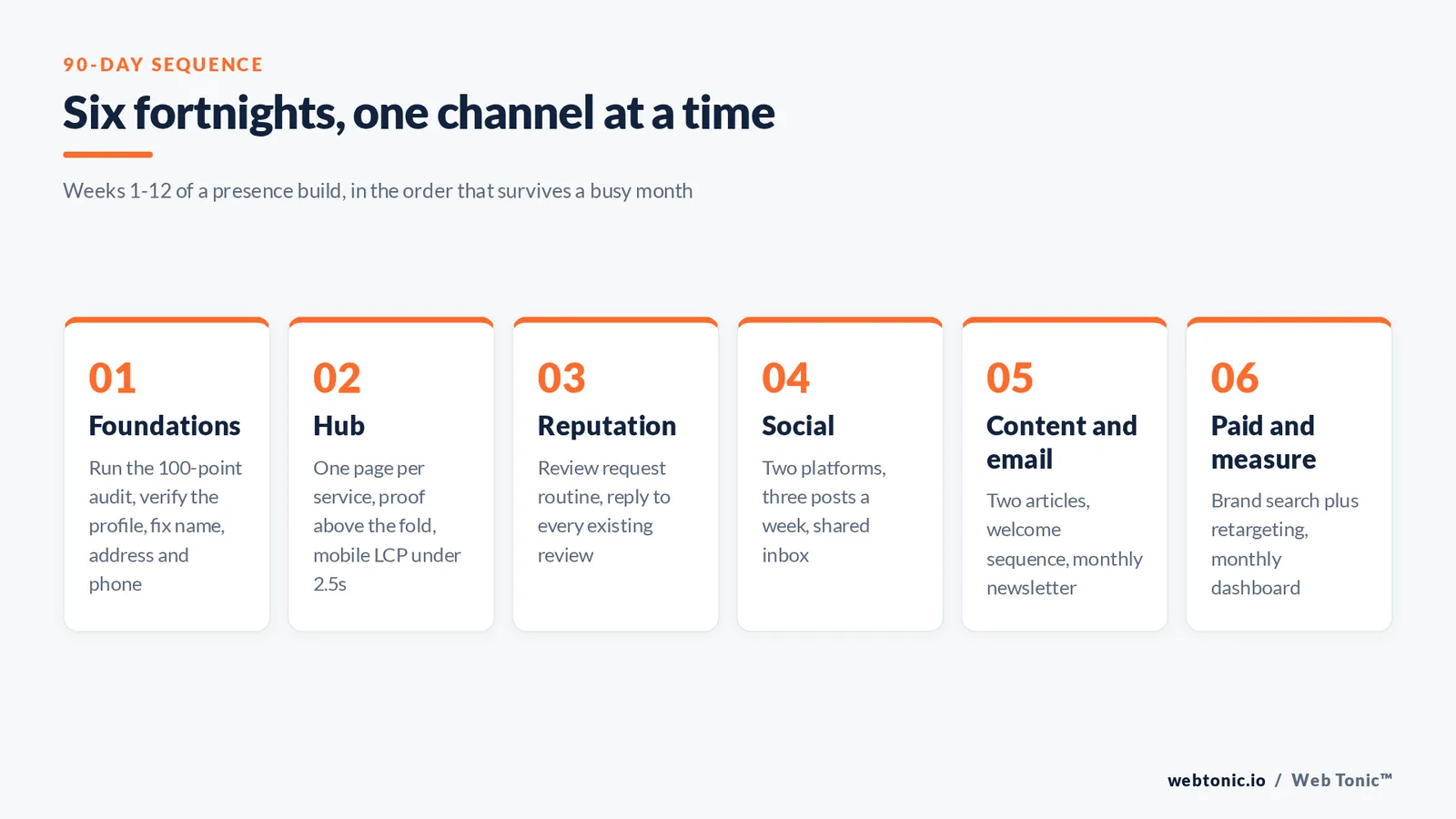
A 90-day plan: action steps in order
| Weeks | Focus | Action steps | Outcome |
|---|---|---|---|
| 1-2 | Foundations | Run the 100-point audit, verify the Google Business Profile, fix name, address and phone consistency | Discoverable and accurate |
| 3-4 | Hub | Build one page per service, add proof, fix mobile speed | Traffic has somewhere to convert |
| 5-6 | Reputation | Launch a review request routine, reply to every existing review | Trust signals start compounding |
| 7-8 | Social | Pick two platforms, post 3x a week, set up a shared inbox | Active, answerable presence |
| 9-10 | Content and email | Publish two articles, launch the newsletter and welcome sequence | Owned distribution |
| 11-12 | Paid and measure | Turn on brand search plus retargeting, review the dashboard | Predictable enquiry flow |
Rule 2 — one channel added per fortnight. Teams that launch six channels in week one abandon four by week six. Sequencing is the difference between a presence that survives a busy month and one that does not.
How to measure online presence
| Metric | Where to find it | What good looks like |
|---|---|---|
| Branded search volume | Search Console query report | Rising month over month |
| Total search impressions | Search Console | Up 20%+ per quarter early on |
| Google Business Profile calls and direction requests | Profile insights | Up month over month |
| Review count and average rating | Profile and industry sites | 20+ reviews, 4.5+, recent |
| Social reach and saves | Native analytics | Saves and shares rising, not just followers |
| Email list size and click rate | Email platform | List growing, 2%+ clicks |
| Direct and organic sessions | Analytics | Direct traffic rising signals real brand recall |
| Share of voice | Listening tool or manual SERP check | Present in the queries that matter |
Sprout Social's annual social media statistics roundup is a useful external yardstick when you need context for your own numbers.
Online presence by business type
| Business type | Highest-return surface | Second priority | Skip for now |
|---|---|---|---|
| Local home service | Google Business Profile and reviews | Service and city pages | TikTok |
| Restaurant or cafe | Profile photos plus Instagram | Reviews and reservations | Long-form blog |
| Ecommerce brand | Product pages plus email | Short-form video and paid social | |
| B2B services | Website case studies | LinkedIn and founder content | |
| Professional practice | Reviews and local search | Educational content | Trend-chasing video |
| Personal brand | One platform, posted daily | Email newsletter | Everything else |
Mistakes that waste an online presence budget
| Mistake | Why it fails | Do instead |
|---|---|---|
| Accounts on 6 platforms, active on none | Dormant profiles read as a dead business | Two platforms, weekly minimum |
| Buying followers | No purchase intent, damages reach | Spend the same money on retargeting |
| No website, social only | You cannot rank or retarget what you do not own | One-page site minimum |
| Ignoring reviews | Silence reads as indifference | Reply to all reviews within 48 hours |
| Redesigning before diagnosing | Rebuilds problems at higher cost | Audit first, fix the top 3 issues |
| Chasing follower counts | Vanity metric with no revenue link | Track enquiries, calls and list growth |
| Inconsistent branding | Weakens recall across channels | One name, logo, description and link everywhere |

FAQ
How long does it take to increase your online presence?
Accuracy and completeness changes show within 2 to 6 weeks: a verified Google Business Profile, correct hours and 20 reviews all move discovery quickly. Organic search and content take 3 to 6 months. Paid ads deliver visibility the same day but stop when the budget stops.
What is the cheapest way to improve online visibility?
Complete your Google Business Profile, ask 20 customers for reviews and reply to every one. All three are free, take a few hours in total, and affect the surfaces where most local buying decisions actually happen.
How many social media platforms should a small business use?
Two, chosen by where your target audience already is, posted to at least weekly and monitored daily for messages. Depth on two platforms consistently beats a dormant presence on six.
Do I need a website if I have strong social media accounts?
Yes. Social accounts are rented: reach, rules and even access can change without notice. A website is the only surface you own where you can rank in search, publish structured data, run retargeting and capture email addresses.
How do I measure whether my online presence is growing?
Track four numbers monthly: branded search volume, total search impressions, review count with average rating, and email list size. If all four rise over a quarter, presence is genuinely growing, whatever your follower counts do.
Sources: DataReportal Digital 2026 Global Overview; BrightLocal Local Consumer Review Survey 2026; Socialinsider 2026 platform engagement studies; Google Business Profile Help; Think with Google; Pew Research Center social media fact sheet; Mailchimp email marketing benchmarks; Litmus email ROI research; Sprout Social 2026 statistics; U.S. Small Business Administration marketing guide; LocaliQ 2026 search advertising benchmarks.