Table of contents
Social media management is the ongoing work of planning, publishing, moderating and measuring a brand's presence across social media platforms — strategy, content creation, community response and analytics treated as one system. This guide covers the daily tasks, the tools worth paying for in 2026, the numbers to hold a team to, and how to get into the job.
Key Takeaways
- There are roughly 5.66 billion active social media users worldwide in 2026, and the typical person uses 6.75 different networks each month.
- Global social media advertising spend is projected at $317.33 billion in 2026, growing about 10.9% a year through 2030.
- 73% of consumers say they will switch to a competitor if a brand does not respond on social media — community management is retention work, not admin.
- Average time on social apps is 2 hours 40 minutes per day, and Facebook remains the largest network at roughly 3.07 billion monthly active users.
- A social media manager's week splits across 6 repeating job areas: strategy, content creation, publishing, community, reporting and paid amplification.
What social media management actually covers
Social media management is often confused with posting. Posting is one of six functions. The complete scope, as Sprout Social defines it, runs from audience research through content creation, scheduling, social listening, community response and performance reporting — plus, in almost every commercial account, paid amplification of the content that earns it.
The scale explains why it is now a discipline rather than a task. DataReportal's Digital 2026 report puts more than 6 billion people online, with global internet penetration at 73.2%, and social platforms absorb the largest share of that attention. Statista tracks the social user base itself, now around 5.66 billion people — a market too large and too fragmented to manage improvisationally.
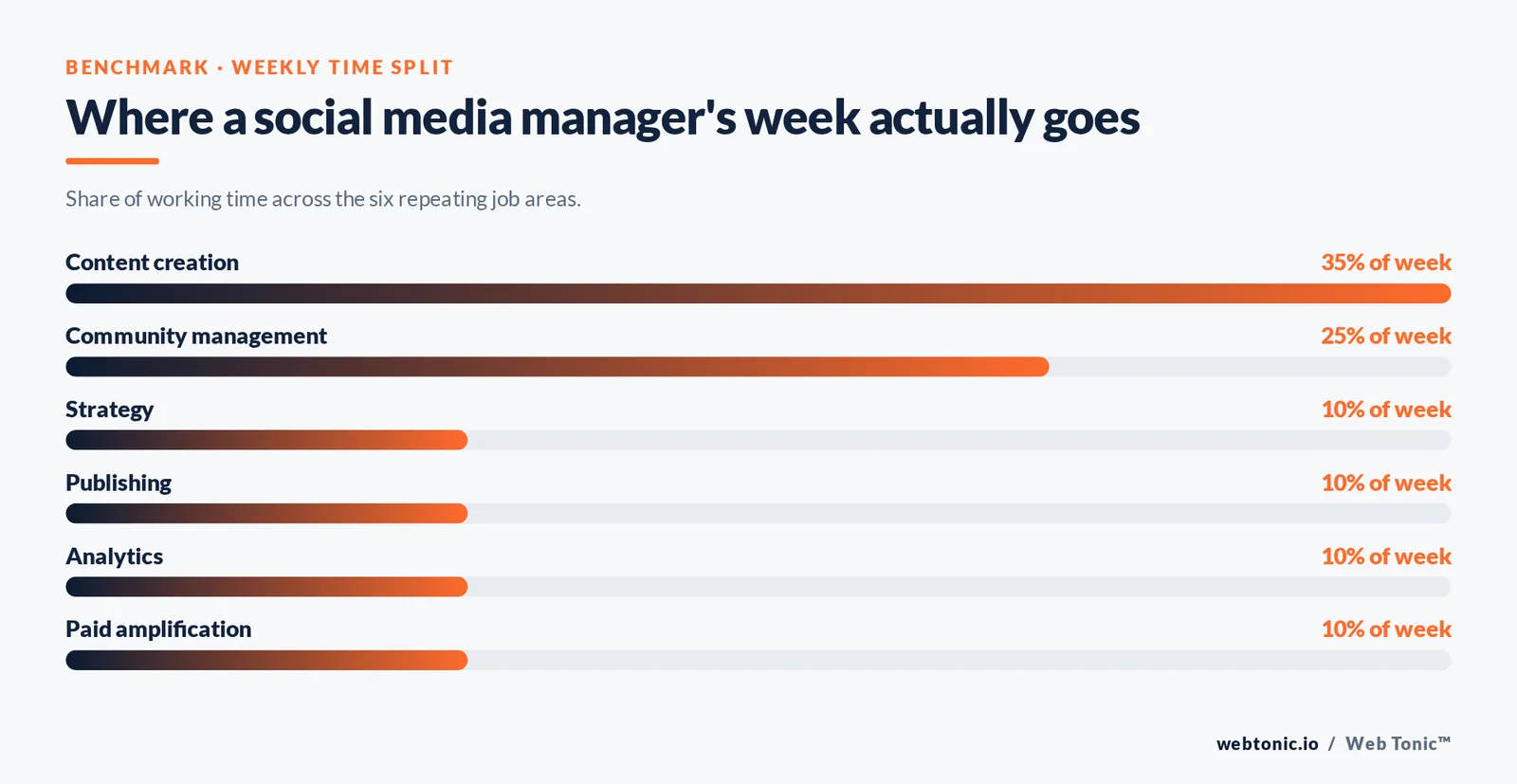
The six job areas of a social media manager
| Job area | Weekly tasks | Share of time | What good looks like |
|---|---|---|---|
| Strategy | Target audience definition, channel selection, campaign planning | 10% | Every platform has a written role and a primary metric |
| Content creation | Briefs, shooting, editing, copywriting, asset versioning | 35% | Native formats per platform, not one asset resized five ways |
| Publishing | Content calendar, scheduling, approvals, link hygiene | 10% | Two weeks queued at all times, with room for reactive posts |
| Community management | Replies, DMs, escalations, social customer service | 25% | First response inside working hours, every time |
| Analytics | Reporting, benchmarking, testing log, social listening | 10% | Numbers tied to business outcomes, not screenshots of reach |
| Paid amplification | Boosting winners, audience setup, creative rotation | 10% | Organic performance decides what gets paid budget |
Community management deserves the weight it gets here. Sprout's 2026 data shows 73% of consumers will move to a competitor when a brand fails to respond, and 45% of consumers use Facebook specifically to seek support. An unanswered inbox is a churn channel.
Best social media management tools in 2026
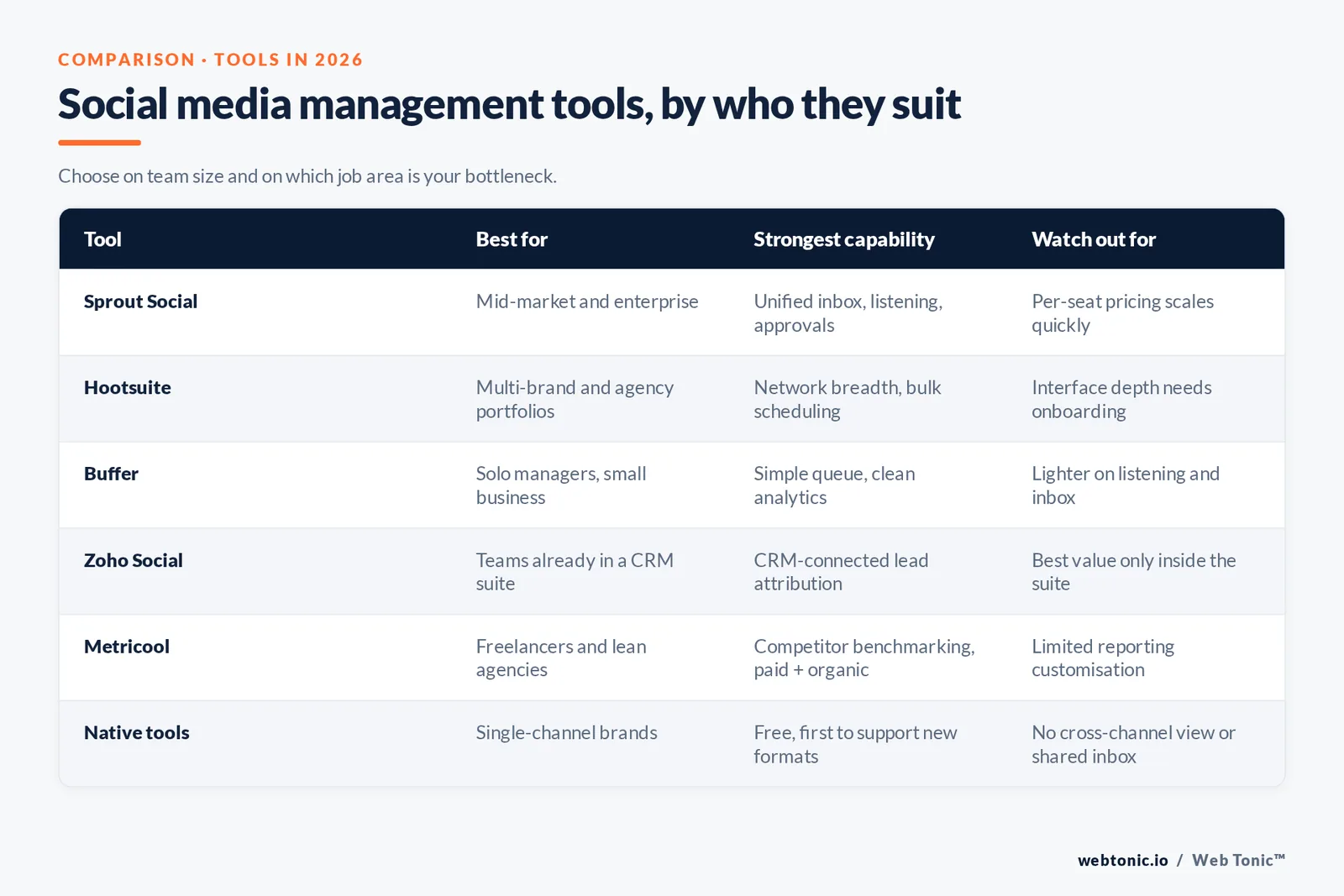
Social media management software exists to collapse publishing, inbox and reporting into one place. Choose on team size and on which of the six job areas is your bottleneck — not on feature counts.
| Tool | Best for | Strongest capability | Watch out for |
|---|---|---|---|
| Sprout Social | Mid-market and enterprise teams | Unified inbox, social listening, approval workflows | Per-seat pricing scales quickly on large teams |
| Hootsuite | Multi-brand and agency portfolios | Breadth of network coverage and bulk scheduling | Interface depth needs onboarding time |
| Buffer | Solo managers and small businesses | Simple publishing queue and clean analytics | Lighter on listening and inbox features |
| Zoho Social | Teams already inside a CRM suite | CRM-connected lead attribution from social | Best value only if you use the wider suite |
| Metricool | Freelancers and lean agencies | Competitor benchmarking plus paid and organic in one view | Reporting customisation is limited at lower tiers |
| Native platform tools | Single-channel brands | Free, and always first to support new formats | No cross-channel view and no shared inbox |
Check the vendors directly before committing — Zoho Social and Metricool both publish current feature tiers, and Buffer's job-description library is a useful cross-check on what your tool actually needs to support. One warning from the data: more than half of marketing leaders say poor integration between social tools and the rest of the stack is the single biggest reason they cannot prove social's business impact. Integration beats features.
Choosing the platform mix
Channel selection is the decision that most affects results, and it is usually made by habit. Start from where your buyers already research, then from what your team can produce natively every week.
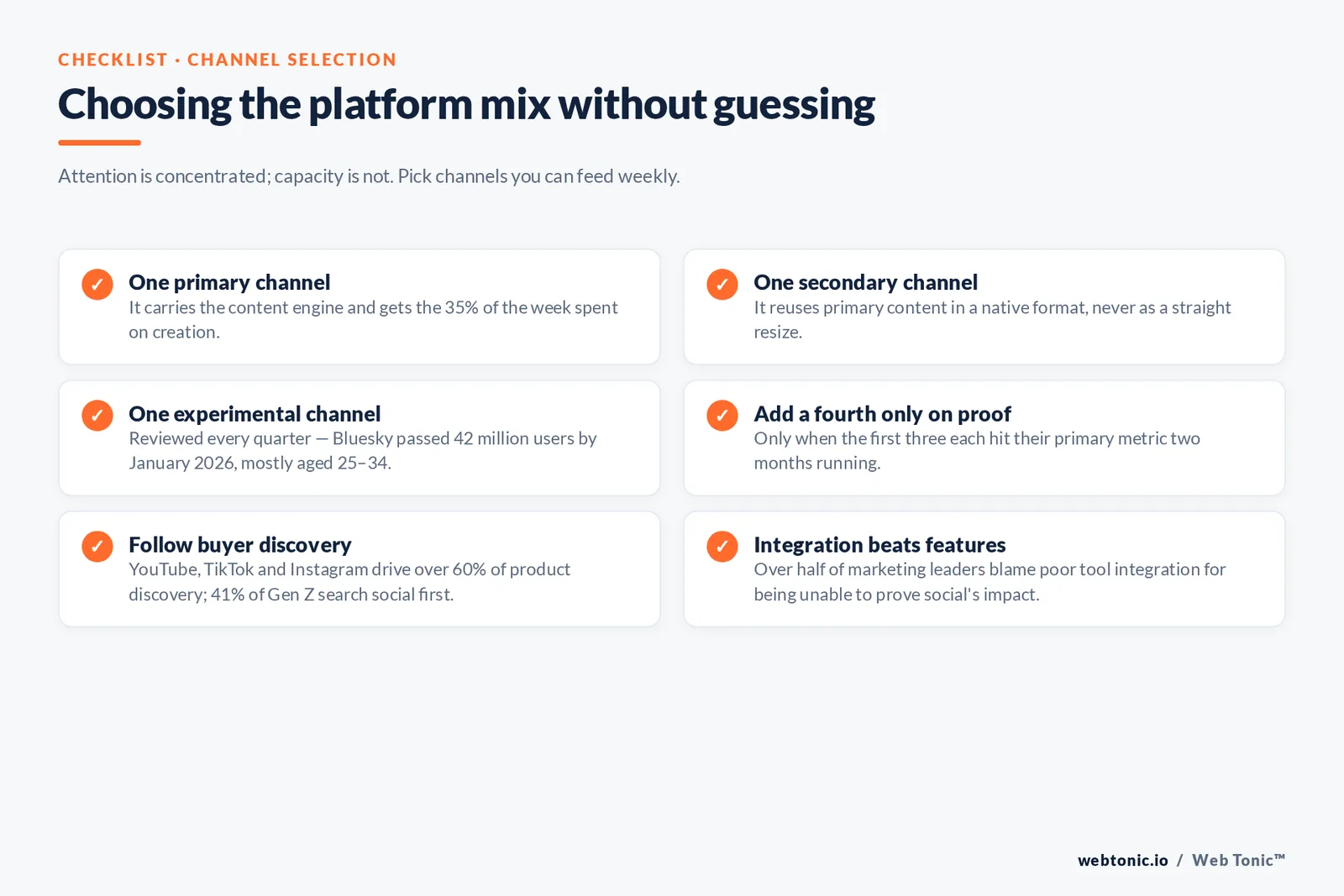
Discovery has moved. Sprout Social's 2026 statistics round-up reports that YouTube, TikTok and Instagram together drive over 60% of product discovery, that 41% of Gen Z turn to social networks first when searching for information online, and that 52% of Gen Z trust product information found on social more than results from search engines or AI chatbots. Social media management is therefore partly a search function now, not only a brand function.
Reach still concentrates in a few places. Facebook remains the largest network at roughly 3.07 billion monthly active users, with the average user spending about 1 hour 7 minutes in the app daily, and it is the most-used platform among marketers at 83%, with Instagram second at 78%. Newer networks matter for early-mover positioning rather than volume: Bluesky passed 42 million users by January 2026, concentrated in the 25-34 age bracket.
Practical rule for a lean team: one primary channel that carries the content engine, one secondary channel that reuses it in a native format, and one experimental channel reviewed every quarter. Add a fourth only when the first three each hit their primary metric two months running. Budget follows the same logic — social ads already account for about $3 of every $10 spent on digital advertising, so the channel you choose to amplify is a material spend decision, not a posting preference.
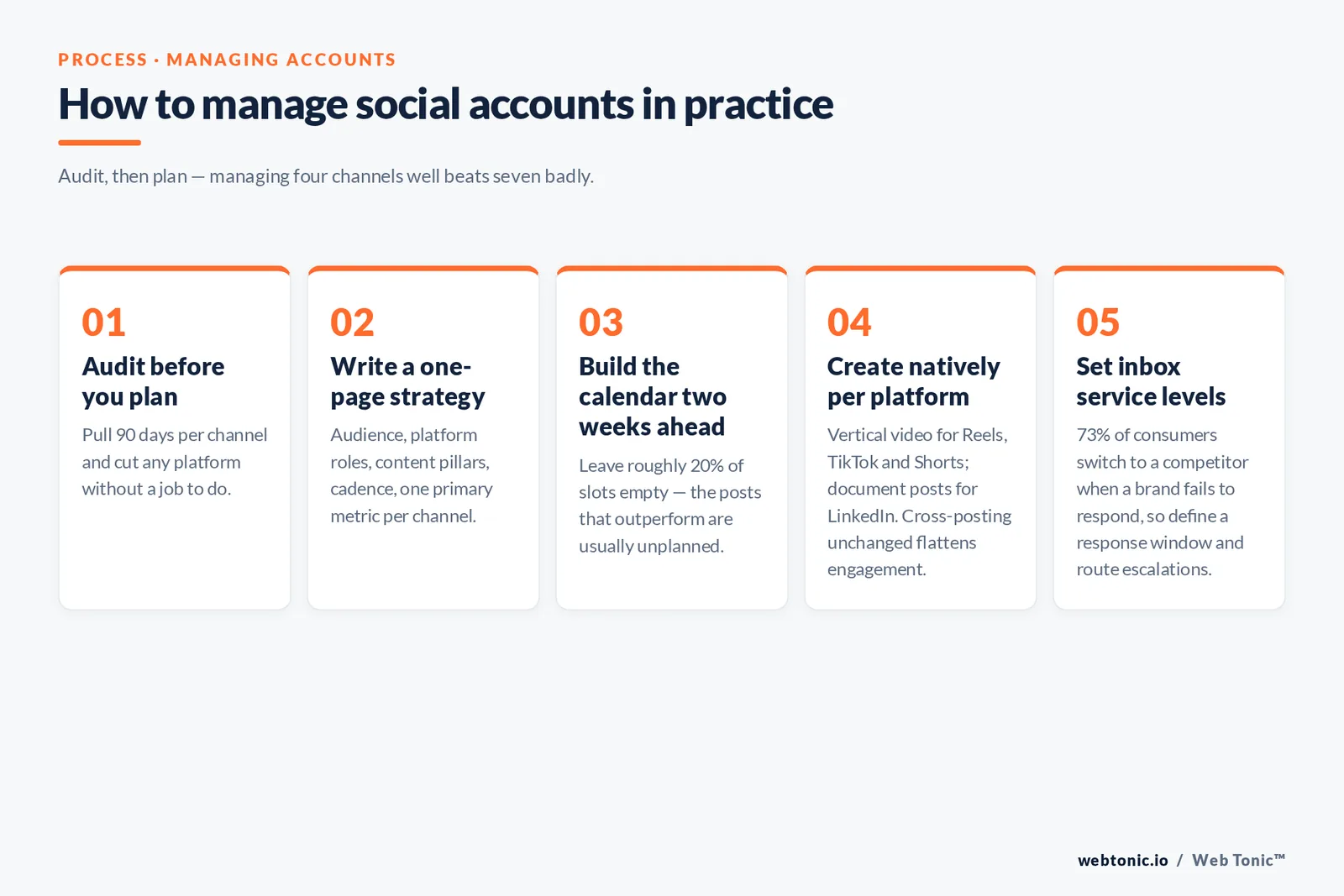
How to manage social media accounts in practice
- Audit before you plan. Pull 90 days of performance per channel and cut any platform without a job to do. Managing four channels well beats managing seven badly.
- Write a one-page social media strategy. Target audience, platform roles, content pillars, posting cadence, primary metric per channel. One page, reviewed quarterly.
- Build a content calendar two weeks ahead. Leave roughly 20% of slots empty for reactive content — the posts that outperform are usually the unplanned ones.
- Create natively per platform. Vertical video for Reels, TikTok and Shorts; document-style posts for LinkedIn. Cross-posting one asset unchanged is the fastest way to flat engagement.
- Set inbox service levels. Define a response window and route escalations to a named owner. This is where the 73% switching statistic gets neutralised.
- Instrument the destination. Tag every link and confirm events fire; event-based analytics is the minimum for connecting social activity to revenue.
- Report on outcomes monthly. Engagement, conversions and revenue impact are the three things marketing leaders track most; reach alone tells you nothing about business results.
Two habits separate teams that sustain this from teams that burn out. First, batch production: one shooting or writing block per week producing 8 to 12 assets is far more durable than daily improvisation, and it protects the calendar when a campaign lands. Second, a written escalation path: decide in advance who answers a pricing question, who answers a complaint, and who signs off on anything involving legal or safety. Most social crises are ordinary messages that waited too long for an owner. Documented once, both habits cut weekly management time noticeably and make the account survivable when the person running it takes a holiday.
The benchmarks to hold a social media team to
Absolute numbers are meaningless without a comparison set. Use industry benchmarks, then your own trailing 90-day baseline.
| Metric | Why it matters | How to read it |
|---|---|---|
| Engagement rate per post | Content quality signal the algorithms also use | Compare against your own trailing 90-day median first |
| Follower growth rate | Audience compounding, not vanity count | Percentage growth beats absolute followers |
| First response time | Directly tied to the 73% competitor-switching risk | Measure in hours, within working hours |
| Share of voice | Positioning against competitors in-category | Track monthly via social listening |
| Conversions from social | The number the business cares about | Tagged links plus assisted-conversion paths |
For external comparison, Socialinsider's benchmark study and Hootsuite's annual trends research both publish per-industry medians. Spend context comes from eMarketer's social ad spend tracking, and audience composition per platform from the Pew Research Center social media fact sheet. If you want that reporting layer built once and maintained, that is what our data intelligence work does.
What social media management delivers for businesses and brands
Businesses rarely buy social media management for its own sake. They buy the outcomes it helps create: consistent brand presence, faster customer service, cheaper demand, and marketing data they can act on.
Brand awareness at low marginal cost. Once the content engine runs, each additional post costs a fraction of a paid impression. Brands that publish consistently across multiple platforms build recall that makes every other channel cheaper, which is why social media marketing budgets keep growing even when performance budgets tighten.
Customer service that customers can see. Social accounts are now a public support desk. Answering a customer in the comments resolves one ticket and demonstrates the service standard to everyone else reading. Set metrics for it — first response time, resolution rate, escalation volume — and review them monthly alongside engagement.
Lead generation and sales. With links tagged and goals defined in analytics, social media content can be attributed like any other channel. Small businesses often find that a single high-performing organic post, amplified with a modest budget, outperforms a month of untargeted spend.
Market and competitor intelligence. Social listening tells you what customers say about your company and your competitors in their own words. That feedback loop improves product design, ad copy and landing pages, not just the content calendar.
Operational leverage. A social media management tool that lets one manager schedule for multiple brands, build approval flows and pull one report replaces hours of manual work every week. The time saved is the real return for lean teams: fewer platform logins, one calendar, one inbox, one set of numbers.
The practical implication for brands is to define the outcome before hiring for the role or buying the software. A company that wants awareness should build a content and design capability. A company that wants leads should build measurement and paid amplification first. Both need a manager who can create, schedule, respond and report — but the order in which those skills matter is set by the business goal, not by the platform.
How to become a social media manager
The role hires on demonstrated output more than credentials. Four moves compress the timeline.
- Run one real account. A personal project with 90 days of consistent posting and a documented result beats a course certificate in every hiring conversation.
- Learn one platform deeply, then broaden. Depth on the platform your target employers depend on is more valuable than shallow coverage of six.
- Get comfortable with editing and analytics. Short-form video editing and reading a performance report are the two hard skills most shortlists filter on.
- Build a portfolio of before-and-after numbers. Engagement lifted from x to y over z weeks, with the reason. Screenshots of follower counts prove nothing.
On the brand side of the table, the same test applies when you hire an agency: ask for the numbers and the reason behind them. Our growth marketing and performance creative teams work exactly that way, and there are more breakdowns on the Web Tonic blog.
FAQ
What is social media management?
Social media management is the practice of planning, creating, publishing, moderating and measuring content across social media platforms on behalf of a brand or business. It combines strategy, content creation, community management and analytics, and in commercial accounts it usually includes paid amplification of the best-performing organic posts.
What are the best social media management tools in 2026?
Sprout Social suits mid-market and enterprise teams needing a unified inbox and listening; Hootsuite fits multi-brand and agency portfolios; Buffer works for solo managers; Zoho Social is strongest when you already use the wider Zoho suite; Metricool suits lean agencies. Choose on integration with your existing stack rather than feature count.
How much time does managing social media take?
For a single brand on three to four platforms, budget 15 to 25 hours a week, with roughly 35% going to content creation and 25% to community management. Publishing itself is a small share of the work once a calendar and a scheduling tool are in place.
What skills does a social media manager need?
Copywriting, short-form video editing, platform-specific format knowledge, community and escalation handling, and the analytics literacy to explain results in business terms. Paid social fundamentals are increasingly expected because organic and paid are managed together.
Is social media management worth it for small businesses?
Yes, if it is focused. With 5.66 billion social users and social platforms driving a large share of product discovery, presence matters — but one or two channels managed consistently outperform five neglected ones. Response time on inbound messages is usually the highest-return improvement available.
Sources: Sprout Social, Social Media Management and 2026 social media marketing statistics · DataReportal, Digital 2026 Global Overview Report · Statista, number of worldwide social network users · Pew Research Center, Social Media Fact Sheet · Socialinsider, social media benchmarks · Hootsuite, Social Media Trends research · eMarketer, social media advertising spend · Buffer, social media manager job description · Zoho Social · Metricool · Google Analytics Help.