Table of contents

Key Takeaways
32,690+ active Shopify stores sell vitamins and supplements alone, growing at 5% monthly. The broader health product ecommerce market reached $53.5 billion in 2025 and is projected to hit $130.7 billion by 2035 at a 9.4% CAGR. Health and wellness Shopify stores convert at a 2.0–2.8% median rate, with top-decile performers reaching 4.5%. Supplements carry 65–80% gross margins and the highest repurchase rate of any consumer category at 37.7%. DTC wellness brands average an $89 CPA, making customer retention and subscription models the primary profit lever.
Health & Wellness Shopify Benchmarks at a Glance
| Metric | Value | Source |
|---|---|---|
| Active Shopify stores (vitamins/supps) | 32,690 (5% mo growth) | BootLeads |
| H&W ecommerce market (2025) | $53.5B → $130.7B by 2035 | WiseGuyReports |
| Conversion rate (median) | 2.3% (top decile: 4.5%) | Eevy.ai |
| Supplement gross margins | 65–80% | Commerce Catalyst |
| Repurchase rate (24-month) | 37.7% (highest of any category) | Commerce Catalyst |
| Avg CPA (DTC wellness) | $89 (range $61–$127) | MHI Growth Engine |
| Supplement COGS per unit | $3–$8 (retail $25–$60) | Commerce Catalyst |
| H&W subscription lead | 1.9M+ active subscribers | Recharge |
Market Size & Growth Trajectory
WiseGuyReports' market analysis values the health product ecommerce market at $53.5 billion in 2025, projecting growth to $130.7 billion by 2035 at a 9.4% CAGR. This encompasses supplements, fitness equipment, wellness devices, and personal care products sold through online channels — a market that has nearly doubled since the post-pandemic ecommerce acceleration.
BootLeads tracks 32,690 active Shopify stores in the vitamins and supplements segment alone, with 1,492 new stores added in the last 3 months — a 5% monthly growth rate. The broader health and wellness Shopify ecosystem is substantially larger when including fitness apparel, skincare, mental wellness apps, and wellness device brands.
The growth trajectory creates both opportunity and competitive pressure for Shopify merchants. New entrants face established DTC brands with sophisticated retention systems, while incumbents must continuously invest in digital marketing and product innovation to maintain market share in an increasingly crowded ecommerce space.
The category's rapid expansion on Shopify is partly driven by the platform's subscription-friendly app ecosystem and low barrier to entry for supplement brands. With contract manufacturing readily available at $3–$8 COGS per unit, launching a health and wellness Shopify store requires minimal upfront inventory investment compared to most consumer goods categories, fueling the 5% monthly growth rate in new store openings.
Conversion Rate & AOV Benchmarks
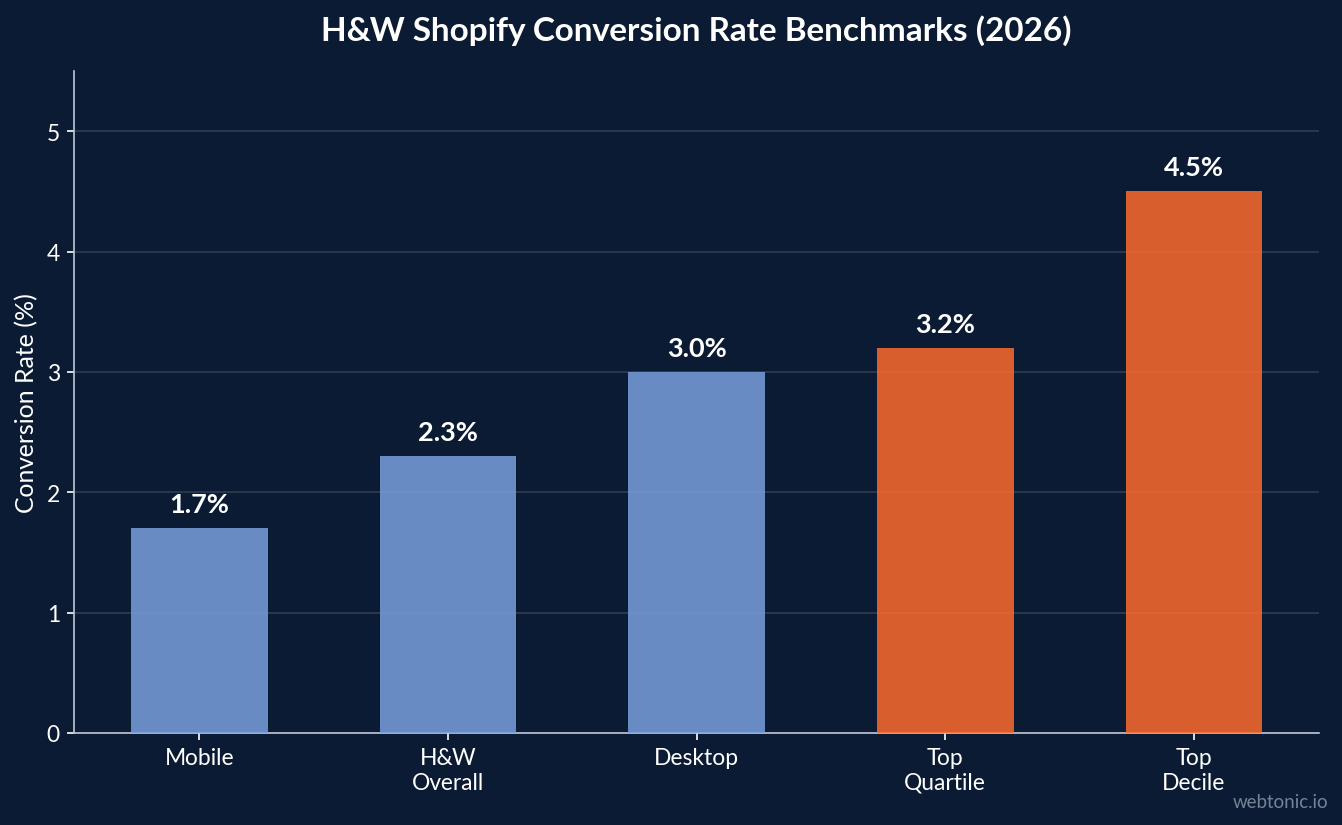
Eevy.ai's 2026 Shopify conversion benchmarks break down health and wellness store performance with granularity that helps merchants set realistic targets:
| Segment | Median CVR | Top Quartile | Top Decile |
|---|---|---|---|
| Health & Wellness (overall) | 2.3% | 3.2% | 4.5% |
| Desktop | 3.0% | 4.1% | 5.5% |
| Mobile | 1.7% | 2.4% | 3.6% |
The desktop-to-mobile CVR gap (3.0% vs 1.7%) is larger in health and wellness than in most Shopify verticals, likely because supplement purchases involve more ingredient research and comparison shopping that favors larger screens. Stores that invest in mobile-optimized product pages with clear ingredient panels and trust badges narrow this gap significantly.
Eevy.ai's supplements AOV analysis warns that tracking only first-order AOV understates actual unit economics. Adding subscriptions with a 10–15% discount and a clear "skip anytime" message is the single most impactful AOV lever, converting one-time buyers into recurring customers with higher lifetime value. For brands running Facebook Ads, this subscription upgrade fundamentally changes ROAS calculations by extending the value of each acquired customer.
Subscription & Retention Economics
Recharge's 2026 subscription data shows health and wellness now leads all DTC categories with 1.9 million+ active subscribers, pulling ahead of beauty for the top position. The category has added the most net new subscribers of any vertical over the past 12 months, confirming a structural shift toward recurring revenue models in wellness ecommerce.
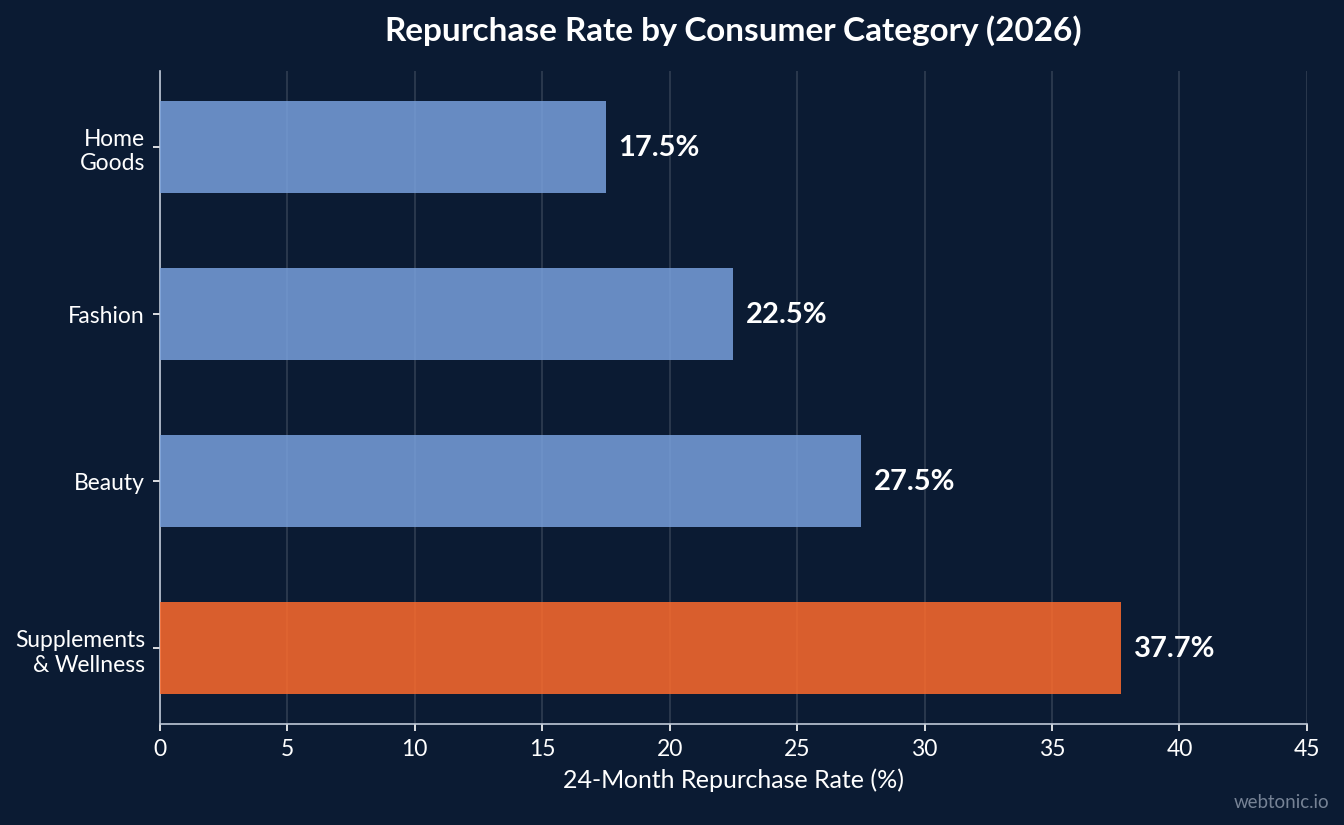
Commerce Catalyst's 2026 supplements benchmarks reveal that supplements have the highest repurchase rate of any consumer category at 37.7% within a 24-month window, up from 33.1% in prior periods. For context: beauty sits at 25–30%, fashion at 20–25%, and home goods at 15–20%. This natural repurchase behavior makes health and wellness uniquely suited to subscription models on Shopify.
The gross margin structure amplifies the retention advantage. Supplements carry 65–80% gross margins, with COGS of $3–$8 per unit for products retailing at $25–$60. Contract manufacturing at scale drives per-unit costs down further, meaning each retained subscriber generates increasingly profitable revenue over time — a dynamic that rewards aggressive customer acquisition spending by brands with proven retention systems and strong email marketing flows.
Customer Acquisition Cost Benchmarks
MHI Growth Engine's 2026 DTC benchmarks show supplements and wellness brands average an $89 CPA (range $61–$127). The variance is driven by product positioning: highly commoditized supplements like basic multivitamins come in at $67 CPA, while premium wellness products with differentiated formulations can exceed $100+.
At an $89 CPA and 65–80% gross margins, first-order profitability is challenging for products retailing under $40. The math works only when factoring in subscription revenue and repeat purchases — which is why the 37.7% repurchase rate is the metric that separates viable wellness brands from unsustainable ones. Brands tracking only first-purchase ROAS through Google Ads or Meta understate true return by 40–60% when they ignore customer lifetime value.
For Shopify wellness stores, integrating analytics tools that track customer cohort LTV — not just per-order ROAS — is essential for making sound acquisition spending decisions. The brands that scale successfully are those that know their 90-day and 180-day LTV numbers precisely and can tolerate short-term acquisition losses for long-term subscriber value.
Traffic Sources & Channel Performance
GetEcommerceLeads' nutrition ecommerce report (500K+ stores) shows that SEO remains the dominant acquisition channel for health and wellness Shopify stores, with paid search at 5.1% of traffic (632,337 visits) outpacing organic social at 4.6% (567,433 visits). The near-parity between paid search and organic social suggests brand-building through social content is a viable complement to direct-response advertising.
PrettyDamnQuick's checkout performance index tracks conversion, AOV, free shipping behavior, and shipping revenue specifically for health and wellness brands on Shopify, indexed against a consistent baseline updated monthly. Their data confirms that checkout optimization and free shipping thresholds are significant conversion levers — even small friction reductions at checkout translate to measurable revenue gains for wellness stores.
For brands spending heavily on ad creative, the channel mix data suggests diversification matters. Over-reliance on a single paid channel creates vulnerability to algorithm changes, while brands with balanced organic, paid, and email traffic typically show more stable growth trajectories and better unit economics across their Shopify stores.
The organic search opportunity for Shopify wellness stores is substantial but requires intentional SEO investment. Most health and wellness Shopify stores under-invest in content marketing relative to paid acquisition. Stores that build educational content hubs around their product categories — condition guides, ingredient breakdowns, usage protocols — capture informational search traffic that converts into customers at lower cost than paid channels. For stores looking to scale beyond paid acquisition, combining Google Ads with an SEO content strategy creates sustainable growth that compounds quarterly.
Product Economics & Margin Structure
| Metric | Supplements | Fitness Equipment | Wellness Devices |
|---|---|---|---|
| Gross margin | 65–80% | 40–55% | 50–65% |
| COGS per unit | $3–$8 | $15–$80 | $10–$40 |
| Retail price | $25–$60 | $50–$300 | $40–$200 |
| Repurchase rate (24mo) | 37.7% | 8–12% | 15–20% |
| Subscription fit | Very high | Low | Moderate |
Commerce Catalyst's benchmarks paint a clear picture of why supplements dominate the Shopify wellness space. The combination of 65–80% gross margins, low COGS ($3–$8), and category-leading 37.7% repurchase rates creates a unit economics flywheel that most consumer categories cannot match. Wellness device brands offset lower repurchase rates with higher AOV, while fitness equipment stores rely on cross-selling accessories and content-driven community engagement to boost lifetime value.
SkaILama's Top 25 Wellness Brands on Shopify analysis highlights brands like 1st Phorm, which built a DTC foundation generating substantial revenue without relying on Amazon or retail distribution. The common pattern among top performers: community-driven marketing, subscription-first pricing, and influencer partnerships that reduce reliance on paid acquisition — principles aligned with effective growth marketing strategies.
Checkout & Shipping Optimization
PrettyDamnQuick's monthly Health & Wellness Checkout Performance Index tracks the checkout behaviors that drive or kill conversion for Shopify stores. Their data shows free shipping thresholds are the most powerful AOV lever for wellness brands: setting the threshold 15–20% above the current AOV consistently lifts average order size without depressing conversion rate.
The checkout experience matters disproportionately in health and wellness because buyers are often making their first purchase of a consumable product from an unfamiliar brand. Trust signals at checkout — money-back guarantees, subscription flexibility ("skip anytime"), and third-party certification badges (NSF, GMP, organic) — can lift conversion rates by 20–40% compared to bare checkout flows, according to Commerce Catalyst.
For brands optimizing their Shopify stores, the data supports a phased approach: first optimize checkout trust and landing page conversion, then layer on subscription options, and finally invest in post-purchase upsell sequences through data intelligence tools. Each phase compounds the others, creating a growth flywheel that improves with every optimization cycle.
Shipping speed and transparency also impact conversion rates for wellness brands on Shopify. PrettyDamnQuick's data shows that stores displaying estimated delivery dates during checkout convert 8–15% higher than those showing only shipping method options. For consumable wellness products where customers may be timing their purchase around running out of a current supply, delivery certainty reduces hesitation and cart abandonment. These checkout optimizations combined with strategic performance creative drive measurable revenue gains across the entire Shopify store experience.
Related reading
- What 47+ Data Points Reveal About WordPress for Health & Wellness (2026)
- Health & Wellness Webflow Statistics: Key Data Points for 2026
- Health & Wellness Landing Page Statistics & Benchmarks (2026)
- Custom Web Development services at Web Tonic
FAQ
How many health and wellness stores are on Shopify?
BootLeads tracks 32,690 active Shopify stores in the vitamins and supplements segment alone as of 2026, with 1,492 new stores added in the last 3 months — a 5% monthly growth rate.
What is the average conversion rate for health and wellness Shopify stores?
According to Eevy.ai's 2026 benchmarks, health and wellness Shopify stores convert at 2.0–2.8%, with a median of 2.3%. Top quartile stores reach 3.2%, and the top decile hits 4.5%. Desktop converts at 3.0% versus 1.7% on mobile.
What is the average customer acquisition cost for wellness DTC brands?
MHI Growth Engine's 2026 DTC benchmarks show supplements and wellness brands average an $89 CPA, with a range of $61–$127. Highly commoditized supplements come in lower at $67.
How big is the health product ecommerce market?
WiseGuyReports values the health product ecommerce market at $53.5 billion in 2025, projecting growth to $130.7 billion by 2035 at a 9.4% CAGR.
What is the repeat purchase rate for supplements on Shopify?
Commerce Catalyst's 2026 benchmarks report supplements have the highest repurchase rate of any consumer category at 37.7% within a 24-month window, up from 33.1% in prior periods.
Sources
bootleads.com — Shopify vitamins & supplements stores 2026
wiseguyreports.com — health product ecommerce market
eevy.ai — Shopify conversion rate benchmarks 2026
eevy.ai — supplements AOV benchmarks
commercecatalyst.ai — supplements & wellness benchmarks 2026
mhigrowthengine.com — DTC CPA by vertical 2026
getrecharge.com — H&W subscription growth
getecommerceleads.com — nutrition ecommerce report
prettydamnquick.com — H&W checkout benchmarks
skailama.com — top 25 wellness brands on Shopify