



Table of contents

Key Takeaways
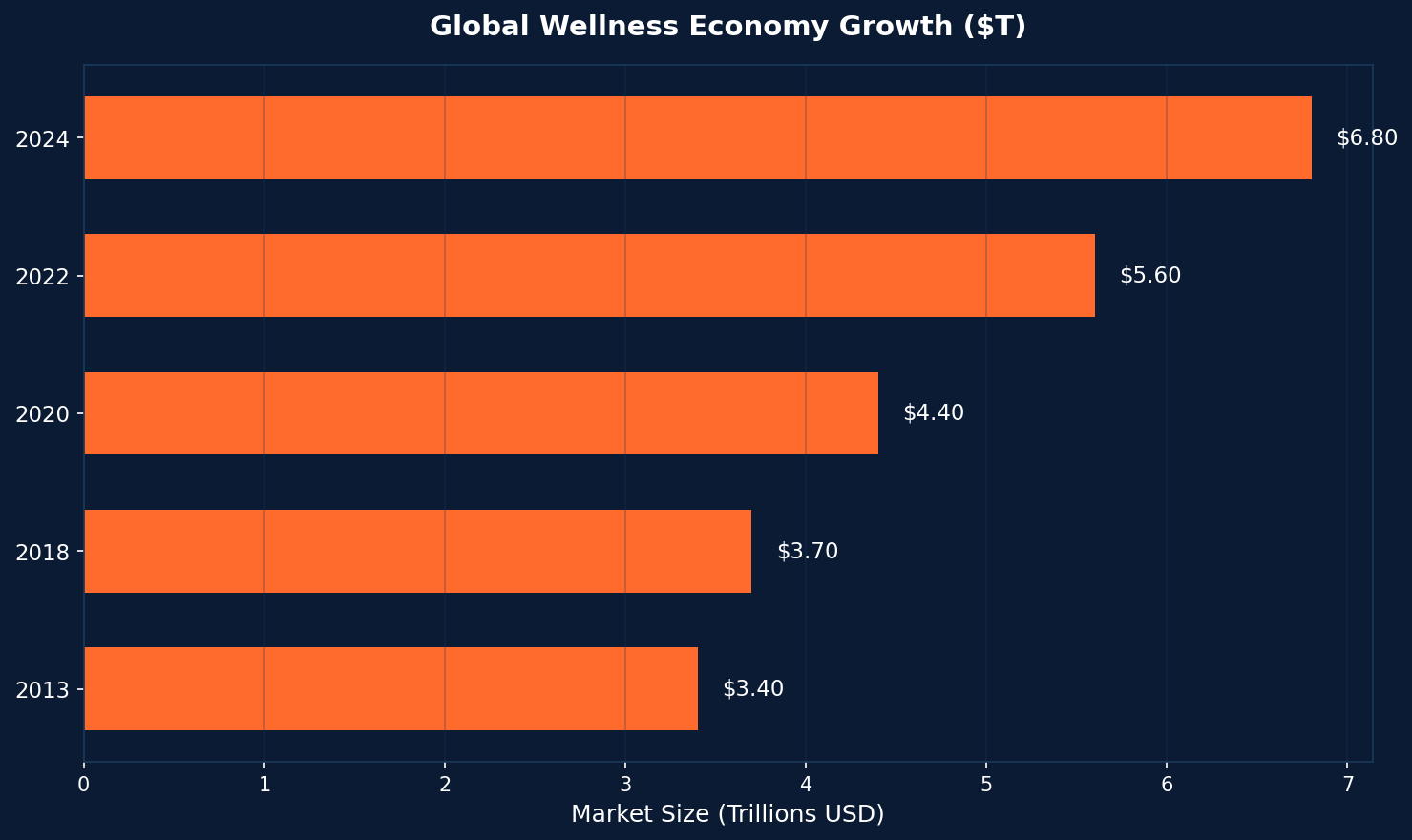
- The global wellness economy reached $6.8 trillion in 2024, growing 7.9% year-over-year and doubling since 2013 (Global Wellness Institute).
- Health and wellness brands average a $52.00 search CPA and $44.00 social CPA, with top-decile performers hitting 5.8% conversion rates (CuFinder).
- Wellness tech is projected to grow from $57.1 billion to $208.36 billion by 2032, fueling massive digital marketing opportunity (Precedence Research).
- Digital ad spend overtook linear TV in healthcare for the first time in 2026, with CTV on track to surpass linear by 2028 (MM+M).
- TikTok engagement for wellness brands rose 146% in views, while Instagram engagement sits between 1.0% and 2.0% (Dash Social).
- Average CPA for wellness brands is £36 ($46) with median ROAS of 3.4× across paid channels (AdFuse AI).
- Telehealth CPA ranges from $55 to $125 depending on specialty, with mental health/therapy at $115 (CuFinder).
Health & Wellness Digital Marketing Benchmarks at a Glance
| Metric | Benchmark | Source |
|---|---|---|
| Global Wellness Economy | $6.8 trillion (2024) | Global Wellness Institute |
| Wellness Tech Market (2032) | $208.36 billion | Precedence Research |
| Search CPA | $52.00 | CuFinder |
| Social CPA | $44.00 | CuFinder |
| Paid Media ROAS | 3.4× | AdFuse AI |
| Conversion Rate (Top 10%) | 5.8% | CuFinder |
| Customer Lifetime Value | $640 | CuFinder |
| Annual Retention | 74% | CuFinder |
| Telehealth CPA | $78.50–$125.00 | CuFinder |
Market Size and Growth Trajectory
The digital marketing opportunity in health and wellness is enormous and accelerating. According to the Global Wellness Institute's 2025 Monitor, the global wellness economy reached a record $6.8 trillion in 2024, growing at 7.9% year-over-year. The economy has doubled since 2013, expanding at a compound annual growth rate of 6.2%.
Within this macro trend, wellness technology is the fastest-growing subsector. Precedence Research projects the wellness tech market will grow from $57.1 billion to $208.36 billion by 2032, a CAGR that far outpaces the broader economy. This growth is driving brands to invest heavily in digital channels — MM+M's Healthcare Marketers Trend Report confirmed that digital ad spend officially overtook linear TV spending in healthcare in 2026, with connected TV (CTV) expected to surpass linear by 2028.
The shift is structural, not cyclical. eMarketer's 2026 Health & Wellness Market report notes that digital content now fuels the majority of wellness spending decisions, but brands must earn consumer loyalty rather than rely on platform reach alone.
Paid Advertising Performance by Channel
Paid media remains the primary acquisition engine for wellness brands, though costs vary significantly by channel and specialty. CuFinder's 2026 Fitness and Wellness Benchmarks report the following paid advertising metrics:
- Search CPA: $52.00 — Google Ads search campaigns deliver the highest-intent traffic.
- Display/Social CPA: $44.00 — Meta and programmatic display cost less per acquisition but require stronger creative.
- Average conversion rate: 3.2% (top 10% achieve 5.8%).
- Customer Lifetime Value: $640 — making the $44–$52 CPA economically viable.
AdFuse AI's wellness benchmarks show a slightly different angle: average CPA of £36 (~$46) with a median ROAS of 3.4× across all paid channels. The ROAS figure suggests most wellness brands achieve profitable paid acquisition when factoring in repeat purchase and subscription revenue.
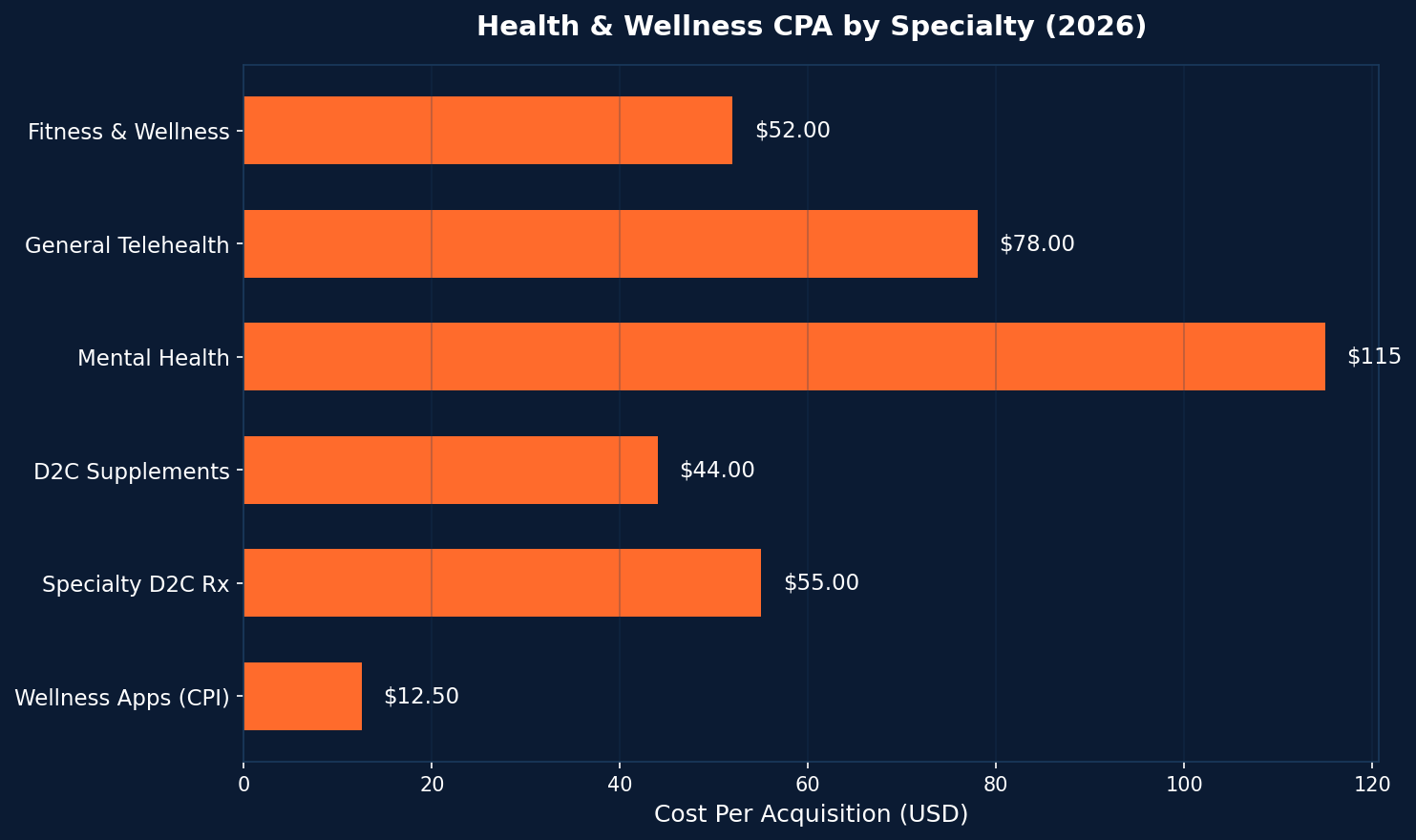
For telehealth specifically, CPAs are higher and more variable. General telehealth runs $78.50 per acquisition, mental health/therapy hits $115, and specialty D2C prescriptions come in lower at $55 (CuFinder Telehealth Benchmarks). Patient retention sits at 65% annually for subscription models.
Social Media Marketing and Content Engagement
Social platforms are central to wellness content strategy, but performance varies dramatically by platform and content format. Dash Social's 2026 Health & Wellness Benchmarks reveal several key trends:
- TikTok views rose 146% year-over-year for wellness brands, though shares dropped 41% and engagement fell from 3.1% to 2.3%.
- Health and wellness brands should target 2.0%–2.5% engagement on TikTok and 1.0%–2.0% on Instagram.
- Discovery-driven content outperforms promotional content — educational wellness videos consistently generate higher view counts than product-focused posts.
The Commerce Catalyst supplements and wellness benchmarks add a critical D2C lens: brands spending $10M–$50M on marketing typically allocate 5–8% to regulatory compliance, with G&A running 18–22% of revenue (Finaloop, 800+ brands analysis).
Patient and Customer Acquisition Costs by Specialty
Acquisition economics vary enormously across the wellness and healthcare landscape. Data-driven marketers need specialty-specific benchmarks to set realistic budgets:
| Specialty / Segment | Avg. CPA | Key Channel | Retention Rate |
|---|---|---|---|
| General Fitness & Wellness | $52.00 | Search | 74% annually |
| General Telehealth | $78.00 | Search + Social | 65% annually |
| Mental Health / Therapy | $115.00 | Search | 58% annually |
| D2C Supplements | $44.00 | Social | 42% (repeat purchase) |
| Specialty D2C Rx | $55.00 | Search + Content | 70% (subscription) |
| Wellness Apps | $8.50–$15.00 (CPI) | Social + ASO | 12% (Day 30) |
Digital Transformation and Wellness Technology
The convergence of health data and digital marketing is reshaping how brands acquire and retain customers. 65% of leading health organizations now use AI for analytics, with 42% applying it to clinical decision-making (NVIDIA Healthcare AI survey). This trend extends to marketing: predictive models now power ad targeting, content personalization, and lifetime value forecasting.
Wearable device adoption reinforces the data flywheel — 65% of consumers own or intend to purchase a health wearable (NIQ), and Rock Health reports 83% of wearable owners use their device 5+ days per week. For marketers, this creates richer first-party data signals and more precise audience segmentation.
The wellness economy's shift toward digital-first consumer journeys means brands that invest in omnichannel attribution and conversion rate optimization now will compound their advantage. Brands operating on 30–40% gross margins (Finaloop D2C data) can afford $44–$52 CPAs when CLV reaches $640, delivering a 12–15× payback ratio over the customer lifecycle.
Best Practices for Health & Wellness Digital Marketing
- Invest in search-first acquisition — At $52 CPA vs. $44 social CPA, search delivers higher-intent prospects with better conversion rates and lower refund rates.
- Build a content engine around TikTok discovery — With 146% view growth, short-form educational wellness content is the cheapest reach channel, but convert via website, not in-app purchases.
- Target specialty-specific CPAs — Don't benchmark mental health ($115 CPA) against supplements ($44 CPA). Set realistic targets by vertical.
- Prioritize retention economics — 74% annual retention and $640 CLV justify aggressive front-end spend. Model LTV:CAC ratios, not just CPA.
- Leverage first-party wearable data — 83% of wearable users are daily active; integrate device data into email segmentation and lookalike audiences.
- Shift budget from linear to CTV — Digital overtook linear TV in 2026; CTV offers the reach of broadcast with the targeting of digital.
- Plan for regulatory compliance costs — Budget 5–8% of marketing spend for compliance, especially in supplements, telehealth, and pharmaceutical-adjacent categories.
Industry Comparison: How Health & Wellness Stacks Up
Understanding where health and wellness stands relative to other verticals helps marketers calibrate expectations and identify competitive advantages. The industry's unique position — high CPAs but exceptional retention — creates a distinct economic profile.
Compared to e-commerce overall, health and wellness brands pay 30–40% more per acquisition but retain customers at nearly double the rate. While general e-commerce sees 30–35% annual repeat purchase rates, wellness subscription models hit 70% retention for D2C prescriptions and 74% for fitness memberships (CuFinder). This retention premium means wellness brands can afford higher front-end costs and still achieve superior unit economics.
Social media engagement tells a similar story. While the average cross-industry engagement rate on Instagram hovers around 0.6–0.8%, health and wellness brands consistently achieve 1.0–2.0% on Instagram and 2.0–2.5% on TikTok (Dash Social). Wellness content benefits from inherent shareability — fitness transformations, recipe tutorials, mental health awareness, and product reviews generate organic engagement that amplifies paid efforts.
The content marketing advantage is equally pronounced. Healthcare and wellness content earns higher trust signals than most B2C categories because consumers actively seek health information. This creates a compounding SEO advantage: brands that publish authoritative wellness content build topical authority faster than competitors in saturated verticals like fashion or home goods.
Emerging Channels and Future Trends
Several emerging digital channels are reshaping wellness marketing economics in 2026 and beyond:
- AI-powered personalization — 65% of health organizations now use AI for analytics (NVIDIA). Marketers are applying the same technology to predict customer needs, automate content recommendations, and optimize bid strategies in real time.
- Connected TV (CTV) advertising — With digital surpassing linear TV spend in 2026, CTV offers wellness brands broadcast-scale reach with digital targeting precision. Early adopters report 30–50% lower CPMs than traditional TV with measurable attribution.
- Voice search optimization — Health queries are among the fastest-growing voice search categories. Brands optimizing for conversational, question-based content capture traffic that traditional keyword strategies miss.
- Influencer micro-communities — Wellness micro-influencers (10K–100K followers) deliver 3–5× higher engagement rates than macro-influencers. Supplement and skincare brands are shifting 15–25% of paid budgets to creator partnerships.
- First-party data strategies — With third-party cookie deprecation accelerating, wellness brands with strong email lists and app ecosystems (83% of wearable users active daily) hold a structural targeting advantage over competitors reliant on platform audiences.
The brands that will win in 2027 and beyond are those building owned data ecosystems — combining wearable data, email engagement signals, and purchase history into unified customer profiles that power both organic and paid acquisition.
Frequently Asked Questions
What is the average CPA for health and wellness digital marketing?
The average cost per acquisition for health and wellness brands is $52 for search campaigns and $44 for display/social, according to CuFinder's 2026 benchmarks. AdFuse AI reports a cross-channel average of £36 (~$46) with a median ROAS of 3.4×. These figures vary significantly by specialty — telehealth CPAs range from $55 to $125.
How big is the global wellness market?
The Global Wellness Institute valued the global wellness economy at $6.8 trillion in 2024, growing 7.9% year-over-year. The market has doubled since 2013 and is forecast to continue expanding at 6.2% CAGR through 2030. The wellness technology segment alone is projected to reach $208 billion by 2032.
Which social platforms work best for wellness brand marketing?
TikTok delivers the highest discovery reach with 146% view growth for wellness brands (Dash Social), while Instagram remains the primary engagement platform with a 1.0%–2.0% target engagement rate. Facebook still dominates for paid acquisition in the $44 social CPA range, particularly for supplements and fitness products.
What digital marketing ROI should wellness brands expect?
The median ROAS across paid channels is 3.4× for wellness brands (AdFuse AI). Top-decile performers achieve 5.8% conversion rates compared to the 3.2% average (CuFinder). With a customer lifetime value of $640 and annual retention of 74%, well-optimized campaigns deliver 12–15× payback ratios over the customer lifecycle.
Has digital ad spend overtaken TV for healthcare marketing?
Yes. MM+M's 2026 Healthcare Marketers Trend Report confirmed that digital ad spend officially surpassed linear TV for the first time. CTV (connected TV) is on track to overtake linear TV as a standalone channel by 2028, driven by double-digit annual growth in programmatic CTV buying.
Sources
Global Wellness Institute — 2025 Global Wellness Economy Monitor
CuFinder — Fitness and Wellness Industry Marketing Benchmarks 2026
Dash Social — 2026 Health and Wellness Industry Benchmarks
AdFuse AI — Wellness & Mindfulness CPA Benchmarks 2026
Commerce Catalyst — Supplements & Wellness Benchmarks 2026
MM+M — Healthcare Marketers Trend Report 2026
Precedence Research — Wellness Technology Market
eMarketer — The Health and Wellness Market 2026


