Table of contents

Dental practices that implement marketing attribution tracking report an 8,700% ROI on attribution systems, saving $12,000 annually in wasted spend while gaining $120,000 in patient lifetime value. Yet fewer than 20% of practices use multi-touch attribution. Here are the numbers that show why attribution is the most under-invested marketing capability in dentistry.
Key Takeaways
- Attribution systems deliver 8,700% ROI for dental practices — $132,000 annual impact from a $1,500/year investment (The Dental Signal).
- 42% of dental practices still use last-click attribution, overvaluing direct/GBP and undervaluing SEO and content marketing (DentalPrice.ai).
- Position-based (40/20/40) attribution is recommended for most practices: 40% credit to first touch, 40% to last touch, 20% distributed among middle touchpoints (Dental Marketing Guy).
- Data-driven practices grow 2.4× faster than those relying on intuition and assumptions (Dental Marketing Guy).
- Organic SEO delivers the lowest patient acquisition cost at $25–$100, while direct mail is the highest at $250+ per patient (Patientfy).
- Only 6% of dental practices use data-driven attribution (GA4 machine learning), leaving significant optimization opportunity (AriaDental).
Dental Marketing Attribution Benchmarks at a Glance
| Metric | Value | Source |
|---|---|---|
| Attribution system ROI | 8,700% | The Dental Signal |
| Annual impact of proper attribution | $132,000 | The Dental Signal |
| Cost of attribution setup (CallRail + GA) | $1,500/year | The Dental Signal |
| Practices using any attribution | 78% | DentalPrice.ai |
| Practices using multi-touch attribution | 12% | AriaDental |
| Average marketing spend tracked | $80K–$250K/year | AriaDental |
| Revenue improvement from data-driven approach | 2.4× faster growth | Dental Marketing Guy |
| Average dental patient LTV | $3,000–$5,000 | Codivox |
Patient Acquisition Cost by Marketing Channel
Attribution enables dental practices to compare cost per patient across every channel, revealing where budgets generate the highest return. Organic search and Google Business Profile consistently deliver the lowest acquisition costs, while outbound channels like direct mail carry the highest per-patient expense.
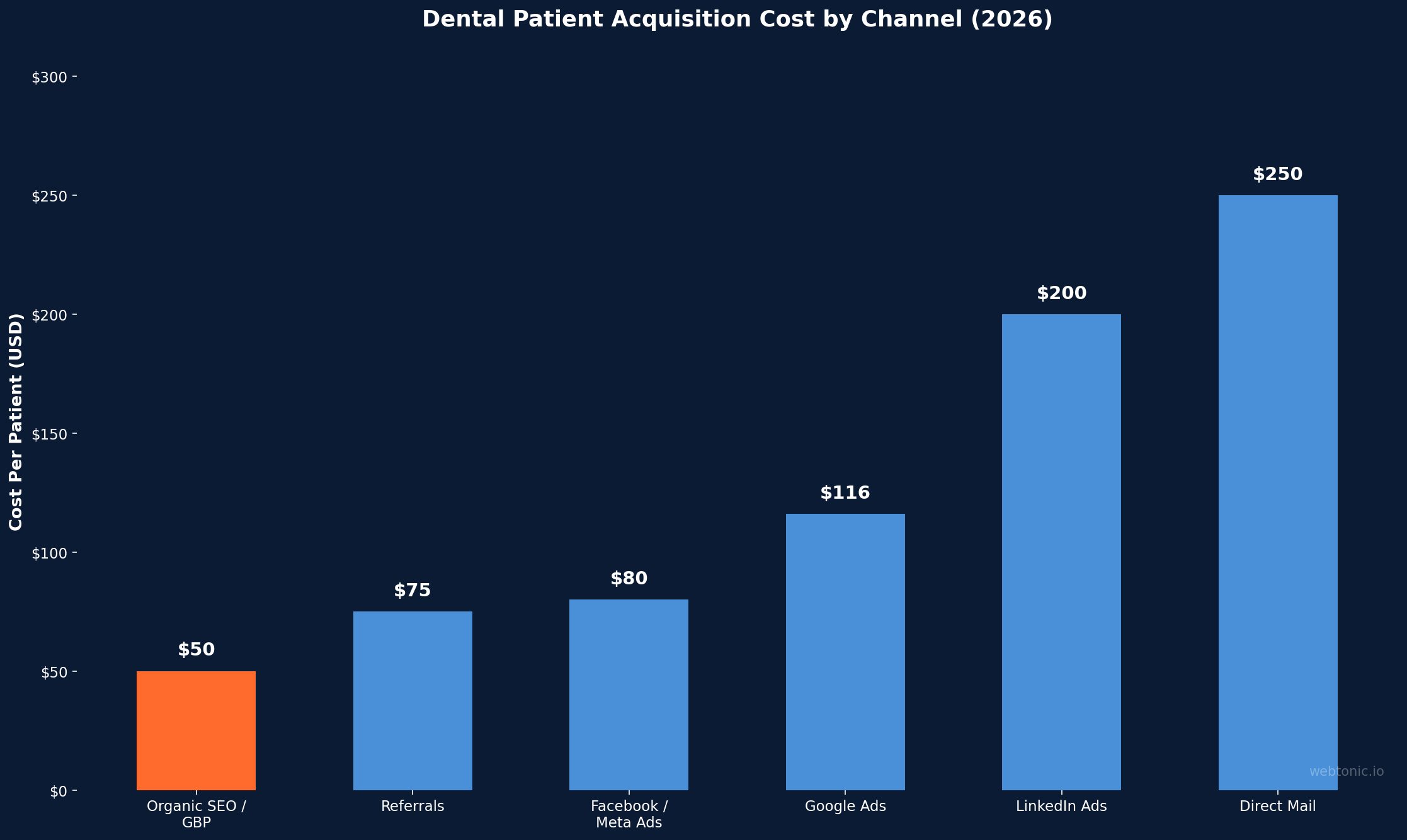
| Channel | Avg CAC | Avg ROAS | Attribution Complexity |
|---|---|---|---|
| Organic SEO / GBP | $25–$100 | 12:1 | Medium (multi-touch) |
| Patient referrals | $50–$100 | 10:1 | Low (single-touch) |
| Facebook / Meta Ads | $80–$150 | 3.5:1 | Medium (cross-device) |
| Google Ads | $116–$200 | 3.5:1 | Low–Medium (click-based) |
| LinkedIn Ads | $120–$280 | 2–3:1 (B2B) | High (long cycle) |
| Direct mail | $200–$400 | 1.5–2:1 | Very Low (response codes) |
According to Inshalytics, many practices discover significant attribution corrections once they implement proper tracking — channels they assumed were underperforming often turn out to be initiators of patient journeys completed through other touchpoints.
Attribution Model Usage and Accuracy for Dental Practices
The choice of attribution model directly impacts how dental practices allocate their marketing budgets. Last-click attribution — still used by 42% of practices — systematically overvalues direct channels and Google Business Profile while undervaluing awareness-building channels like SEO and social media.

| Attribution Model | Usage Rate | Accuracy | Best For |
|---|---|---|---|
| Last-click | 42% | Low | Simple tracking, small practices |
| First-click | 18% | Low–Medium | Identifying discovery channels |
| No formal attribution | 22% | None | Practices <$1K/mo spend |
| Position-based (40/20/40) | 12% | High | Recommended for most practices |
| Time-decay | 5% | Medium–High | Multi-month patient journeys |
| Data-driven (GA4) | 6% | Highest | High-volume multi-location |
DentalPrice.ai recommends that practices start with first-click attribution to understand awareness channels, then transition to position-based attribution as they build more sophisticated tracking infrastructure. Position-based models assign 40% credit to the discovery touchpoint, 40% to the converting touchpoint, and 20% distributed across nurturing interactions in between.
Call Tracking and Attribution Technology Adoption
Phone calls remain the primary conversion action for dental practices, making call tracking the foundation of any attribution system. Dynamic number insertion (DNI) assigns unique phone numbers to each marketing channel, enabling practices to attribute every inbound call to its originating source.
- CallRail is the most widely adopted call tracking platform for dental practices, providing session-level attribution and keyword-level tracking for paid search campaigns
- Dynamic number insertion enables source-level attribution for phone calls at a cost of $45–$150/month for most single-location practices
- AI-powered call scoring now classifies calls as new patient vs. existing patient with 90%+ accuracy, eliminating the manual review burden
- HIPAA-compliant platforms (Liine, CallRail Healthcare, Practice by Numbers) ensure that call recordings and patient data meet regulatory requirements
- Integration with PMS (Dentrix, Eaglesoft, Open Dental) closes the loop between marketing attribution and actual patient production revenue
According to The Dental Signal, the total cost of a comprehensive attribution stack (CallRail + GA4 + UTM tracking) averages just $1,500 per year — a fraction of the $12,000+ in waste it typically eliminates.
The Multi-Touch Dental Patient Journey
Modern dental patients interact with 6–8 marketing touchpoints before scheduling their first appointment. Understanding this journey is critical for accurate attribution and budget allocation.
A typical new dental patient journey in 2026 follows this pattern, according to Dentplicity:
- Search query — patient searches "dentist near me" or specific treatment (Google organic or paid click)
- Website visit — browses the practice website, reads reviews, checks services offered
- Google Business Profile — views photos, reads reviews, checks hours and location
- Social media — encounters the practice on Facebook or Instagram through ads or organic content
- Review platforms — reads detailed reviews on Google, Yelp, or Healthgrades
- Return visit — revisits the practice website via direct URL or branded search
- Phone call or online booking — converts to a scheduled appointment
Single-touch attribution models (last-click or first-click) capture only one of these touchpoints, misattributing the remaining 5–7 interactions. This is why practices using multi-touch attribution reallocate budgets more effectively and achieve better returns per marketing dollar.
Marketing ROI Metrics Every Dental Practice Should Track
Effective attribution requires tracking the right metrics at each stage of the patient journey. According to AriaDental, most dental practices spend between $80,000 and $250,000 annually on marketing — but few could identify which specific investments generate the highest return.
| Metric | Benchmark | Why It Matters |
|---|---|---|
| Cost per lead (CPL) | $25–$150 | Measures channel efficiency before qualification |
| Cost per new patient (CPA) | $150–$400 | True acquisition cost after conversion |
| Patient lifetime value (LTV) | $3,000–$5,000 | Revenue from avg patient relationship |
| LTV:CAC ratio | 10:1 to 25:1 | Should exceed 3:1 minimum |
| ROAS by channel | 3.5–12:1 | Varies significantly by channel |
| Treatment acceptance rate | 60–80% | Measures post-visit conversion quality |
| Show rate | 75–90% | Identifies lead quality differences by source |
The Direction.com framework emphasizes that dental practices should track these seven metrics monthly and by channel — blending metrics across channels hides which investments work and which waste money.
Attribution Best Practices for Dental Marketing
- Implement call tracking first. Since 60–70% of dental conversions happen via phone, call tracking provides the highest-impact attribution improvement for the lowest cost.
- Add "How did you hear about us?" to intake forms. This simple offline attribution method captures patient self-reported sources that digital tracking misses (Patientfy).
- Use UTM parameters on every campaign URL. Consistent tagging enables GA4 to attribute web visits to specific campaigns and ad groups.
- Reconcile online and offline data monthly. Match PMS new-patient records with digital attribution data to close the loop between marketing spend and revenue.
- Transition to position-based attribution. The 40/20/40 model gives dental practices the best balance between recognizing discovery and conversion channels.
- Track LTV, not just CPL. A $200 Google Ads lead who becomes a $15,000 implant patient is far more valuable than a $50 Facebook lead who only books a cleaning.
Channel-Specific Attribution Insights for Dental Practices
Each marketing channel presents unique attribution challenges for dental practices. Understanding these nuances prevents misallocation of budget based on incomplete or misleading data.
- Google Ads attribution is the most straightforward because click-based tracking captures the exact search query, campaign, and ad that drove the call or form submission. However, Google Ads overstates its own contribution by 15–30% because it cannot see the SEO touchpoints and review reading that preceded the paid click (Response Mine).
- SEO and GBP attribution is chronically undervalued. Most patients who call from a Google Business Profile listing were influenced by prior touchpoints including blog content, social media, or paid ads. Without multi-touch tracking, SEO gets zero credit for awareness it actually generated.
- Social media attribution suffers from the view-through problem. A patient may see a dental practice's Facebook ad three times before searching for the practice name on Google. Last-click attribution credits Google, not the Facebook ads that created awareness. View-through windows of 1–7 days help capture this hidden contribution.
- Referral attribution depends almost entirely on intake forms. Digital tracking cannot capture word-of-mouth referrals unless patients self-report. Practices that add specific referral source options to intake forms typically discover that referrals drive 20–35% of new patients — far more than digital analytics suggest.
- Email marketing attribution benefits from direct click tracking via UTM parameters. Dental reactivation campaigns targeting dormant patients average 15–25% open rates and 2–4% click-through rates, with clear attribution to specific campaigns and segments.
Privacy Compliance and Attribution Challenges
Dental practices face unique attribution challenges at the intersection of HIPAA compliance and digital tracking requirements. The shift toward privacy-first browsers and cookie restrictions has made traditional pixel-based attribution less reliable, pushing practices toward server-side solutions.
Key privacy-related attribution considerations for dental practices include:
- HIPAA-compliant call tracking requires Business Associate Agreements (BAAs) with tracking vendors and proper handling of Protected Health Information (PHI) in call recordings and transcripts
- Cookie deprecation has reduced the effectiveness of cross-device attribution by an estimated 25–40%, making first-party data and server-side tracking more critical than ever
- Google Consent Mode v2 enables dental practices to continue using GA4 attribution while respecting user privacy preferences, with modeled data filling attribution gaps for non-consenting users
- Server-side conversion tracking through Google Ads Conversion API and Meta Conversions API improves attribution accuracy by 15–30% compared to browser-based pixels alone
- Offline conversion import connects PMS patient production data back to the originating ad click, closing the loop between marketing spend and actual revenue generated per channel
Frequently Asked Questions
What is dental marketing attribution?
Dental marketing attribution is the process of assigning credit to the marketing channels and campaigns that influence a patient's decision to schedule an appointment. It answers the question "which marketing touchpoints brought this patient to our practice?" using tools like call tracking, UTM parameters, and analytics platforms to connect marketing spend to patient revenue.
What attribution model is best for dental practices?
Position-based (40/20/40) attribution is recommended for most dental practices. It assigns 40% credit to the first touchpoint (how the patient discovered you), 40% to the last touchpoint (what directly triggered conversion), and 20% distributed among middle nurturing interactions. This model recognizes both awareness-building and conversion-driving channels.
How much does dental marketing attribution cost?
A comprehensive attribution stack for a single-location dental practice costs approximately $1,500 per year — including call tracking ($45–$150/month), Google Analytics 4 (free), and UTM tracking setup. This investment typically eliminates $12,000+ in wasted spend annually while uncovering $120,000 in additional lifetime value through better channel optimization.
What is the average patient acquisition cost for dentists?
The average dental patient acquisition cost ranges from $150 to $400 across all channels combined. By channel, organic SEO and GBP deliver the lowest cost at $25–$100 per patient, while Google Ads averages $116 and direct mail exceeds $250 per patient. Proper attribution helps practices identify and scale their lowest-cost channels.
How many dental practices use attribution tracking?
Approximately 78% of dental practices use some form of attribution, but only 12% use multi-touch attribution and just 6% use data-driven models. The remaining 22% rely on no formal attribution, typically asking patients "how did you hear about us?" as their only tracking method. Data-driven practices using proper attribution grow 2.4× faster than those relying on assumptions.
Sources
https://www.thedentalsignal.com/marketing-attribution-channels/
https://dentalprice.ai/resources/guides/dental-marketing-roi/
https://dentalmarketingguy.co/blog/dental-practice-analytics-roi-tracking-2026/
https://ariadental.ai/dental-practice-marketing-roi-tracking
https://dentplicity.com/blog/dental-marketing-roi-tracking
https://responsemine.com/top-multi-touch-attribution-models-used-in-healthcare-and-when-to-use-each/
https://patientfy.ai/blog/dental-patient-acquisition-cost-2026
https://inshalytics.com/blogs/cost-per-acquisition-dental-patients
https://direction.com/how-to-measure-dental-marketing-roi/
https://cufinder.io/blog/benchmarks/dentists/