Table of contents

Health and wellness marketing has an unusual measurement problem: the buying journey is long and research-heavy, the categories are regulated, and the most persuasive touchpoints — a subreddit thread, a practitioner recommendation, a podcast mention — leave no click behind. That is why only 41% of teams have adopted multi-touch attribution while 67% of B2B marketers still report on last touch, according to MarqOps. Below are the numbers that define attribution and business intelligence for wellness brands in 2026, and what they imply for how you spend.
Key Takeaways
- 76% of B2B marketers now use some form of multi-touch attribution model, up from 56% in 2020.
- 26% of US marketers use marketing mix modelling in April 2026, up from 9% in 2023 — a 212% jump.
- 78% of decision-makers think at least 10% of marketing spend is wasted through weak measurement.
- Athletic Greens measured 2.1x true incremental ROAS versus 3.9x reported by Ads Manager.
- Privacy-safe server-side setups hold 60–75% match rates in low-stigma health categories.
- Teams that switch to multi-touch report an 18% ROI lift and 15% lower CAC.
Attribution Benchmarks at a Glance
These are the anchor figures we return to when auditing a wellness brand's measurement stack. Sources differ in method and sample, so treat them as ranges rather than absolutes.
| Metric | 2026 figure | Source |
|---|---|---|
| Multi-touch attribution adoption (B2B) | 76% use some MTA model (56% in 2020) | AMW |
| Active MTA frameworks (all companies) | 42–48% | Hyperone / Digital Applied |
| Teams fully off last touch | 41% adopted MTA; 67% still report last touch | MarqOps |
| MMM usage, US marketers | 26% (April 2026) vs 9% in 2023 | Primores / eMarketer |
| Retail decision-makers using MMM for incrementality | 61% | Feedvisor via eMarketer |
| Incrementality testing adoption, $10M+ spend | 41% | Presenc AI |
| Spend believed wasted on poor measurement | 78% say 10%+; 7% say 30%+ | Haus via eMarketer |
| Reported ROI lift after MTA adoption | +18% ROI, +22% lead quality, -15% CAC | MarqOps |
1. Multi-Touch Attribution Adoption Is Broad but Shallow
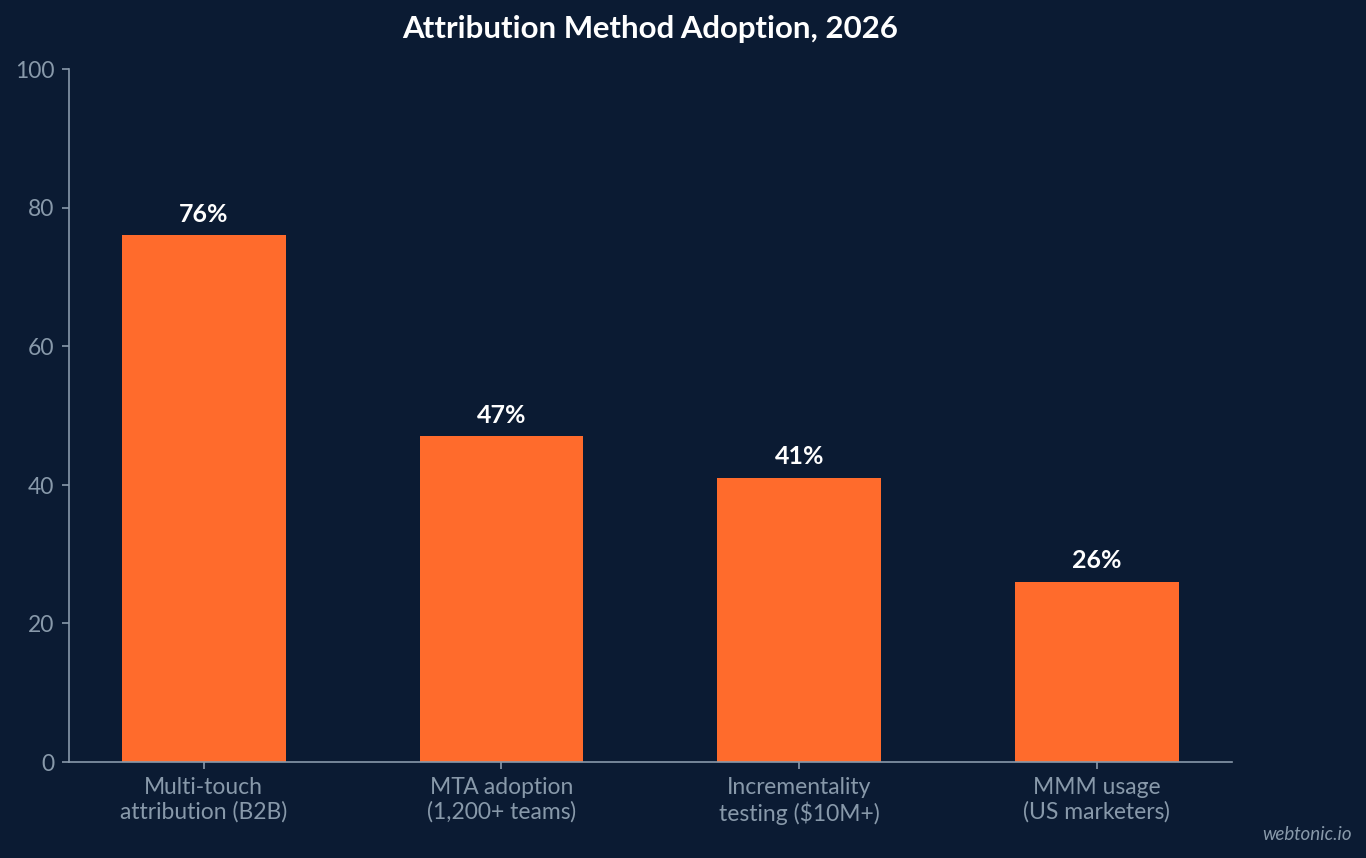
The headline adoption numbers look healthy. AMW's 2026 roundup puts 76% of B2B marketers on some form of multi-touch model, up from 56% in 2020. Vendor-side surveys are more conservative: 42–48% of companies report an active multi-touch framework, and Digital Applied's survey of 1,200+ marketing teams lands at 47% multi-touch adoption.
The gap between "we have a model" and "we act on the model" is where wellness brands lose money. MarqOps found that 67% of marketers still make decisions from last-touch reports even when a multi-touch model exists in the stack. In practice a linear or position-based model is switched on in a BI tool, nobody trusts it against the platform dashboards, and budget keeps flowing to the channel that claims the final click — usually branded search and retargeting, the two places wellness demand is already captured.
Agencies feel the same friction. In the 2026 AgencyAnalytics Marketing Agency Benchmarks Report, 44% to 48% of agencies reported four separate attribution challenges — no single dominant problem, but a cluster of data-quality, cross-channel and client-education issues that compound.
2. What Last-Click Hides in a Wellness Funnel
Wellness purchases are researched across forums, review sites, practitioner content and long email nurtures. Last-click reporting collapses all of that into whichever tab was open at checkout. Prooflytics notes that last click awards 100% of credit to a single touchpoint while ignoring 6–12 prior interactions, and that moving to multi-touch typically reveals 30–60% of spend was aimed at the wrong channels.
The direction of the correction is consistent. A public multi-touch modelling analysis found referral traffic moved from 21.6% of credit under last click to 39.7% under a data-driven model — an 18-point swing. Older Microsoft research cited by Gitnux found multi-touch users saw 10–30% changes in budget allocation decisions versus last click. And a Neil Patel study of 100 businesses estimated that 41% of conversions are AI-influenced but invisible to last-click models — a fast-growing blind spot as wellness buyers ask chat assistants for supplement or clinic recommendations.
| Channel behaviour | Under last click | Under data-driven | Implication for wellness brands |
|---|---|---|---|
| Referral / community traffic | 21.6% of credit | 39.7% of credit | Forums, subreddits and practitioner referrals are systematically underfunded |
| Prior touchpoints counted | 1 | 6–12 | Education content gets credit for the demand it creates |
| Typical budget reallocation | Baseline | 10–30% of budget moves | Expect a real reshuffle, not a cosmetic one |
| Misdirected spend revealed | Hidden | 30–60% of spend | Audit before scaling, not after |
| AI-influenced conversions | Untracked | ~41% of conversions influenced | Add AI-referral and brand-search tracking |
3. MMM Went from Enterprise Luxury to Category Standard
Marketing mix modelling is the fastest-moving line in the measurement stack. US marketer usage rose from 9% in 2023 to 26% by April 2026 — a 212% increase driven by cookie deprecation, Apple's ATT and state privacy law. Among retail decision-makers the figure is far higher: 61% use media mix modelling to measure incrementality, per December 2025 Feedvisor data reported by eMarketer.
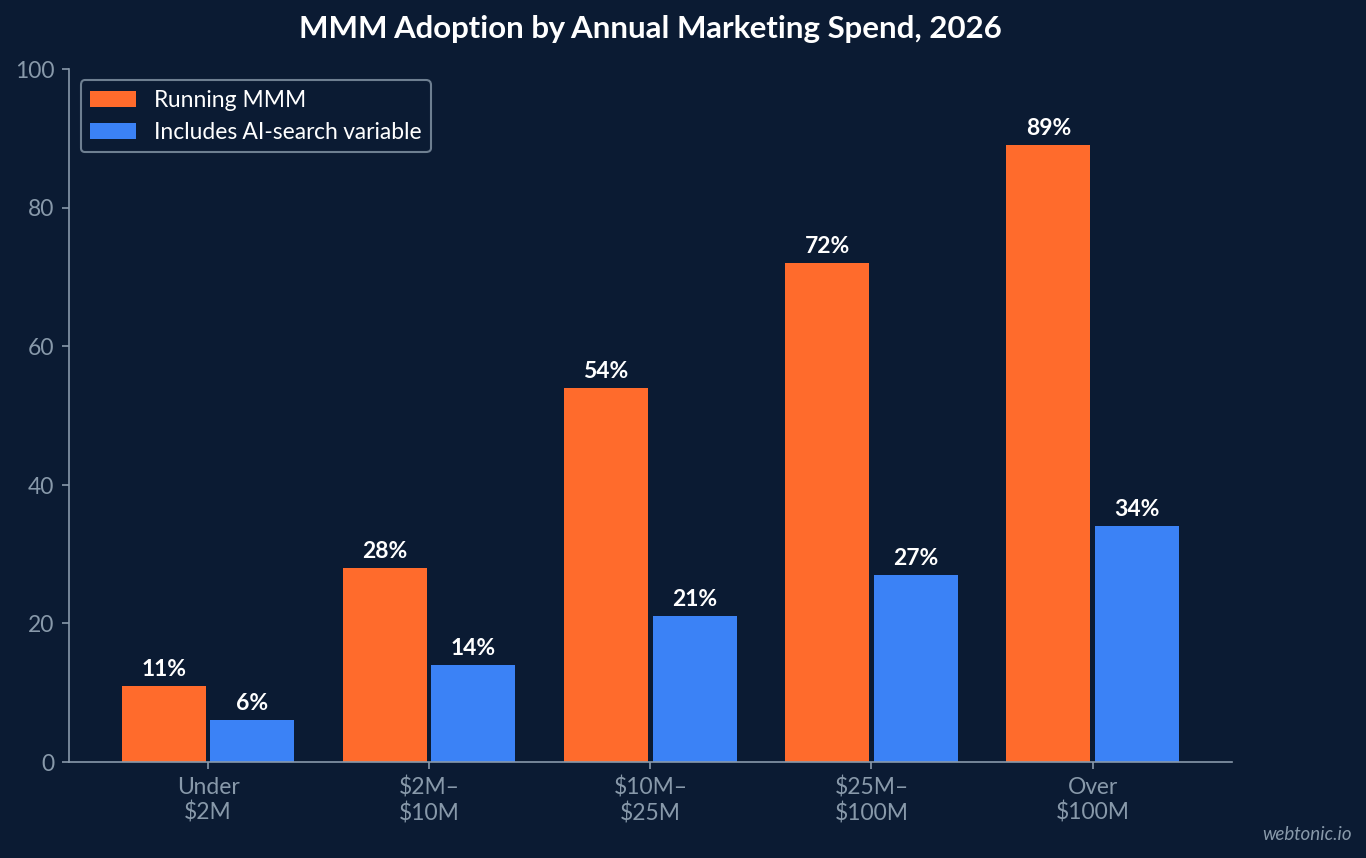
Spend level is the single best predictor of whether a brand models its mix. Presenc AI's 2026 research shows adoption climbing with budget, and only a minority of adopters yet feeding AI search into the model.
| Annual marketing spend | % running MMM | % including an AI-search variable |
|---|---|---|
| Over $100M | 89% | 34% |
| $25M–$100M | 72% | 27% |
| $10M–$25M | 54% | 21% |
| $2M–$10M | 28% | 14% |
| Under $2M | 11% | 6% |
Adoption is not the same as competence. eMarketer reports that only 28% of marketers say their organisation is very effective at converting MMM insights into action. Bunker DB, drawing on 1,200+ teams surveyed between 2024 and 2026, adds two useful figures: 43% of new MMM adopters cite signal loss as the primary trigger, and teams with real attribution capability spend 23% more on martech but generate 1.6x more marketing-sourced pipeline.
4. Incrementality Testing Is the Trust Layer
Where models disagree, experiments decide. Presenc AI puts incrementality testing adoption at 41% of brands with $10M+ annual marketing spend, 19% at $2M–$10M and 6% below $2M, with the economic threshold for a lift test falling around $5M–$10M of annual media. eMarketer's reporting on Haus data found incrementality testing earns marketers' highest trust of any measurement method — while 78% of US decision-makers believe at least 10% of spend is wasted for lack of it.
The wellness-specific example is instructive. As reported by D2C Times, Athletic Greens ran a geographic holdout across its five largest Meta campaign clusters and measured 2.1x true incremental ROAS against the 3.9x Ads Manager was reporting — nearly half of credited conversions were not caused by the ads. Supplement economics make that gap expensive: Eightx puts blended DTC supplement CAC near a median of $80–$89, among the highest of any DTC vertical, and Foundry CRO quantifies an additional regulatory "friction tax" on paid acquisition in the category.
5. Privacy Rewrote the Wellness Measurement Stack
Any wellness brand touching clinical services, telehealth or diagnostics is measuring under HIPAA-style constraints. Improvado's 2026 post-pixel playbook reports achievable match rates of 60–75% in primary care and 55–70% in dermatology, with lower rates in higher-stigma categories such as mental health. Matchnode describes the working pattern: a server-side conversion API routes every event through the covered entity's own infrastructure first, and URL parameters are stripped or hashed before anything reaches an ad platform.
Three practical consequences for measurement design:
- Event coverage drops before accuracy does. A 60–75% match rate means a fifth to a third of conversions never reach the bidding algorithm, so target CPAs must be set on modelled, not raw, volume.
- Sensitive-page pixels are a compliance risk, not a tracking choice. Consent banners do not constitute HIPAA authorisation.
- Aggregate methods gain relative value. When user-level signal is degraded, MMM and geo lift tests become the primary sources of truth rather than a nice-to-have.
6. Health & Wellness vs All Industries
Wellness marketers face a harder measurement problem than the cross-industry average, on four axes at once.
| Dimension | All industries | Health & wellness | Why it diverges |
|---|---|---|---|
| Tracking method | Client-side pixels plus server-side | Server-side mandatory on clinical journeys | HIPAA and state health-privacy law |
| Conversion match rate | Platform-typical | 55–75% by condition category | Identifiers stripped or hashed |
| Acquisition cost | Varies widely | Median blended supplement CAC $80–$89 | Regulated claims, high competition |
| Consideration window | Days to weeks | Weeks to months of research | Trust-heavy, practitioner-influenced buying |
| Primary source of truth | Platform dashboards | MMM plus geo lift tests | User-level signal is structurally incomplete |
7. What Good Looks Like: A Practical Measurement Order of Operations
The consensus across 2026 sources is a layered hierarchy rather than a single model. We build wellness measurement stacks in this order:
- Business-level efficiency first. Total revenue over total spend (MER) does not depend on tracing individual conversions, so it stays trustworthy while platform numbers conflict.
- Server-side event layer. First-party capture, hashed identifiers, documented data flow — this protects both compliance and match rate.
- Incrementality tests on the two largest channels. Geo holdouts answer the "would this have happened anyway" question that no model can.
- MMM once spend and history justify it. Roughly $5M+ annual media, one to two years of history, five or more channels with genuine spend variation.
- Multi-touch for in-channel tactics only. Creative, audience and campaign decisions inside a channel, never the strategic budget split.
- One dashboard, one definition per metric. Governance beats sophistication; see our work on data intelligence for how we structure this.
If your paid programme is the thing being measured, our growth marketing and Meta Ads teams treat measurement design as part of the media plan rather than a reporting afterthought, and the same logic applies to evaluating whether Facebook Ads are worth it in a regulated category.
8. Five Measurement Failure Modes We See in Wellness Accounts
Patterns repeat across audits. Each of these is cheap to detect and expensive to leave alone.
- Double-counted conversions. A client-side pixel and a server-side conversions API firing the same event without deduplication inflates reported volume and depresses reported CPA — the fastest way to over-scale a losing campaign.
- Branded search taking credit for everything. When community and content channels create demand, branded search harvests it. Splitting branded from non-branded before reading any report is non-negotiable.
- Subscription revenue measured at first order. With supplement CAC medians near $80–$89, a first-order ROAS target will kill profitable subscription acquisition; measure to at least 90-day contribution.
- No holdout, ever. Brands with 41% of conversions AI-influenced but untracked cannot resolve the gap analytically — only an experiment closes it.
- Reporting cadence mismatched to signal. Weekly reads on a channel with a multi-week consideration window generate noise-driven decisions; align the reporting window to the measured lag.
Frequently Asked Questions
What attribution model should a health and wellness brand use in 2026?
Most wellness brands land on a layered stack rather than one model: marketing mix modelling for the strategic budget split, geo or holdout incrementality tests to calibrate it, and multi-touch or platform reporting for tactical, in-channel creative and campaign decisions. Only 41% of teams have adopted multi-touch attribution while 67% of B2B marketers still lean on last-touch reporting, so simply moving off last click already puts a brand ahead of the field.
How wrong is platform-reported ROAS for supplement and wellness brands?
It is usually optimistic. When Athletic Greens ran a geographic holdout across its top five Meta campaign clusters, true incremental ROAS came in at 2.1x versus the 3.9x Meta's Ads Manager reported — close to half the reported conversions were not incremental. Independent studies put the same directional gap elsewhere: switching from last click to multi-touch typically reveals that 30–60% of spend was pointed at the wrong channels.
Can wellness and telehealth brands still track conversions under HIPAA?
Yes, but the plumbing changes. Pixels that fire on sensitive pages are replaced by a server-side layer that routes events through the brand's own infrastructure first, strips or hashes identifiers, and only then forwards permitted signals. Match rates land around 60–75% for low-stigma categories such as primary care and 55–70% in dermatology, so measurement is degraded but far from blind.
How much marketing spend do brands waste because of weak measurement?
In eMarketer's reporting on Haus data, 78% of US decision-makers believe at least 10% of marketing spend is wasted due to insufficient measurement, and 7% put that figure at 30% or more. For a wellness brand spending $150,000 a month, the conservative end of that range is roughly $15,000 a month of unattributed, unoptimised budget.
When is marketing mix modelling worth it for a wellness brand?
Adoption follows spend almost linearly: 89% of brands above $100M in annual marketing spend run MMM, 54% in the $10M–$25M band, 28% at $2M–$10M and only 11% below $2M. The usual practical threshold for MMM and lift testing is roughly $5M–$10M of annual media, plus one to two years of spend history with real variation across five or more channels.
Sources
Digital Applied — Marketing Attribution Statistics 2026
AMW — Marketing Attribution Statistics 2026
MarqOps — Multi-Touch Attribution in 2026
Presenc AI — MMM Adoption Rate 2026
eMarketer — Incrementality testing earns marketers' top trust
Improvado — Telehealth Marketing Without Pixels (2026 HIPAA guide)
D2C Times — Athletic Greens attribution rebuild
Eightx — Supplements Brand Financial Benchmarks 2026
AgencyAnalytics — Marketing Attribution in 2026
Prooflytics — Why Last-Click Attribution Is Broken