Table of contents
Google Ads remains the fastest way for a dental practice to show up in front of patients at the exact moment they search for care — but in 2026 it is also more expensive and more automated than ever. This report compiles the most important dental Google Ads statistics for 2026 — drawn from industry benchmark studies, the ADA Health Policy Institute, and aggregated data from thousands of dental practice ad accounts — to help you budget, benchmark, and optimize your campaigns with real numbers instead of guesswork. Whether you run a single dental practice or a multi-location group, these statistics show what it really costs to attract new patients with Google Ads in 2026.
Key Takeaways
- The average CPC for dentists and dental services on Google Ads is $7.85 — well above the all-industry average of $5.26 (WordStream).
- Average cost per lead in dental sits around $83.93, against an all-industry average of $70.11.
- Dental Google Ads conversion rates range from 4% to 10%+, with well-optimized accounts reaching 10.4% or better.
- 89.7% of patients start their search for a new dentist online, and "dentists near me" generates roughly 1.83 million searches per month in the US.
- A new dental patient acquired via Google Ads typically costs $150–$350, against an average patient lifetime value of $4,000–$8,400 — a 20–40x return when campaigns are managed well.
- 71% of advertisers now run Performance Max, and AI-assisted campaigns are reshaping how dental budgets get spent.
Dental Google Ads Benchmarks at a Glance (2026)
Before diving into the details, here is how the core dental Google Ads metrics stack up across the major benchmark datasets:
| Metric | Dental benchmark | All-industry average | Source |
|---|---|---|---|
| Average CPC (search) | $7.85 | $5.26 | WordStream |
| Average cost per lead | $83.93 | $70.11 | WordStream |
| Conversion rate | 4%–10% (top performers 10–15%) | ~7.5% | RYN Digital |
| Click-through rate | 3.5%–4.9% | ~6.4% | CUFinder |
| Cost per booked patient (general) | $150–$200 | — | CUFinder |
| Cost per booked patient (implants/cosmetic) | $350–$500 | — | CUFinder |
The takeaway: dental clicks cost roughly 50% more than the average Google Ads click, but the economics still work because dental patients are unusually valuable over their lifetime.
How Much Do Dental Google Ads Cost in 2026?
Dental CPCs vary enormously by procedure. High-revenue treatments attract more bidders, so a click for "dental implants" can cost five times more than a click for a routine cleaning (KeyGrow):
| Keyword category | Typical CPC range | Why |
|---|---|---|
| General dentistry / cleanings | $3–$8 | Lower revenue per visit, broad competition |
| Cosmetic / teeth whitening | $5–$12 | Elective, moderate case value |
| Emergency dentist | $6–$15 | Extreme urgency and intent |
| Invisalign / orthodontics | $8–$15 | Multi-thousand-dollar case value |
| Dental implants | $12–$25+ (up to $50 in urban markets) | Cases worth $5,000–$30,000 |

Implant keywords are consistently the most expensive in dental PPC — but a single implant case can generate $5,000 to $30,000 in revenue, so even a $200–$400 acquisition cost delivers a strong return.
Monthly budgets follow the same logic. Most practices spend $1,500–$10,000+ per month on Google Ads depending on market competitiveness and growth goals. If you want a broader look at pricing across industries, see our complete Google Ads pricing guide.
Conversion Rates and Cost per Lead
Cost per click only matters in relation to what happens after the click. Here is what the 2026 benchmark data shows:
- Dental Google Ads conversion rates cluster between 4% and 10%, with the best-performing accounts hitting 10–15% (RYN Digital, aggregated from 80+ dental and healthcare accounts).
- WebFX's 2026 healthcare benchmarks put dental services at a 10.40% conversion rate — among the highest in healthcare (WebFX).
- Dedicated landing pages convert around 12.5%, nearly 3x better than sending traffic to a homepage (~4.2%), and call-only ads convert at 18.2% (CUFinder).
- Cost per lead lands between $63 and $116 in most datasets, with $83.93 the most-cited industry average.
Two structural findings stand out from the account-level data: procedure-specific campaigns outperform generic "dentist near me" campaigns by roughly 60% in conversion rate, and appointment-focused CTAs like "Book Today" outperform generic "Learn More" buttons by about 40%.
Dental Keyword Statistics: What Patients Search For
Keyword selection drives everything in dental PPC — targeting the right search terms determines both your cost per click and the quality of patients you attract. The 2026 keyword statistics show where the volume and the money are (SoftScotch):
| Keyword | US monthly searches | Avg. CPC |
|---|---|---|
| dentists near me | 1,830,000 | $11.81 |
| teeth whitening | 301,000 | $5–$12 |
| tooth extraction near me | 110,000 | $6–$14 |
| emergency dentist | 90,500 | $6–$15 |
| dental implants cost | 74,000 | $12–$25 |
| invisalign near me | 60,500 | $8–$15 |
Three keyword statistics stand out for campaign targeting. First, "near me" search terms dominate local dental search — patients searching for a tooth extraction or teeth whitening want a nearby practice, not general information. Second, high-intent keywords like "emergency dentist" and "dental implants near me" justify premium bids because searchers convert at the highest rates. Third, question-style searches ("how much does a tooth implant cost") are growing fastest, which is why content marketing — every blog post that answers a cost or treatment question — helps lower your blended acquisition cost and feeds your remarketing audiences.
How Patients Actually Find a Dentist in 2026
The patient journey now starts online almost by default:
- 89.7% of patients begin their search for a new dentist online, primarily on Google — versus just 7% who start with a personal referral (The Profitable Dentist).
- 82% say their choice of dentist is highly influenced by online reputation, and 89% consider reviews more important than where the dentist went to school.
- "Dentists near me" generates about 1.83 million monthly searches in the US, at an average CPC of $11.81 (SoftScotch).
- The Google local pack absorbs an estimated 60–70% of clicks on "near me" dental searches — which is why your Google Business Profile and your ads need to work together.
- Mobile devices account for 68.5% of dental website traffic, so a slow or non-mobile-optimized landing page or website quietly destroys ad ROI.
Demand-side context matters too: statistics from the ADA show there are 135,665 dental practice establishments in the US, and consumer dental spending grew about 4% over the past year (ADA Health Policy Institute). With one-third of dentists reporting they are "not busy enough," competition for high-intent searches keeps pushing auction prices up.
ROI and Budget Benchmarks: What a Patient Is Worth
Google Ads is typically the most expensive dental acquisition channel per patient — and still one of the most profitable, because of patient lifetime value. Benchmark data from 1,500+ dental practices shows the following cost per new patient by channel (Pete Johnson / Lasso MD):
| Channel | Cost per new patient |
|---|---|
| Referrals | $0–$50 |
| Google Business Profile | ~$0–$30 |
| SEO (organic) | $50–$150 |
| Google Ads | $150–$350 |
| Paid social | $200–$500 |
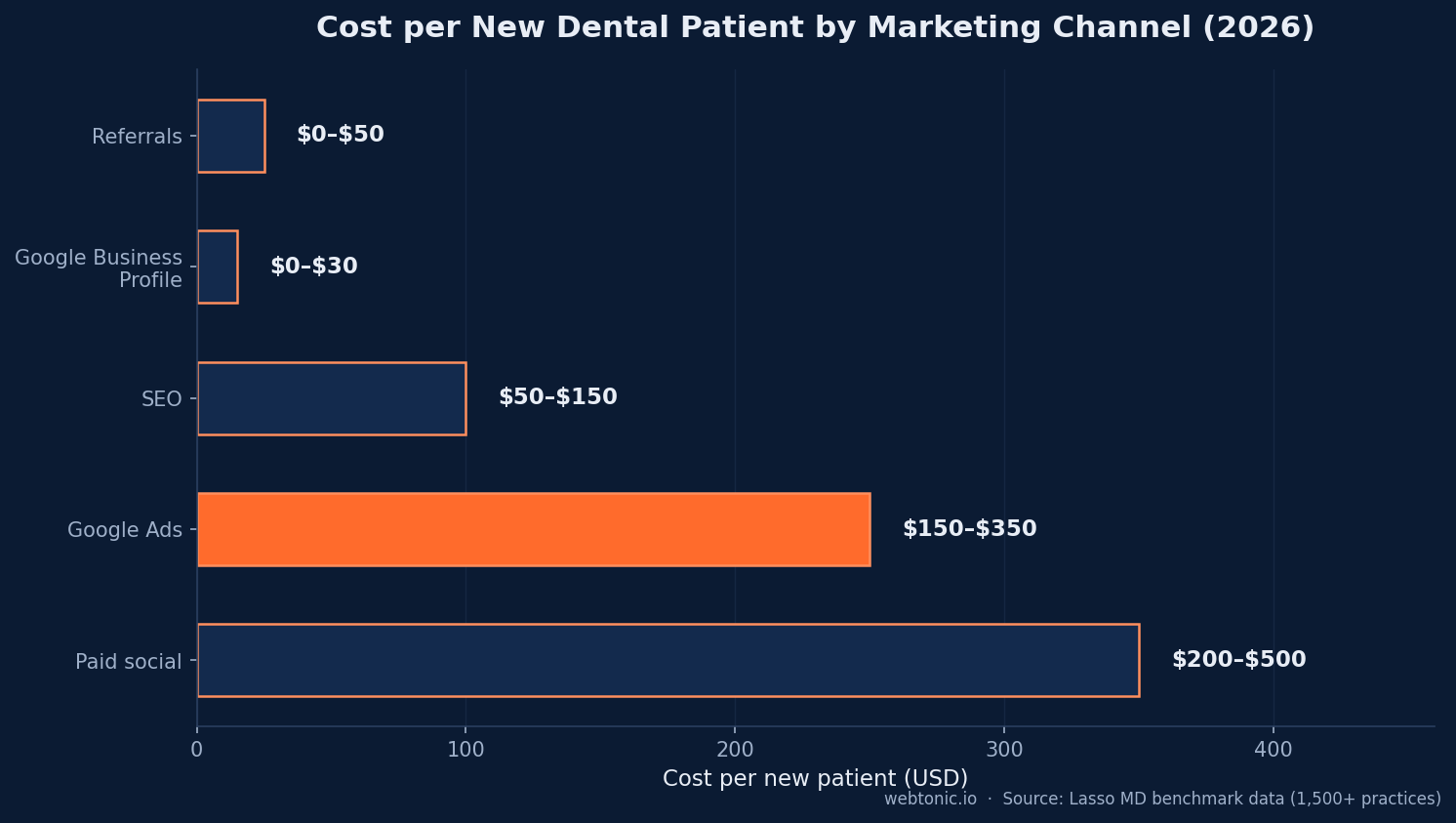
Because the average dental patient is worth $4,000–$8,400 over their lifetime, a patient acquired for $200 via Google Ads returns 20–40x that investment. Budget-wise, established practices typically allocate 3–8% of collections to marketing; practices in aggressive growth mode or opening a new location plan for 10–15%, and startups budget 15–25% in their first two years.
Well-managed dental campaigns typically produce a 5x to 8x return on ad spend, according to agencies managing $20M+ in dental Google Ads spend (Creekside Marketing).
AI and Performance Max: The 2026 Shift
The biggest change in how dental Google Ads budgets get spent is automation:
- 71% of surveyed advertisers used Performance Max in 2025, up from 60% in 2024, and PMax now accounts for roughly 20% of total Google Ads spend (EverTrue Marketing).
- PMax campaigns drive approximately 45% of all Google Ads conversions in 2026.
- Campaigns using AI Max with Smart Bidding Exploration report a 19% increase in conversions, and early PMax adopters see about 13% more conversions at similar CPA.
For dental practices, the practical implication is that campaign success in 2026 depends less on manual bid tweaking and more on feeding the algorithm accurate conversion data — call tracking, booking-form tracking, and offline conversion imports — so Google's AI optimizes for booked patients, not just clicks. HIPAA compliance in tracking setup and ad copy remains non-negotiable and directly affects Quality Score.
Google Ads vs. Local SEO for Dental Practices
The data argues clearly for both, in sequence:
| Factor | Google Ads | Local SEO |
|---|---|---|
| Time to first patient | Days | 3–6+ months |
| Cost per new patient | $150–$350 | $50–$150 |
| Scalability | Immediate — spend more, get more | Compounds over time |
| Durability | Stops when budget stops | Persists after investment |
| Share of "near me" clicks | Ads + local pack ads | Local pack takes 60–70% of clicks |
Organic search still drives 42–48% of dental website traffic, versus 16–22% from paid search. The most resilient growth strategy uses Google Ads for immediate, controllable patient flow while SEO and Google Business Profile optimization build a cheaper long-term acquisition engine underneath it. That is exactly how we structure growth marketing engagements at Web Tonic — and why our dental marketing programs pair PPC with local SEO from day one.
7 Data-Backed Best Practices for Dental Google Ads in 2026
- Build procedure-specific campaigns. They convert ~60% better than generic "dentist near me" campaigns and let you match budget to case value.
- Send every click to a dedicated landing page. Dedicated landing pages with a short booking form above the fold convert at ~12.5% versus ~4.2% for general website pages.
- Use call-only and call-extension formats for emergencies. Call-focused formats convert at up to 18.2%, and emergency searches are the highest-intent traffic you can buy.
- Lead with appointment CTAs. "Book Today" style CTAs outperform "Learn More" by ~40%.
- Put new-patient offers in headlines. Promotion-led headlines lift CTR by roughly 35%.
- Track phone calls and booked appointments, not just form fills. Most dental patients still book by phone — call tracking plus offline conversion imports give Smart Bidding the data it needs. Your results are only as good as the conversion data you feed the algorithm.
- Run separate campaigns per location. Multi-location practices need per-location budgets and geo-targeting to avoid one office cannibalizing the others.
- Support ads with content marketing. A steady stream of blog posts answering treatment and cost questions (tooth extraction costs, implant timelines, whitening options) helps you attract patients earlier in their research, build remarketing audiences, and lower your blended cost per patient over time.
For a deeper tactical walkthrough, see our guide on building a Google Ads strategy that improves ROI.
FAQ: Dental Google Ads Statistics
Do Google Ads still work for dentists in 2026?
Yes. Well-managed campaigns typically deliver a 5x–8x return, with cost per new patient of $150–$350 against a lifetime value of $4,000–$8,400. The practices that struggle are usually paying premium CPCs for generic keywords with no procedure segmentation or landing pages.
How much should a dental practice spend on Google Ads?
Most practices spend $1,500–$10,000+ per month. A useful anchor: established practices allocate 3–8% of collections to total marketing, with Google Ads usually the single largest paid line item.
What is a good cost per lead for dental Google Ads?
The industry average is roughly $84, with most accounts falling between $63 and $116. General dentistry leads cost less; implant and cosmetic leads cost more but carry far higher case values.
Should I prioritize Google Ads or SEO?
Run Google Ads for immediate patient flow and build local SEO simultaneously. SEO patients cost $50–$150 (roughly half the paid cost), and the local pack captures 60–70% of "near me" clicks — but SEO takes months to mature, which is exactly the gap ads fill.
What are the best keywords for dental Google Ads?
The highest-converting keyword targeting combines high-intent local terms ("emergency dentist near me", "tooth extraction near me") with procedure keywords matched to your most profitable services (implants, Invisalign, teeth whitening). Statistics show procedure-specific targeting converts ~60% better than generic terms — so build your keyword lists around the treatments you actually want to sell.
Sources
WordStream — Google Ads Benchmarks
ADA Health Policy Institute — Dental Practice Research
WebFX — PPC for Dentists: Cost, Strategy & ROI
The Profitable Dentist — How Patients Find and Choose a New Dentist
Pete Johnson (Lasso MD) — Dental Marketing Benchmarks
CUFinder — Dentists Industry Marketing Benchmarks
KeyGrow — How Much Does Google Ads Cost for Dentists?
RYN Digital — Google Ads Benchmarks by Industry
EverTrue Marketing — The State of Performance Max in 2026
Creekside Marketing — Google Ads Costs for Dentists