Table of contents
Key Takeaways
- Facebook advertising remains viable in 2026, with the platform generating $160 billion in ad revenue because it continues delivering value for advertisers who approach it strategically
- Industry matters significantly: finance and insurance brands see 6x+ ROAS while food and beverage averages near breakeven—understand your vertical's benchmarks before setting expectations
- Campaign objective selection drives outcomes more than budget: sales-optimized campaigns outperform traffic campaigns by 835% in ROAS
- Retargeting consistently outperforms prospecting by 71%, suggesting Facebook works best as part of a multi-channel, full-funnel strategy rather than a standalone acquisition tool
- Budget requirements have increased: meaningful testing now requires $1,000-3,000+ monthly for most businesses, with $5 daily minimums rarely generating actionable results
- For businesses uncertain about Facebook advertising effectiveness, consider working with performance marketing specialists who can audit current campaigns, establish proper tracking, and benchmark performance against industry standards
What Are Facebook Ads?
Facebook advertising operates within Meta's ecosystem, allowing businesses to reach users across Facebook, Instagram, Messenger, and the Audience Network. Unlike search advertising, Facebook ads generate interest through visual content and behavioural targeting, enhancing brand awareness. The platform shows ads to users based on demographics, interests, and past behaviours rather than search intent.
Statista's analysis of Meta's financial reports reveals the platform generated $160 billion in advertising revenue in 2024, representing 97.3% of Meta's total revenue, thanks in part to the effectiveness of tools like the Meta Pixel. That figure alone tells you something important: businesses keep spending because they keep seeing returns.
For mid-market and enterprise businesses evaluating advertising investments, Facebook represents a fundamentally different proposition than search advertising. Where Google Ads captures users actively searching for solutions, Facebook advertising creates demand by reaching potential customers before they recognize a need. With over 3 billion monthly active users, this distinction matters considerably when calculating expected returns and allocating marketing budgets.
Facebook Advertising ROI: What the Data Actually Shows
Understanding Facebook's return on investment requires examining multiple data points across industries and campaign types. The headline figures tell a compelling but incomplete story.
Average Returns Across Industries
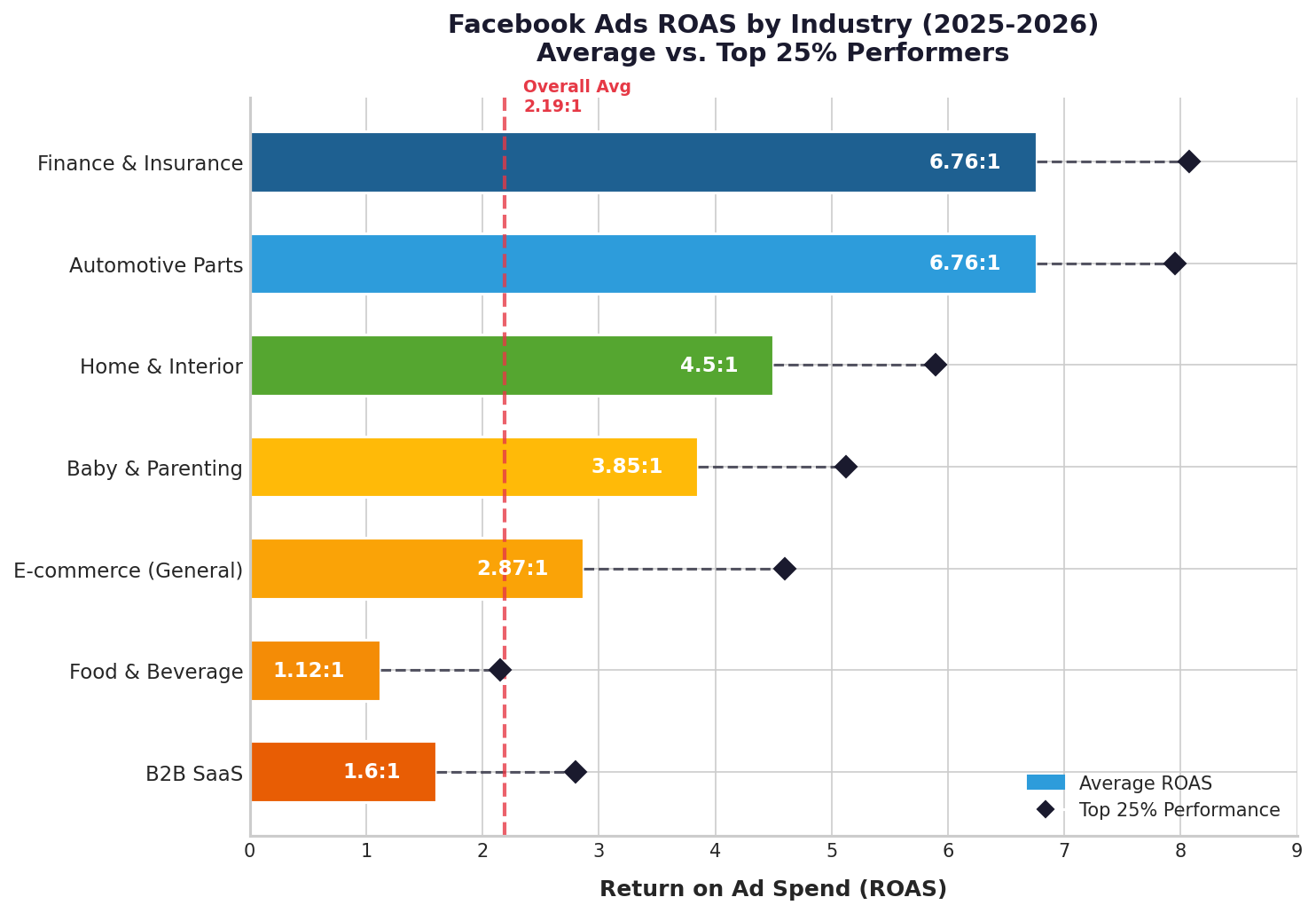
The 2025 Facebook Ads ROAS benchmarks from Focus Digital analyzed over 5,000 companies and billions in annual ad spend, finding that the average ROAS stands at 2.19:1. However, this figure masks substantial variation based on industry, campaign objectives, targeting strategies, and social network effectiveness.
| Industry | Average ROAS | Top 25% Performance | Bottom 25% Performance |
|---|---|---|---|
| Finance & Insurance | 6.76:1 | 8.07:1 | 4.52:1 |
| Automotive Parts | 6.76:1 | 7.95:1 | 4.21:1 |
| Home & Interior Design | 4.50:1 | 5.89:1 | 2.85:1 |
| Baby & Parenting | 3.85:1 | 5.12:1 | 2.45:1 |
| E-commerce (General) | 2.87:1 | 4.60:1 | 1.52:1 |
| Food & Beverage | 1.12:1 | 2.15:1 | 0.45:1 |
| B2B SaaS | 1.60:1 | 2.80:1 | 0.75:1 |
The disparity between industries reflects fundamental differences in customer lifetime value, purchase consideration cycles, and product margins. A furniture brand achieving 4x ROAS operates within benchmark expectations, while a SaaS company at 1.5x may be performing well given longer sales cycles and higher customer values.
Campaign Objective Impact
Not all Facebook campaigns are created equal. Research from Focus Digital found that sales-optimized campaigns generate 835% higher ROAS than traffic campaigns, especially when directing users to a landing page. That's not a typo. Objective selection is critical.
Sales campaigns average a ROAS of 2.43:1 with a range spanning 1.52 to 8.07. Engagement campaigns drop to 0.76:1 on average, ranging from 0.21 to 2.15, highlighting the importance of user engagement. Traffic campaigns sit lowest at 0.29:1, ranging from just 0.08 to 0.95.
This data reveals a common mistake among advertisers: optimizing for the wrong objective. Businesses seeking direct revenue should prioritize conversion-focused campaigns rather than website traffic or engagement, despite the latter appearing more affordable on surface-level metrics.
Cost Benchmarks for 2026
WordStream's 2025 Facebook Ads Benchmarks Report analyzed over 1,000 campaigns to establish current cost expectations for various marketing strategies. For traffic campaigns, expect an average CPC around $0.70 and CTR near 1.71%. Lead generation campaigns run higher: average CPC of $1.92, CTR of 2.59%, conversion rate of 7.72%, and cost per lead around $27.66.
These figures represent medians across industries. Actual costs vary significantly based on competition, audience size, and creative quality.
When Facebook Ads Work Best
Facebook advertising delivers strongest returns under specific conditions. Understanding these factors helps businesses make informed investment decisions.
High-Performing Business Types
Fashion, home décor, travel, and food brands consistently outperform on Facebook due to the platform's visual-first format. Carousel ads generate 1.6x more clicks than single-image formats, and video content delivers 47% higher engagement than static images. If your product photographs well or demonstrates better on video, Facebook gives you an advantage that text-based search ads, including ad copy, simply cannot match.
Companies with subscription models or repeat purchase cycles can justify higher acquisition costs because customer lifetime value extends well beyond the initial transaction. The baby and parenting category exemplifies this dynamic, where urgent needs and high repeat rates drive strong ROAS. This ad type is especially effective in reaching parents, as they don't buy diapers once. They buy them for years.
Products purchased based on aspiration, social identity, or impulse also perform well because Facebook's targeting can identify users in receptive mindsets before they actively search for solutions. Additionally, using a custom audience for geographic targeting capabilities makes Facebook particularly effective for local businesses seeking to reach customers within specific radius areas.
Targeting Strategy Performance
Targeting approach significantly impacts campaign returns. Focus Digital's analysis found retargeting campaigns deliver 71% higher ROAS than prospecting campaigns, leveraging audience insights.
Retargeting warm audiences averages 4.0 to 5.5:1 ROAS. Lookalike audiences typically fall between 2.5 and 3.5:1. Interest-based prospecting ranges from 1.8 to 2.5:1, while broad targeting sits lowest at 1.2 to 2.0:1.
This performance hierarchy suggests Facebook works best as part of a multi-touch strategy rather than a standalone acquisition channel. Businesses using Facebook exclusively for cold prospecting often report disappointing results, while those combining prospecting with retargeting across platforms see significantly better outcomes.
When Facebook Ads Underperform
Not every business will see positive returns from Facebook advertising. Several factors consistently correlate with poor performance.
Business Types Facing Challenges
Complex B2B solutions requiring multiple stakeholders and extended evaluation periods struggle to attribute value to Facebook's interrupt-driven model. While LinkedIn typically delivers stronger B2B ROI despite higher costs, Facebook can support awareness objectives within a broader strategy, including effective product ads. Healthcare, financial services, and legal businesses face advertising restrictions that limit targeting options and creative approaches, reducing campaign effectiveness.
Items purchased primarily through active research (like specific replacement parts or professional services in emergencies) typically convert better through search advertising where users have already identified their need.
Here's a demographic reality worth noting: Taboola's analysis shows only 13% of Gen Z visits Facebook weekly, compared to 34% using Snapchat and 33% on TikTok. Brands targeting younger demographics may find better returns on alternative platforms.
Common Failure Patterns
Meta's algorithm requires approximately 50 conversions per week per ad set to optimize effectively. Campaigns that cannot reach this threshold remain stuck in learning limited status, preventing proper optimization and resulting in poor performance of their advertising efforts. In practice, we've seen brands spend months wondering why results stay flat, only to discover their daily budget simply couldn't generate enough conversion data for the algorithm to learn.
Businesses optimizing for traffic or engagement when seeking sales create a fundamental mismatch between algorithm optimization and business goals. Apple's iOS privacy changes have also created significant attribution gaps, with some businesses seeing 20-30% of conversions misattributed. This doesn't mean Facebook isn't working. It means traditional tracking underreports results.
The platform requires fresh creativity regularly to maintain performance. Campaigns running the same assets beyond 2-3 weeks typically see declining results as audiences experience ad fatigue.
Common Misconceptions
Misconception 1: Facebook Ads Don't Work Anymore
Some marketers claim Facebook advertising effectiveness has permanently declined, citing iOS privacy changes and increased competition. The data tells a different story: Meta's advertising revenue grew to $160 billion in 2024, a figure that would be impossible if ads weren't delivering value for advertisers.
What has changed is the complexity of successful advertising. Campaigns that worked in 2020 with minimal optimization now require more sophisticated approaches, including better creative, proper pixel setup, and Conversions API implementation. The platform works differently, not worse.
Misconception 2: Low CPC Means Good Performance
Facebook's relatively low cost-per-click compared to Google ($1.72 versus $5.26) leads some advertisers to assume better value. But cost efficiency depends on what happens after the click. Google's higher-intent traffic often converts at 2-3x the rate of Facebook traffic, meaning the effective cost-per-acquisition may favor either platform depending on the business model.
The relevant metric is cost-per-acquisition or ROAS, not cost-per-click. A $5 click that converts at 10% costs $50 per customer; a $1 click that converts at 1% costs $100 per customer.
Misconception 3: You Need a Large Budget to See Results
While Facebook previously offered genuine low-cost entry points, competitive dynamics have shifted this reality. Industry experts note that $5 daily budgets (often cited as Facebook's minimum) rarely generate meaningful returns for new businesses in 2026.
The required investment varies by industry and objective. Lead generation campaigns in less competitive verticals can still deliver results with $1,000-2,000 monthly budgets, while e-commerce brands in saturated markets may need $5,000+ monthly to gather sufficient data for optimization.
Facebook Ads vs. Google Ads: A Comparative Analysis
Many businesses face a choice between platforms or must decide how to allocate budget across both. The comparison reveals complementary strengths rather than a clear winner.
| Factor | Facebook Ads | Google Ads |
|---|---|---|
| Average CPC | $1.72 | $5.26 |
| Average CVR | 8.8-9.2% (lead gen) | 7.0-7.5% |
| ROAS | 3.4:1 | 4.2:1 |
| Best For | Demand generation, visual products, retargeting | High-intent searches, immediate needs |
| Learning Curve | Moderate | Steep |
| Creative Requirements | High | Low |
Cross-platform research suggests optimal budget allocation around 60% Google Ads and 40% Facebook Ads for businesses targeting direct response, though visual products and awareness objectives may justify reversing this ratio.

The most successful advertisers use both platforms strategically: Facebook for top-of-funnel awareness and mid-funnel retargeting, Google for capturing high-intent searches at the bottom of the funnel. Businesses reporting 45% higher ROI from multi-platform strategies compared to single-platform approaches suggest integration (not competition) as the optimal approach.
Real-World Examples and Case Studies
E-commerce Case Study: The Shelf Shop
A furniture e-commerce brand launched Meta advertising campaigns from scratch in early 2024. Despite starting with zero audience data and extended learning periods typical of new accounts, the brand achieved significant quarter-over-quarter improvements by Q3 2024.
The strategy focused on building top-of-funnel awareness rather than immediately chasing ROAS, recognizing that retargeting requires an audience to retarget. This patience paid off with a 70% increase in ROAS by the third quarter, demonstrating that Facebook ads can work for brands new to the platform. But they require time and proper funnel construction.
ThinSlim Foods: Scaling with Video Creative
Low-carb food brand ThinSlim Foods achieved consistent 100-150% annual growth over seven years, partially attributed to Facebook advertising strategy. Their approach emphasized video content, which generates 67.55% more ad clicks compared to other formats according to Backlinko's analysis.
The key learning: creative quality correlates directly with campaign performance, particularly for consumable products where showing the product in use drives purchase intent.
Service Business Challenges: SkeletonHD
Men's jewelry brand SkeletonHD struggled initially with rising customer acquisition costs despite quality products. Their experience highlights a common challenge: as Facebook's average CPC increased, smaller e-commerce businesses found margins compressed without corresponding conversion improvements.
The resolution came through restructured campaigns focusing on retargeting existing website visitors and lookalike audiences based on purchasers, rather than broad interest targeting. This shift reduced customer acquisition costs significantly while maintaining volume. The takeaway isn't that Facebook failed them. It's that the default approach needed refinement.
Frequently Asked Questions
Is Facebook advertising worth it for small businesses in 2026?
Facebook advertising can deliver positive ROI for small businesses, but success depends on realistic budget expectations and proper campaign structure. Most small businesses should budget $1,000-3,000 monthly for meaningful testing and optimization. Businesses spending less than this threshold often lack sufficient data for the algorithm to optimize, leading to poor results that don't reflect the platform's actual potential.
What is a good ROAS for Facebook Ads?
A strong Facebook Ads ROAS in 2026 typically falls between 2x and 4x, depending on industry and margins. The overall median across industries is 2.19:1, but benchmarks vary widely: automotive parts average 6.76:1 while B2B SaaS averages 1.60:1. Rather than comparing against industry averages, businesses should calculate their breakeven ROAS based on profit margins, then target meaningful improvement above that threshold.
How long does it take to see results from Facebook Ads?
Initial performance indicators emerge within 5-7 days, but meaningful optimization requires 3-4 weeks of consistent data collection as a starting point. Meta's algorithm needs approximately 50 conversions per week per ad set to exit the learning phase and optimize effectively. Businesses running campaigns below this threshold should expect longer timelines and consider optimizing for higher-funnel events initially.
Should I use Facebook Ads or Google Ads for my business?
The choice depends on where customers are in their buying journey and what you're selling, which is key to understanding the overall customer journey. Use Google Ads when customers actively search for your products or services, as you're capturing existing demand. Use Facebook Ads to build interest in visual products, reach impulse buyers, or target people based on lifestyle and behaviours, as you're creating demand. Most businesses benefit from using both platforms together, with Facebook for awareness and retargeting and Google for capturing high-intent searches.
Why did my Facebook Ads stop working after iOS 14?
Apple's App Tracking Transparency framework limited Facebook's ability to track user behaviour across apps and websites, creating attribution gaps rather than actual performance declines. Many businesses saw reported conversions drop while actual sales remained stable, indicating tracking issues rather than delivery problems. Solutions include implementing Meta's Conversions API, using UTM parameters for independent tracking, setting up a Facebook pixel for better ad measurement, and comparing ad activity to overall revenue rather than relying solely on Facebook's reported metrics.