Table of contents
Black Friday marketing is decided in October, not on the day. The brands that win the weekend lock their offer, their creative and their budget pacing weeks early, then spend the sale itself watching inventory and margin rather than writing copy.
Key Takeaways
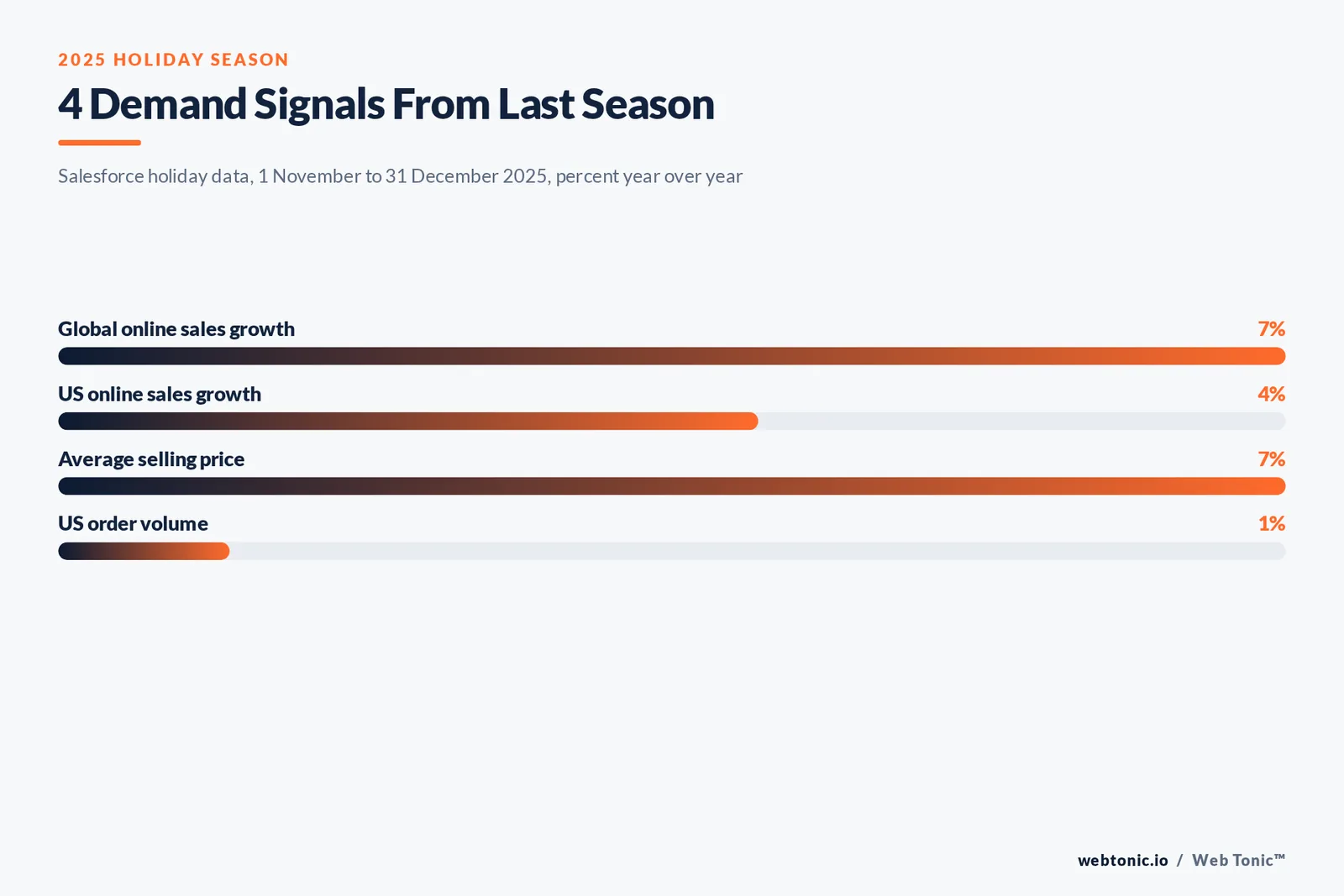
- US online holiday sales reached $294 billion in the 2025 season, part of $1.29 trillion globally, up 4% and 7% year over year.
- Average selling price rose 7% while order volume grew only 1% in the US — the season grew on price, not on baskets.
- AI and agent-driven experiences influenced 20% of retail sales and $262 billion in revenue.
- Build the plan on an 8-week runway: offer locked by week 6, creative by week 4, list warmed by week 2.
- Nearly 1 in 5 orders used buy online, pick up in store, rising to 1 in 3 in the final five days before Christmas.
What the Last Holiday Season Actually Showed
Plan against measured demand, not against last year's feelings. Salesforce's 2025 holiday shopping data covers 1 November to 31 December and gives a usable picture of how the season behaved.
| Signal | Result | What it changes in your plan |
|---|---|---|
| Global online sales | $1.29 trillion, up 7% year over year | Demand is there; discounting is not the only lever |
| US online sales | $294 billion, up 4% | Modest US growth means share must be taken |
| Average selling price | Up 7% worldwide and in the US | Bundles beat blanket percentage cuts |
| Order volume | Up 3% globally, 1% in the US | Focus on basket size, not order count |
| Late season surge | Final two December weeks up 12% globally | Hold budget back for the last-minute window |
Broader context matters too. The NRF forecast for 2026 retail sales is 4.4% growth against a ten-year average of 3.6% excluding the pandemic period, and the Census monthly retail trade release is the free source for tracking whether that holds as the season runs.
The 8-Week Black Friday Operating Calendar
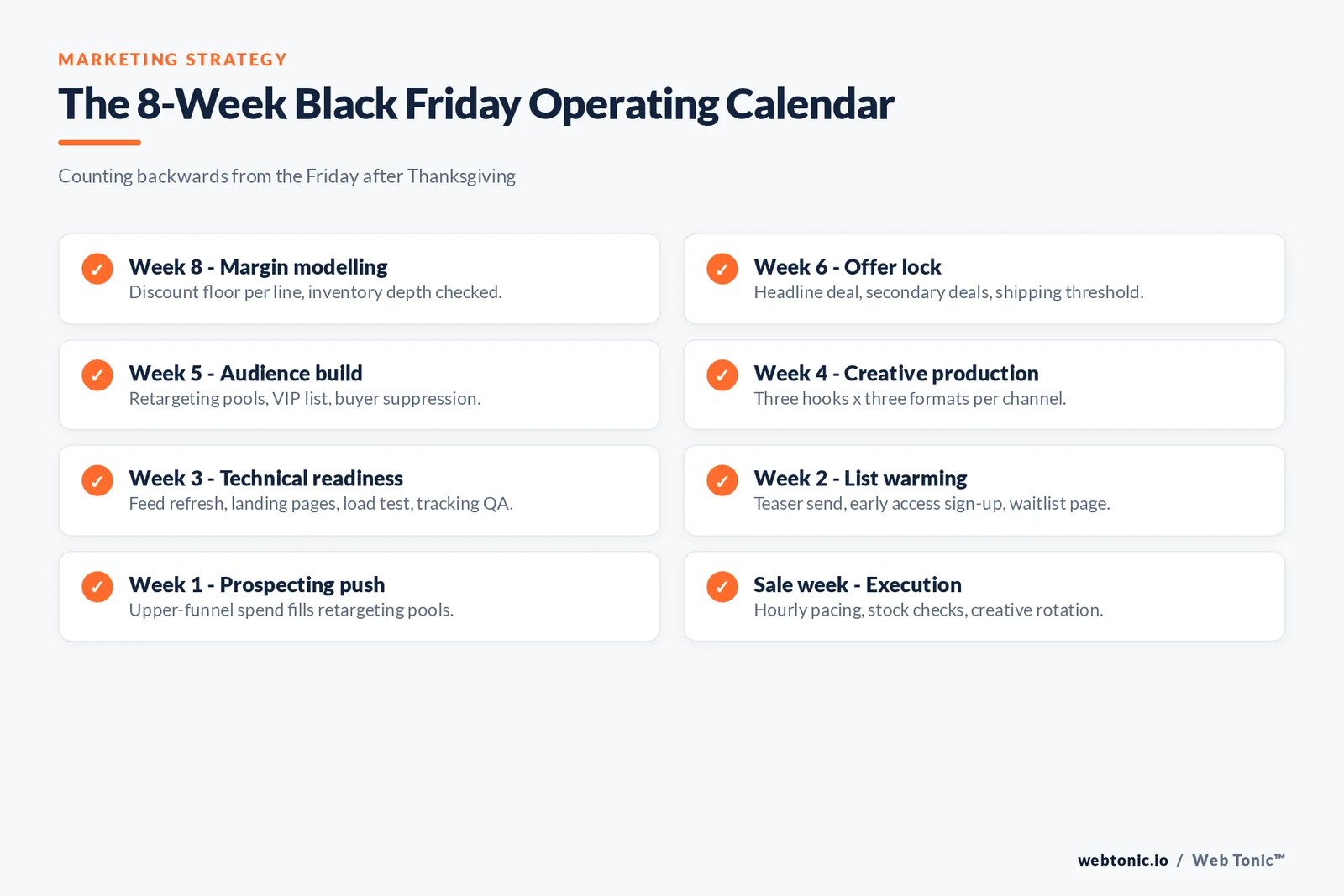
Almost every failed Black Friday campaign fails on timing rather than on the offer itself. This calendar counts backwards from the Friday after Thanksgiving.
| Week out | Focus | Deliverable | Owner |
|---|---|---|---|
| Week 8 | Margin modelling | Discount floor per product line, inventory depth check | Finance and merchandising |
| Week 6 | Offer lock | Headline deal, secondary deals, free shipping threshold | Marketing lead |
| Week 5 | Audience build | Retargeting lists, VIP list, suppression list of recent buyers | Paid media |
| Week 4 | Creative production | 3 hooks x 3 formats per channel, all sized and captioned | Creative team |
| Week 3 | Technical readiness | Feed refresh, landing pages live, load test, tracking QA | Web and analytics |
| Week 2 | List warming | Teaser email, early access sign-up, waitlist page | Lifecycle marketing |
| Week 1 | Prospecting push | Upper funnel spend to fill retargeting pools | Paid media |
| Sale week | Execution | Hourly pacing, stock checks, creative rotation, live support | Whole team |
Week 5 is the one most teams skip, and it is the cheapest week in the plan: building retargeting pools before the traffic spike is what makes sale-week ads efficient. Week 1 prospecting typically returns 2 to 4 times more during the sale than during the sale itself, because it converts on the second exposure rather than the first.
Offer Architecture by Business Type
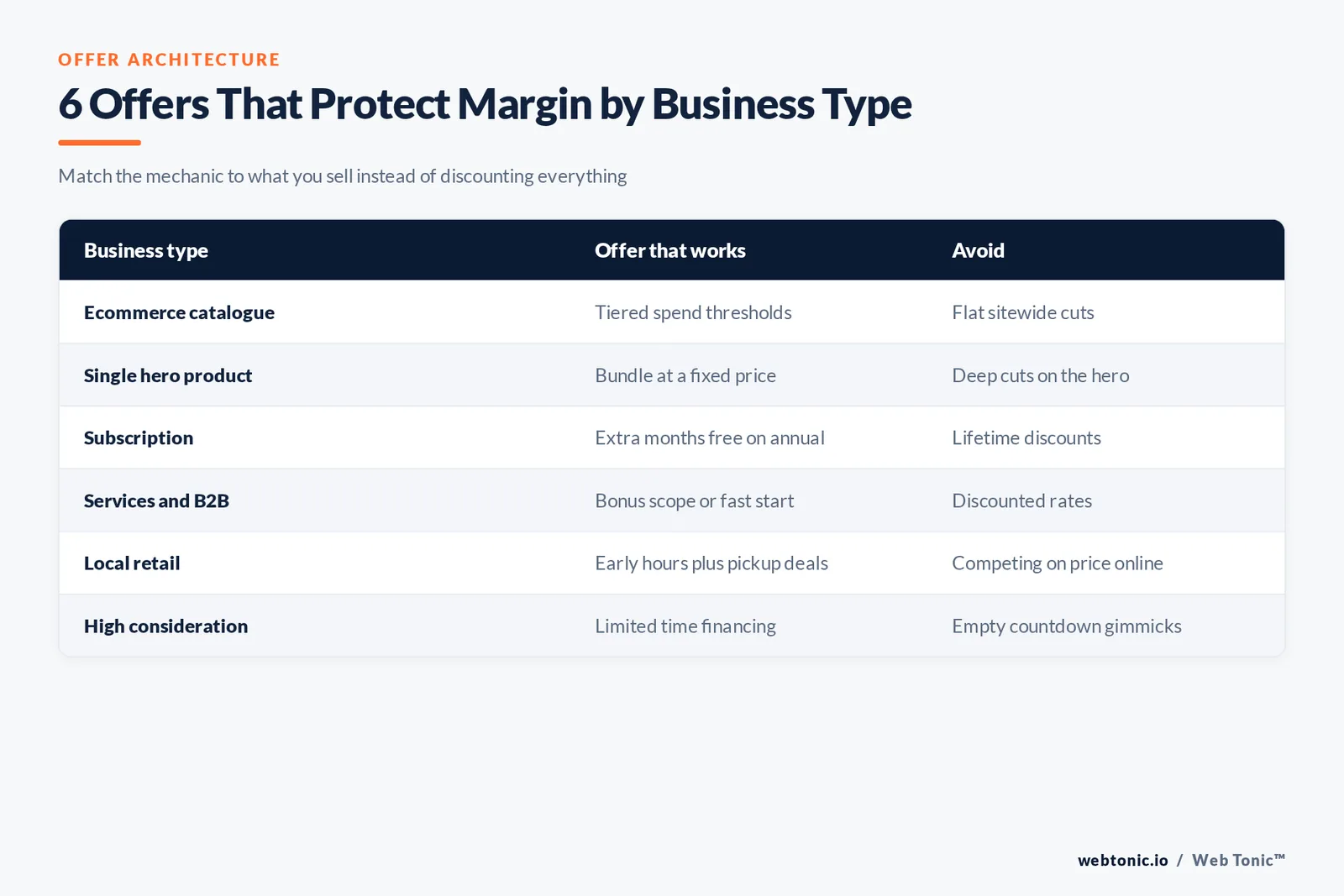
A percentage off everything is the laziest possible Black Friday offer and the most damaging to margin. Match the mechanic to what you sell.
| Business type | Offer that works | Why it protects margin | Avoid |
|---|---|---|---|
| Ecommerce, broad catalogue | Tiered spend thresholds such as 10, 20 and 30 percent | Raises basket size instead of cutting every unit | Flat sitewide discounts |
| Single hero product | Bundle with an accessory at a fixed price | Moves slow stock and hides the unit discount | Deep cuts on the hero itself |
| Subscription | Extra months free on annual plans | No price erosion on renewal | Lifetime discounts |
| Services and B2B | Bonus scope or fast-start onboarding | Value added without rate cuts | Discounting hourly rates |
| Local retail | Early access hours plus in-store pickup deals | Uses footfall and avoids shipping cost | Competing online on price alone |
| High consideration goods | Limited time financing or extended warranty | Removes friction without touching price | Countdown gimmicks with no substance |
Trap 1 — a free shipping threshold set below average order value. If your average order is $68 and shipping is free above $50, you have given away margin without changing behaviour; set the threshold roughly 15 to 25% above your current average instead.
15 Black Friday Marketing Ideas Worth Testing
These are grouped by channel so a small team can pick one per row rather than attempting everything.
| Channel | Idea | Effort | Best for |
|---|---|---|---|
| Early access window for subscribers 24 hours before the public sale | Low | Brands with an engaged list | |
| Segmented deals by past category purchased | Medium | Broad catalogues | |
| Cyber Monday second-chance send to non-openers | Low | Everyone | |
| SMS | Single limited time drop alert with a hard end time | Low | Impulse categories |
| Social media | Daily deal reveal series across stories and reels | Medium | Visual products |
| Social media | UGC round-up post using real customer photos | Medium | Apparel and home |
| Social media | Creator-led unboxing scheduled for the Wednesday before | High | New product launches |
| Paid search | Promotion assets and sale-specific ad copy | Low | Any advertiser |
| Google Shopping | Sale price annotations on the feed | Medium | Retailers |
| Paid social | Retargeting sequence split by browse depth | Medium | Considered purchases |
| On site | Sitewide banner with a live countdown to the end time | Low | Everyone |
| On site | Gift finder or deal quiz to guide browsing | High | Gifting categories |
| Retention | Loyalty double points during the weekend | Low | Repeat purchase brands |
| Retention | Post-purchase offer valid in January only | Low | Cashflow smoothing |
| Brand | Anti-sale positioning such as donating the day's revenue | High | Values-led brands |
The last row deserves a caveat. Patagonia's decision to give away its Black Friday revenue and REI's choice to close stores both worked because they matched a decade of consistent positioning. Idea 15 fails badly when it is the first values-led thing a brand has ever done, so treat it as a multi-year play rather than a weekend tactic. For inspiration on formats that travel well, campaign breakdowns of past Black Friday social work are more useful than generic idea lists.
Five Black Friday Campaign Examples and the Strategy Behind Each
Generic idea lists rarely explain why something worked. Each example below pairs a real campaign with the strategy it expressed, so you can judge whether the same logic fits your brand and your customers.
| Example | Strategy | What shoppers were offered | Why it worked |
|---|---|---|---|
| Patagonia, 2016 | Values-led counter-positioning | Normal prices, with 100% of the day's sales donated to grassroots environmental groups | Consistent with a decade of brand messaging, and it raised about $10 million |
| REI and its OptOutside campaign | Opt out of the sale entirely | Closed stores and paid staff to go outside instead | Earned coverage far cheaper than discount-funded revenue |
| Amazon | Extend the event window | Deals released across weeks rather than one day | Spreads fulfilment load and captures early research |
| Sephora | Loyalty-tiered access | Exclusive early savings by loyalty tier | Rewards existing customers and drives programme sign-ups |
| Cards Against Humanity | Deliberate anti-discount stunt | Absurd offers instead of price cuts, including raising prices | Perfect fit with the brand voice, so the joke sold products |
Example 2 is the hardest to copy: closing a store on the highest revenue day of the year only pays back if earned media and loyalty are already part of how the brand grows. Example 4 is the easiest to copy for most brands, because exclusive early access costs nothing except a segment and a send. Read the column headed why it worked before the offer column — the strategy is what transfers, not the tactic.
How to Create Exclusive Offers for Each Audience Segment
One offer for everyone wastes margin on people who would have bought anyway. Create three or four variants instead and let the audience decide which campaigns they see.
| Audience | Exclusive offer to create | Where to run it | Products to feature |
|---|---|---|---|
| Top 10% of customers by spend | Early access 24 to 48 hours before the public sale | Email and SMS only | Premium and new season lines |
| Lapsed buyers, no order in 12 months | Win-back credit with a January expiry | Email plus paid social retargeting campaigns | Bestsellers they already know |
| Cart abandoners in the last 14 days | The exact item at the sale price, held for 24 hours | Retargeting and one triggered email | The abandoned product itself |
| First-time visitors from prospecting | Entry bundle with free shipping above a threshold | Paid social and Google Shopping | Best reviewed entry products |
| In-store and local shoppers | Pickup-only deals and extended store hours | Local ads, store signage, email by postcode | Bulky items where shipping hurts margin |
Rule 4 — cap the number of live offers at 4. Beyond that, support cannot explain the rules and shoppers assume a better deal exists elsewhere on the site. Rule 5 — write the exclusion rules before the creative: which products are out, whether codes stack, and the exact end time in a named time zone. Those three lines prevent most of the complaints a Black Friday sale generates, and they let a small team run several strategies at once without confusing anyone.
Email, SMS and the Early Access Play
Owned channels carry the weekend because they cost nothing per send and they reach people who already chose you. The structure below assumes a five-send sequence.
| Send | Timing | Angle | Primary CTA |
|---|---|---|---|
| Send 1 | 14 days out | Teaser plus early access sign-up | Join the list |
| Send 2 | 2 days out | Exact offer reveal with start time | Set a reminder |
| Send 3 | Sale open | Best sellers and the headline deal | Shop the sale |
| Send 4 | Saturday | Category deep dives, low stock notes | See what is left |
| Send 5 | Cyber Monday evening | Final hours, single strongest offer | Last chance |
Rule 1 — suppress buyers within 6 hours of purchase, or the last two sends will annoy the people who already converted. Rule 2 — send fewer, better emails to the least engaged 40% of the list; deliverability damage from a bulk blast lasts long past December. Practical mechanics for segmentation and cadence are covered well in this email marketing strategy guide.
Paid Media: Pacing, Feeds and Bid Behaviour
Auction costs rise every year in the same week, which means the plan has to be about pacing and readiness rather than about last-minute bid heroics.
| Lever | Action | Timing | Risk if skipped |
|---|---|---|---|
| Budget pacing | Raise daily budgets gradually, not overnight | Weeks 2 to 1 | Delivery instability during peak hours |
| Bid strategy | Avoid switching strategy inside the sale window | Locked at week 2 | Learning reset on the highest traffic day |
| Product feed | Refresh availability and sale price attributes | Week 3 | Disapprovals and mismatched prices |
| Creative rotation | Fresh sale creative live before the traffic arrives | Week 1 | Fatigue by Saturday |
| Reserve budget | Hold 20 to 30 percent for Cyber Monday and mid December | Whole season | Nothing left for the late surge |
Two references keep this honest: Google's guidance on choosing bid and budget and the Merchant Center rules for the availability attribute, which is the single most common cause of feed disapprovals when stock moves fast. If you are still choosing where the money goes, our breakdown of the Google Ads campaign types maps each format to a funnel stage, and audience targeting mechanics explains how to build the retargeting pools this plan depends on.
Social Media and UGC During the Sale
Organic social will not carry the revenue, but it does carry proof. The point of the weekend is to make buying feel obvious, and customer content does that faster than a polished ad.
| Content type | Post cadence | Job it does | Reuse in paid |
|---|---|---|---|
| Deal reveal | 1 per day of the sale | Creates a reason to check back | Yes, as retargeting creative |
| UGC and reviews | 2 to 3 during the weekend | Removes purchase doubt | Highest performing paid asset |
| Behind the scenes | 1 to 2 in the run-up | Builds anticipation without discounting | Rarely |
| Stock and shipping updates | As needed | Reduces support load | No |
| Gift guides | Weekly from week 3 | Captures gifting intent early | Yes, on prospecting |
Plan the calendar against the wider seasonal moment rather than the single day: a social media holiday calendar shows where Black Friday sits between Thanksgiving and Christmas, and Google's holiday shopping research shows how early the research phase begins. Turning that raw content into assets that actually convert is what our performance creative team spends the autumn doing.
Site and Offer Mechanics to Check Before the Sale
| Check | Standard | Why it matters on the day |
|---|---|---|
| Landing page load | Under 2.5 seconds on mobile at peak | Traffic spikes expose every slow asset |
| Offer clarity | Deal, exclusions and end time in one line | Ambiguity generates support tickets |
| CTA consistency | Same wording in ad, email and page | Mismatch kills conversion rate |
| Checkout stress test | 5 times normal peak concurrency | A checkout failure is unrecoverable revenue |
| Price and claim accuracy | Reference prices genuinely charged before | Misleading savings claims invite complaints |
| Tracking QA | Test purchase confirmed end to end | Broken tracking blinds bidding and reporting |
The fifth row is a legal exposure, not just a trust issue: the FTC's online advertising guidance is explicit that claims and disclosures must be truthful and clear, and a struck-through price that was never charged is the classic Black Friday violation. Rule 3 — every discount claim needs a date-stamped record of the reference price, kept for at least 12 months.
Measuring the Campaign Without Fooling Yourself
Weekend dashboards flatter everyone. These five measures are the ones that survive January scrutiny.
| Metric | How to read it | Benchmark to beat |
|---|---|---|
| Contribution margin per order | Revenue minus discount, shipping and fulfilment | Your normal month, not last Black Friday |
| Incremental revenue | Sale week versus a matched pre-sale baseline | Positive after pull-forward is removed |
| New versus returning split | Share of orders from first-time buyers | Above 40% for a growth-focused sale |
| Second purchase rate at 90 days | Cohort tracked from the weekend | Within 5 points of a full-price cohort |
| Return rate | Measured at 60 days, by category | No worse than your annual average |
Fact 1 — pull-forward is real: some share of weekend revenue would have arrived in December anyway, so a season-long view is the only honest read. Fact 2 — a 90-day cohort view is the single best predictor of whether the discount bought customers or just bought orders.
After the Weekend: Keeping the Buyers You Bought
The expensive part of Black Friday is acquiring a deal-motivated buyer. The valuable part is the second order.
| Window | Action | Goal |
|---|---|---|
| Days 1 to 3 | Shipping transparency and setup or usage content | Reduce anxiety and support volume |
| Days 7 to 14 | Review request plus a cross-sell relevant to the purchase | Collect UGC for next season |
| Days 21 to 30 | Full-price replenishment or accessory offer | Prove the brand sells at full price |
| Days 60 to 90 | Loyalty or subscription invitation | Convert a discount buyer into a habit |
Retention economics are what justify an aggressive weekend in the first place, and the fundamentals are unchanged by the season — customer retention research is a reasonable place to calibrate expectations. If planning this end to end is more than your team can absorb in October, that is exactly the work our growth marketing engagements cover, and you can talk it through with us.

Five Traps That Cost Real Money
| Trap | What it looks like | Fix |
|---|---|---|
| Trap 2: launching the offer late | Creative approved 3 days before the sale | Hard deadline at week 4, no exceptions |
| Trap 3: doubling budgets overnight | Spend up 300% in one day, CPA doubles | Step increases of 20 to 30 percent every 2 days |
| Trap 4: discounting best sellers | Top 5 products cut 40 percent | Discount the second tier, bundle the heroes |
| Trap 5: no post-sale plan | Silence until January | Sequence built before the sale opens |
| Trap 6: ignoring inventory depth | Hero product sells out in 4 hours | Cap the deal quantity and say so up front |
None of these are exotic. Every one of them is a planning decision made in week 6 or week 4, which is why the calendar earlier on this page matters more than any single tactic in the ideas table.
FAQ
When should Black Friday marketing planning start?
Eight weeks before the Friday after Thanksgiving. Margin modelling and inventory checks come first, the offer is locked six weeks out, creative is finished four weeks out, and the final two weeks go to list warming and upper-funnel prospecting so retargeting pools are full when demand peaks.
What is the most effective Black Friday offer?
It depends on the model. Tiered spend thresholds work best for broad ecommerce catalogues, bundles for single-product brands, extra free months for subscriptions, and added scope rather than rate cuts for services. Flat sitewide percentage discounts are the least efficient option in almost every case.
How much budget should be held back for Cyber Monday?
Reserve roughly 20 to 30 percent of the season budget. Salesforce data showed the final two weeks of December growing 12 percent globally and 9 percent in the US, faster than the first half of the season, so a plan that spends everything by Monday leaves the late surge uncovered.
How do I know whether the sale actually made money?
Measure contribution margin per order, incremental revenue against a matched pre-sale baseline, the new versus returning split, and the second purchase rate at 90 days. Revenue alone will always look good during a discount week.
Is Black Friday worth it for a service business?
Sometimes, but not as a discount. Bonus scope, fast-start onboarding or a limited number of audit slots capture seasonal urgency without setting a lower price expectation that follows you into the next contract renewal.
Sources: Salesforce — 2025 holiday shopping data. National Retail Federation — 2026 retail sales forecast. US Census Bureau — Monthly Retail Trade. Google Ads Help — Choose your bid and budget. Google Merchant Center Help — Availability attribute. Think with Google — Holiday shopping trends. Sprout Social — Social media holidays calendar. Shopify — Email marketing strategy. Federal Trade Commission — Online advertising and marketing guidance. Zendesk — Customer retention. Socialinsider — Black Friday social media campaigns.