Table of contents

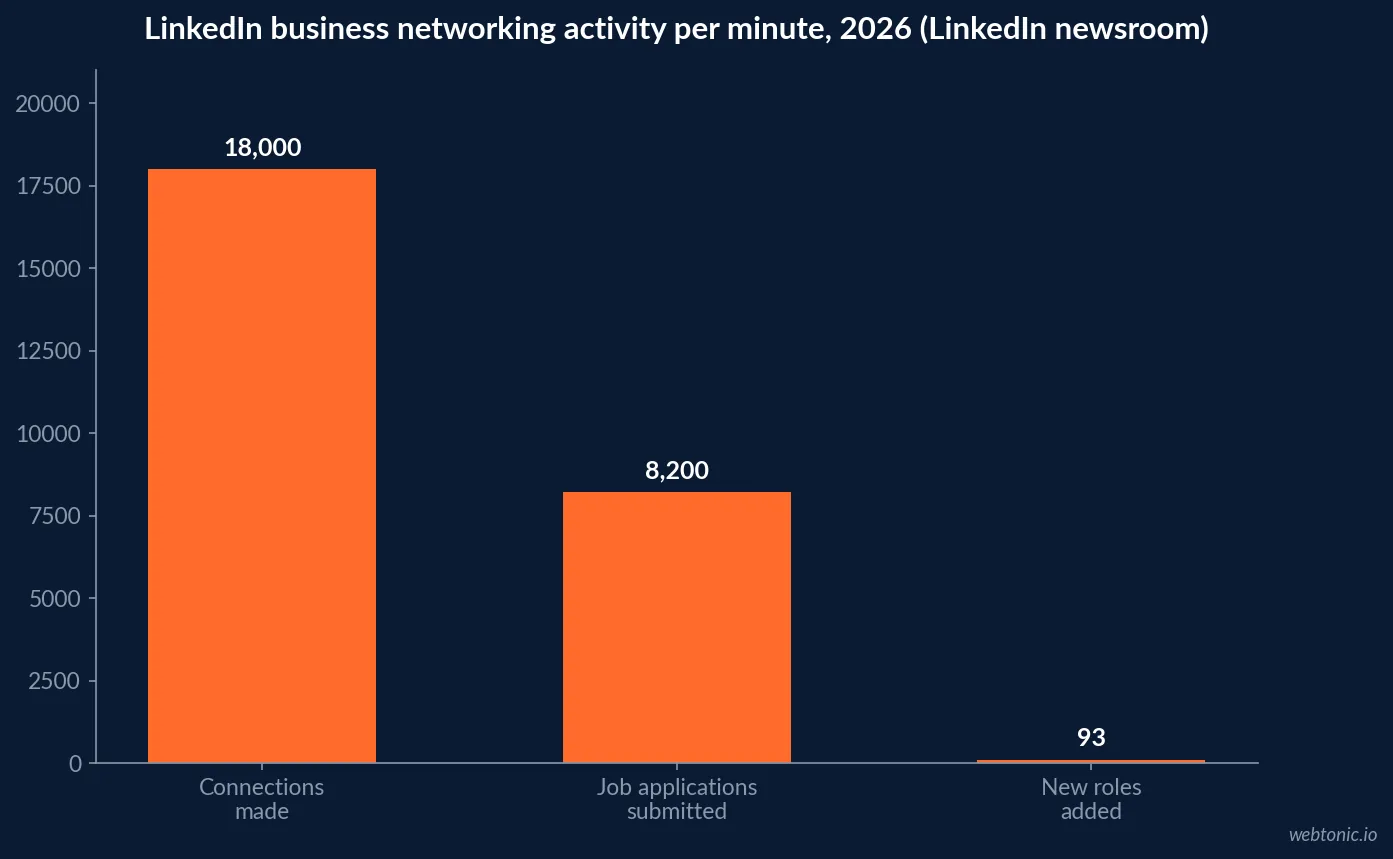
Roughly 18,000 new professional connections are made every single minute on LinkedIn alone, across a community that now exceeds 1.3 billion members. Business networking in 2026 is no longer an event-calendar activity; it is continuous, measurable infrastructure most companies still under-use.
Key Takeaways
- LinkedIn's community exceeds 1.3 billion members.
- Roughly 18,000 new connections are made every minute.
- About 8,200 job applications are submitted every minute.
- 93 people add a new role to their profile every minute.
- 1.8 million-plus feed updates are viewed every minute.
- 123 hours of learning content are consumed every minute.
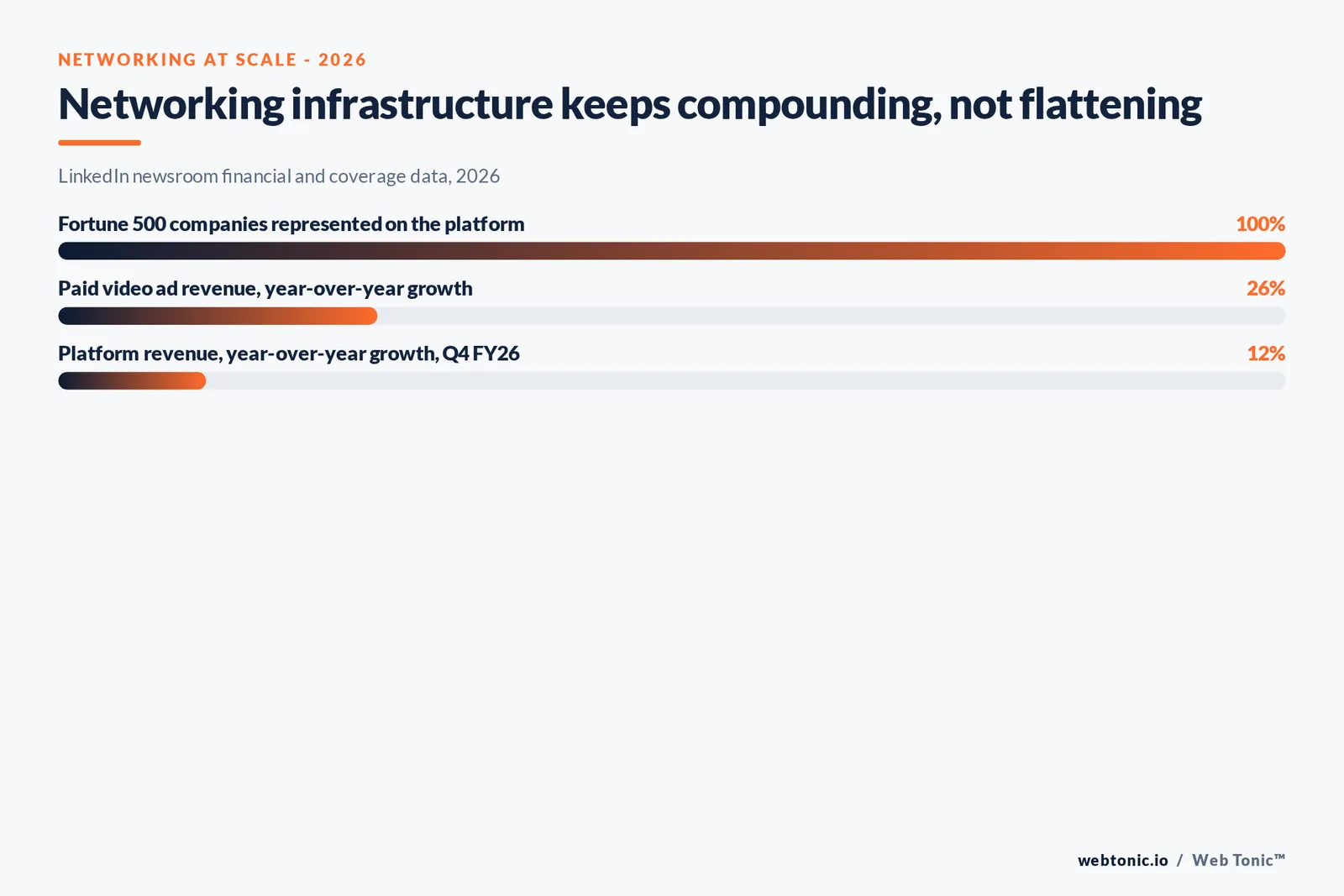
- Close to 100% of Fortune 500 companies are represented on the platform.
- More than 144,000 schools are listed.
- More than 42,000 distinct skills are listed.
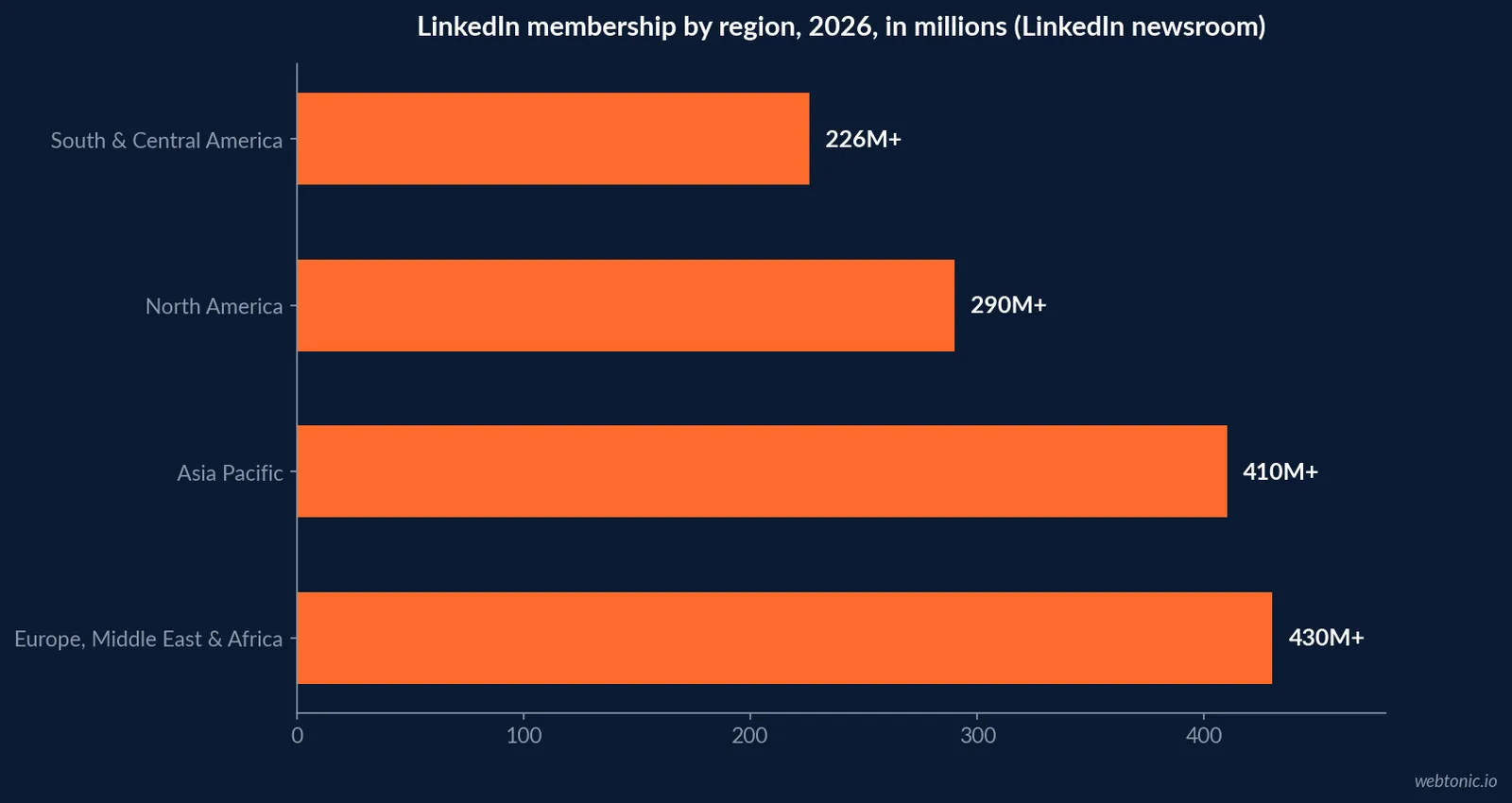
- EMEA carries 430 million-plus members, the largest region.
- Asia-Pacific follows at 410 million-plus members.
- North America holds 290 million-plus members.
- Annual revenue reached USD 19.8 billion.
- Revenue grew 12% year over year in Q4 FY26.
- Paid video ad revenue grew 26% year over year.
Business networking at a glance in 2026
The clearest public data on the scale of professional networking activity comes straight from LinkedIn's own newsroom, updated August 2026. It is a single-platform view, not an industry-wide census, but at 1.3 billion members it is the largest structured networking dataset publicly available anywhere.
| Metric (2026) | Figure | Cadence | Source |
|---|---|---|---|
| Total community | 1.3B+ members | Point in time | LinkedIn newsroom |
| New connections made | ~18,000 | Per minute | LinkedIn newsroom |
| Job applications submitted | ~8,200 | Per minute | LinkedIn newsroom |
| New role added to a profile | 93 | Per minute | LinkedIn newsroom |
| Feed updates viewed | 1.8M+ | Per minute | LinkedIn newsroom |
| Learning content consumed | 123 hours | Per minute | LinkedIn newsroom |
Why the per-minute numbers matter more than the headline member count
A membership total is a vanity number; the per-minute figures are an activity number, and activity is what actually describes networking behavior. Roughly 18,000 new connections forming every minute means the platform is generating the equivalent of a mid-sized conference's total attendee list in new professional relationships every sixty seconds. 8,200 job applications per minute means career-motivated networking — the specific behavior most business networking advice is built around — is running continuously, not seasonally.
The learning and content figures point to a second, quieter layer: 123 hours of learning content and 1.8 million-plus feed updates consumed every minute mean that being visible in someone's professional network now competes directly with an enormous, always-on content feed, not just with other networking events on a shared calendar.
| Behavior | Per-minute figure | What it signals for a networking strategy | Practical implication |
|---|---|---|---|
| New connections made | ~18,000/min | Relationship-building is continuous, not event-bound | A networking plan needs an always-on layer, not just event RSVPs |
| Job applications submitted | ~8,200/min | Career-motivated networking runs year-round | Talent-facing content should never go fully dormant |
| New role added to profile | 93/min | Career movement is a live signal, rarely monitored | Profile-change alerts are an underused prospecting trigger |
| Learning hours consumed | 123/min | Professional audiences reward useful content over pitches | Educational content earns network attention faster than a sales pitch |
Business networking is now a global, not a US-centric, activity
LinkedIn's regional breakdown is a useful corrective to the assumption that professional networking is primarily a North American behavior. EMEA carries 430 million-plus members, ahead of Asia-Pacific's 410 million-plus, while North America holds 290 million-plus and South and Central America 226 million-plus. For any brand building a networking-led growth or partnership strategy across multiple markets, the largest available pool of professional connections is outside North America, not inside it.
Institutional presence backs up the scale claim: close to 100% of Fortune 500 companies are represented, alongside more than 144,000 schools and 42,000 distinct skills listed on the platform — the taxonomy that makes structured, filterable networking possible at this scale in the first place.
| Region | Members (2026) | Coverage | Read for a networking strategy |
|---|---|---|---|
| Europe, Middle East & Africa | 430M+ | UK, Germany, Saudi Arabia, UAE, South Africa and more | Largest single regional pool |
| Asia Pacific | 410M+ | India, China, Japan, Southeast Asia, Australia, New Zealand | Fastest-scaling professional markets |
| North America | 290M+ | United States and Canada | Highest average tenure, not highest volume |
| South & Central America | 226M+ | Mexico, Brazil, Argentina, Colombia and the Caribbean | Smallest of the four, still nearly a quarter-billion strong |
The financial signal behind the activity data
LinkedIn's own reported financials show the activity numbers translating into real revenue growth, not just engagement volume. Annual revenue sits at USD 19.8 billion, with 12% year-over-year growth in Q4 FY26 (10% in constant currency), and paid video ad revenue up 26% year over year — a faster growth rate than the platform overall, suggesting that networking-adjacent content formats (video, in particular) are becoming a bigger part of how professional relationships actually form and get maintained.
For businesses building a networking strategy on top of this infrastructure, that content shift matters directly: a static profile is competing against a feed where video is growing faster than every other format, and against 123 hours of learning content consumed every minute platform-wide.
Structured referral networking runs at a different, still-massive scale
Digital-first platform data is not the only structured networking dataset worth citing. BNI (Business Network International), the world's largest in-person referral networking organization, reports 355,000 global members meeting across 11,800 global chapters, generating 17.8 million-plus member referrals and USD 26.9 billion-plus in member-generated business since its founding in 1985. That is a fundamentally different networking mechanic than a LinkedIn connection — weekly, in-person, one-member-per-profession meetings built specifically around exchanging referrals — and it has run for 41 straight years of member growth.
| Structured referral networking (BNI, 2026) | Figure | What it represents | How it differs from platform networking |
|---|---|---|---|
| Global members | 355,000 | Active dues-paying members worldwide | Vetted, one-per-profession membership model |
| Global chapters | 11,800 | Weekly in-person meeting groups | Local and recurring, not asynchronous |
| Member referrals generated | 17.8M+ | Cumulative referrals passed between members | Tracked, attributable introductions, not passive connections |
| Member-generated business | USD 26.9B+ | Cumulative revenue tied to those referrals | Directly tied to closed business, not just relationship count |
Where structured small-business networking still fills a different gap
Individual professional networking at LinkedIn's scale, and structured referral networking at BNI's scale, are not the same use case as general small-business support networking. The U.S. Small Business Administration's business guide, the U.S. Chamber of Commerce's small-business hub and local chamber of commerce networks function as more localized, resource-oriented channels aimed at owner-operators rather than individual career-building or referral exchange — a complementary layer, not a competing one, to the platform-scale and referral-scale networking described above.
Our growth marketing team builds outbound and partnership programs around exactly this kind of always-on networking signal rather than a quarterly event calendar, and if you want a read on how your own network-driven pipeline compares to these benchmarks, talk to us.
A networking infrastructure checklist for 2026
Given how continuous professional networking activity has become, most companies are still running it like a quarterly event rather than an always-on channel. This checklist is a starting point for closing that gap.
Our data intelligence team can help set up the tracking behind each row below before you try to benchmark against it.
| Checklist item | Benchmark to compare against | Question to ask your team | Owner |
|---|---|---|---|
| Content cadence | 1.8M+ feed updates viewed per minute platform-wide | Is our content published often enough to compete for attention? | Marketing lead |
| Career-move monitoring | 93 profile role changes per minute | Do we track when a prospect or partner changes roles? | Sales/partnerships |
| Referral tracking | 17.8M+ referrals tracked cumulatively by BNI alone | Are our own referral introductions tracked and attributed? | Business development |
| Educational content investment | 123 hours of learning content consumed per minute | Does our content teach, or does it only pitch? | Content lead |
What to watch through the rest of 2026
Three signals are worth tracking. First, whether LinkedIn's paid video ad growth (26% year over year, ahead of the platform's overall growth) keeps outpacing other formats, which would confirm video is becoming the default networking-content format. Second, whether regional membership growth in Asia-Pacific closes the gap with EMEA's current lead. Third, whether structured referral organizations like BNI keep growing their per-member referral value as digital-first networking scales alongside them rather than replacing them.
The institutional footprint behind the activity numbers
The per-minute activity figures are only meaningful because of the institutional depth underneath them. LinkedIn reports more than 17,000 full-time employees across offices in more than 30 cities, and the platform is available in 36 languages — from Arabic and Bangla through Simplified and Traditional Chinese, Hindi, Japanese, Korean and Vietnamese. That language coverage is part of why the platform can plausibly claim near-total Fortune 500 coverage: a networking tool that only worked in English would cap out well before reaching 1.3 billion members across four global regions.
The company's own five straight years of double-digit member growth, cited alongside its USD 19.8 billion in annual revenue, is the clearest signal that the per-minute activity data is not a one-time spike tied to a single viral moment, but a sustained, compounding usage pattern that a networking strategy can be built around with some confidence it will still be true next year.
| Institutional metric | Figure | Why it matters for a networking strategy | Source |
|---|---|---|---|
| Full-time employees | 17,000+ | Platform investment scale behind the networking infrastructure | LinkedIn newsroom |
| Office cities | 30+ | Global support footprint, not a single-market product | LinkedIn newsroom |
| Supported languages | 36 | Networking reach extends well beyond English-speaking markets | LinkedIn newsroom |
| Consecutive years of double-digit member growth | 5 | Growth is sustained, not a single strong year | LinkedIn newsroom |
Frequently Asked Questions
How big is professional networking activity in 2026, in real numbers?
Larger than most growth plans account for. LinkedIn's own newsroom data puts its community at more than 1.3 billion members, with roughly 18,000 new connections made and 8,200 job applications submitted every single minute. Ninety-three people add a new role to their profile every minute, which is a live signal of career movement most companies never watch, let alone act on in real time.
Is LinkedIn actually where business networking now happens by default?
For professional-to-professional networking specifically, its own scale argues yes. Its community spans more than 1.3 billion members, close to 100% of Fortune 500 companies are represented, and it lists more than 144,000 schools and 42,000 skills. Regionally, EMEA carries 430 million-plus members and Asia-Pacific 410 million-plus, ahead of North America's 290 million-plus - networking scale has become a global, not US-centric, story.
Is LinkedIn's own growth still accelerating or leveling off?
Growth is still double-digit but has been for multiple years running, not just one strong quarter. The company reports revenue growing 12% year over year in Q4 FY26 (10% in constant currency) on top of annual revenue of USD 19.8 billion, with paid video ad revenue up 26% year over year - suggesting networking-adjacent content formats are growing faster than the base platform itself.
What does the per-minute activity data actually tell a marketer or business owner?
That professional relationship-building is now a continuous, high-frequency behavior rather than an event-driven one. With 1.8 million-plus feed updates viewed and 123 hours of learning content consumed every minute across the platform, the opportunity for a brand or individual to be discovered through networking activity is happening constantly, not just at the quarterly conference or the annual chamber mixer.
Do small businesses have their own dedicated networking infrastructure, or is it all LinkedIn?
Both exist and serve different needs. The U.S. Small Business Administration's business guide and the U.S. Chamber of Commerce's small-business hub both function as structured, often local, networking and resource channels for owner-operators - a different use case than the individual professional relationship-building LinkedIn's data describes. Most durable networking strategies now use both layers rather than picking one.
Sources
LinkedIn Newsroom - About Us, member and activity data
BNI (Business Network International) - About BNI
U.S. Small Business Administration - Business Guide
U.S. Chamber of Commerce - CO, small business hub
Chamber of Commerce - local chamber network
Wikipedia - Business networking