Table of contents

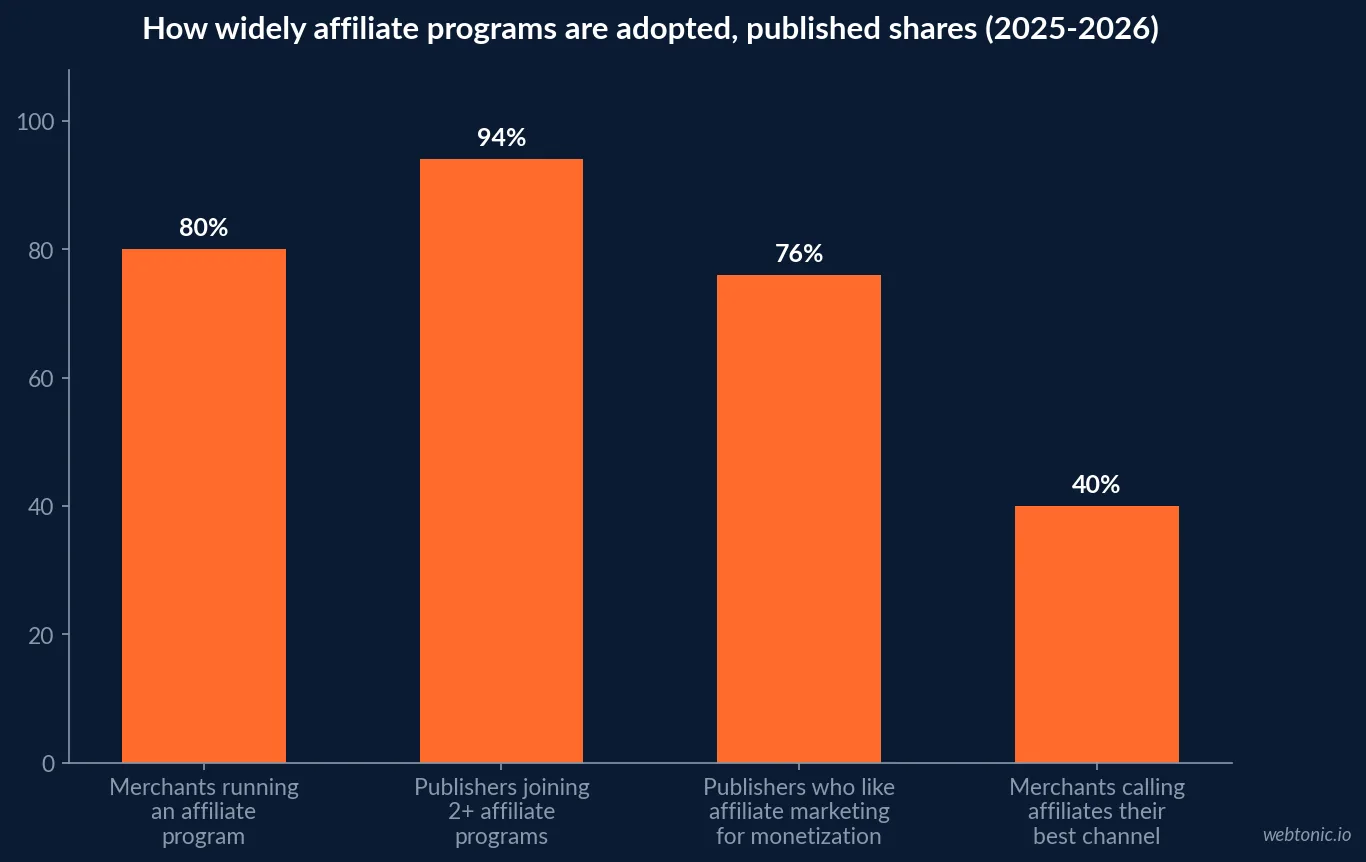
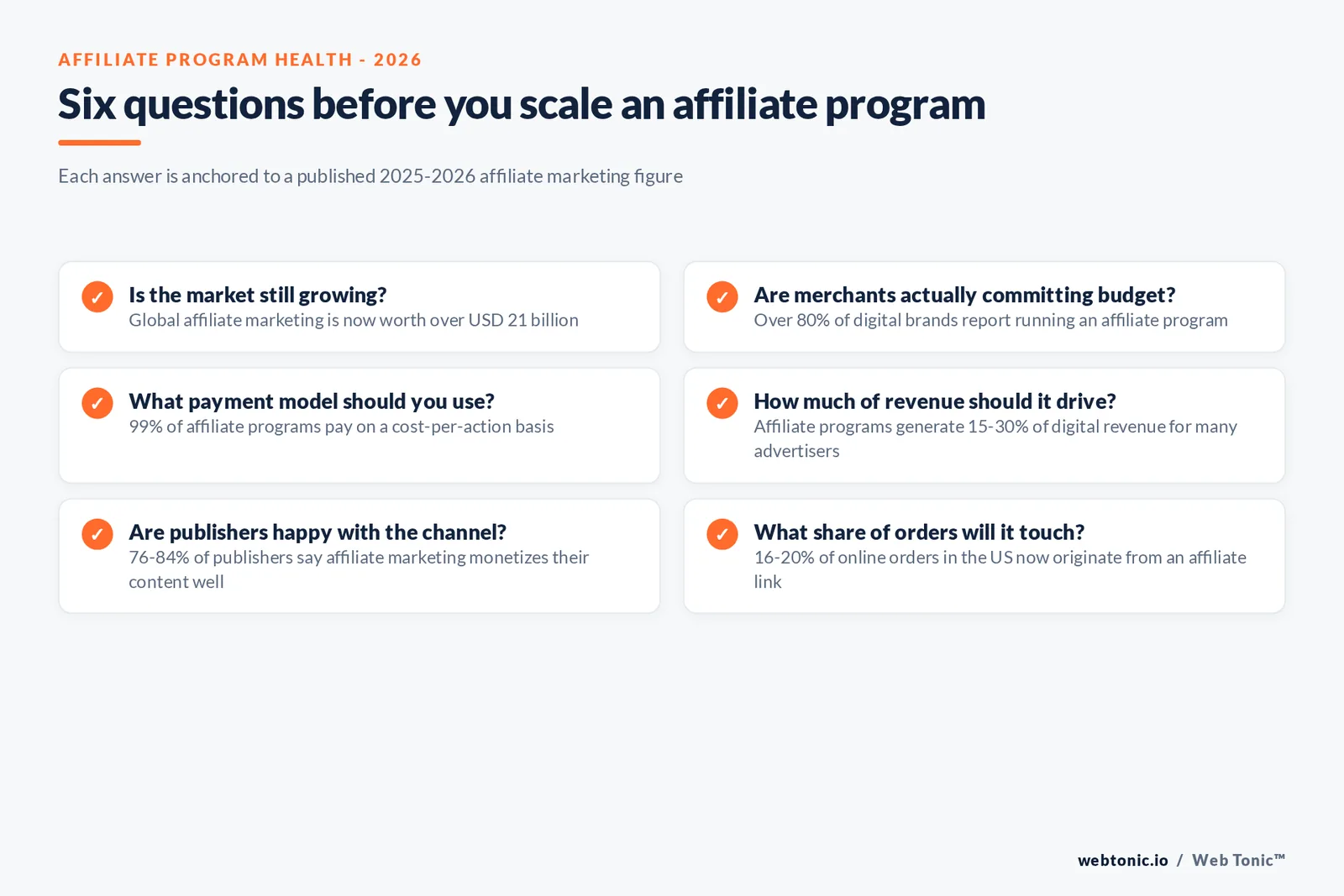
The global affiliate marketing industry is now worth over USD 21 billion, projected to reach USD 27.78 billion by 2027, and more than 80% of digital brands report running an affiliate program. This page pulls together what the published 2025-2026 data says about program size, payout models and publisher earnings.
Key Takeaways
- The global affiliate marketing industry is worth over USD 21 billion.
- The market is projected to reach USD 27.78 billion by 2027.
- Affiliate marketing is growing at roughly 7.7% a year through 2030.
- Over 80% of digital brands run an affiliate program.
- 16% of all online orders come from affiliate links.
- Affiliate programs drive 15% to 30% of e-commerce revenue.
- 99% of affiliate programs use a cost-per-action payment model.
- Starting a program can lift merchant revenue by about 30%.
- The average affiliate marketer earns USD 54,251 a year.
- 57.5% of affiliate marketers earn USD 10,000 or less annually.
- Only about 10% of affiliate marketers clear USD 73,000 or more.
- 84% of online content publishers participate in affiliate marketing.
- 94% of publishers join two or more affiliate programs.
- Amazon Associates holds close to 48% of publisher-link market share.
- Over USD 1.5 billion was invested in affiliate marketing companies in 2023.
- 31% of publishers rank affiliate income in their top 3 revenue sources.
- SaaS affiliate commissions run 20% to 70% per sale.
| Affiliate marketing benchmark (2025-2026) | Published figure | Source |
|---|---|---|
| Global industry size | > USD 21 billion | WPBeginner |
| Projected size by 2027 | USD 27.78 billion | WPBeginner |
| Projected CAGR, 2025-2030 | ~7.7% | WPBeginner |
| Brands running an affiliate program | > 80% | WPBeginner |
| Online orders from affiliate links | 16% | WPBeginner / 99firms |
| Revenue lift from starting a program | ~30% | WPBeginner |
How big is the affiliate marketing industry right now
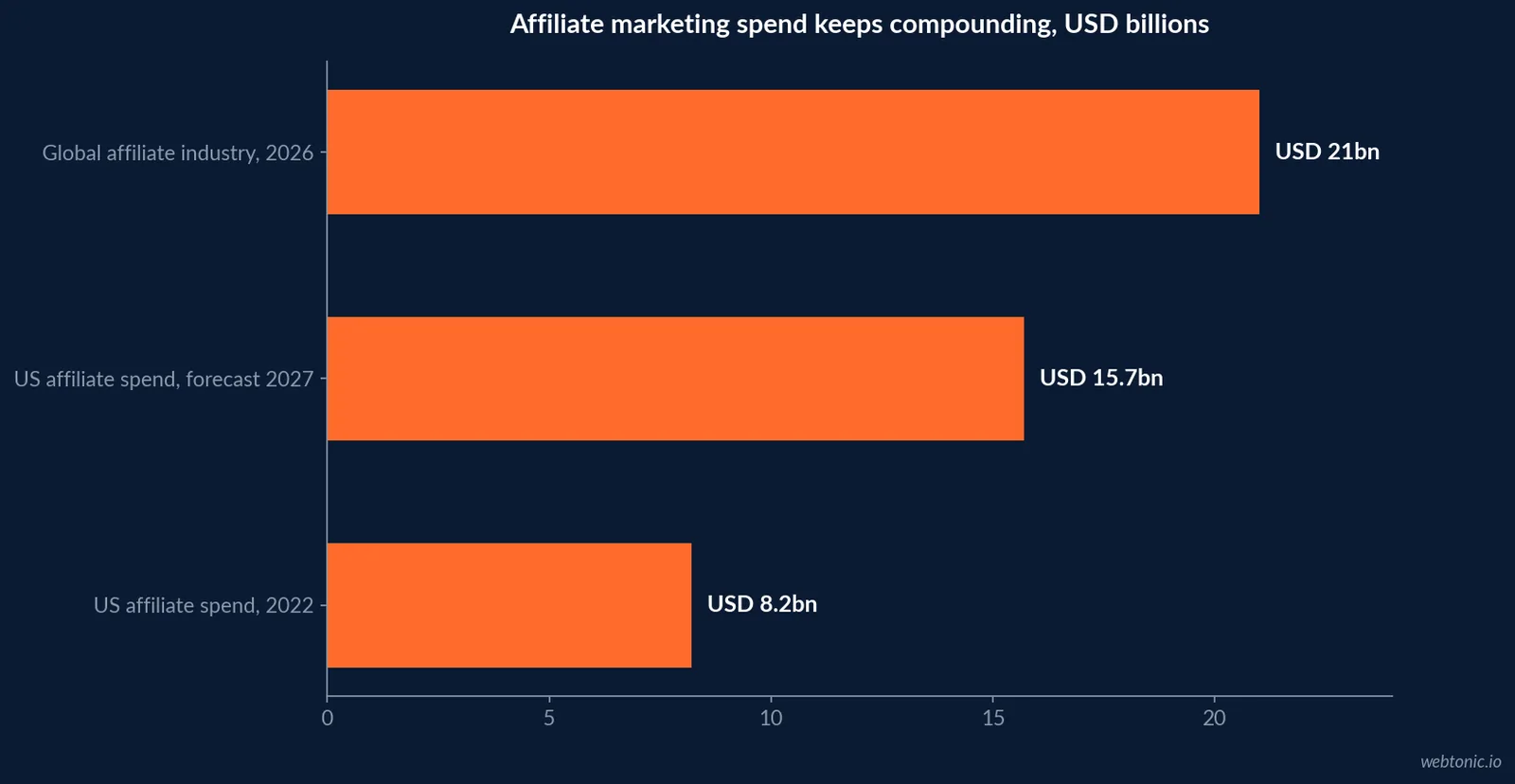
WPBeginner's 2026 affiliate marketing research puts the global industry at over USD 21 billion, projected to reach USD 27.78 billion by 2027 and grow at roughly 7.7% a year between 2025 and 2030. Influencer Marketing Hub's separate compilation reports the Performance Marketing Association tracking 47% industry growth from 2018 to the end of 2021 alone, with global affiliate spending having reached roughly USD 14.3 billion by the end of 2023 and climbing toward USD 15.7 billion by 2024 on that measure.
In the US specifically, Statista data cited by Influencer Marketing Hub shows affiliate spend growing from USD 2.5 billion in 2012 to USD 8.2 billion in 2022. The UK and Japan show the same trajectory: UK affiliate spend reached about GBP 793 million in 2021, up from GBP 738 million in 2020, while Japan spent more than 349 billion yen in 2021, projected to exceed 514 billion yen by 2025.
How much of online revenue actually runs through affiliates
Affiliate marketing's share of digital revenue is consistently estimated between 15% and 30% of e-commerce sales, and 16% of all online orders in the US are attributed to affiliate links according to both WPBeginner and 99firms. 99firms' affiliate marketing statistics separately cite an earlier SaaS Scout estimate that put the global industry closer to USD 12 billion, illustrating how quickly the measured market size has grown as more studies capture direct and social-driven affiliate activity that older estimates missed.
For merchants, starting a program is reported to lift revenue by about 30%, and 80% of businesses running one say affiliate marketing has improved their revenue, per WPBeginner's 2026 data.
| Revenue and adoption signal | Published figure | Source |
|---|---|---|
| Share of e-commerce revenue from affiliates | 15%-30% | Influencer Marketing Hub |
| Online orders attributed to affiliate links | 16% | WPBeginner / 99firms |
| Revenue lift after launching a program | ~30% | WPBeginner |
| Businesses reporting improved revenue | 80% | WPBeginner |
| Merchants calling affiliates their best channel | 40% | WPBeginner |
| Digital brands running an affiliate program | > 80% | WPBeginner |
What affiliate marketers actually earn
Earnings are heavily skewed toward a small top tier. WPBeginner's 2026 data shows the average annual income for an affiliate marketer at USD 54,251, but 57.5% earn USD 10,000 or less, and only around 10% clear USD 73,000 or more. On the management side, PayScale data cited by Influencer Marketing Hub puts an Online Affiliate Marketing Manager's average base salary at USD 61,748, with top-end earners reaching roughly USD 88,000 in base pay plus bonus and commission, and entry-level pay recently down 21%.
SaaS products remain among the most lucrative niches, paying 20% to 70% commission per sale according to Influencer Marketing Hub's benchmark research.
Payment models: how publishers actually get paid
Cost-per-action dominates. WPBeginner's data shows 99% of affiliate programs use a CPA payment model, and IAB Australia research cited by Influencer Marketing Hub finds 74% of advertisers/agencies and 83% of publishers specifically confirm using it, ahead of tenancy fees (43%/48%) and cost-per-click (33%/35%) - often layered in combination rather than used exclusively. Roughly 49% of merchants pay a flat rate per sale, with the rest paying a percentage tied to customer spend.
| Payment model | Advertiser/agency usage | Publisher usage | Source |
|---|---|---|---|
| Cost-per-action (CPA) | 74% | 83% | IAB Australia via Influencer Marketing Hub |
| Tenancy fees (placement) | 43% | 48% | IAB Australia via Influencer Marketing Hub |
| Cost-per-click (CPC) | 33% | 35% | IAB Australia via Influencer Marketing Hub |
| CPA programs overall | 99% of programs use it | - | WPBeginner |
Which network actually controls the market
The answer changes depending on the measurement. Research from Publisher Discovery, cited by Influencer Marketing Hub, ranks Awin first by total publisher links at 30%, followed by CJ Affiliate (15.8%) and Rakuten (7.4%) - a share Awin built partly by acquiring ShareASale. But Datanyze's measurement, which includes Amazon Associates, puts Amazon on top with almost 48% of the market, with CJ Affiliate a distant second at 7.21% and Rakuten third at 7.17%. Combine Awin with its ShareASale acquisition and the two networks would rank second behind Amazon on that measure.
| Network | Market share measure | Published figure | Source |
|---|---|---|---|
| Awin | Share of total publisher links | 30% | Publisher Discovery |
| CJ Affiliate | Share of total publisher links | 15.8% | Publisher Discovery |
| Amazon Associates | Share incl. Amazon links | ~47.85% | Datanyze |
| CJ Affiliate | Share incl. Amazon links | 7.21% | Datanyze |
| Rakuten | Share incl. Amazon links | 7.17% | Datanyze |
Who publishes affiliate content, and how
Affiliate publishers skew toward content-first channels. WPBeginner's data shows 84% of online content publishers participate in affiliate marketing, and 94% join two or more programs, with 39% joining three or more and 20% joining five or more. 31% of publishers rank affiliate income among their top 3 revenue sources, per eMarketer data cited by Influencer Marketing Hub, and over 65% use social media to reach potential customers, reflecting how much affiliate activity now happens outside a traditional coupon or review site.
Affiliate marketer demographics: who is actually running these programs
The publisher side of affiliate marketing is more balanced by gender than many adjacent creator categories, though not evenly split. Influencer Marketing Hub's compiled data shows about 54% of publishers are male and 43% are female, a roughly 12-point gap that has been narrowing as more women enter the creator and content economy. By age, publishers between 35 and 44 make up the largest share of the total affiliate marketer population, suggesting the channel skews toward marketers with an existing audience or content platform rather than first-time creators.
Search interest in the category itself has tracked the spending growth: 99firms' data shows searches for "affiliate marketing" rose over 200% between 2015 and 2020, a pace that has continued as more publishers treat it as a primary income stream rather than a side project.
| Affiliate publisher demographic | Published figure | Source |
|---|---|---|
| Male publishers | ~54% | Influencer Marketing Hub |
| Female publishers | ~43% | Influencer Marketing Hub |
| Largest publisher age band | 35-44 years old | Influencer Marketing Hub |
| Growth in "affiliate marketing" search interest, 2015-2020 | > 200% | 99firms |
Growth capital is still flowing into the category
Investor interest has kept pace with program growth. Influencer Marketing Hub reports more than USD 1.5 billion raised in all-time funding across 232 rounds for affiliate marketing companies through 2023 - a 15.38% increase over the prior year. That capital is largely funding the tracking, attribution and fraud-verification tooling that programs increasingly need as spend grows, the same category covered in our paid social cost breakdown for programs that run affiliate alongside paid media.
How to read these numbers before scaling a program
The consistent theme across every section above is that affiliate marketing rewards programs that pick a clear payment model, verify traffic quality, and match their network choice to how they actually measure market share - Amazon-inclusive or link-based rankings tell two different stories. Our data and analytics team builds that verification layer into a program's tracking setup before it scales spend, and if you're weighing affiliate against paid channels for the next budget cycle, talk to us.
Popular affiliate niches worth knowing
Not every category performs the same inside an affiliate program. WPBeginner's research highlights web hosting as one of the most consistently lucrative affiliate niches, thanks to high commission rates and repeat renewal payouts, while Influencer Marketing Hub's own benchmarking flags fashion, sports/outdoors and health & beauty as the top three affiliate categories by publisher volume. Mobile devices now generate over 50% of affiliate traffic according to 99firms' SaaS Scout-sourced data, which is worth checking against your own program's device-level conversion rates before assuming desktop still carries the bulk of referred sales.
The bottom line before you set next quarter's affiliate budget
The published numbers above point to a market that has grown past the "extra revenue stream" label most merchants gave it a decade ago: a USD 21 billion-plus industry, 99% of programs standardized on CPA, and a majority of publishers running multiple programs at once. The gap between a program that performs and one that stalls is rarely the payout structure - it's whether traffic quality and network selection get revisited as often as the commission rate does.
Frequently Asked Questions
How big is the affiliate marketing industry in 2026?
WPBeginner's 2026 research puts the global affiliate marketing industry at over USD 21 billion, with the market projected to reach USD 27.78 billion by 2027 and grow at roughly 7.7% a year between 2025 and 2030. That is up sharply from an earlier SaaS Scout estimate of around USD 12 billion cited by 99firms, reflecting both real growth and different measurement scopes across studies.
What percentage of online orders come through affiliate links?
Multiple sources converge on a similar range. WPBeginner and 99firms both cite 16% of all online orders coming from affiliate links, while Influencer Marketing Hub's data puts affiliate marketing's share of e-commerce revenue at 15% to 30%, depending on the channel mix and merchant category.
How much can an affiliate marketer actually earn?
It's a wide spread. WPBeginner's 2026 data shows the average annual income for an affiliate marketer at USD 54,251, but 57.5% of affiliate marketers earn USD 10,000 or less a year, while only about 10% clear USD 73,000 or more. PayScale data cited by Influencer Marketing Hub separately puts an Online Affiliate Marketing Manager's average base salary at USD 61,748, before bonuses or commission.
Which payment model do most affiliate programs use?
Cost-per-action (CPA), overwhelmingly. WPBeginner's data shows 99% of affiliate programs use a CPA payment model. IAB Australia research cited by Influencer Marketing Hub finds 74% of advertisers and 83% of publishers specifically confirm using CPA, ahead of tenancy fees (43%/48%) and cost-per-click (33%/35%), often in combination.
Which network has the largest share of affiliate publishers?
It depends how you measure it. Research from Publisher Discovery, cited by Influencer Marketing Hub, ranks Awin first by total publisher links at 30%, followed by CJ Affiliate (15.8%) and Rakuten (7.4%). But Datanyze's measurement, which includes Amazon Associates, puts Amazon on top with almost 48% of the market, with CJ Affiliate a distant second at 7.21%.
Sources
WPBeginner - 60+ Affiliate Marketing Statistics You Need to Know (2026)
Influencer Marketing Hub - Top Affiliate Marketing Statistics
99firms - Affiliate Marketing Stats and Emerging Trends
PayScale - Online Affiliate Marketing Manager Salary
Awin - Global affiliate marketing network
eMarketer - Digital marketing research