Table of contents
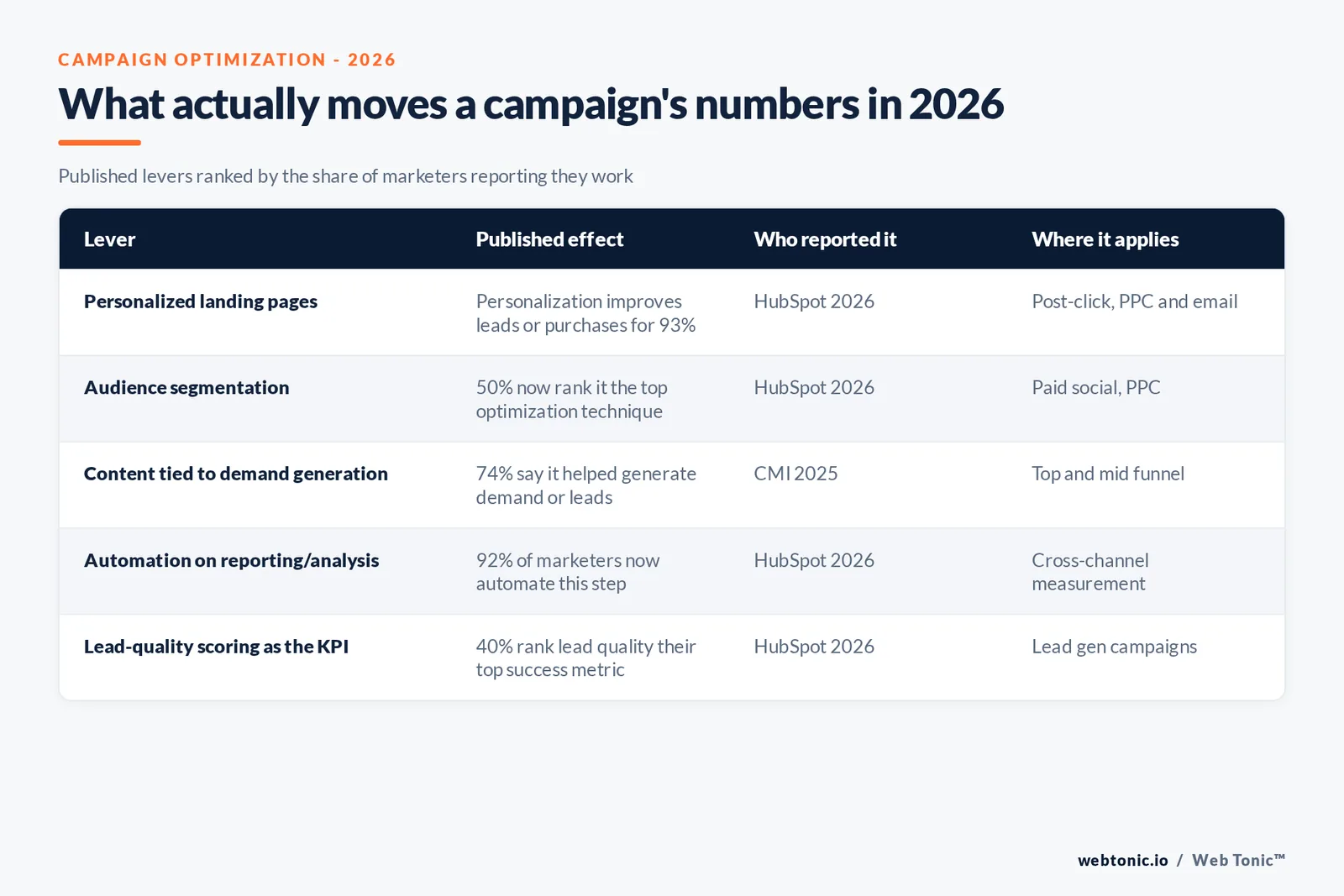
93% of marketers say personalization improves leads or purchases, and audience segmentation has become the single most-used campaign optimization technique in 2026, just ahead of conversion rate optimization. This page pulls together what the published data actually says moves a campaign's numbers - not overall ad spend, but the levers inside a live campaign.
Key Takeaways
- 93% of marketers say personalization improves leads or purchases.
- Audience segmentation is now the top optimization technique, at 50%.
- CRO ranks second among optimization techniques, at 49%.
- 56% of marketers say improving conversion rates is easier than a decade ago.
- 77% of marketers rate their lead quality as high or very high.
- 40% name lead quality as their single most important success metric.
- 30% of marketers still call lead generation a top challenge.
- A personalized landing page can lift PPC effectiveness by about 5%.
- 84% of brands report good results from their PPC campaigns.
- The average e-commerce conversion rate sits under 2%.
- Skincare converts as high as 2.7%; luxury apparel as low as 0.4%.
- B2C email campaigns convert at about 2.8%, B2B at 2.4%.
- 93% of marketers say video marketing has given them a good ROI.
- 89% of people have bought a product after watching a video about it.
- 66% of marketers judge campaign success by engagement, 62% by views.
- 92% of marketers now automate campaign data analysis and reporting.
- 74% credit content with generating campaign demand or leads.
| Campaign lever (2025-2026) | Published effect | Source |
|---|---|---|
| Personalization | 93% say it improves leads or purchases | HubSpot |
| Audience segmentation | Now the #1 optimization technique, 50% | HubSpot |
| Personalized landing pages | ~5% lift in PPC effectiveness | Ranktracker |
| Lead quality scoring | Top success metric for 40% of marketers | HubSpot |
| Video creative | 93% report good ROI from video | WPBeginner |
| Automation on reporting | 92% of marketers now use it | HubSpot |
Personalization and segmentation are running the show
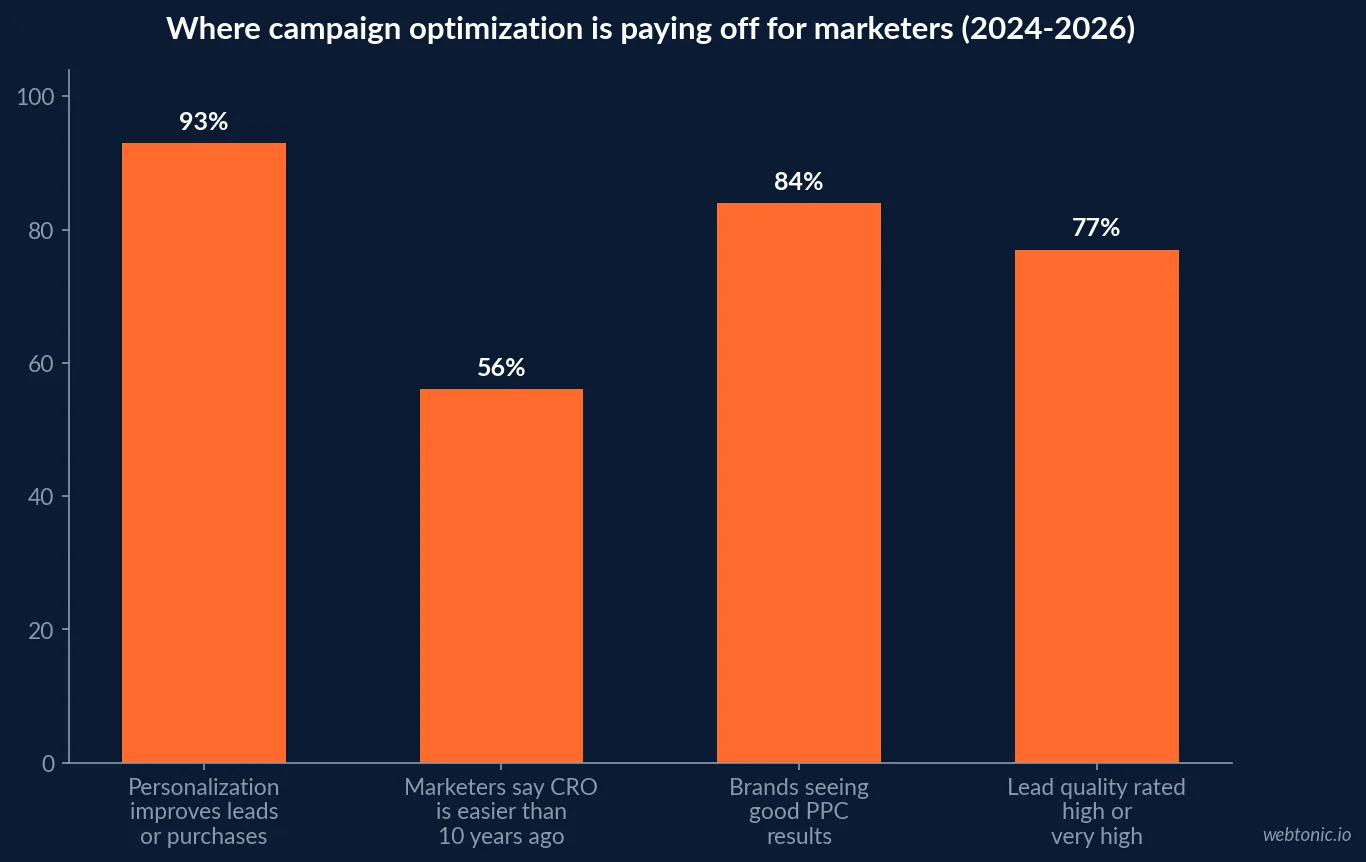
HubSpot's 2026 State of Marketing Report data shows audience segmentation refinement is now the single most-used campaign optimization technique, cited by 50% of marketers, narrowly ahead of conversion rate optimization at 49%. The payoff shows up downstream: 93% of marketers say personalization improves leads or purchases, and 56% say it is much easier to improve conversion rates now than it was a decade ago.
On the paid side specifically, a personalized landing page can make a PPC campaign about 5% more effective, and 84% of brands and marketers report seeing good results from their PPC campaigns overall, according to Ranktracker data cited in HubSpot's roundup.
Lead quality has replaced volume as the scoreboard
The clearest shift in how campaigns get judged is the move away from raw lead count. HubSpot's 2026 data shows 77% of marketers rate the quality of their leads as high or very high, and 40% now name lead quality and marketing-qualified leads as their single most important success metric - more than any other KPI tracked. Still, 30% of marketers report lead generation itself as a top challenge in 2026, and 37% say AI has made leads more informed before they ever reach a sales conversation.
| Lead-quality signal (2026) | Published figure | Source |
|---|---|---|
| Marketers rating lead quality high/very high | 77% | HubSpot |
| Marketers naming lead quality their top metric | 40% | HubSpot |
| Marketers still citing lead gen as a top challenge | 30% | HubSpot |
| Marketers saying AI made leads more informed | 37% | HubSpot |
| Marketers reporting leads arrive later in the funnel | ~70% | HubSpot |
Conversion rate benchmarks by channel and category
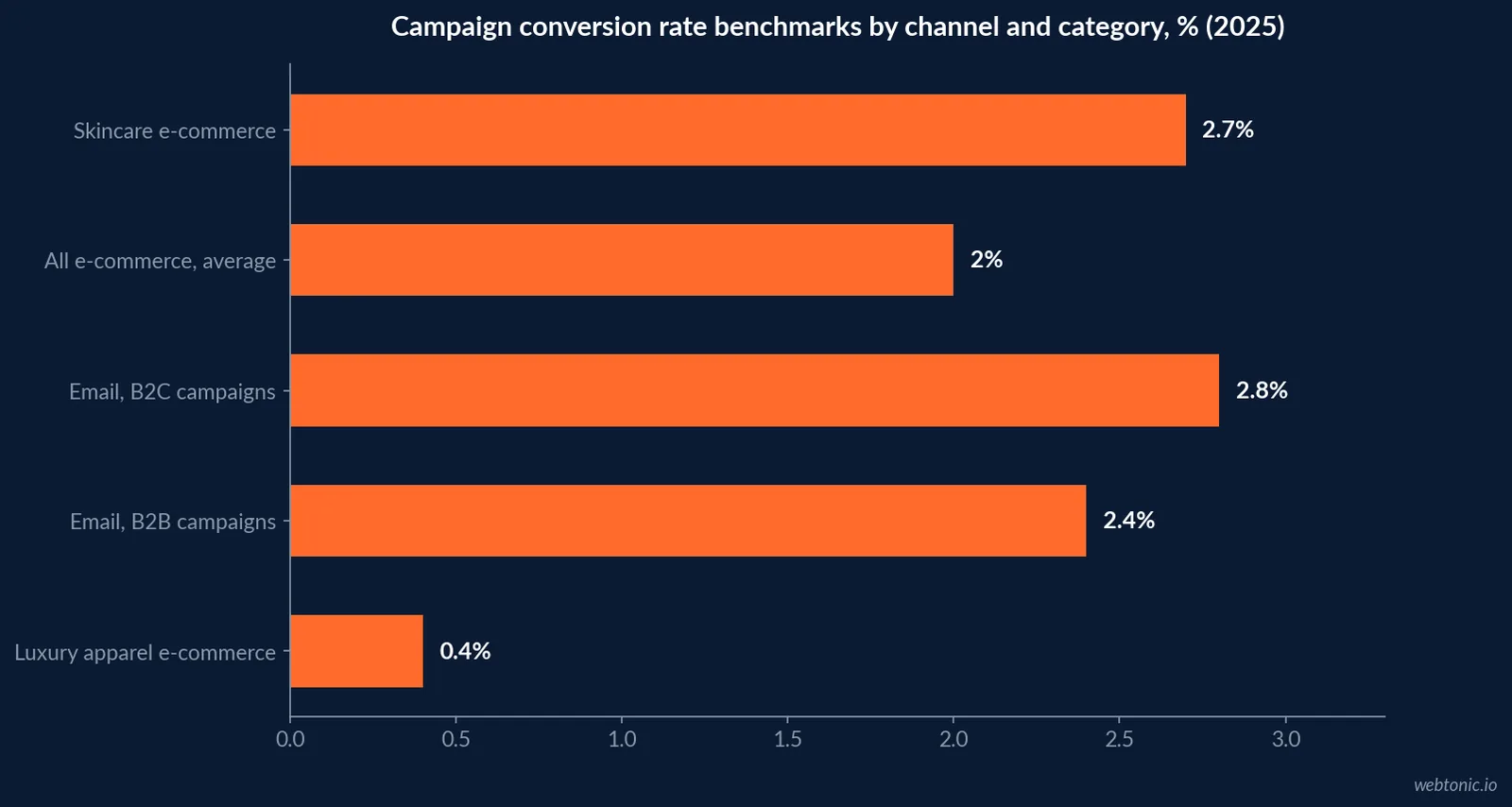
Conversion rate is the metric every campaign gets measured against, and it varies more by category than most benchmarks admit. Statista's 2025 e-commerce data puts the average conversion rate across all e-commerce sites under 2%, with skincare converting as high as 2.7% and luxury apparel as low as 0.4%. Email remains one of the stronger converting channels for a campaign, running around 2.8% for B2C and 2.4% for B2B campaigns, according to FirstPageSage data cited in HubSpot's roundup.
Video creative is the format with the loudest self-reported ROI
WPBeginner's video marketing statistics show 93% of marketers say video marketing has given them a good ROI, and on the buyer side, 89% of people have bought a product after watching a video about it, while 81% have bought or downloaded an app after watching one. Short videos under 60 seconds and long videos over 10 minutes are the two formats currently seeing the most growth, which suggests the middle length is losing ground in campaign creative rotations.
How success gets measured still varies by goal: 66% of marketers judge video campaign success through engagement (likes, comments, shares), 62% through views, and 49% through leads and clicks.
| Video campaign signal | Published figure | Source |
|---|---|---|
| Marketers reporting good video ROI | 93% | WPBeginner |
| Buyers purchasing after watching a product video | 89% | WPBeginner |
| Buyers converting after an app video | 81% | WPBeginner |
| Marketers measuring success via engagement | 66% | WPBeginner |
| Marketers measuring success via views | 62% | WPBeginner |
| Marketers measuring success via leads/clicks | 49% | WPBeginner |
Automation is changing how campaigns get optimized mid-flight
HubSpot's 2026 data shows 92% of marketers now use automation for data analysis and reporting, and 93% use it for administrative tasks like scheduling and documentation. On content specifically, 74% of marketers credit content marketing with generating campaign demand or leads, and 62% say it nurtures the subscriber and lead audience a campaign depends on, according to Content Marketing Institute data cited in HubSpot's roundup.
The practical read: campaigns are no longer optimized purely at launch. Mid-flight adjustment, powered by automated reporting, is now a default part of how a campaign gets run rather than a manual exception.
What multi-channel campaigns are prioritizing for ROI
HubSpot's 2025 channel-ROI data shows the top channel mix differs by business model. For B2B brands, the top three ROI-driving channels in 2024 were website, blog and SEO efforts, followed by paid social media content and social media shopping tools. For B2C brands, the order flips toward direct commerce: email marketing ranked first, with paid social content and content marketing rounding out the top three. A campaign brief built for a B2B audience that borrows a B2C channel plan - or the reverse - is optimizing against the wrong benchmark from the start.
Platform-level ROI reinforces the split: Facebook is cited by 43% of marketers as one of the highest ROI social platforms, and Instagram is the most-cited platform for ROI overall, according to HubSpot's 2026 data.
| Business model | Top 3 ROI channels, 2024-2025 | Source |
|---|---|---|
| B2B | Website/blog/SEO, paid social, social shopping tools | HubSpot |
| B2C | Email marketing, paid social, content marketing | HubSpot |
What targeting shifts are showing up in campaign briefs
Audience targeting itself is moving. HubSpot's 2025 data shows marketers shifting focus toward younger cohorts: 36% target Gen Z (up from 34% the year before), while targeting of Gen X and Boomers has fallen sharply. Millennials remain the most commonly targeted generation at 72%, even as that share edges down from 74%. A campaign brief that hasn't revisited its generational targeting in the last year is quietly working against where the market has already moved.
| Generation targeted | 2024 share of marketers targeting it | Change vs. 2023 | Source |
|---|---|---|---|
| Millennials | 72% | down from 74% | HubSpot |
| Gen X | 41% | down from 67% | HubSpot |
| Gen Z | 36% | up from 34% | HubSpot |
| Boomers | 19% | down from 27% | HubSpot |
What AI is changing about campaign optimization
AI-assisted workflows are now embedded in how campaigns get built and adjusted, not just reported on. HubSpot's 2026 data shows 80% of marketers currently use AI for content creation and 75% use it for media production, while 47% report leveraging automation broadly to make marketing processes more efficient. On the audience side, 37% of marketers say leads are now more informed thanks to AI-assisted research before ever engaging with a campaign, which is part of why 93% of marketers lean on automated reporting rather than manual tracking to keep pace with how quickly a campaign's audience now moves through the funnel.
| AI/automation use in campaigns (2026) | Published figure | Source |
|---|---|---|
| Marketers using AI for content creation | 80% | HubSpot |
| Marketers using AI for media production | 75% | HubSpot |
| Marketers using automation for efficiency | 47% | HubSpot |
| Marketers automating data analysis/reporting | 92% | HubSpot |
| Marketers saying AI made leads more informed | 37% | HubSpot |
Turning these benchmarks into a campaign brief
The pattern across every section above is the same: personalization, segmentation and lead-quality scoring consistently beat volume-based tactics in self-reported results. A campaign brief that still optimizes purely for clicks or impressions is optimizing against data most of the market has already moved past. Our performance creative team builds segmentation and personalization into a campaign brief from day one rather than retrofitting it after a launch, and our guide on building a Google Ads strategy walks through how that translates into a live account. If you want a second read on a campaign that isn't hitting these benchmarks, talk to our team.
How campaign testing cadence is changing
Faster reporting cycles are changing how often campaigns get retested rather than just relaunched. With 92% of marketers now automating data analysis, the practical cadence for a mid-size paid campaign has shifted from a monthly creative refresh to a rolling test-and-learn cycle, often weekly, on the segments and personalization variables covered above. That shift is also why lead-quality scoring at 40% adoption is overtaking simpler click-volume metrics: a weekly cadence needs a metric that moves fast enough to be useful before the next test starts.
A quick benchmark checklist before the next campaign brief
Before locking a brief, run it against five checks drawn from the data above: does the audience segmentation go deeper than basic demographics (the 50% using it as their top technique are not stopping at age and gender); does the landing page get personalized per channel rather than reused (worth roughly a 5% lift on its own); is lead quality, not just volume, the headline metric in the reporting dashboard; does the creative plan include at least one short-form and one long-form video variant; and does the targeting reflect this year's generational mix rather than last year's. Campaigns that pass all five are, on the published data above, working with the market rather than against it.
Frequently Asked Questions
What has the biggest measurable impact on campaign performance?
Personalization, by a wide margin in the published data. HubSpot's 2026 State of Marketing Report finds 93% of marketers say personalization improves leads or purchases, and audience segmentation refinement is now the single most-used optimization technique, edging out conversion rate optimization by one percentage point (50% versus 49%).
How do marketers measure whether a campaign actually worked?
Metrics vary by goal. WPBeginner's 2026 video marketing data shows 66% of marketers measure success through engagement, 62% through views, and 49% through leads and clicks. On the lead-generation side, HubSpot's 2026 data shows 40% of marketers rank lead quality as their single most important success metric, ahead of every other KPI.
What conversion rate should a campaign expect?
It depends heavily on the channel and category, so a single target is misleading. Statista's 2025 e-commerce data puts the average site conversion rate under 2%, ranging from 2.7% for skincare down to just 0.4% for luxury apparel. Email campaigns convert higher: FirstPageSage-cited data puts B2C email at 2.8% and B2B email at 2.4%.
Does video actually improve campaign ROI?
The self-reported numbers say yes, consistently. WPBeginner's video statistics show 93% of marketers say video marketing gave them a good ROI, 89% of people have bought a product after watching a video about it, and 81% have bought or downloaded an app after watching one. Short videos under 60 seconds and long videos over 10 minutes are the two formats seeing the most growth.
How important is lead quality versus lead volume in a campaign?
Quality is winning the argument. HubSpot's 2026 data shows 77% of marketers rate their lead quality as high or very high, and 40% now name lead quality and marketing-qualified leads as their most important success metric - more than any other single measure, including raw volume.
Sources
HubSpot - Marketing Statistics (State of Marketing Report 2026)
WPBeginner - Video Marketing Statistics
WPBeginner - Marketing Statistics, Trends and Facts
Semrush - Online Advertising Statistics
Statista - Advertising Worldwide, Statistics and Facts
99firms - Advertising Statistics and Market Insights
Ranktracker - PPC and campaign performance research
FirstPageSage - Email marketing conversion benchmarks
Content Marketing Institute - Content marketing research